Slide 1 / 62 Slide 2 / 62 1 What are the missing coefficients for - - PDF document

slide 1 62 slide 2 62
SMART_READER_LITE
LIVE PREVIEW

Slide 1 / 62 Slide 2 / 62 1 What are the missing coefficients for - - PDF document

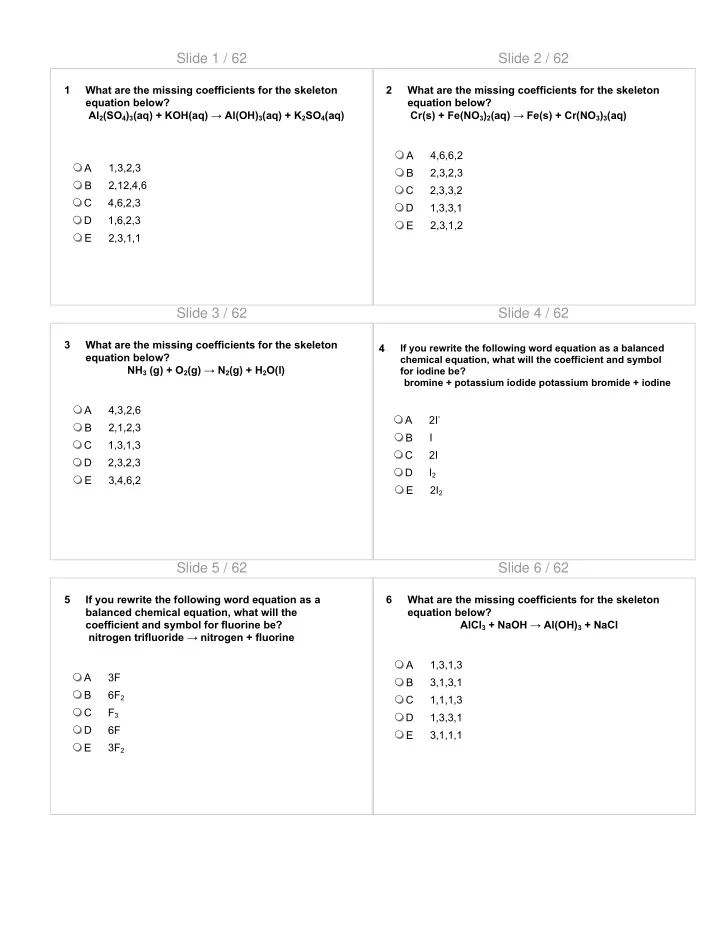
Slide 1 / 62 Slide 2 / 62 1 What are the missing coefficients for the skeleton 2 What are the missing coefficients for the skeleton equation below? equation below? Al 2 (SO 4 ) 3 (aq) + KOH(aq) Al(OH) 3 (aq) + K 2 SO 4 (aq) Cr(s) + Fe(NO


slide-1
SLIDE 1

Slide 1 / 62

1 What are the missing coefficients for the skeleton equation below? Al2(SO4)3(aq) + KOH(aq) → Al(OH)3(aq) + K2SO4(aq) A 1,3,2,3 B 2,12,4,6 C 4,6,2,3 D 1,6,2,3 E 2,3,1,1

Slide 2 / 62

2 What are the missing coefficients for the skeleton equation below? Cr(s) + Fe(NO3)2(aq) → Fe(s) + Cr(NO3)3(aq) A 4,6,6,2 B 2,3,2,3 C 2,3,3,2 D 1,3,3,1 E 2,3,1,2

Slide 3 / 62

3 What are the missing coefficients for the skeleton equation below? NH3 (g) + O2(g) → N2(g) + H2O(l) A 4,3,2,6 B 2,1,2,3 C 1,3,1,3 D 2,3,2,3 E 3,4,6,2

Slide 4 / 62

4

If you rewrite the following word equation as a balanced chemical equation, what will the coefficient and symbol for iodine be? bromine + potassium iodide potassium bromide + iodine

A 2I- B I C 2I D I2 E 2I2

Slide 5 / 62

5 If you rewrite the following word equation as a balanced chemical equation, what will the coefficient and symbol for fluorine be? nitrogen trifluoride → nitrogen + fluorine A 3F B 6F2 C F3 D 6F E 3F2

Slide 6 / 62

6 What are the missing coefficients for the skeleton equation below? AlCl3 + NaOH → Al(OH)3 + NaCl A 1,3,1,3 B 3,1,3,1 C 1,1,1,3 D 1,3,3,1 E 3,1,1,1
slide-2
SLIDE 2

Slide 7 / 62

7 What are the missing coefficients for the skeleton equation below? N2 + H2 → NH3 A 1,1,2 B 1,3,3 C 3,1,2 D 1,3,2 E 2,6,6

Slide 8 / 62

8 Aluminum chloride and bubbles of hydrogen gas are produced when metallic aluminum is placed in hydrochloric acid. What is the balanced equation for this reaction? A

H + AlCl → Al + HCl

B

2Al + 6HCl → 2AlCl3 + 3H2

C

Al + HCl3 → AlCl3 + H

D

Al + 2HCl → AlCl2 + H2

E

H2 + AlCl3 → Al + 2HCl

Slide 9 / 62

9 What does the symbol in a chemical equation mean? A heat is supplied to the reaction B a catalyst is needed C yields D precipitate

Slide 10 / 62

10 When the equation, Fe + Cl2 → FeCl3, is balanced, what is the coefficient for Cl2? A 1 B 2 C 3 D 4

Slide 11 / 62

11 When the following equation is balanced, what is the coefficient for HCl? Mg(s) + HCl(aq) → MgCl2 (aq) + H2(g) A 6 B 3 C 1 D 2

Slide 12 / 62

12 Chemical reactions _____. A

  • ccur only in living organisms

B create and destroy atoms C

  • nly occur outside living organisms

D produce new substances

slide-3
SLIDE 3

Slide 13 / 62

13 Which of the following is NOT a true statement concerning what happens in all chemical reactions? A The ways in which atoms are joined together are changed. B New atoms are formed as products. C The starting materials are named reactants. D The bonds of the reactants are broken and new bonds of the products are formed. E In a word equation representing a chemical reaction, the reactants are written on the left and the products

  • n the right.

Slide 14 / 62

14 Chemical equations _____. A describe chemical reactions B show how to write chemical formulas C give directions for naming chemical compounds D describe only biological changes

Slide 15 / 62

15 A skeleton equation does NOT show which of the following? A the correct formulas of the reactants and products B the reactants on the left, the products on the right C an arrow connecting the reactants to the products D the physical states of the substances E the relative amounts of reactants and products

Slide 16 / 62

16 Chemical equations describe _____. A nuclear reactions B electrochemical processes C chemical reactions D biological reactions

E

all of the above

Slide 17 / 62

17 Chemical equations must be balanced to satisfy the _____. A law of definite proportions B law of multiple proportions C law of conservation of mass D principle of Avogadro

Slide 18 / 62

18 Symbols used in equations, together with the explanations of the symbols, are shown below. Which set is correct? A (g), grams B (l), liters C (aq), dissolved in water D (sp), solid product E (lq), liquid

slide-4
SLIDE 4

Slide 19 / 62

19 In the chemical equation, H2O2(aq) → H2O(l) + O2 (g), the H2O2 is a _____. A product B reactant C catalyst D solid E gas

Slide 20 / 62

20 A catalyst is _____. A the product of a reaction B a reactant C

  • ne of the reactants in single-replacement reactions

D a solid product of a reaction

E

a chemical that speeds up the reaction

Slide 21 / 62

21 When the following equation is balanced, KClO3 (s) → KCl(s) + O2(g), the coefficient of KClO3 is _____. A 1 B 2 C 3 D 4 E 6

Slide 22 / 62

22 Which of the following is the correct skeleton equation for the reaction that takes place when solid phosphorus combines with oxygen gas to form diphosphorus pentoxide? A P(s) + O2(g) → PO2(g) B P(s) + O(g) → P2O5 (g) C P(s) + O2 (g) → P2O5(g) D P2O5 → P2(s) + O2 (g) E P2(s) + O5(g) → P2O5 (g)

Slide 23 / 62

23 In every balanced chemical equation, each side of the equation has the same number of _____. A atoms B molecules C moles D coefficients E subscripts

Slide 24 / 62

24 When potassium hydroxide and barium chloride react, potassium chloride and barium hydroxide are formed. The balanced equation for this reaction is _____. A KH + BaCl → KCl + BaH B KOH + BaCl → KCl + BaOH C 2KOH + BaCl2 → 2KCl + Ba(OH)2 D KOH + BaCl2 → K+ BaOH E 2KOH + 2BaCl2 → 2KCl2 + 2Ba(OH)2

slide-5
SLIDE 5

Slide 25 / 62

25 The double arrow symbol indicates _____. A that heat must be applied B an incomplete combustion reaction C that a gas is formed by the reaction D that the reaction is reversible

Slide 26 / 62

26 If a combination reaction takes place between potassium and chlorine, what is the product? A KCl B KCl2 C K2Cl D PCl E PCl2

Slide 27 / 62

27 The product of a combination reaction is Ba(OH)2. If one reactant was H2O what was the other reactant? A Ba2O B BaO C BaH D BaO2 E Ba2O7

Slide 28 / 62

28 Write a balanced equation for the combination reaction that takes place when iron(III) oxide is formed from its constituent elements. A Fe2 + O3 → Fe2O3 B 2Fe + 3O → Fe2O3 C 4Fe + 3O2 → 2Fe2O3 D 3Fe + O → Fe3O E Fe + O3 → FeO3

Slide 29 / 62

29 The reaction, 2Fe + 3Cl2 → 2FeCl3, is an example

  • f which type of reaction?

A combustion reaction B single-replacement reaction C combination reaction D decomposition reaction

Slide 30 / 62

30 Write a balanced equation to represent the decomposition of lead(IV) oxide. A PbO2 → Pb + 2O B PbO2 → Pb + O2 C Pb2O → 2Pb + O D PbO → Pb + O2 E 2PbO → 2Pb + O2

slide-6
SLIDE 6

Slide 31 / 62

31 What is the balanced equation for the reaction that takes place between bromine and sodium iodide? A Br2 + NaI → NaBr2 + I B Br2 + 2NaI → 2NaBr + I2 C Br2 + 2NaI → 2NaBr + 2I- D Br + NaI2 → NaBrI2 E Br + NaI2 → NaBr + I2

Slide 32 / 62

32 The equation Mg(s) + 2HCl(aq) → MgCl2(aq) + H2 is an example of which type of reaction? A combination B single-replacement C decomposition D double-replacement

Slide 33 / 62

33 What are the correct formulas and coefficients for the products of this double-replacement reaction? RbOH + H3PO4 → A Rb(PO4)3 + H2O B RbPO4 + 2H2O C Rb3PO4 + 3H2O D H3Rb + PO4OH E 3RbH + H2OPO4

Slide 34 / 62

34 The equation H3PO4+ 3KOH → K3PO4+ 3H2O is an example of which type of reaction? A double-replacement B combination C decomposition D single-replacement

Slide 35 / 62

35 When the equation for the complete combustion of ethanol, C2H5OH, is balanced, what is the coefficient for oxygen? A 1 B 3 C 6 D 7 E 14

Slide 36 / 62

36 The equation 2C3H7OH + 9O2 → 6CO2 + 8H2O is an example of which type of reaction? A combustion B single-replacement C double-replacement D decomposition

slide-7
SLIDE 7

Slide 37 / 62

37 Which of the following is NOT true concerning the decomposition of a simple binary compound? A The products are unpredictable. B The products are the constituent elements. C The reactant is a single substance. D The reactant could be an ionic or a molecular compound. E Energy is usually required.

Slide 38 / 62

38 Which of the following statements is true concerning single-replacement reactions? A They are restricted to metals. B They involve a single product. C They involve a single reactant. D Any metal replaces any other metal. E They are also called displacement reactions.

Slide 39 / 62

39 In order to predict whether or not a single- replacement reaction takes place, we need to consult a chart which shows the _____. A periodic table B activity series of metals C common polyatomic ions D ionic charges of representative elements E formulas and names of common metal ions having an ionic charge greater than 1.

Slide 40 / 62

40 In the activity series of metals, which metal(s) will displace hydrogen from an acid? A any metal B

  • nly metals above hydrogen

C

  • nly metals below hydrogen

D

  • nly metals from Li to Na

E

  • nly gold

Slide 41 / 62

41 Which of the following reactions will NOT take place spontaneously in the direction written? A Cu + HCl → B Ca + Pb(NO3)2 → C Ag + AuCl3 → D Zn + HNO3 → E K + H2SO4 →

Slide 42 / 62

42 Use the activity series to write a balanced chemical equation for the following single replacement reaction: Ag(s) + KNO3(aq) → A Ag(s) + KNO3(aq) → AgNO3 + K B Ag(s) + KNO3(aq) → AgK + NO3 C Ag(s) + KNO3(aq) → AgKNO3 D Ag(s) + KNO3(aq) → Ag + K + NO3 E No reaction takes place because silver is less reactive than potassium.

slide-8
SLIDE 8

Slide 43 / 62

43 In order for the reaction 2Al + 6HCl → 2AlCl3 + 3H2 to occur, which of the following must be true? A Al must be above Cl on the activity series. B Al must be above H on the activity series. C Heat must be supplied for the reaction. D A gas must be formed.

Slide 44 / 62

44 Which of the following statements is NOT true concerning double-replacement reactions? A The product may precipitate from solution. B The product may be a gas. C The product may be a molecular compound. D The reactant may be a solid metal. E The reactant may be a binary ionic compound.

Slide 45 / 62

45 A double-replacement reaction takes place when aqueous cobalt(III) chloride reacts with aqueous lithium hydroxide. One of the products of this reaction would be _____. A Co(OH)3 B Co(OH)2 C LiCO3 D LiCl3 E Cl3OH

Slide 46 / 62

46 What is the driving force in the following reaction? Ni(NO3)2(aq) + K2S(aq) → NiS + 2KNO3(aq) A A gas is formed. B A precipitate is formed. C Ionic compounds are reactants. D Ionic compounds are products. E Heat is required.

Slide 47 / 62

47 In a double-replacement reaction _____. A the reactants are usually a metal and a nonmetal B

  • ne of the reactants is often water

C the reactants are generally two ionic compounds in aqueous solution D energy in the form of heat or light is often produced

Slide 48 / 62

48 A double-replacement reaction takes place when aqueous Na2CO3 reacts with aqueous Sn(NO3)2. You would expect one of the products of this reaction to be _____. A NaNO3 B NaSn C Sn(CO3)2 D CNO3

slide-9
SLIDE 9

Slide 49 / 62

49 In a combustion reaction, one of the reactants is _____. A hydrogen B nitrogen C

  • xygen

D a metal E a binary ionic compound

Slide 50 / 62

50 The products of a combustion reaction do NOT include _____. A water B carbon dioxide C carbon monoxide D heat E hydrogen

Slide 51 / 62

51 The complete combustion of which of the following substances produces carbon dioxide and water? A C8H18 B K2CO3 C CaHCO3 D NO E H2S

Slide 52 / 62

52 Which of the following is the correctly balanced equation for the incomplete combustion of heptene, C7H14? A C7H14+ 14O → 7CO + 7H2O B C7H14 + 7O2 → 7CO + 7H2O C 2C7H14 + 21O2 → 14CO2 + 14H2O D C7H14 + O2 → C7O2 + 7H2 E C7H14 + 7O2 → 7CO2 + 7H2O

Slide 53 / 62

53 The type of reaction that takes place when one element reacts with a compound to form a new compound and a different element is a _____. A combination reaction B decomposition reaction C single-replacement reaction D double-replacement reaction E combustion reaction

Slide 54 / 62

54 In a double-replacement reaction, _____. A the products are always molecular B the reactants are two ionic compounds C the reactant is always oxygen D the reactants are two elements E the products are a new element and a new compound

slide-10
SLIDE 10

Slide 55 / 62

55 Which of the following statements is incorrect? A The only way to determine the products of a reaction is to carry out the reaction. B All chemical reactions can be classified as one of five general types. C Complete combustion occurred when all the carbon in the product is in the form of carbon dioxide. D A single reactant is the identifying characteristic of a decomposition reaction.

Slide 56 / 62

56 What are the spectator ions in the reaction between KOH (aq) and HNO3 (aq)? A K+ and H+ B H+ and OH- C K+ and NO3

  • D

H+ andNO3

  • E

OH- only

Slide 57 / 62

57 The net ionic equation for the reaction between aqueous solutions of HF and KOH is __________. A HF + KOH → H2O + K+ + F- B HF + OH- → H2O + F- C HF + K+ + OH- → H2O + KF D H+ + OH- → H2O E H+ + F- + K+ + OH- → H2O + K+ + F-

Slide 58 / 62

58 Combining aqueous solutions of BaI2 and Na2SO4 affords a precipitate of BaSO4. Which ion(s) is/are spectator ions in the reaction? A Ba2+ only B Na+ only C Ba2+ and SO4

2-

D Na+ and I- E SO4

2- and I-

Slide 59 / 62

59 Which ion(s) is/are spectator ions in the formation

  • f a precipitate of AgCl via combining aqueous

solutions of CoCl2 and AgNO3? A Co2+ and NO3

  • B

NO3

  • and Cl-

C Co2+ and Ag+ D Cl- E NO3

  • Slide 60 / 62

60 The balanced net ionic equation for precipitation

  • f CaCO3 when aqueous solutions of Na2CO3 and

and CaCl2 are mixed is __________. A 2Na+(aq) + CO3

2-(aq) → Na2CO3(aq)

B 2Na+(aq) + 2Cl-(aq) → 2NaCl(aq) C Na+(aq) + Cl-(aq) → NaCl(aq) D Ca2+(aq) + CO3

2-(aq) → CaCO3(s)

E Na2CO3(aq) + CaCl2(aq) → 2NaCl(aq) + CaCO3(s)

slide-11
SLIDE 11

Slide 61 / 62

61 When aqueous solutions of AgNO3 and KI are mixed, AgI precipitates. The balanced net ionic equation is: A Ag+(aq) + I-(aq) → AgI(s) B Ag+(aq) + NO3

  • (aq) → AgNO3(s)

C Ag+(aq) + NO3

  • (aq) → AgNO3(aq)

D AgNO3(aq) + KI(aq) → AgI(s) + KNO3(aq) E AgNO3(aq) + KI(aq) → AgI(aq) + KNO3(s)

Slide 62 / 62

62 When H2SO4 is neutralized by NaOH in aqueous solution, the net ionic equation is __________. A SO4

2-(aq) + 2Na+(aq) → Na2SO4(aq)

B SO4

2-(aq) + 2Na+(aq) → Na2SO4(s)

C H+(aq) + OH-(aq) → H2O(l) D H2SO4(aq) + 2OH-(aq) → 2H2O(l) + SO4

2-(aq)

E 2H+(aq) + 2NaOH(aq) → 2H2O(l) + 2Na+(aq)