1 The tender documents must provide clear and The tender documents - - PDF document

1
SMART_READER_LITE
LIVE PREVIEW

1 The tender documents must provide clear and The tender documents - - PDF document

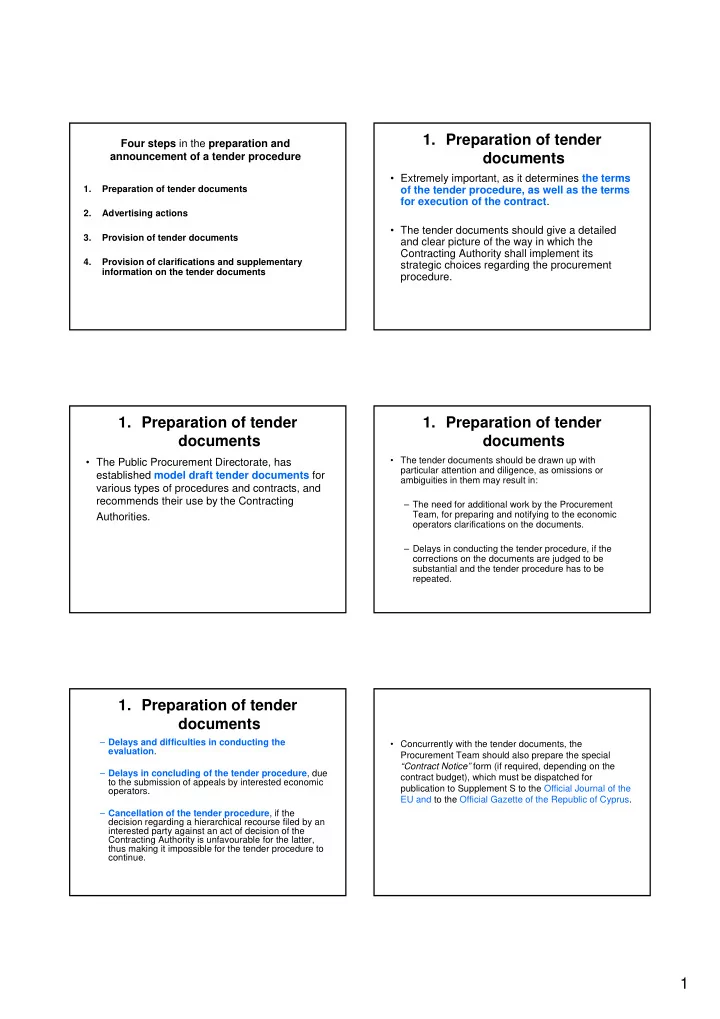
1. Preparation of tender Four steps in the preparation and announcement of a tender procedure documents Extremely important, as it determines the terms 1. Preparation of tender documents of the tender procedure, as well as the terms for


slide-1
SLIDE 1

1

1. Preparation of tender documents 2. Advertising actions 3. Provision of tender documents 4. Provision of clarifications and supplementary information on the tender documents

Four steps in the preparation and announcement of a tender procedure

  • 1. Preparation of tender

documents

  • Extremely important, as it determines the terms
  • f the tender procedure, as well as the terms

for execution of the contract.

  • The tender documents should give a detailed

and clear picture of the way in which the Contracting Authority shall implement its strategic choices regarding the procurement procedure.

  • 1. Preparation of tender

documents

  • The Public Procurement Directorate, has

established model draft tender documents for various types of procedures and contracts, and recommends their use by the Contracting Authorities.

  • 1. Preparation of tender

documents

  • The tender documents should be drawn up with

particular attention and diligence, as omissions or ambiguities in them may result in: – The need for additional work by the Procurement Team, for preparing and notifying to the economic

  • perators clarifications on the documents.

– Delays in conducting the tender procedure, if the corrections on the documents are judged to be substantial and the tender procedure has to be repeated.

  • 1. Preparation of tender

documents

– Delays and difficulties in conducting the evaluation. – Delays in concluding of the tender procedure, due to the submission of appeals by interested economic

  • perators.

– Cancellation of the tender procedure, if the decision regarding a hierarchical recourse filed by an interested party against an act of decision of the Contracting Authority is unfavourable for the latter, thus making it impossible for the tender procedure to continue.

  • Concurrently with the tender documents, the

Procurement Team should also prepare the special “Contract Notice” form (if required, depending on the contract budget), which must be dispatched for publication to Supplement S to the Official Journal of the EU and to the Official Gazette of the Republic of Cyprus.

slide-2
SLIDE 2

2

The tender documents must provide clear and detailed information on the following three issues:

1. Scope of the contract to be awarded. Description of the purpose and objectives of the contract, of the environment within which it shall be implemented, and

  • f its scope, deliverables and delivery times.

2. Eligibility and method for participation of interested economic operators in the tender procedure and method for their evaluation. Determination of the award procedure, of the selection and award criteria, and of the contents of tenders and their evaluation procedure.

The tender documents must provide clear and detailed information on the following three issues:

3. Terms of cooperation for implementation of the

  • contract. Identification of the special (value, time,

delivery and payment method, penalties for delay etc.) and general conditions (guarantees, subcontracting,

  • bligations of the contracting parties, contract

termination etc.) of the agreement to be entered into by the Contracting Authority and the economic

  • perator selected to execute the contract.

At the contract award stage (commencing with the announcement of the tender procedure and concluding with the selection of the contractor), the tender documents should provide economic operators with all the information which they need in order to answer the following questions:

  • Do I have the formal and essential qualifications for implementing the

contract?

  • What is the estimated business benefit of potentially winning the contract?
  • What are the actions required for participating in the tender procedure?

Contract Award Stage

At the contract implementation stage (commencing with the signature of the contract and ending with its completion), the tender documents, together with the tender of the selected contractor, form the contractual documents which govern the relations between the two contracting parties regarding the implementation of the contract.

Prerequisites

Examples of prerequisites include the approval of funding for the contract, the issue of certain permits which are required, the positive evaluation of some other similar contracts which have already been implemented, the application of some relevant policy measures etc. The prerequisites of a contract are the conditions (if any) which must be met before (or by) the starting date of the implementation of the

  • contract. As such they are very important, because they affect the

start of the contract and (obviously) the time and cost of its implementation.

The following are examples of assumptions:

  • The (necessary) expropriations will take place on time (with mention of the

completion time of the expropriation procedure).

  • The local agencies will collaborate on the planning for the project.
  • Suitable personnel shall be sourced and hired.
  • Funding will be available for the contract without problems throughout the

implementation phase etc.

Constraints, Assumptions

slide-3
SLIDE 3

3

Risks There are many risks associated with the implementation of a contract and posing threats to its success.

Implementation environment This part contains information which does not refer directly to the contract but instead refers to the broader environment of the contract, and is extremely useful for the candidate economic operators, as they allow them to understand better the overall framework in which the contract to be implemented is included.

  • Country background

A description is given of the particular characteristics of the country which are related to the contract scope or to the sector within which the contract will be implemented. References may be made to relevant national social and economic factors which may affect the implementation of the contract.

  • To help understand the way in which the contents of the

Terms of Reference for a contract are specified, a relevant example is provided below: – Summary description of the Project: Construction (as public work) of a two-span, 300m long and 10m wide concrete road bridge, with access roads at both ends, 450m and 550m long respectively, with two traffic lanes in each direction and a twin metal barrier dividing the two directions. This bridge (used to cross a small stream) will replace an existing old bridge (with one traffic lane in each direction and no division

  • f traffic directions), in order to eliminate the

bottleneck on a road axis with two traffic lanes in each

  • direction. The new bridge will be constructed parallel

to the existing one, at a distance of 250m from it. General Aim: To improve the transport infrastructure in the area, so as to reduce transport costs and improve the conditions for the development of the area.

  • To help understand the way in which the contents of the

Terms of Reference for a contract are specified, a relevant example is provided below: – Specific objectives: Ensure crossing at the specific location without problems (low speed, accidents, delays etc.), safely, comfortably and in a shorter time.

  • To help understand the way in which the contents of the

Terms of Reference for a contract are specified, a relevant example is provided below: – Expected results: The bridge and its access roads, fully constructed and operational, in accordance with their specifications. Activities: Earthworks (excavations for the road and for the foundations of the bridge, embankments), road surfacing (in the segments of the access roads), concreting (foundations, piers, load-bearing structure

  • f the bridge), asphalt works-laying, other (signage,

signalisation, landscaping, installation of noise barriers etc.).

  • To help understand the way in which the contents of the

Terms of Reference for a contract are specified, a relevant example is provided below: – Resources: Materials (e.g. concrete, reinforcement iron, formwork/metalwork, asphaltic mix, road surfacing materials, iron parts, colour paint, noise barriers etc.), labour (machinery operators, workers, engineers, foremen etc.), machinery (excavators, transport, rollers, spreaders, water carriers, cement pumps, cement barrels, cranes etc.), site installations, site organisation, logistics, technical and financial supervision/monitoring, funding etc.

slide-4
SLIDE 4

4

  • To help understand the way in which the contents of the

Terms of Reference for a contract are specified, a relevant example is provided below: – Prerequisites: Social acceptance of the project. Minimisation of adverse project impacts on the environment (natural and man-made) – Approval of environmental terms. Securing of funding for the

  • project. Completion of technical designs/studies.
  • To help understand the way in which the contents of the

Terms of Reference for a contract are specified, a relevant example is provided below: – Assumptions, constraints: The area required will be secured on time (expropriations). Funding for the project will be available without problems (the monthly payments to the contractor shall be made within [X] days from the submission of the relevant certification for the work carried out). Traffic regulation measures will be taken, so that traffic does not obstruct

  • construction. The permits for the disposal of

excavation products and for borrowing earth for fill to/from specific (foreseen) locations will be secured

  • n time, and any reactions by local

residents/organisations will be settled. The Contracting Authority will respond to Contractor requests quickly, giving its answers in less than three days.

  • To help understand the way in which the contents of the

Terms of Reference for a contract are specified, a relevant example is provided below: – Risks:

  • The inability to secure the use of the area (e.g. because of

insurmountable reactions from local residents) may (potentially) lead to changes: from a small-scale modification

  • f the project design (e.g. layout) to even the complete

cancellation of its implementation.

  • Problems in the funding for the project,
  • Problems in connection with the locations for borrowing earth

for fill or for the disposal of excavation products will create significant extra costs and delays. Inability to borrow earth for fill may lead even to the cancellation of the contract.

  • To help understand the way in which the contents of the

Terms of Reference for a contract are specified, a relevant example is provided below:

– Implementation Environment The project is included in a Programme co-financed by national resources (Public Investments Programme) and by the European Fund for Regional Development (ERDF), under the Operational Programme “………”. The specific project forms part of the programme for improvement of the road axis “……”, on which the bridge to be constructed is located, so that it may become a high-speed road axis in its entirety. Relevant other projects are the following: A) ………………… B) …………………

Three principal methods of choosing a contractor

  • 1. Open Tendering
  • 2. Selective Tendering
  • 3. Nomination
  • 1. Open Tendering
  • Advertising in local newspapers and/or the

technical press inviting contractors to apply for tender documents and to tender in competition for carrying out the work.

  • Usually a deposit is required in order to get the

tender documents to discourage frivolous applications.

slide-5
SLIDE 5

5

  • 1. Open Tendering

Advantages:

1. There can be no charge of favoritism as might be the case of selective tendering. 2. An opportunity is provided for a capable firm to submit a tender, which might not be included on a selected list. 3. More competition

  • 1. Open Tendering

Disadvantages:

1. There is a danger that the lowest tender may be submitted by a firm inexperienced in preparing tenders (particularly if bills of quantities are used) and whose tender is only lowest due to

  • errors. The Contracting Authority should therefore check for

arithmetic errors 2. There is no guarantee that the lowest tenderer is sufficiently capable or financially stable. Although tenders may require that the Contractor provides references or state of the company’s financial condition.

  • 2. Selective Tendering
  • Selective Tendering can be either single or two

stage.

  • 2. Selective Tendering

Single stage selective tendering

  • A short list is drawn up of contractors considered

suitable for the project.

  • It gives the client the opportunity to exclude any

firms thought unsuitable and to limit the number

  • f tenderers.
  • 2. Selective Tendering

Single stage selective tendering

  • The criteria the client may use to decide upon the

suitability of a contractor are: 1. Whether the company has had recent experience

  • f similar projects of a similar standard and

completed within the predicted time scale. 2. Whether the company has the skills necessary to carry out the works.

  • 2. Selective Tendering

Single stage selective tendering

  • The criteria the client may use to decide upon the

suitability of a contractor are: 3. The quality of the company management structure and personnel employed by the company. 4. Whether the company has the spare capacity to carry out the work within the proposed time scale.

slide-6
SLIDE 6

6

  • 2. Selective Tendering

Single stage selective tendering

  • The criteria the client may use to decide upon the

suitability of a contractor are: 5. The financial standing and record of the company.

  • 2. Selective Tendering

Single stage selective tendering Advantages 1. It ensures that only capable and approved firms submit tenders. 2. It tends to reduce the aggregate cost of tendering

  • 2. Selective Tendering

Single stage selective tendering Disadvantages 1. The cost level of the tenders received will be higher, due to less competition and also due to the higher calibre of the tenderers.

  • 2. Selective Tendering

Single stage selective tendering - Nomination

  • It is used when the client has a preference for a

particular contractor, often because he has done satisfactory work for him before.

  • 2. Selective Tendering

Single stage selective tendering - Nomination

  • Obviously, competition is eliminated leading to higher

prices.

  • 2. Selective Tendering

Single stage selective tendering - Nomination

  • The contract sum will be arrived at by a process of
  • negotiation. This can be done using bills of quantities
  • r schedules of rates, but instead of the contractor

pricing the tender document on his own and submitting his tender to be accepted or rejected, the rates and prices are discussed and agreed until eventually a total price is arrived at which is acceptable to both sides.

slide-7
SLIDE 7

7

  • 2. Selective Tendering

Two stage selective tendering

  • This procedure is used when it is desired to obtain the

benefits of competition and at the same time to have the advantage of bringing a contractor into the planning of the project, thus making use of his practical knowledge and expertise.

  • 2. Selective Tendering

Two stage selective tendering

  • The first stage aims at selecting a suitable contractor

by means of limited competition.

  • The second stage is a process of negotiation with the

selected contractor on the basis of the first-stage tender.