1 Collaborative Project Collaborative EMD Overview J-DSP J-DSP - - PDF document

1
SMART_READER_LITE
LIVE PREVIEW

1 Collaborative Project Collaborative EMD Overview J-DSP J-DSP - - PDF document

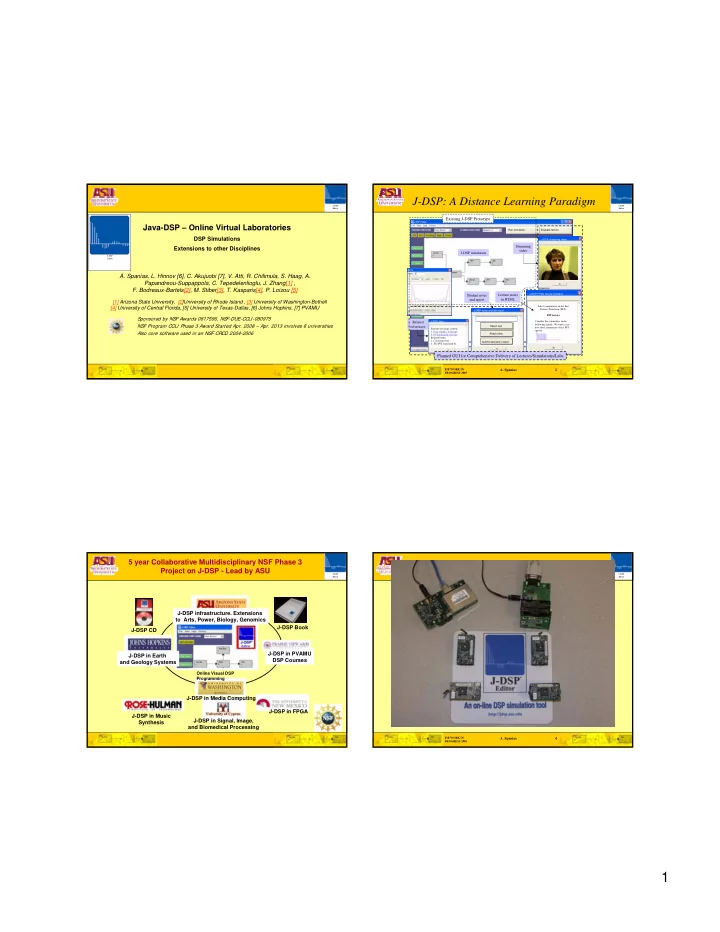
J-DSP: A Distance Learning Paradigm J-DSP J-DSP Editor Editor Existing J-DSP Prototype Java-DSP Online Virtual Laboratories Run simulation Evaluate lecture DSP Simulations J-DSP streaming video Streaming Extensions to other


slide-1
SLIDE 1

1

J-DSP Editor

Sponsored by NSF Awards 0817596, NSF-DUE-CCLI-080975 NSF Program CCLI Phase 3 Award Started Apr. 2008 – Apr. 2013 involves 8 universities Also core software used in an NSF CRCD 2004-2006

  • A. Spanias, L. Hinnov [6], C. Akujuobi [7], V. Atti, R. Chilimula, S. Haag, A.

Papandreou-Suppappola, C. Tepedelenlioglu, J. Zhang[1] ,

  • F. Bodreaux-Bartels[2], M. Stiber[3], T. Kasparis[4], P. Loizou [5]

[1] Arizona State University, [2]University of Rhode Island , [3] University of Washington-Bothell [4] University of Central Florida, [5] University of Texas-Dallas, [6] Johns Hopkins, [7] PVAMU

Java-DSP – Online Virtual Laboratories

DSP Simulations Extensions to other Disciplines

J-DSP Editor

FIE WORK IN PROGRESS 2005

  • A. Spanias

2

J-DSP Editor

J-DSP: A Distance Learning Paradigm

J-DSP simulation

Load instructors example simulation Run simulation Evaluate lecture J-DSP streaming video J-DSP notes and lab report Submit laboratory report Attach text Attach plots Lab 2 concentrates on the Fast Fourier Transform (FFT). FFT lecture Consider the symmetries in the following signals. We want to see how these symmetries affect FFT spectra. J-DSP HTML lecture interface Related web page content:

  • 1. Prof. Smith’s web page
  • 2. FFT dedicated web site

Related books:

  • 1. Classroom text
  • 2. The FFT transform by

J-DSP links

Streaming video Lecture notes in HTML Student notes and report Related references

Planned GUI for Comprehensive Delivery of Lectures/Simulations/Labs Existing J-DSP Prototype

J-DSP Editor

5 year Collaborative Multidisciplinary NSF Phase 3 Project on J-DSP - Lead by ASU

J-DSP in Earth and Geology Systems J-DSP in Media Computing J-DSP in PVAMU DSP Courses J-DSP in Music Synthesis J-DSP in FPGA J-DSP in Signal, Image, and Biomedical Processing J-DSP infrastructure. Extensions to Arts, Power, Biology, Genomics J-DSP Book J-DSP CD

Online Visual DSP Programming

FIE WORK IN PROGRESS 2005

  • A. Spanias

4

J-DSP Editor

slide-2
SLIDE 2

2

FIE WORK IN PROGRESS 2005

  • A. Spanias

5

J-DSP Editor

Collaborative Project

FIE WORK IN PROGRESS 2005

  • A. Spanias

6

J-DSP Editor

EXISTING SOFTWARE AND INFRASTRUCTURE FOR ON-LINE LABORATORIES IN UNDERGRADUATE DSP ASU J-DSP: Integrated On-line Simulation Animation Laboratory Technology http://jdsp.asu.edu J-DSP Software Technology Enables:

  • students to run web simulations/visualization
  • students to perform on-line laboratories
  • interface with MATLAB™ [81]
  • instructors to embed demos in web lectures [3]

PLANNED IN THIS COLLABORATIVE EMD SOFTW ARE TASKS AT ASU J-DSP Infrastructure Upgrades and Software Development for labs in:

CRS 1: Multimedia Computing, CRS 2 : Networks, CRS 3 : Probability, CRS 4 : Signals and Systems

UWB CRS-1 Lab Development ASU CRS-2 Lab Development ASU/URI CRS-3 Lab Development UTD/URI/UCF/ ASU CRS-4 Lab Development

Local Lab Assessment and Software Evaluation Local Lab Assessment and Software Evaluation Local Lab Assessment and Software Evaluation Local Lab Assessment and Software Evaluation A G G R E G A T E A S S E S S M E N T

Collaborative EMD Overview

FIE WORK IN PROGRESS 2005

  • A. Spanias

7

J-DSP Editor

J

  • D

S P and MIT Open Courseware

FIE WORK IN PROGRESS 2005

  • A. Spanias

8

J-DSP Editor

Why J-DSP / Objectives

Develop an on-line simulation tool for use in Linear Systems courses. Motivate Students to take Systems electives Provide hands-on experiences to undergraduate/ graduate DSP students and distance learners. Accelerate leaning by exposing students to hands-on manipulation of signals and DSP systems. Expose High School Students to Electrical Engineering TOOLS FOR INSTRUCTORS Seamlessly embed J-DSP simulations in web lectures; Demos for use in High-School Environments

slide-3
SLIDE 3

3

FIE WORK IN PROGRESS 2005

  • A. Spanias

9

J-DSP Editor

J-DSP Overview

Buttons to select blocks Working area Blocks Dialog windows

Visualize DSP concepts!

BASIC FUNCTIONALITY IN J-DSP

  • Fundamental DSP Functions (FFT, IFFT,

Windowing etc.)

  • Basic Arithmetic Functionality,
  • Multi-rate DSP
  • Pole-Zero z-domain diagrams
  • Frequency Response,
  • Visualization Blocks,
  • Digital Filtering,
  • FIR/IIR Filter Design
  • Spectral Estimation
  • 3D Animations,

Pole-Zero fie-ne\ fie- 03\ Prof_SPANI AS\ ASSESSMENT\ AV I \ PoleZeroPlacement1.aviAnimation

FIE WORK IN PROGRESS 2005

  • A. Spanias

10

J-DSP Editor

The J-DSP Editor

A H C I J K G D E F B

Error messages shown here

L A H C I J K G D E F B

Error messages shown here

L

A B C D E F G H I J K L Menu items Filter Blocks Section Permanent Blocks List Menu Selection (Existing) List Menu Selection (Planned) Disclaimer Interactive Visual Demos Simulation Flowgram Dialog window (PZ Placement) Plot Window to View Results Help Information Error messages

J-DSP Editor

On-line J-DSP Labs

LAB LAB – – Intro: Signals And Systems Introductory Exercise Intro: Signals And Systems Introductory Exercise How to use J How to use J-

  • DSP, Step by Step Procedure

DSP, Step by Step Procedure Generating and Analyzing Signals Generating and Analyzing Signals Sampling Issues Sampling Issues Simple Filters, Sine plus noise simulation Simple Filters, Sine plus noise simulation Simple IIR Design (Butterworth, Simple IIR Design (Butterworth, Chebychev Chebychev), Shelving Filters ), Shelving Filters MIDI and DTMF examples and spectral estimation MIDI and DTMF examples and spectral estimation

J-DSP Editor

Prior Work: J-DSP Labs

LAB LAB – – 1: 1: Difference Equations and the Z-Transform LAB LAB – – 2: 2: Pole-Zero Plots and Frequency Responses

LAB LAB – – 3: 3: FIR and IIR Filter Design LAB LAB – – 4: 4: The Fast Fourier Transform (FFT) LAB LAB – – 5: 5: Multi-rate Signal Processing and QMF Banks LAB LAB – – 6: 6: Random Signal Processing – Spectral Estimation

Lab Submission Procedure

slide-4
SLIDE 4

4

FIE WORK IN PROGRESS 2005

  • A. Spanias

13

J-DSP Editor

Extensions from DSP to other Systems Courses

Analog and Digital Communications Control Systems Image and 2D Signal Processing Speech Analysis and Synthesis Time/Frequency Representations

FIE WORK IN PROGRESS 2005

  • A. Spanias

14

J-DSP Editor

MIDI Functionality

Simulates a piano keyboard and generates MIDI sounds at the frequencies described by the MIDI standard. Generate a sequence of pre-recorded tones. The MIDI block can generate a single tone of length: 256 (1 frame), 1280 (5 frames) and 8192 (32 frames) samples. cos(2 ) y fnT  

where f is taken from a MIDI standard table [www.midi.org] FFT

MIDI DEMO

FIE WORK IN PROGRESS 2005

  • A. Spanias

15

J-DSP Editor

Advanced Functionality

Hidden Markov Model (HMM) Training Perceptual Audio Coding Techniques Genomic Signal Processing Adaptive Signal Processing and Beam- forming Applications

FIE WORK IN PROGRESS 2005

  • A. Spanias

16

J-DSP Editor

Seamlessly Embed J-DSP Simulations in Web Content

  • 1. Prepare demonstration

in J-DSP.

  • 2. Export simulation in

J-DSP script.

  • 3. Copy and paste script

into an HTML file.

  • 4. Add your own

educational content

  • 5. Deliver to students.

FIVE SIMPLE STEPS

J-DSP SCRIPT

<applet CODE="JDsp.class" width="400" height="250"> <param name="numCommand" value="15"> <!-- START PARTS --> <param name="0" value="B0-siggen(1,1)"> <param name="3" value="B3-pzplace(2,3)"> <param name="4" value="B4-freqresp(2,0)"> <!-- END PARTS --> <!-- START CONNECTIONS --> <param name="5" value="C-0-4-2-0"> <param name="6" value="C-2-4-1-0"> <param name="7" value="C-3-3-2-2"> <!-- END CONNECTIONS -->

HTML code HTML code Z – transform laboratory exercise In this lab we use the Filter block of J-DSP to invert the Z transform of various signals. As we have seen in the previous lab, the Filter block in J- DSP can implement a filter transfer function of the following form: Start the J-DSP editor to see an example of a filter with an impulse response h(n) = 0.9nu(n). Convert the impulse response equation to the equivalent transfer function in the z- transform domain.

1 2 3 4 5

DSP Tutorial 3

slide-5
SLIDE 5

5

FIE WORK IN PROGRESS 2005

  • A. Spanias

17

J-DSP Editor

J-DSP Interface with MATLAB Preliminary

  • 1. Prepare demonstration

in J-DSP.

  • 2. Export simulation in

MATLAB script.

  • 3. Copy and paste into

MATLAB editor window. THREE SIMPLE STEPS

1 2 3

Functionality being developed in J-DSP

FIE WORK IN PROGRESS 2005

  • A. Spanias

18

J-DSP Editor

J-DSP for use in High Schools

Developed a series of J-DSP functions that are high school friendly.

These functions are categorized as:

Tone-generators, MIDI, DTMF Echo and Reverberation Effects.

These functions are complemented with simple exercises (tone, echo, echo, etc) as well as advanced simulations (vocoders, MP3, etc). Developed pilot materials a for dissemination to high-school students.

FIE WORK IN PROGRESS 2005

  • A. Spanias

19

J-DSP Editor

Java-DSP and the Motes

J-DSP J-DSP J-DSP

Internet “Collaborative Sensor Signal Processing enabled by J-DSP”

J-DSP Editor

J-DSP Assessment

Concept-Specific Assessment (1)

50% 46% 3% 1% 0% Understanding of the concepts

  • f the Z-transform (in Lab 1)

Agree (%) Neutral (%) Strongly Agree (%) Disagree (%) Strongly Disagree (%) 47% 44% 7% 1% 1% Understanding of the concepts

  • f pole-zero and freq-response

42% 47% 8% 3% 0% Understanding of the concepts

  • f FIR and IIR filter design

24% 61% 13% 2% 0%

Understanding of general concepts

  • f using FFT in signal analysis.

29% 55% 11% 3% 2% Learning of generating a sinusoid with a digital filter 42% 47% 8% 3% 0% Learning of using window type for sharp transition (in Lab 4)

slide-6
SLIDE 6

6

FIE WORK IN PROGRESS 2005

  • A. Spanias

21

J-DSP Editor

Remarks

Developed several functions in J-DSP Performed Assessment. Collaborative Labs using Java Scripting Capabilities Obtain Feedback and use for Continuous Improvement

FIE WORK IN PROGRESS 2005

  • A. Spanias

22

J-DSP Editor

Universities that received materials include: Georgia Tech University of Southern California University of Maryland University of Minnesota University of New Mexico University of Texas-Austin University of Texas-Dallas University of Central Florida Northeastern University University of Kent Marquette University Stevens Institute of Technology Georgia Institute of Technology

Preliminary Dissemination at IEEE FIE, ICASSP, and ASEE Conferences

Blekinge Institute of Technology Drexel University University of Nebraska Cal Poly Pomona University of Detroit-Mercy University of Pennsylvania Rice University Massachusetts Institute of Technology University of Akron University of Connecticut University of Puerto Rico Clemson University North Carolina State University Ecole Nationale Polytechnique-Algeria Bogazici University-Turkey

FIE WORK IN PROGRESS 2005

  • A. Spanias

23

J-DSP Editor

Book that Features J-DSP Exercises

  • The J-DSP book for use in an undergraduate DSP class to

complement the theory of signal processing.

  • Every chapter starts with a compact description of the

theory and continues with experiments and computer exercises

  • Topics: Review of linear signals and systems, basics of

digital filters,z transforms,FIR and IIR filter design,multi-rate signal processing, FFT in signal processing, discrete-time random signal analysis, speech processing, adaptive filters

FIE WORK IN PROGRESS 2005

  • A. Spanias

24

J-DSP Editor

Workshop at FIE 05

Includes tutorials and examples to demonstrate how instructors can use J- DSP in their classes both as a demonstration tool and as a computer laboratory software Objectives are:

  • to learn how to use Java-DSP.
  • to learn how to use the signal generator and filter design functions
  • to learn how to use the FFT to compute spectra of signals
  • to learn how to use other pre-canned signal functions
  • to learn how to use J-DSP scripts to embed demonstrations from web

course content

  • to enable participants to design their own J-DSP laboratory exercises
  • to demonstrate how to carry an assessment of the exercises and

practices with J-DSP

slide-7
SLIDE 7

7

FIE WORK IN PROGRESS 2005

  • A. Spanias

25

J-DSP Editor

Publications

  • Clausen A., Spanias A., Xavier A. “A Java Signal Analysis Tool for Signal Processing Experiments, IEEE International Conference on Acoustics

Speech and Signal Processing (ICASSP-98), pp. 1849-1852 vol. 3 Seattle, May 1998.

  • Spanias A. et al, “Development of a Web-based Signal and Speech Processing Laboratory for Distance Learning,” ASEE Computers in Educ.

Journal, pp. 21-26, Vol. X, No.2, April-June 2000.

  • Spanias A. and Bizuneh F., "Development of new functions and scripting capabilities in java-dsp for easy creation and seamless integration of

animated dsp simulations in web courses,” Proc. IEEE International Conference on Acous, Speech and Sign. Proc. (ICASSP-2001), pp. 2717-20, Salt Lake City, May 2001.

  • Thrasyvoulou T., Tsakalis K. and A. Spanias, “J-DSP-C, A Control Systems Simulation Environment for Distance Learning: Labs and Assessment,”

33rd ASEE/IEEE FIE-03 Conf, pp. T4E_11 - T4E_16, Vol. 2, Boulder, Nov 5-8, 2003.

  • Spanias A., Ahmed K., Papandreou-Suppappola A., and Zaman M.,"Assessment of the Java-DSPOn-Line Laboratory Software," 33rd ASEE/IEEE

FIE-03, Boulder, T2E - 16-21 Vol. 1, Nov 2003.

  • Spanias A., T. Thrassyvoulou, C. Panayiotou, Y. Song, "Using J-DSP to Introduce Communications and Multimedia Technologies to High Schools,"

33rd ASEE/IEEE FIE-03, Page(s):F3A_22 - F3A_27 Boulder, November 2003.

  • Yasin M., Karam L., and Spanias A., "On-Line Laboratories For Image And Two-Dimensional Signal Processing," 33rd ASEE/IEEE FIE-03, T3E-19
  • T3E-22 Vol.1 Boulder, Nov 2003.
  • Atti V. and Spanias A., "On-line Simulation Modules for Teaching Speech and Audio Compression," 33rd ASEE/IEEE FIE-03, T4E - 17-22 Vol.1

Boulder, Nov 2003.

  • V. Atti, A. Spanias, C. Panayiotou, Y. Song, Y. Ko, "On the use of J-DSP for on-line laboratories in linear systems courses," Invited Paper,

Conference Record of the Thirty-Seventh IEEE Asilomar Conference on Signals, Systems and Computers, Vol 2, pp. 1375-79, Nov. 9-12 2003

  • Ko, Y. Duman, T., Spanias A., "J-DSP for Communications," 33rd ASEE/IEEE FIE-03, T3E-13 - T3E-18 Vol.1 Boulder, Nov. 2003
  • A. Spanias, C. Panayiotou, T. Thrasyvoulou, and V. Atti, "Java-DSP Interface with MATLAB and its Use in Engineering Education," in Proc. of

ASEE-2004 Conference, June 20-23, 2004, Salt Lake City, Utah.

  • A. Spanias, et al., “Teaching Genomics and Bioinformatics to Undergraduates using J-DSP” in Proc. of ASEE-2004 Conference, June

20-23, 2004, Salt Lake City, Utah.

  • V. Atti, A. Spanias, C. Panayiotou, and Y. Song, "Teaching Digital Filter Design Techniques Used in High-Fidelity Audio Applications," in Proc. of

ASEE-2004 Conference, June 20-23, 2004 Salt Lake City, Utah.

  • A. Spanias, C. Panayiotou, and V. Atti, "Graphical Design of Frequency

Sampling Filters for use in a Signals and Systems Laboratory," in Proc. of 34th ASEE/IEEE FIE-04, pp. 26-31, Oct. 20-23, 2004, Savannah.

  • Y. Song, Spanias, A. Atti, V., Berisha, V, “Interactive Java Modules for the MPEG-1 Psychoacoustic Model,” IEEE International Conference on

Acoustics, Speech, and Signal Processing, 2005. Proceedings. (ICASSP '05).Volume 5, pp.:581 – 584, March 18-23, 2005

FIE WORK IN PROGRESS 2005

  • A. Spanias

26

J-DSP Editor

FIE WORK IN PROGRESS 2005

  • A. Spanias

27

J-DSP Editor

Questions … Visit http://jdsp.asu.edu for more information on J-DSP