0.5 1 1.5 2 2.5 3 Maximum # of dihotomies Gro wth - - PowerPoint PPT Presentation

0 5 1 1 5 2 2 5 3 maximum of di hotomies gro wth fun tion
SMART_READER_LITE
LIVE PREVIEW

0.5 1 1.5 2 2.5 3 Maximum # of dihotomies Gro wth - - PowerPoint PPT Presentation

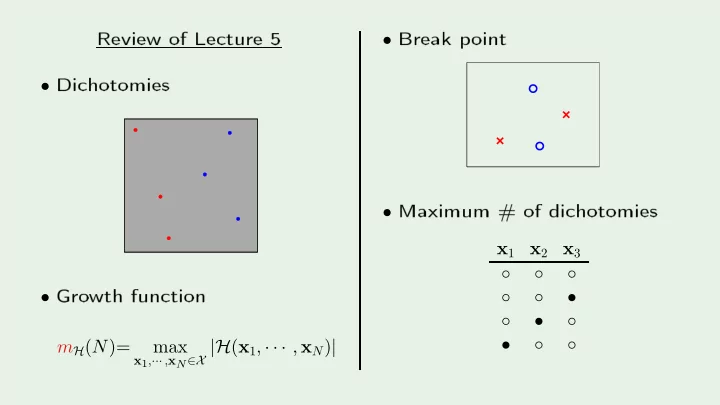
PSfrag replaements 0 0.5 1 1.5 2 Review of Leture 5 Break p oint 2.5 3 3.5 Dihotomies 4 0.5 1 1.5 2 2.5 3 Maximum # of dihotomies Gro wth funtion x 1 x 2 x 3


slide-1
SLIDE 1 Review
  • f
Le ture 5
  • Di hotomies
  • Gro
wth fun tion

mH(N)= max

x1,··· ,xN∈X |H(x1, · · · , xN)|

  • Break
p
  • int
PSfrag repla ements 0.5 1 1.5 2 2.5 3 3.5 4 0.5 1 1.5 2 2.5 3
  • Maximum
#
  • f
di hotomies

x1 x2 x3

slide-2
SLIDE 2 Lea rning F rom Data Y aser S. Abu-Mostafa Califo rnia Institute
  • f
T e hnology Le ture 6: Theo ry
  • f
Generalization Sp
  • nso
red b y Calte h's Provost O e, E&AS Division, and IST
  • Thursda
y , Ap ril 19, 2012
slide-3
SLIDE 3 Outline
  • Pro
  • f
that mH(N) is p
  • lynomial
  • Pro
  • f
that mH(N) an repla e M

A

M L

Creato r: Y aser Abu-Mostafa
  • LFD
Le ture 6 2/18
slide-4
SLIDE 4 Bounding mH(N) T
  • sho
w:

mH(N)

is p
  • lynomial
W e sho w:

mH(N) ≤ · · · ≤ · · · ≤

a p
  • lynomial
Key quantit y:

B(N, k)

: Maximum numb er
  • f
di hotomies
  • n N
p
  • ints,
with b reak p
  • int k

A

M L

Creato r: Y aser Abu-Mostafa
  • LFD
Le ture 6 3/18
slide-5
SLIDE 5 Re ursive b
  • und
  • n B(N, k)
#
  • f
ro ws

x1 x2 . . . xN−1 xN +1 +1 . . . +1 +1 −1 +1 . . . +1 −1 S1 α

. . . . . . . . . . . . . . .

+1 −1 . . . −1 −1 −1 +1 . . . −1 +1 +1 −1 . . . +1 +1 −1 −1 . . . +1 +1 S+

2

β

. . . . . . . . . . . . . . .

+1 −1 . . . +1 +1 S2 −1 −1 . . . −1 +1 +1 −1 . . . +1 −1 −1 −1 . . . +1 −1 S−

2

β

. . . . . . . . . . . . . . .

+1 −1 . . . +1 −1 −1 −1 . . . −1 −1

Consider the follo wing table:

B(N, k) = α + 2β

A

M L

Creato r: Y aser Abu-Mostafa
  • LFD
Le ture 6 4/18
slide-6
SLIDE 6 Estimating α and β #
  • f
ro ws

x1 x2 . . . xN−1 xN +1 +1 . . . +1 +1 −1 +1 . . . +1 −1 S1 α

. . . . . . . . . . . . . . .

+1 −1 . . . −1 −1 −1 +1 . . . −1 +1 +1 −1 . . . +1 +1 −1 −1 . . . +1 +1 S+

2

β

. . . . . . . . . . . . . . .

+1 −1 . . . +1 +1 S2 −1 −1 . . . −1 +1 +1 −1 . . . +1 −1 −1 −1 . . . +1 −1 S−

2

β

. . . . . . . . . . . . . . .

+1 −1 . . . +1 −1 −1 −1 . . . −1 −1

F
  • us
  • n x1, x2, · · · , xN−1
  • lumns:

α + β ≤ B(N − 1, k)

A

M L

Creato r: Y aser Abu-Mostafa
  • LFD
Le ture 6 5/18
slide-7
SLIDE 7 Estimating β b y itself #
  • f
ro ws

x1 x2 . . . xN−1 xN +1 +1 . . . +1 +1 −1 +1 . . . +1 −1 S1 α

. . . . . . . . . . . . . . .

+1 −1 . . . −1 −1 −1 +1 . . . −1 +1 +1 −1 . . . +1 +1 −1 −1 . . . +1 +1 S+

2

β

. . . . . . . . . . . . . . .

+1 −1 . . . +1 +1 S2 −1 −1 . . . −1 +1 +1 −1 . . . +1 −1 −1 −1 . . . +1 −1 S−

2

β

. . . . . . . . . . . . . . .

+1 −1 . . . +1 −1 −1 −1 . . . −1 −1

No w, fo us
  • n
the S2 = S+

2 ∪ S− 2

ro ws:

β ≤ B(N − 1, k − 1)

A

M L

Creato r: Y aser Abu-Mostafa
  • LFD
Le ture 6 6/18
slide-8
SLIDE 8 Putting it together #
  • f
ro ws

x1 x2 . . . xN−1 xN +1 +1 . . . +1 +1 −1 +1 . . . +1 −1 S1 α

. . . . . . . . . . . . . . .

+1 −1 . . . −1 −1 −1 +1 . . . −1 +1 +1 −1 . . . +1 +1 −1 −1 . . . +1 +1 S+

2

β

. . . . . . . . . . . . . . .

+1 −1 . . . +1 +1 S2 −1 −1 . . . −1 +1 +1 −1 . . . +1 −1 −1 −1 . . . +1 −1 S−

2

β

. . . . . . . . . . . . . . .

+1 −1 . . . +1 −1 −1 −1 . . . −1 −1

B(N, k) = α + 2β α + β ≤ B(N − 1, k) β ≤ B(N − 1, k − 1) B(N, k) ≤ B(N − 1, k) + B(N − 1, k − 1)

A

M L

Creato r: Y aser Abu-Mostafa
  • LFD
Le ture 6 7/18
slide-9
SLIDE 9 Numeri al
  • mputation
  • f B(N, k)
b
  • und

B(N, k) ≤ B(N − 1, k) + B(N − 1, k − 1)

bottom top

k 1 2 3 4 5 6 . . 1 1 2 2 2 2 2 . . 2 1 3 4 4 4 4 . . 3 1 4 7 8 8 8 . . N 4 1 5 11 . . . . . . . . 5 1 6 : . 6 1 7 : . : : : : .

A

M L

Creato r: Y aser Abu-Mostafa
  • LFD
Le ture 6 8/18
slide-10
SLIDE 10 Analyti solution fo r B(N, k) b
  • und

B(N, k) ≤ B(N − 1, k) + B(N − 1, k − 1)

bottom top

k 1 2 3 4 5 6 . . 1 1 2 2 2 2 2 . . 2 1 3 4 4 4 4 . . 3 1 4 7 8 8 8 . . N 4 1 5 11 . . . . . . . . 5 1 6 : . 6 1 7 : . : : : : .

Theo rem:

B(N, k) ≤

k−1

  • i=0

N i

  • 1.
Bounda ry
  • nditions:
easy

A

M L

Creato r: Y aser Abu-Mostafa
  • LFD
Le ture 6 9/18
slide-11
SLIDE 11 2. The indu tion step

bottom top

N

k−1 k

N−1

k−1

  • i=0

N i

  • =

k−1

  • i=0

N − 1 i

  • +

k−2

  • i=0

N − 1 i

  • ?

= 1+

k−1

  • i=1

N − 1 i

  • +

k−1

  • i=1

N − 1 i − 1

  • = 1 +

k−1

  • i=1

N − 1 i

  • +

N − 1 i − 1

  • = 1 +

k−1

  • i=1

N i

  • =

k−1

  • i=0

N i

  • A

M L

Creato r: Y aser Abu-Mostafa
  • LFD
Le ture 6 10/18
slide-12
SLIDE 12 It is p
  • lynomial!
F
  • r
a given H , the b reak p
  • int k
is xed

mH(N) ≤

k−1

  • i=0

N i

  • maximum
p
  • w
er is Nk−1

A

M L

Creato r: Y aser Abu-Mostafa
  • LFD
Le ture 6 11/18
slide-13
SLIDE 13 Three examples

k−1

  • i=0

N i

  • H
is p
  • sitive
ra ys: (b reak p
  • int k = 2)

mH(N) = N + 1 ≤ N + 1

  • H
is p
  • sitive
intervals: (b reak p
  • int k = 3)

mH(N) = 1

2N 2 + 1 2N + 1

1 2N 2 + 1 2N + 1

  • H
is 2D p er eptrons: (b reak p
  • int k = 4)

mH(N) = ? ≤

1 6N 3 + 5 6N + 1

A

M L

Creato r: Y aser Abu-Mostafa
  • LFD
Le ture 6 12/18
slide-14
SLIDE 14 Outline
  • Pro
  • f
that mH(N) is p
  • lynomial
  • Pro
  • f
that mH(N) an repla e M

A

M L

Creato r: Y aser Abu-Mostafa
  • LFD
Le ture 6 13/18
slide-15
SLIDE 15 What w e w ant Instead
  • f:
P P [ |E in(g) − E
  • ut(g)| > ǫ ] ≤ 2

M e−2ǫ2N

W e w ant: P P [ |E in(g) − E
  • ut(g)| > ǫ ] ≤ 2 mH(N) e−2ǫ2N

A

M L

Creato r: Y aser Abu-Mostafa
  • LFD
Le ture 6 14/18
slide-16
SLIDE 16 Pi to rial p ro
  • f
  • Ho
w do es mH(N) relate to
  • verlaps?
  • What
to do ab
  • ut E
  • ut
?
  • Putting
it together

A

M L

Creato r: Y aser Abu-Mostafa
  • LFD
Le ture 6 15/18
slide-17
SLIDE 17

(a) (b) (c)

. data sets space of Hoeffding Inequality Union Bound VC Bound

D

A

M L

Creato r: Y aser Abu-Mostafa
  • LFD
Le ture 6 16/18
slide-18
SLIDE 18 What to do ab
  • ut E
  • ut

Ein(h)

Hi

E E

(h)

  • ut

in(h)

Hi

E (h)

  • ut

in(h)

E’

A

M L

Creato r: Y aser Abu-Mostafa
  • LFD
Le ture 6 17/18
slide-19
SLIDE 19 Putting it together Not quite: P P [ |E in(g) − E
  • ut(g)| > ǫ ] ≤ 2 mH( N ) e− 2 ǫ2N
but rather: P P [ |E in(g) − E
  • ut(g)| > ǫ ] ≤ 4 mH(2N) e− 1

8 ǫ2N

The V apnik-Chervonenkis Inequalit y

A

M L

Creato r: Y aser Abu-Mostafa
  • LFD
Le ture 6 18/18