Zero Failure Data Analysis for Alloy 690 PWSCC Initiation Time - - PDF document

β–Ά
zero failure data analysis for alloy 690 pwscc initiation
SMART_READER_LITE
LIVE PREVIEW

Zero Failure Data Analysis for Alloy 690 PWSCC Initiation Time - - PDF document

Transactions of the Korean Nuclear Society Virtual Spring Meeting July 9-10, 2020 Zero Failure Data Analysis for Alloy 690 PWSCC Initiation Time Prediction Dayu Fajrul Falaakh a , Chi Bum Bahn a a School of Mechanical Engineering, Pusan


slide-1
SLIDE 1

Zero Failure Data Analysis for Alloy 690 PWSCC Initiation Time Prediction

Dayu Fajrul Falaakh a, Chi Bum Bahn aο€ͺ

a School of Mechanical Engineering, Pusan National University, Busan 46241, Republic of Korea *Corresponding author: bahn@pusan.ac.kr

  • 1. Introduction

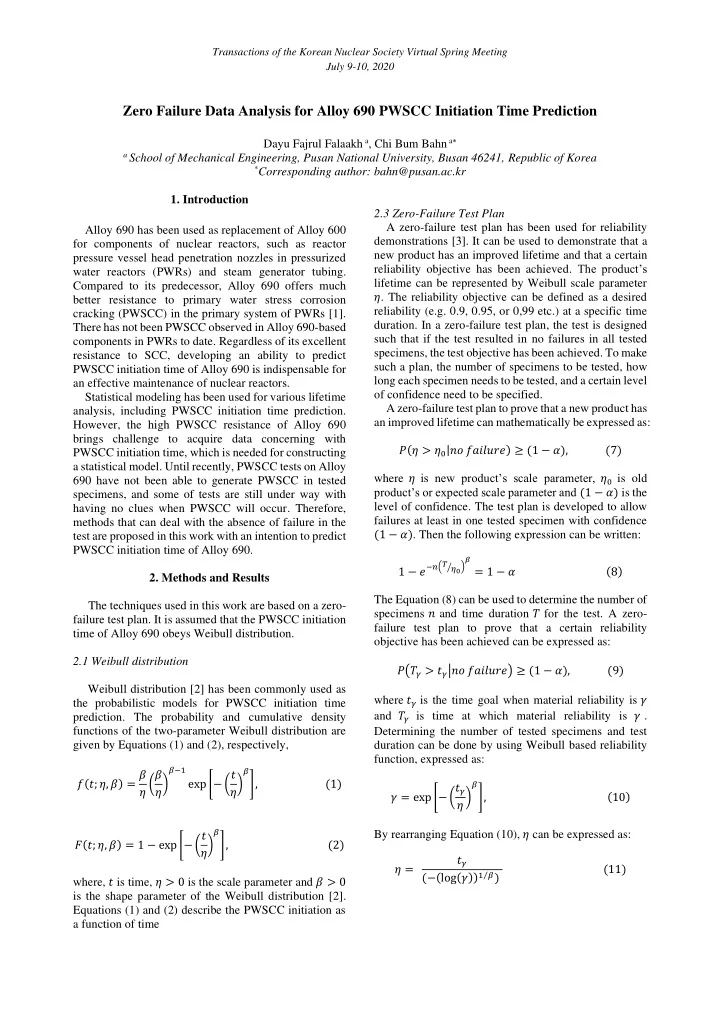
Alloy 690 has been used as replacement of Alloy 600 for components of nuclear reactors, such as reactor pressure vessel head penetration nozzles in pressurized water reactors (PWRs) and steam generator tubing. Compared to its predecessor, Alloy 690 offers much better resistance to primary water stress corrosion cracking (PWSCC) in the primary system of PWRs [1]. There has not been PWSCC observed in Alloy 690-based components in PWRs to date. Regardless of its excellent resistance to SCC, developing an ability to predict PWSCC initiation time of Alloy 690 is indispensable for an effective maintenance of nuclear reactors. Statistical modeling has been used for various lifetime analysis, including PWSCC initiation time prediction. However, the high PWSCC resistance of Alloy 690 brings challenge to acquire data concerning with PWSCC initiation time, which is needed for constructing a statistical model. Until recently, PWSCC tests on Alloy 690 have not been able to generate PWSCC in tested specimens, and some of tests are still under way with having no clues when PWSCC will occur. Therefore, methods that can deal with the absence of failure in the test are proposed in this work with an intention to predict PWSCC initiation time of Alloy 690.

  • 2. Methods and Results

The techniques used in this work are based on a zero- failure test plan. It is assumed that the PWSCC initiation time of Alloy 690 obeys Weibull distribution. 2.1 Weibull distribution Weibull distribution [2] has been commonly used as the probabilistic models for PWSCC initiation time

  • prediction. The probability and cumulative density

functions of the two-parameter Weibull distribution are given by Equations (1) and (2), respectively, 𝑔(𝑒; πœƒ, 𝛾) = 𝛾 πœƒ (𝛾 πœƒ)

π›Ύβˆ’1

exp [βˆ’ (𝑒 πœƒ)

𝛾

], (1) 𝐺(𝑒; πœƒ, 𝛾) = 1 βˆ’ exp [βˆ’ (𝑒 πœƒ)

𝛾

], (2) where, 𝑒 is time, πœƒ > 0 is the scale parameter and 𝛾 > 0 is the shape parameter of the Weibull distribution [2]. Equations (1) and (2) describe the PWSCC initiation as a function of time 2.3 Zero-Failure Test Plan A zero-failure test plan has been used for reliability demonstrations [3]. It can be used to demonstrate that a new product has an improved lifetime and that a certain reliability objective has been achieved. The product’s lifetime can be represented by Weibull scale parameter πœƒ. The reliability objective can be defined as a desired reliability (e.g. 0.9, 0.95, or 0,99 etc.) at a specific time

  • duration. In a zero-failure test plan, the test is designed

such that if the test resulted in no failures in all tested specimens, the test objective has been achieved. To make such a plan, the number of specimens to be tested, how long each specimen needs to be tested, and a certain level

  • f confidence need to be specified.

A zero-failure test plan to prove that a new product has an improved lifetime can mathematically be expressed as: 𝑄(πœƒ > πœƒ0|π‘œπ‘ π‘”π‘π‘—π‘šπ‘£π‘ π‘“) β‰₯ (1 βˆ’ 𝛽), (7) where πœƒ is new product’s scale parameter, πœƒ0 is old product’s or expected scale parameter and (1 βˆ’ 𝛽) is the level of confidence. The test plan is developed to allow failures at least in one tested specimen with confidence (1 βˆ’ 𝛽). Then the following expression can be written: 1 βˆ’ π‘“βˆ’π‘œ(π‘ˆ πœƒ0

⁄ )

𝛾

= 1 βˆ’ 𝛽 (8) The Equation (8) can be used to determine the number of specimens π‘œ and time duration π‘ˆ for the test. A zero- failure test plan to prove that a certain reliability

  • bjective has been achieved can be expressed as:

𝑄(π‘ˆ

𝛿 > 𝑒𝛿|π‘œπ‘ π‘”π‘π‘—π‘šπ‘£π‘ π‘“) β‰₯ (1 βˆ’ 𝛽), (9)

where 𝑒𝛿 is the time goal when material reliability is 𝛿 and π‘ˆ

𝛿 is time at which material reliability is 𝛿 .

Determining the number of tested specimens and test duration can be done by using Weibull based reliability function, expressed as: 𝛿 = exp [βˆ’ (𝑒𝛿 πœƒ )

𝛾

], (10) By rearranging Equation (10), πœƒ can be expressed as: πœƒ = 𝑒𝛿 (βˆ’(log(𝛿))1 𝛾

⁄ ) (11)

Transactions of the Korean Nuclear Society Virtual Spring Meeting July 9-10, 2020

slide-2
SLIDE 2

Putting Equation (11) into (8), the following equation will be obtained: 1 βˆ’ 𝑓

βˆ’π‘œ ( π‘ˆ 𝑒𝛿 (βˆ’(log(𝛿))1 𝛾

⁄ )

⁄ )

𝛾

= 1 βˆ’ 𝛽 (12) If the test duration π‘ˆ is specified beforehand, number of specimens π‘œ can be determined from Equation (11) and vice versa. 2.4 PWSCC Initiation Time Prediction Equation (12) can also be used to predict the PWSCC initiation time of Alloy 690. Instead of directly predicting the SCC initiation time, this way can tell us, depending on the data, whether Alloy 690 surpasses a reliability goal at a certain operation time. Being reliable here means that the material will not experience PWSCC. From a PWSCC test on Alloy 690, all variables in Equation (10) needed to calculate the level of confidence can be determined except for 𝛾. One EPRI MRP report suggested 𝛾 value to be 5 for Alloy 690 [1]. In this work, various values of 𝛾 will also be used to see how it affects the calculation. As an example, data taken from PWSCC test done in [4] are used (see Table I). The test was done

  • n thermally treated Alloy 690 under 360ο‚°C water with

500 ppm B and 2 ppm Li. Test was done with constant load at ~ 500 MPa.

  • Fig. 1 shows the level of confidence (1 βˆ’ 𝛽) as a

function of time 𝑒𝛿 with 𝛾 = 5 if reliability goal 𝛿 = 0.95 is chosen. It is clearly seen that the level of confidence decreases as the time increases. The level of confidence here can be interpreted as our confidence that the material reliability is 0.95 with 𝛾 = 5. To interpret this result, for example, the operation time at which we can believe that the material’s reliability is 0.95 with high confidence, e.g. 90%, is ~86340 hours. Fig. 2 shows the effect of 𝛾 value on the level of confidence when reliability is 95% and operation time is 78440 hours (9 years). It is shown that the level of confidence increases as 𝛾 value increases.

Table I: Data from [4] Number of specimens Test duration (hour) 18 123,000

2.5 Factor of Improvement Thanks to abundant PWSCC initiation data of Alloy 600, it is possible to determine the factor of improvement (FOI) for PWSCC initiation of Alloy 690 relative to that

  • f Alloy 600. The work on determining the FOI has been

done using Weibayes and Weibull analyses [1]. Weibayes is used for Alloy 690 while Weibull is used for Alloy 600. FOI in this approach is the ratio of πœƒ obtained from Alloy 690 Weibayes assuming that a failure is assumed to occur immediately if the test continues and 𝛾 = 5 to πœƒ obtained from Alloy 600 Weibull analysis, which can be expressed as: 𝐺𝑃𝐽 = 𝑋𝑓𝑗𝑐𝑏𝑧𝑓𝑑 (𝑠 = 1, 𝛾 = 5.0) πœƒ, π΅π‘šπ‘šπ‘π‘§ 690 π‘‹π‘“π‘—π‘π‘£π‘šπ‘š πœƒ, π΅π‘šπ‘šπ‘π‘§ 600 , (13) where 𝑠 here is number of failure. In the current work, we use zero-failure test plan approach to determine the FOI. Equation (8) can be used to estimate the value of πœƒ. Instead of determining directly the value of πœƒ, this way allows to determine the level of confidence that πœƒ value is greater than a certain value. As an example, data taken from an EPRI report [1] are used and shown in Table II. All the specimens were thermally treated (TT) and tested under the same

  • Fig. 1. The level of confidence as a function of operation

time π’–πœΉ with 𝜸 = 5 if reliability goal 𝜹 = 0.95 is chosen

  • Fig. 2. The level of confidence as a function of 𝜸 when

reliability is 95% and operation time is 78440 hours Transactions of the Korean Nuclear Society Virtual Spring Meeting July 9-10, 2020

slide-3
SLIDE 3
  • conditions. The FOI in Table II is obtained by Equation

(13). Table II: Data from [1] Material Number

  • f

specimens Test duration (hours) πœƒ (hours) FOI 690TT 16 100,000 174,110 15.5 600TT 12 Up to all specimens cracked 11,199

  • Fig. 3 shows the level of confidence as a function of πœƒ

value and a decreasing function is seen. It can be seen that the level of confidence is low (~63%) for the FOI to be greater than ~174,000 hours, which is not in agreement with the FOI obtained by Equation (13). If, for example, 90% of confidence is chosen, πœƒ value will be greater than 147,360.4 hours with this level of

  • confidence. Then we can say that with a confidence level
  • f 90%, the FOI is greater than 13.2.
  • 3. Conclusions

Zero-failure test plan can be used for prediction of PWSCC initiation of Alloy 690. In the current work, the data are taken from only one test for each technique. However, there have been actually plenty of PWSCC initiation tests on Alloy 690 although there is a lack of coordination, i.e. conducted under various testing

  • conditions. These tests have yielded useful data but the

variety of testing conditions such as temperature, load and water chemistry makes it challenging to take the available data into account. In the future, a model that can consider factors such as temperature and load will be pursued in order to be able to take as much as available data as possible. REFERENCES

[1] Materials Reliability Program (MRP), Resistance to Primary Water Stress Corrosion Cracking of Alloys 690, 52, and 152 in Pressurized Water Reactors (MRP-111), EPRI, Palo Alto, CA, U.S. Department of Energy, Washington, DC: 2004. 1009801. [2] Weibull, W., A Statistical Theory of the Strength of Materials, Generalstabens Litografiska Anstalts FΓΆrlag: Stockholm, Sweden (1939). [3] Liu, Yan, and Athula I. Abeyratne. Practical Applications

  • f Bayesian Reliability. John Wiley & Sons, 2019.

[4] T. Meaguchi, K. Sakima, K. Sato, K. Fujimoto, Y. Nagoshi,

  • K. Tsutsumi, PWSCC susceptibility of Alloy 690, 52 and 152,

in: 18th International Conference

  • n

Environmental Degradation of Materials in Nuclear Systems-Water Reactors, Portland, OR, 2017.

  • Fig. 3. The level of confidence as a function of 𝜽 value.

Transactions of the Korean Nuclear Society Virtual Spring Meeting July 9-10, 2020