Yu. Stroganov, The importance of being odd Kiev 2000 Typeset by - - PowerPoint PPT Presentation

yu stroganov the importance of being odd
SMART_READER_LITE
LIVE PREVIEW

Yu. Stroganov, The importance of being odd Kiev 2000 Typeset by - - PowerPoint PPT Presentation

Yu. Stroganov, The importance of being odd Kiev 2000 Typeset by Foil T EX Integrability and combinatorics, 2014 N. Kitanine Combinatorics of the form factors Combinatorics of the form factors of critical integrable models N.


slide-1
SLIDE 1
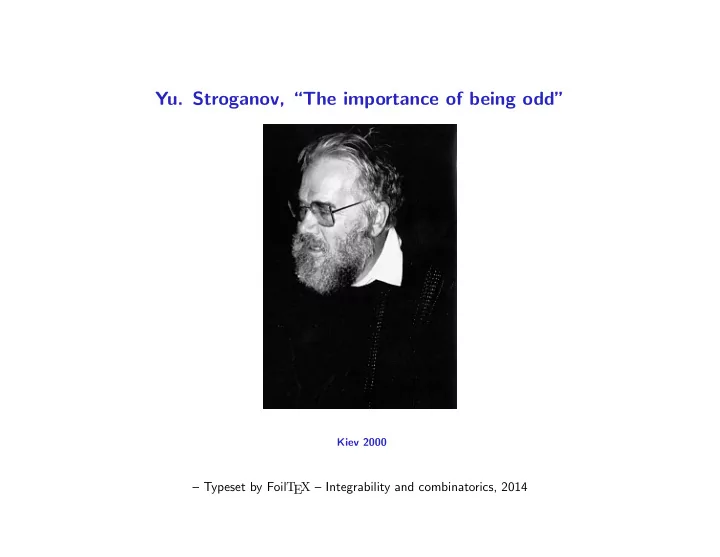
  • Yu. Stroganov, “The importance of being odd”

Kiev 2000

– Typeset by FoilT EX – Integrability and combinatorics, 2014
slide-2
SLIDE 2
  • N. Kitanine

Combinatorics of the form factors

Combinatorics of the form factors of critical integrable models

  • N. Kitanine

IMB, Universit´ e de Bourgogne Integrability and Combinatorics Conference in memory of Yu. Stroganov Presqu’ˆ ıle de Giens, 26 June 2014 In collaboration with : K. K. Kozlowski, J.M. Maillet, N. Slavnov, V. Terras

– Typeset by FoilT EX – Integrability and combinatorics, 2014 1

slide-3
SLIDE 3
  • N. Kitanine

Combinatorics of the form factors

References:

Form factor approach to the asymptotic behavior of correlation functions in critical models, N. K., K. K. Kozlowski, J. M. Maillet, N. Slavnov and V. Terras, J. Stat. Mech. (2011) P12010. arXiv:1110.0803 Form factor approach to dynamical correlation functions in critical models, N. K., K.

  • K. Kozlowski, J. M. Maillet, N. Slavnov and V. Terras, J. Stat. Mech. (2012) P09001,

arXiv:1206.2630 Long-distance asymptotic behavior of multi-point correlation functions in massless quantum integrable models, N. K., K. K. Kozlowski, J. M. Maillet and V. Terras, J.

  • Stat. Mech., (2014) P05011 arXiv:1312.5089

– Typeset by FoilT EX – Integrability and combinatorics, 2014 2

slide-4
SLIDE 4
  • N. Kitanine

Combinatorics of the form factors

Critical Integrable models

  • 1. The XXZ spin-1

2 Heisenberg chain in a magnetic field

Defined on a one-dimensional lattice with M sites, with Hamiltonian, H = H(0) − hSz, H(0) =

M

  • m=1
  • σx

mσx m+1 + σy mσy m+1 + ∆(σz mσz m+1 − 1)

  • ,

Sz = 1 2

M

  • m=1

σz

m,

[H(0), Sz] = 0. σx,y,z

m

are the local spin operators (in the spin-1

2 representation) associated with each site

m of the chain and ∆ = cos(ζ), ζ real, is the anisotropy parameter. h - external magnetic field; h > 0. We impose the periodic (or quasi-periodic) boundary conditions

– Typeset by FoilT EX – Integrability and combinatorics, 2014 3

slide-5
SLIDE 5
  • N. Kitanine

Combinatorics of the form factors

  • 2. The non-linear Schr¨
  • dinger (Lieb-Lineger) model
  • NLSE ≡ 1D limit of 3D Bose gas.
  • Simplest possible interacting massless integrable model.

H =

L

  • ∂yΨ†(y)∂yΨ(y) + c Ψ†(y)Ψ†(y)Ψ(y)Ψ(y) − h Ψ†(y)Ψ(y)
  • dy,

Ψ(x), Ψ†(x) quantum Bose fields

  • Ψ(x), Ψ†(y)
  • = δ(x − y),

L: length, c > 0 coupling constant (repulsive regime), h > 0 chemical potential. Both models: solution by algebraic Bethe ansatz, ground state finite Fermi zone

– Typeset by FoilT EX – Integrability and combinatorics, 2014 4

slide-6
SLIDE 6
  • N. Kitanine

Combinatorics of the form factors

Multipoint correlation functions

  • r
  • j=1

Oj(xj)

  • T

= trH

  • r
  • j=1

Oj(xj) e−H/kT

  • trH
  • e−H/kT

, T > 0

  • r
  • j=1

Oj(xj) = Ψg|

r

  • j=1

Oj(xj) |Ψg, T = 0 where |Ψg is the (normalized) ground state. We consider only T = 0 case. O(x) - local operators. Here we consider only equal-time correlation functions

  • For the XXZ spin chain local spin operators σ±

m, σz m ,

  • For the Non-linear Schr¨
  • dinger Model (NLSM) local fields Ψ(x), Ψ†(x) and local

densities j(x) = Ψ†(x)Ψ(x)

– Typeset by FoilT EX – Integrability and combinatorics, 2014 5

slide-7
SLIDE 7
  • N. Kitanine

Combinatorics of the form factors

Form factor approach

Our goal is to study the behavior of correlation functions using their form factor expansion

  • r
  • j=1

Oj(xj) =

  • | ψ1,...,|ψr−1

Ψg| O1(x1) |Ψ1 Ψ1| O2(x2) |Ψ2 . . . Ψr−1| Or(xr)|Ψg Main difficulty : form factors scale to zero in the limit L → ∞ for critical models. Ψg| O†(x) |Ψ1 Ψ1| O(0)|Ψg = L−θ eixPex A(Ψ1 , Ψg) Analyze the form factor series for large (but finite) system size. Hence we need to describe states that will contribute to the leading behavior of the series in the limits x → ∞ and L → ∞ with x << L, and also to compute the corresponding form factors and their behavior in these limits

– Typeset by FoilT EX – Integrability and combinatorics, 2014 6

slide-8
SLIDE 8
  • N. Kitanine

Combinatorics of the form factors

Algebraic Bethe ansatz and form factors

  • 1. Diagonalise the Hamiltonian using ABA 1979 Faddeev, Sklyanin, Takhtajan

→ key point : Yang-Baxter algebra A(λ), B(λ), C(λ), D(λ) → |ψ = B(λ1) . . . B(λN)|0 with {λ} satisfying Bethe equations

  • 2. Describe the ground state and excited states

→ Bethe equations.

  • 3. Act with local operators on eigenstates

→ solve the quantum inverse problem 1999 N.K., Maillet, Terras O(x) = f(A, B, C, D) → use Yang-Baxter commutation relations

  • 4. Compute the resulting scalar products (determinant representation) 1989 Slavnov

→ determinant representation for the form factors in finite volume 1999 N.K., Maillet, Terras

  • 5. Analysis of the form factors in the thermodynamic limit.

2010 N.K., Kozlowski, Maillet, Slavnov, Terras

– Typeset by FoilT EX – Integrability and combinatorics, 2014 7

slide-9
SLIDE 9
  • N. Kitanine

Combinatorics of the form factors

The ground state

Ground state solution of the Bethe equations can be described in terms of real rapidities λj densely filling (with a density ρ(λ)) the Fermi zone [−q, q] : Lp0(λj) −

N

  • k=1

ϑ(λj − λk) = 2π

  • j − N + 1

2

  • ,

j = 1, . . . , N. With bare momentum: p0(λ) = i log sinh(iζ/2 + λ) sinh(iζ/2 − λ) for XXZ, p0(λ) = λ for NLS and bare scattering phase ϑ(λ) = i log sinh(iζ + λ) sinh(iζ − λ) for XXZ, ϑ(λ) = i log ic − λ ic + λ for NLS.

– Typeset by FoilT EX – Integrability and combinatorics, 2014 8

slide-10
SLIDE 10
  • N. Kitanine

Combinatorics of the form factors

The particle-hole spectrum

Excited states parametrized by numbers {µℓa}N′

1

with N ′ = N + k, involving other choices of integers ℓ1 < · · · < ℓN′ in the rhs : Lp0(µℓj) −

N′

  • k=1

ϑ(µℓj − µℓk) = 2π

  • ℓj − N ′ + 1

2

  • ,

j = 1, . . . , N ′. New set of integers can be presented in terms of particle and hole quantum numbers ℓa = a , a ∈ {1, . . . , N ′} \ {h1, . . . , hn} ℓha = pa , pa ∈ Z \ {1, . . . , N ′}. To every choice of integers {pa} and {ha} there is an associated configuration of rapidities for the particles {µpa} and for the holes {µha}. We don’t consider complex solutions for XXZ (open problem, can contribute for the dynamical correlation functions).

– Typeset by FoilT EX – Integrability and combinatorics, 2014 9

slide-11
SLIDE 11
  • N. Kitanine

Combinatorics of the form factors

Thermodynamics of the excited states

  • ”holes” in continuous distribution of rapidities at µh1, . . . , µhn
  • new ”particle” rapidities at µp1, . . . , µpn
  • ×

× × × × ×

  • ×
  • ×

× ×

  • Ground State

Exited

✲ ✛ ✲ ✛

1 Lρ F Lρ

⇒ Excited state’s roots µj shifted infinitesimally in respect to the ground state roots λj. µj − λj = 1 Lρ(λj) · F

  • λj
  • µp1, . . . , µpn

µh1, . . . , µhn

  • + O(L−2)

⇒ Additive excitation spectrum. Pex − PG.S. =

n

  • a=1

p(µpa) − p(µha) and Eex − EG.S. =

n

  • a=1

ε(µpa) − ε(µha)

– Typeset by FoilT EX – Integrability and combinatorics, 2014 10

slide-12
SLIDE 12
  • N. Kitanine

Combinatorics of the form factors

Dressed quantities

Lieb equation for the density of Bethe roots ρ(λ) − 1 2π

q

  • −q

K(λ − µ) ρ(µ) dµ = 1 2πp′

0(λ),

with K(λ) = ϑ′(λ). Similar integral equations can be written for the dressed charge, dressed momentum, dressed energy and dressed phase:     Z(λ) p(λ) ε(λ) φ(λ, ν)     − 1 2π

q

  • −q

K(λ − µ)     Z(µ) p(µ) ε(µ) φ(µ, ν)     dµ =     1 p0(λ) ε0(λ) ϑ(λ − ν)     Boundary value of the dressed charge Z = Z(±q) is related to the Luttinger liquid parameter KLl = Z2

– Typeset by FoilT EX – Integrability and combinatorics, 2014 11

slide-13
SLIDE 13
  • N. Kitanine

Combinatorics of the form factors

Computation of form factors

Fψ1 ψ2(x) = |ψ1|O(x)|ψ2|2 ψ12 · ψ22

  • 1. Determinant representation (quantum inverse problem, scalar product)
  • 2. Cauchy determinant extraction: 1999 Izergin, N.K., Maillet, Terras

Fψ1 ψ2(x) = det

N

1 λa − µb × Smooth part

  • 3. Thermodynamic limit L, N → ∞ (global density D = N/L fixed, related to the

magnetic field h) ¯ Fψ1 ψ2(x) · Fψ1 ψ2(0) ∼ L−θ eixPex S D ,

– Typeset by FoilT EX – Integrability and combinatorics, 2014 12

slide-14
SLIDE 14
  • N. Kitanine

Combinatorics of the form factors

S - smooth part depends continuously on the rapidities µpj and µhj of the particles and

  • holes. Model dependent, explicit expression is rather complicated.

D - Discrete part depends on the set of integers appearing in the logarithmic Bethe equations, when the rapidities of the particles or holes approach the Fermi surface, a microscopic (of order 1/M) deviation of a particle (or hole) rapidity leads to a macroscopic change in Da. Universal and rather simple. Exponent θℓ can be written in terms of the shift function It is solely the kinematical factor D (together with the values of θ for the various form factors) that drives the asymptotic behavior, while the S part enters only the corresponding amplitude. For the particle-hole contribution we get: O†(x) O(0)ph = lim

L→∞

  • {µp},{µh}

L−θ eixPex S({µp}, {µh}) D({µp}, {µh}|{p}, {h}).

– Typeset by FoilT EX – Integrability and combinatorics, 2014 13

slide-15
SLIDE 15
  • N. Kitanine

Combinatorics of the form factors

Critical form factors

Equal time correlation functions: In the large distance limit x → ∞, the oscillatory character of the form factor sums localizes the particle and hole rapidities, in the absence

  • f any other saddle point of the oscillating exponent, around the Fermi boundaries ±q.

n-particle hole excitations with macroscopic momenta {µpa}n

1, {µha}n 1

  • n the Fermi

surface: µpa, µhb → ±q µpa ∼ q + 2π Lρ(q)p+

a

µha ∼ q − 2π Lρ(q)h+

a

  • n+

h holes and n+ p particles on right Fermi zone ⇒ local deficiency ℓ = n+ p − n+ h ;

  • n−

h holes and n− p particles on left Fermi zone ⇒ local deficiency −ℓ = n− p − n− h .

Critical exponents: θℓ = (F +

ℓ + ℓ)2 + (F − ℓ + ℓ)2

and F ±

are values of the shift function on the lest and right Fermi boundaries.

– Typeset by FoilT EX – Integrability and combinatorics, 2014 14

slide-16
SLIDE 16
  • N. Kitanine

Combinatorics of the form factors

Computation of the 2-point functions

We consider excited states containing n±

p particles, resp. n± h holes, with rapidities equal

to ±q such that n+

p − n+ h = n− h − n− p = ℓ,

ℓ ∈ Z. Sum of the critical form factors O†(x) O(0)cr= lim

L→∞ ∞

  • ℓ=−∞

L−θℓ exp

  • 2ixℓkF

Fℓ

  • 2 fℓ(F +

ℓ , w)fℓ(F − ℓ , w)

  • w=exp(2πix

L )

  • Fℓ
  • 2 - special renormalized form factor of class ℓ (correlation amplitude).

Corresponds to the ℓ-Umklapp excited state, with ℓ particles and ℓ holes located on the

  • pposite ends of the Fermi zone ±q: Bethe roots {µ1, . . . , µN} defined by the integers

˜ nj = nj ± ℓ.

  • Fℓ
  • 2 =

lim

L− →+∞

  • Lθℓ
  • ψℓ|O|ψg
  • 2

ψg|ψg · ψℓ|ψℓ

  • – Typeset by FoilT

EX – Integrability and combinatorics, 2014 15

slide-17
SLIDE 17
  • N. Kitanine

Combinatorics of the form factors

The sum of the discrete parts is hidden in the hypergeometric series fℓ(ν, w). fℓ(ν, w) =

  • n,k=0

k−n=ℓ

  • p1<···<pn

pa∈N∗

  • h1<···<hk

ha∈N∗

w

n

  • j=1

(pj−1)+ k

  • j=1

hj sin πν

π 2n ×

n

  • a>b

(pa − pb)2

k

  • a>b

(ha − hb)2

n

  • a=1

k

  • b=1

(pa + hb − 1)2 Γ2 {pa + ν}, {hb − ν} {pa}, {hb}

  • .

We use standard hypergeometric notations for ratios of Γ functions: Γ a1 , . . . , ar b1 , . . . , bs

  • =

r

  • k=1

Γ(ak) ·

s

  • k=1

Γ(bk)−1.

– Typeset by FoilT EX – Integrability and combinatorics, 2014 16

slide-18
SLIDE 18
  • N. Kitanine

Combinatorics of the form factors

Combinatorics of the form factors

Main identity (KMST’11) fℓ(ν, w) = wℓ(ℓ−1)/2G2(1 + ℓ + ν) G2(1 + ν) (1 − w)−(ν+ℓ)2 . Here G(x) is the Barnes function G(x + 1) = Γ(x)G(x). In particular f0(ν, w) = (1 − w)−ν2 . First appearance (ℓ = 0 case) in the theory of random partitions (Kerov-Vershik, Borodin-Olshanski, Okounkov ). It is the normalisation formula for the Z-measures on

  • partitions. Easy to establish one to one correspondence between particle-hole configurations

and Young diagrams (Frobenius coordinates). But relation between Z-mesure and correlation functions is not clear.

– Typeset by FoilT EX – Integrability and combinatorics, 2014 17

slide-19
SLIDE 19
  • N. Kitanine

Combinatorics of the form factors

Thermodynamic limit

The thermodynamic limit becomes easy to handle leading to the asymptotic results

  • O (x) O† (0)
  • ℓ∈Z

ei2xℓpF ·

  • Fℓ
  • 2

(−ix)∆ℓ;+ · (ix)∆ℓ;− . Structure of the asymptotics

  • Asymptotics indexed by Umklapp excitations ℓ

;

  • Fℓ
  • 2 model dependent but universal interpretation

;

  • Critical exponent

∆ℓ;+ = (F +

ℓ + ℓ)2

and ∆ℓ;− = (F −

ℓ + ℓ)2 . – Typeset by FoilT EX – Integrability and combinatorics, 2014 18

slide-20
SLIDE 20
  • N. Kitanine

Combinatorics of the form factors

Equal-time correlation functions. XXZ

  • Correlation function σz

1σz m+1

Asymptotic expansion: σz

1σz m+1cr = (2D − 1)2 − 2Z2

π2m2 + 2

  • ℓ=1

cos(2mℓkF )

  • Fz

  • 2

1

  • 2πm

2ℓ2Z2, where

  • Fz

  • 2

= lim

L→∞ L2ℓ2Z2 |ψg|σz 1|ψℓ|2

ψg|ψgψℓ|ψℓ, and the Bethe roots corresponding to the ℓ-shifted ground state |ψℓ are defined as usual Lp0(µj) −

N

  • k=1

ϑ(µj − µk) = 2π

  • j + ℓ − N + 1

2

  • ,

j = 1, . . . , N.

– Typeset by FoilT EX – Integrability and combinatorics, 2014 19

slide-21
SLIDE 21
  • N. Kitanine

Combinatorics of the form factors

  • Correlation function σ−

1 σ+ m+1

The boundary values of the shift function are F −

ℓ = ℓ(Z − 1) − 1

2Z, F +

ℓ = ℓ(Z − 1) + 1

2Z. Asymptotic expansion σ−

1 σ+ m+1cr =

(−1)m

  • 2πm
  • 1

2Z2 ∞

  • ℓ=−∞

(−1)ℓe2imℓ kF

  • F+

  • 2

1

  • 2πm

2ℓ2Z2. The special form factor of the ℓ class and the ℓ-shifted ground state |ψ′

  • F+

  • 2

= lim

L→∞ L

  • 2ℓ2Z2+

1 2Z2

ψg|σ+

1 |ψ′ ℓ

  • 2

ψg|ψgψ′

ℓ|ψ′ ℓ,

Lp0(µj) −

N+1

  • k=1

ϑ(µj − µk) = 2π

  • j + ℓ + 1 − N

2

  • ,

j = 1, . . . , N + 1.

– Typeset by FoilT EX – Integrability and combinatorics, 2014 20

slide-22
SLIDE 22
  • N. Kitanine

Combinatorics of the form factors

Multipoint functions

C

  • xr; or
  • = Ψg|O1(x1) . . . Or(xr)|Ψg ,

Local operators Oa(x) connect states with N and N + oa quasi-particles; we sum up

  • ver intermediate normalized states |Ψ
  • I(s)

n

  • with s = 1, . . . r − 1, labeled by sets of

integers corresponding to particles and holes excitations : I(s)

n

=

  • {p(s)

a }n 1

; {h(s)

a }n 1

  • ,

(∆P)s

s−1 = P I(s−1) m

− P

I(s) n

Ψ

  • I(s−1)

m

  • |Os(x)|Ψ
  • I(s)

n

  • = eix(∆P)s

s−1 · FOs

  • I(s−1)

m

| I(s)

n

  • C
  • xr; or
  • =

r−1

  • s=1
  • I(s)

n(s)

  • r−1
  • s=1
  • exp
  • i(xs+1−xs)∆P(I(s)

n(s))

r

  • s=1

FOs

  • I(s−1)

n(s−1) | I(s) n(s)

  • – Typeset by FoilT

EX – Integrability and combinatorics, 2014 21

slide-23
SLIDE 23
  • N. Kitanine

Combinatorics of the form factors

General form-factor, discrete part

F = (−1)nt sin[πν] π nt + nh

np

  • a<b

(pa − pb)

nh

  • a<b

(ha − hb)

np

  • a=1

nh

  • b=1

(pa + hb − 1) ·

nk

  • a<b

(ka − kb)

nt

  • a<b

(ta − tb)

nk

  • a=1

nt

  • b=1

(ka + tb − 1) × Γ {pa + ν} {ha − ν} {ka − ν} {ta + ν} {pa} {ha} {ka} {ta}

  • ̟
  • Jnp;nh; Jnk;nt | ν
  • ,

̟

  • Jnp;nh; Jnk;nt | ν
  • =

nh

  • a=1

        

nk

  • b=1
  • 1 − kb − ha + ν
  • nt
  • b=1
  • tb − ha + ν

       

np

  • a=1

        

nt

  • b=1
  • pa + tb + ν − 1
  • nk
  • b=1
  • pa − kb + ν

        . This ̟ term couples the right and left states particles and holes integers (not present if

  • ne of them is the ground state) hence leading to coupling of previous combinatorial sums!

– Typeset by FoilT EX – Integrability and combinatorics, 2014 22

slide-24
SLIDE 24
  • N. Kitanine

Combinatorics of the form factors

Multipoint hypergeometric identity

The generalized combinatorial sums can be computed exactly! fℓr−1

  • {νs}r

1, {ws}r−1 1

  • =

r−1

  • s=1
  • w

ℓs(ℓs+1) 2 s

G 1 + (ℓs − νs), 1 + (ℓs + νs+1) 1 − νs, 1 + νs+1

  • ×

r−1

  • s=2

G

  • 1 + νs, 1 + (ℓs−1 − ℓs + νs)

1 − (ℓs − νs), 1 + (ℓs−1 + νs)

  • ·

r

  • b>a
  • 1 −

b−1

  • s=a

wa (νa+κa)(νb+κb) κs = ℓs−1 − ℓs for s = 1, . . . , r so that

r

  • a=1

κa = 0.

– Typeset by FoilT EX – Integrability and combinatorics, 2014 23

slide-25
SLIDE 25
  • N. Kitanine

Combinatorics of the form factors

Thermodynamic limit

Taking the thermodynamic limit we arrive at the following n-point correlation function asymptotic behavior : C

  • xr; or
  • =
  • κr∈Zr

κa=0 r

  • s=1
  • e2ipF κsxs
  • · F
  • {κa}r

1; {oa}r 1

  • ×

r

  • b>a
  • i(xb − xa)

θ−

b (κb)θ− a (κa) ·

  • − i(xb − xa)

θ+

b (κb)θ+ a (κa)

  • .

θ±

b (κb) = ν± b + κb

Note that the above asymptotic expansion is symmetric under a simultaneous permutation.

  • xr, or

r, oσ r

  • with

r =

  • xσ(1), . . . , xσ(r)
  • σ ∈ Sr .

– Typeset by FoilT EX – Integrability and combinatorics, 2014 24

slide-26
SLIDE 26
  • N. Kitanine

Combinatorics of the form factors

Four-point function. XXZ chain

Consider a four point function: Cxxxx = Ψg|σx

m1 σx m2 σx m3 σx m4|Ψg.

The leading term confirms the CFT prediction: Cxxxx = 2

  • F+
  • 4

·

  • (m2 − m1) · (m4 − m3)

(m3 − m1) · (m4 − m1) · (m3 − m2) · (m4 − m2)

  • 1

2Z2

+ (2 ↔ 3) + (2 ↔ 4)

  • + . . . .

– Typeset by FoilT EX – Integrability and combinatorics, 2014 25

slide-27
SLIDE 27
  • N. Kitanine

Combinatorics of the form factors

Conclusion and outlook

Advantages of the form-factor approach:

  • All the results are obtained directly from the first principles
  • Reproduces all the predictions (for XXZ model and Lieb-Lineger model) from the

CFT, Luttinger liquid approach, non-linear Luttinger liquid approach.

  • Gives a possibility to analyse the correlation amplitudes

The necessary conditions to apply this method:

  • Finite Fermi zone.
  • Cauchy determinant extraction (kinematic factor, quite general)

Open problems: Relation with random partitions, relation with CFT, contribution from the bound states, h = 0, explicit results for the amplitudes, multipoint time-dependent functions... Beyond integrability? Cauchy determinant of rapidities is always there, but can be difficult to compute the shift function.

– Typeset by FoilT EX – Integrability and combinatorics, 2014 26

slide-28
SLIDE 28
  • N. Kitanine

Combinatorics of the form factors

Time-dependent correlation functions. Lieb-Lineger model

Two regimes, to distinguish we introduce a parameter τ:

  • Space-like regime |x/t| > vF , the saddle point is outside the Fermi zone |λ0| > q,

τ = 1

  • Time-like regime |x/t| < vF , , the saddle point is inside the Fermi zone |λ0| < q,

τ = −1 Correlation function of fields: Ψ†(x, t) Ψ(0, 0) =

  • n0=0

  • ℓ=−∞

( √ 2πρ(λ0))n0 G(1 + n0) |t ε′′(λ0) − x p′′(λ0)|n2

0/2

× eiπ

2 ϕτ (n0,ℓ) |FΨ τ,ℓ|2 exp

  • ix(2ℓ + τn0)kF + iτn0(x p(λ0) − t ε(λ0))
  • |2π(x − vF t)|(ℓZ− 1

2Z +τn0 Φ+)2|2π(x + vF t)|(ℓZ+ 1 2Z +τn0 Φ−)2, – Typeset by FoilT EX – Integrability and combinatorics, 2014 27

slide-29
SLIDE 29
  • N. Kitanine

Combinatorics of the form factors

Correlation function of densities: j(x, t) j(0, 0) = kF π 2 − Z2 2π2 x2 + v2

F t2

(x2 − v2

F t2)2

+

  • n0=0

  • ℓ=−∞

|ℓ|+n0>0

( √ 2πρ(λ0))n0 G(1 + n0) |t ε′′(λ0) − x p′′(λ0)|n2

0/2

×

  • Fj

τn0,ℓ

  • 2eix(2ℓ+n0τ)kF +iτn0(x p(λ0)−t ε(λ0))+iπ

2 ϕτ (n0,ℓ)

  • 2π|x − vF t|

(ℓZ+τn0Φ+)2 2π|x + vF t| (ℓZ+τn0Φ−)2 . Here Z - Fermi boundary value of the dressed charge, φ(λ, µ) - dressed phase and Φ± = −φ(±q, λ0) + Z ∓ Z−1 2 ,

– Typeset by FoilT EX – Integrability and combinatorics, 2014 28

slide-30
SLIDE 30
  • N. Kitanine

Combinatorics of the form factors

Dynamical structure factors

S(k, ω) =

  • −∞

dx

  • −∞

dt ei(ωt−kx) O†(x, t) O(0, 0) DSF gives the response functions under external perturbations of the system and can be experimentally measured. Numerical computation from the algebraic Bethe ansatz results for the form factors

XXZ - Caux, Hagemans, Maillet (2005) NLSM - Calabrese, Caux (2006) – Typeset by FoilT EX – Integrability and combinatorics, 2014 29

slide-31
SLIDE 31
  • N. Kitanine

Combinatorics of the form factors

Edge exponents. NLSM

Two structure factors: density structure factor S(k, ω) and spectral function A(k, ω) (Fourier transforms of the density and field correlation functions) Two thresholds: particle (upper) and hole (lower). Edge exponents and amplitudes can be computed for both functions and both thresholds. Example: density structure factor on the hole threshold S(k, ω)hole = H(δω)

  • Fj

−1,1

  • 2

Γ(α+ + α−) (v − vF )α+ (v + vF )α− δω 2π α++α−−1 , Exponents: α+ = Z 2 + 1 2Z + φ(q, λ) 2 , α− = Z 2 − 1 2Z + φ(−q, λ) 2 .

– Typeset by FoilT EX – Integrability and combinatorics, 2014 30