23 20 15 25 Peter thinks that 20 is the - - PowerPoint PPT Presentation
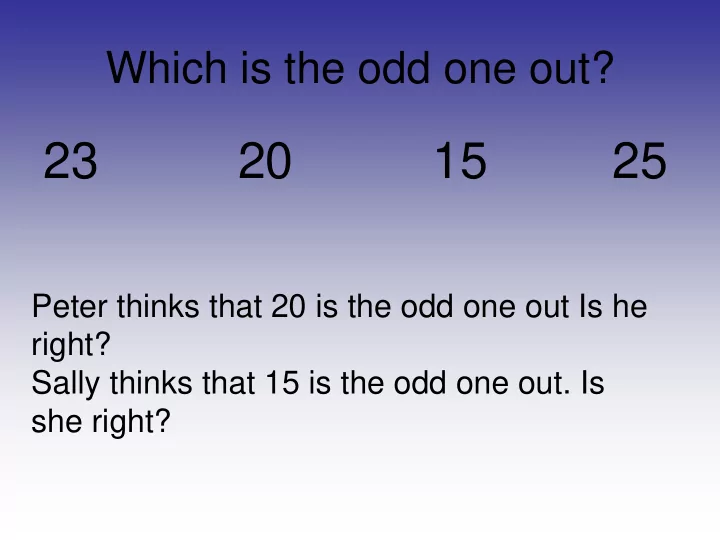
Which is the odd one out? 23 20 15 25 Peter thinks that 20 is the odd one out Is he right? Sally thinks that 15 is the odd one out. Is she right? Mathematics at Bathwick St. Mary Primary School AIMS To inform
Mathematics at Bathwick
- St. Mary Primary School
AIMS
- To inform you about the Maths national
curriculum in kS2 classes
- To tell you about Maths learning and
progression at School
- To show you ideas for helping at home
with Maths
Years 1-6
- There is an expectation that children
will master specific targets by the end
- f each year.
Aims of the new curriculum for KS1 and KS2:
- To become fluent in the fundamentals
- f mathematics and to be able to recall
and apply knowledge rapidly and accurately
- To reason mathematically
- To solve problems by applying
knowledge
What is covered at lower KS2? (Y3/4)
- Numbers- place value, addition, subtraction,
multiplication and division
- Fractions and decimals
- Measurements
- geometry – positions, directions and shapes
- statistics
Targets to be met at the end of each year:
e.g. Year 3 –
- count in multiples of
4,8,50,100
- Compare and order numbers
to 1000
- Add and subtract using
formal columnar addition and subtraction methods
- Know 2x, 3x,4x,5x,8x,10
tables
- Count in tenths
- Add and subtract fractions
with the same denominator
- Measure perimeter
- Know 12hr and 24hr clock
- Tell time to the minute.
- Identify parallel and
perpendicular lines Year 4-
- Count in multiples of
6,7,9,25,and 100
- Use negative numbers
- Know Roman numerals
- Add and subtract formally to
4 digits
- Know ALL x tables to 12x
- Use columnar multiplication
- Use equivalent fractions
- Use decimal equivalents
- Round decimals to 1.d.p.
- Find area
- Convert time from digital to
analogue
What is covered at Upper KS2? (y5/6)
- Numbers- place value, addition, subtraction,
multiplication and division
- Fractions, decimals and percentages
- Measurements
- geometry – positions, directions and shapes
- Statistics
- Ratio and proportion
- Algebra
Targets to be met at the end of each year:
e.g. Year 5.
- Read, write and order to 1
million
- Add and subtract large
numbers
- Identify factor and multiples
- Know prime, cube and square
numbers
- Use formal multiplication
- Use short division
- Recognise mixed numbers
and improper fractions
- Use percentages
- Order decimals to 3.d.p.
- Multiply fractions
- Know how to convert from
metric to imperial measures
Year 6
- Read, write and order to
10million
- Use long multiplication and
long division
- Add and subtract fractions
- Divide fractions
- Multiply and divide decimals
- Use scaling to solve problems
(ratio and proportion)
- Use algebraic formulae
- Calculate the area of
parallelograms and triangles
- Us e pie charts
- Calculate angles in a circle or
line
The Daily Lesson from Years 1-6
- Mental starter
- Main Introduction and Group Activity
- Independent/Group Activity
- Plenary
Ways of Learning
- VISUAL
- AUDITORY
- KINESTHETIC
- MENTAL
- WRITTEN
- Paired/ group or individual
Written Calculations at Bathwick
Subtraction addition multiplication division Essential to have number knowledge: bonds and times tables
Addition
1. Hands on addition
- 2. Pictorial addition
- 3. The empty number line
- 4. Partitioning
- 5. Expanded method in columns
- 6. Column method
The empty number line
Partitioning
- 47+76 = 47+70+6 = 117+6=123
- 47+76 = 40+70+7+6=110+13=123
- 47 = 40 + 7
- +76 = 70 + 6
- 110 + 13 = 123
Expanded method in columns
Column Method
Subtraction
- 1. Hands on subtraction
- 2. Pictorial subtraction
- 3. Using the empty number line
- 4. Counting up (Complimentary addition)
- 5. Partitioning
- 6. Column subtraction
The empty number line
Counting up – Complimentary addition
Partitioning
- Subtraction can be recorded using partitioning on a
number line: 74 - 27 = 74 - 20 - 7 = 54 - 7 = 47
Partitioning is not just about tens and units.
- Look at this sum
51- 17 What would you partition 51 into?
- 51 -17 =
51 40 11 10 7
Column Method
- We use exchanging from the next column to complete
the sums:
What about 2000- 179?
Multiplication
1. Hands on 2. Pictorial 3. Jottings with arrays 4. Number line 5. Mental multiplication using partitioning 6. Grid method
- One digit by two digits
- Two digits by two digits
- Three digits by two digits
Arrays
3 x 5 5 x 3
Mental multiplication using partitioning
Grid method
- One digit by two digits
Two digits by two digits Three digits by two digits
Column multiplication
Division
1. Sharing and grouping using objects 2. Jottings on pictures/number line 3. Empty number line 4. Mental division using partitioning 5. Expanded method for HTU (Chunking) 6. Short division
The empty number line
Mental division using partitioning
Short and long Division
We want children to ask themselves:
- Can I do this in my head?
- Can I do this in my head using drawings
- r jottings?
- Do I need to use an expanded/compact
written method?
- (Do I need a calculator?)- No
longer used in KS2 tests but still taught in y5/6.
TESTS
KS2
- 1 arithmetic paper on number only
(30minutes)
- 2 tests for mathematical fluency, solving
problems and reasoning. (40minutes each)
- Levels are no longer given.
- A SATS meeting for parents will be held
nearer the time.
How you can help at home.
- Crucial that children practice times
tables and number bonds.
- Look for number in everyday
activities.
Make Maths fun to do… Play games: snakes and ladders, darts, dominoes and other games that depend on numbers, counting, calculation and
- scoring. 'Battleships' is a fun way to use co-ordinates.
Cooking is great for helping your child get to know simple weights and measures. An old-fashioned set of balance scales is ideal. This is a good way to introduce the idea of ratios and proportions, too. Measure in both grammes and ounces.
- POCKET MONEY. Help her to add it up week by week, and work out
whether they can afford a particular toy or treat. Shop using money and calculate change.
- HOBBIES. If your child is car-mad, talk about
relative engine sizes, fuel economy, speed and
- performance. Watch and play sports that involve
scoring, timing, counting, measuring.
- TIME. Look at clocks, both digital and analogue. Estimate how long a
certain activity will take to do and see if you are right! Work out how long it is until the next mealtime. Play games: how long is a minute, starting from now? CALENDARS AND DATES. Give your child a calendar to record special
- ccasions. Count the days in each month. Learn the poem 30days hath
September etc.
How you can help at home…
A positive Attitude from Parents.
- Good role models .
- Don’t say ‘I am no good at Maths’ or ‘I
wasn’t any good at maths at school’ or ‘Ask your Dad as he is better than me’ – this is especially important for girls.
- It is ok to make mistakes.
Parent Booklets
- There is a parent booklet available for each
year group with some targets, questions and activities that you can refer to.
- Include calculation progressions for addition,