Mobile Payment Systems: Mobile Payment Systems: Legal and Regulatory - - PowerPoint PPT Presentation

mobile payment systems mobile payment systems legal and
SMART_READER_LITE
LIVE PREVIEW

Mobile Payment Systems: Mobile Payment Systems: Legal and Regulatory - - PowerPoint PPT Presentation

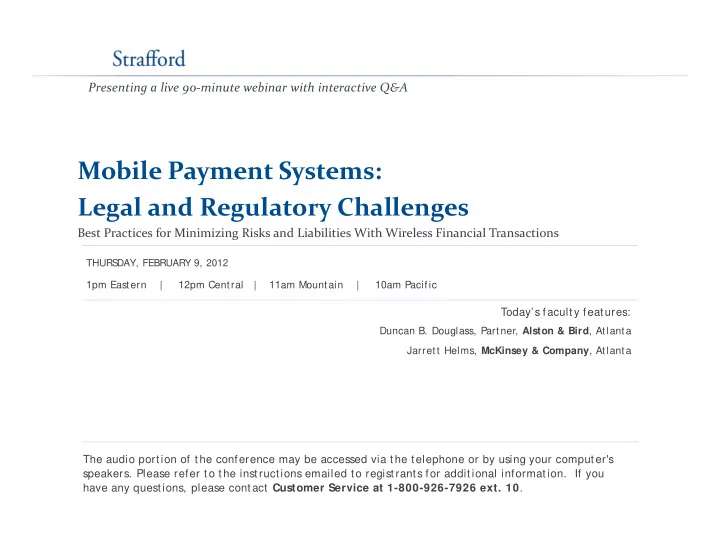
Presenting a live 90 minute webinar with interactive Q&A Mobile Payment Systems: Mobile Payment Systems: Legal and Regulatory Challenges Best Practices for Minimizing Risks and Liabilities With Wireless Financial Transactions THURS DAY,


slide-1
SLIDE 1

Presenting a live 90‐minute webinar with interactive Q&A

Mobile Payment Systems: Mobile Payment Systems: Legal and Regulatory Challenges

Best Practices for Minimizing Risks and Liabilities With Wireless Financial Transactions

Today’s faculty features:

1pm Eastern | 12pm Central | 11am Mountain | 10am Pacific THURS DAY, FEBRUARY 9, 2012

Today s faculty features:

Duncan B. Douglass, Partner, Alston & Bird, Atlanta Jarrett Helms, McKinsey & Company, Atlanta

The audio portion of the conference may be accessed via the telephone or by using your computer's

  • speakers. Please refer to the instructions emailed to registrants for additional information. If you

have any questions, please contact Customer Service at 1-800-926-7926 ext. 10.

slide-2
SLIDE 2

Conference Materials

If you have not printed the conference materials for this program, please complete the following steps:

  • Click on the + sign next to “ Conference Materials” in the middle of the left-

hand column on your screen hand column on your screen.

  • Click on the tab labeled “ Handouts” that appears, and there you will see a

PDF of the slides for today's program.

  • Double click on the PDF and a separate page will open.

Double click on the PDF and a separate page will open.

  • Print the slides by clicking on the printer icon.
slide-3
SLIDE 3

Continuing Education Credits

FOR LIVE EVENT ONLY

For CLE purposes, please let us know how many people are listening at your location by completing each of the following steps:

  • Close the notification box
  • In the chat box, type (1) your company name and (2) the number of

attendees at your location

  • Click the S

END button beside the box

slide-4
SLIDE 4

Tips for Optimal Quality

S d Q lit S

  • und Quality

If you are listening via your computer speakers, please note that the quality of your sound will vary depending on the speed and quality of your internet connection. If the sound quality is not satisfactory and you are listening via your computer speakers, you may listen via the phone: dial 1-888-450-9970 and enter your PIN when prompted Otherwise please send us a chat or e mail PIN -when prompted. Otherwise, please send us a chat or e-mail sound@ straffordpub.com immediately so we can address the problem. If you dialed in and have any difficulties during the call, press *0 for assistance.

Viewing Qualit y

To maximize your screen, press the F11 key on your keyboard. To exit full screen, press the F11 key again press the F11 key again.

slide-5
SLIDE 5

Mobile Payment Systems: Mobile Payment Systems: The US Market and Its Legal and Regulatory Challenges and Regulatory Challenges

Jarrett Helms, Payments Practice Expert y p McKinsey & Company Duncan Douglass, Partner Alston & Bird LLP Alston & Bird LLP

CONFIDENTIAL AND PROPRIETARY Any use of this material without specific permission of McKinsey & Company and Alston & Bird is strictly prohibited

slide-6
SLIDE 6

Defining the U.S. Mobile g Payments Market

slide-7
SLIDE 7

GCI-AAA123-20110606-

There are numerous forms of mobile payments, we will concentrate on using the mobile device at the traditional point-of-sale

NFC Traditional POS Mobile Commerce

“Near Field Communication”

Mobile POS Other POS

Communication based POS purchases Payment processing from a mobile device (e.g., card swipe “ l ”) NFC alternatives (e.g., SMS, barcodes, “bump”, Bluetooth, etc) “sleeve”) Mobile purchase of digital content (e g

Money Transfer & Bill P Digital Content

The use of a mobile device to initiate bill t digital content (e.g., music, books, games, apps, etc)

Pay Mobile e- commerce Content

payment or money transfers Mobile purchase of physical goods and services (e.g. shopping via a b )

McKinsey & Company | 7 SOURCE: Team analysis

browser or app)

slide-8
SLIDE 8

GCI-AAA123-20110606-

A rich ecosystem of mobile payment services is evolving that will benefit from mobile wallet capabilities

I Alternatives to the Alternatives to the

Potential mobile wallet applications

EXAMPLES

Mobile Mobile In-person retail card / cash alternative traditional card / cash based POS experience (e.g., NFC, bar codes, etc.) traditional card / cash based POS experience (e.g., NFC, bar codes, etc.) Payment processing from a mobile d i ( d Payment processing from a mobile d i ( d Mobile Incentives Mobile POS Deploying coupons,

  • ffers, etc. via mobile

device (e.g., location based offers) Deploying coupons,

  • ffers, etc. via mobile

device (e.g., location based offers) device (e.g., card swipe “sleeve”) device (e.g., card swipe “sleeve”) Mobile Wallet Banking and bill pay P2P / social E- C based offers) based offers) Enabling online banking and bill Enabling online banking and bill Mobile purchase of digital content (e.g., music, books, games, apps, etc) Mobile purchase of digital content (e.g., music, books, games, apps, etc) Commerce “check-

  • ut”

banking and bill payment via mobile device banking and bill payment via mobile device Services that streamline the ability to pay for mobile / ecommerce Services that streamline the ability to pay for mobile / ecommerce

McKinsey & Company | 8 SOURCE: McKinsey Payments Practice

transactions initiated via mobile transactions initiated via mobile

slide-9
SLIDE 9

GCI-AAA123-20110606-

Mobile payments themselves are unlikely to generate significant new payments revenues …

US Mobile Payment Transaction Value1 Billions

60

100%

Existing card-based spend via mobile Cash displacement % of merchant terminals that are NFC enabled

44 BN represents less

40 50 60

44 100%

g p

p than 1% of total card spend

44 20 30 40

50% 30

In general, mobile payments will simply shift the form factor of a

29 8 2 1 10 20

8

simply shift the form factor of a card transaction from a plastic card to the mobile device. This does not change the economics of the base transaction

2016 2011 15 14 13 12

McKinsey & Company | 9 1 includes only NFC based transactions originated in the US 2 Effectively zero volume; mobile NFC pilots may have generated some volume SOURCE: McKinsey US Payments Map, team analysis

slide-10
SLIDE 10

GCI-AAA123-20110606-

…So why is there a big fuss over mobile payments?

Mobile payments offer more opportunities to attackers than incumbents, threatening direct consumer relationships for issuing banks and providing new revenue streams for entrants

Area of ILLUSTRATIVE ea o change: Consumer Merchant Terminal Processor Network Issuer Card controlled by an issuing bank Loaded into E-wallet controlled by any of the

McKinsey & Company | 10 1 Optional SOURCE: Team analysis

any of the following:

slide-11
SLIDE 11

GCI-AAA123-20110606-

Integrating digital wallets into mobile devices presents many opportunities to improve customer experience and generate new revenue streams

Key opportunities for in-person mobile payments: NFC Example

Provide enabled devices Telco’s Develop ad / loyalty platforms Groupon / Scoutmob

1 3

Mobile components Transaction flow Telco’s Handset manufactures NFC chip manufacturers Mobile OS developers Groupon / Scoutmob Issuing Banks Card Networks EXAMPLES Consumer NFC Enabled Device Coupons / Rewards & Loyalty1 e-Wallet Contactless Terminal Merchant Transaction flow Payment Processing Merchant offers1 Develop e-wallet Telco’s Google / Apple Develop POS systems Verifone ViVOtech

2 4

Google / Apple Issuing Banks Coupon providers Card Networks PayPal Other 3rd parties ViVOtech

The mobile payments ecosystem promises a richer shopping experience for consumers with real time contextual

McKinsey & Company | 11

p

1 Optional SOURCE: Team analysis

for consumers, with real-time, contextual information and offers.

slide-12
SLIDE 12

GCI-AAA123-20110606-

New technologies and functionalities have lead to new purchase & payment related products and applications for the mobile device…

Hype around mobile payments tends to be blurred together with hype over other mobile based products and services, but some payments applications are coming

  • nline

Couponing / Rewards Location based marketing Mobile ticketing Transaction based marketing Mobile POS NFC

McKinsey & Company | 12 SOURCE: Team analysis

slide-13
SLIDE 13

GCI-AAA123-20110606-

…But further convergence among these new applications is likely, and could create a powerful tool for consumers and merchants alike

The next generation of payments applications could combine the functionality of several existing mobile products to create a more integrated and compelling product

Marketing Money Savings Mobile Payments New Application

Location based marketing E ll t Budgeting applications marketing E-wallet pp

= + +

New Transactional based marketing Coupons / Rewards NFC combined application

McKinsey & Company | 13 SOURCE: Team analysis

slide-14
SLIDE 14

GCI-AAA123-20110606-

Driving consumer and merchant adoption is a classic “chicken or the egg” conundrum… you can’t get one without the other

The two-sided market dynamics in payments have historically made it very difficult to build new payment systems. Mobile is no exception. A network effect is needed.

Achieving a network effect for mobile payments is hampered A network effect depends on: 1. Enough consumers using mobile to make it compelling for merchants Achieving a network effect for mobile payments is hampered by both real and perceived hurdles:

Basic concerns:

Failure of contactless cards to achieve adoption

Lack of a single standard for mobile payments A network effect depends on:

A

compelling for merchants to adopt 2. Enough mobile enabled merchants to make adoption meaningful for consumers

Low, but growing penetration of smartphones

Consumer perception of security

Consumer payment preferences and behaviors:

The mobile wallet will need to allow for the same basic payment preferences that consumers have today

Cost benefits to the merchant:

B C

Cost benefits to the merchant:

Merchants want to know that enough consumers will demand mobile payments, that it merits upgrading their existing systems, and implementing new marketing programs The most problematic hurdle is simply the lack of a clear value

C

The most problematic hurdle is simply the lack of a clear value proposition for both merchants and consumers. Mobile payments are not necessarily faster, cheaper, or more reliable; and on their own they may not provide enough value for consumers or merchants to shift payment behavior. To be successful they must partner with other value added

McKinsey & Company | 14 SOURCE: Team analysis

products

slide-15
SLIDE 15

GCI-AAA123-20110606-

The competitive stalemate over mobile is beginning to thaw… or is it?

Numerous players are moving forward, but in different directions p y g ,

  • A joint venture between AT&T, T-Mobile, and Verizon Wireless
  • Establishes an “open” mobile wallet via NFC enabled

smartphones across all major card networks

  • The Telco response to mobile payments
  • Theoretical reach of 200MM US consumers
  • n the three largest networks

Company Description Implications

smartphones across all major card networks

  • n the three largest networks
  • Google brought the first consumer available NFC capable

phone and wallet to market

  • Hold patent for proximity based searches allowing GPS-based

couponing and marketing D l i NFC b d ith I i

  • Google is keen to make sure that they

continue to own every form factor for web based searches

  • Google could leverage their patent to

t ti ll l t th ti ti t

  • Developing NFC-based coupons with Ingenico
  • Newly released Android Honeycomb OS leverages tablet

computers in addition to regular mobile devices potentially close out other parties wanting to deliver GPS-based couponing

  • Apple stalled in implementation of NFC into the iPhone5 with

potential plans to create their own NFC technology in 2012

  • iPad creates even more demand for “micro payments”
  • Goes against conventional wisdom that NFC

is the agreed upon standard

  • Preexisting database of accountholders gives
  • iPad creates even more demand for micro-payments
  • Large base of credit cards from iTunes accountholders
  • Preexisting database of accountholders gives

Apple a significant jump on other e-wallet providers

  • PayPal takes alternative route to breaking into mobile payments

space

–Recent acquisition of Fig Card to obtain contactless

payment terminal alternative via USB device that plugs into

  • Goes against conventional wisdom that NFC

is the agreed upon standard

  • The simplicity /lower cost of the USB device

may allow PayPal to gain an advantage payment terminal alternative via USB device that plugs into POS terminals allowing merchants to accept NFC payments

  • Acquires Where.com, a GPS-based loyalty coupon app
  • Mobile payments with PayPal account more secure

may allow PayPal to gain an advantage

  • Potential to incorporate GPS-based

couponing into NFC payments

  • Reach of 98 MM active accounts
  • Rebuffs a $6 BN buyout offer from Google
  • Growing rapidly with 40 million subscribers currently
  • Partners with CardStar, an iPhone app that consolidates and
  • Partnerships with mobile application

companies indicates movement to develop their own mobile wallet McKinsey & Company | 15 SOURCE: Internet, team analysis , pp

  • rganizes consumers’ loyalty cards, to offer targeted couponing
  • Global expansion with acquisitions worldwide (e.g. Berlin, Chile,

China, India, Japan)

  • Reach of 40 MM global consumers interested

in mobile couponing

slide-16
SLIDE 16

GCI-AAA123-20110606-

Backed by major brands, consumer and merchant applications are emerging to test demand for mobile payment technologies at the POS

Partners Value proposition Revenue Model Additi l d ti i

Consumer example

An e-wallet integrated into a marketing platform which will allow Consumers will be able to store all the documents from their wallets into one mobile app as well as receive, store and redeem Additional advertising and marketing spend store, and redeem coupons/offers at the POS Mobile application that Partners Value proposition Merchants can integrate Revenue Model Merchant fee

Merchant example

Mobile application that allows users to pay for a restaurant or bar tab using an app on their smartphone this payment app with their POS system allowing for more convenient and efficient transactions resulting in increased sales

McKinsey & Company | 16

increased sales

SOURCE: Corporate websites, team analysis

slide-17
SLIDE 17

GCI-AAA123-20110606-

NFC is the front-runner standard for mobile payments, but other alternatives exist, causing marketplace confusion & investment delays

Standard Used by Pros/Cons

Pro: Has the most momentum behind it, and is already deployed

Con: Necessitates hardware upgrades for

Industry consortium including: Visa, MasterCard, Isis, NFC Ease of integration Likelihood of adoption pg the merchant

Used globally, but no current US , , Microsoft, Sony N SMS

Pro: No contactless terminal needed

Pro: No smart phone needed

Con: Clumsy and slow to use systems

PayPal S asonic

Con: Clumsy and slow to use

Pro: Only needs a USB plug-in, making integration easier

Pro: No card information is stored or shared PayPal

Sparkbase Ultra code

Amazon Pro: No card information is stored or shared

Con: No phone signal, no payment

Pro: Easiest to integrate of any solution

Apple ple Barc Amazon

Apple has been unclear about their release

  • f an NFC enabled iPhone, and there are

th t th d l

Con: Works best for closed loop accounts

? ?

McKinsey & Company | 17 SOURCE: Team analysis

Apple App rumors that they may develop an alternate standard. This uncertainty promotes market stagnation

? ?

slide-18
SLIDE 18

GCI-AAA123-20110606-

The scramble for mobile acquisitions has started primarily with e-wallets

Valuations of mobile companies are extremely high and large industry players

4/28/2010: PayPal acquires 5/17/2011: SK C&C USA 6/13/2011: NuWallet

are making the first major moves in the mobile payments arena

7/7/2011: Zong is 4/28/2010: PayPal acquires FigCard as a means of bypassing NFC hurdles and more directly working with POS merchants to provide a streamlined payment 5/17/2011: SK C&C USA launches Corfire with mobile wallet platform based on NFC technology 6/13/2011: NuWallet introduces mobile payments solution that allows users to make online purchases via their mobile devices more efficiently by storing the 7/7/2011: Zong is purchased by eBay in a continuing effort to build PayPal a full scale mobile

  • ffering able of competing

in the POS experience consumers information within the app

May June April July

5/11/2011: Visa announces plans to launch NFC based mobile wallet to be launched 6/13/2011: Payfone partners with Verizon

2011

in Fall 2011 5/26/2011: Release of Google Wallet with Google Offers 5/27/2011: PayPal sues Google y Wireless to develop new mobile payment system for Verizon customers enabling

  • nline purchases from smartphones,

tablets, and PCs through various payment methods.

McKinsey & Company | 18 SOURCE: Press releases, corporate websites

indicating similar mobile wallet development by PayPal

slide-19
SLIDE 19

GCI-AAA123-20110606-

The definition of success in mobile payments will change over time, and is dependent on a company’s position in the ecosystem

Near Term Mid Term Long Term

Develop a product

Form alliances/ partnerships

Establish product in the market space

Obtain a consumer

Gain consumer adoption

Increase product awareness

Improve and continue to develop product

Retain dominance in market space by surviving industry consolidation

Maintain consumer base with most up to

Obtain a consumer base

Next 12 months

to develop product

1 -2 years 2 years +

base with most up-to- date couponing services Continuum Issuer – Success is maintaining close customer relationships, not necessarily driving new revenue Marketer – Success is building market share to drive revenue growth

McKinsey & Company | 19 SOURCE: Team analysis

slide-20
SLIDE 20

GCI-AAA123-20110606-

Although many players are interested in developing e-wallets, all are constrained by avoiding significant trade-offs with their core businesses

Issuers Key Ecosystem Assets Constrained by … Players

Maintaining share of wallet – “stay relevant for every payment”

Trusted brands as payment account and instrument providers

Stakeholder

Mobile subscriber market share

Driving data revenues

UICC / OTA provisioning

App’ preload

Supported devices

Maintaining handset market share

Device feature set (NFC chip)

Embedded secure element

Telco’s Handset f

share

Embedded secure element

m’facturers

Maintaining OS market share to drive application / license revenue

App’ store / preload

Source code / SDK

Application processor

Mobile OS developers Payments networks Marketing / Advertising

Maintaining overall transaction / wallet share growth

Need to generate advertising impressions (access to as

Wallet eligibility

Existing e-wallet userbase

Existing user base (consumers / merchants) /

Advertising platforms

impressions (access to as many networks as possible) ( ) consumer interest

Key patents

Retailers

Acceptance

Existing e-wallet userbase

Sales volume

McKinsey & Company | 20

Payment intermediaries

Existing e-wallet userbase

Maintaining existing user / transaction base

SOURCE: Team analysis

slide-21
SLIDE 21

GCI-AAA123-20110606-

Competitors are adopting varied e-wallet strategies based on current strengths and placement in the market

ple

Current and future mobile wallet applications:

Examp

Intermediary Lone Wolf Coalition

Characteristics:

Open Platform

Characteristics: Characteristics: Characteristics: Characteristics:

Continue to provide intermediary processing

Leverage existing ll t b t Strategy

Characteristics:

Unique stand-alone platforms

Leverage loyal user base to extend d l tf

Characteristics:

Attempt to consolidate efforts of like parties (issuers, telcoms) B d h b d

Characteristics:

Create an open wallet for other developers to leverage B d h b d wallet base to move to POS

Move e-commerce capabilities to bricks- and-mortar rewards platform

Drive cross-sell of

  • ther products or sell

access to others

Broad reach based

  • n consumer base

Keep known quantities in control

Broad reach based

  • n smartphone
  • wnership

Drive ad or app’ revenue

McKinsey & Company | 21 SOURCE: Team analysis

slide-22
SLIDE 22

REGULATION OF MOBILE PAYMENTS IN THE U.S.

slide-23
SLIDE 23

GCI-AAA123-20110606-

Mobile Payments Operating Models Operating Models

Bank-Driven Model – Financial institution offers account access through mobile device-initiated transactions

  • Transactions are processed over traditional payment networks/channels
  • Funding source is payor’s DDA, line of credit or prepaid account with the

financial institution Mobile Payment Service Provider (MPSP) Driven Model MPSP offers mobile Mobile Payment Service Provider (MPSP)-Driven Model – MPSP offers mobile payment capabilities to its service users (which may include small merchants)

  • Transactions are processed over MPSP’s systems
  • MPSP may access existing customer funding source held at/issued by a third

party (e.g., a DDA or payment card) or may establish a dedicated funding party (e.g., a DDA or payment card) or may establish a dedicated funding account Mobile Network Operator-Driven Model – Mobile network operator offers mobile payments capabilities for purchases using mobile devices associated with its i l t k wireless network

  • Transactions are processed over the operator’s wireless network
  • Charges appear on payor’s wireless bill and/or are funded on a prepaid basis

McKinsey & Company | 23

slide-24
SLIDE 24

GCI-AAA123-20110606-

Overview

  • As contemplated and piloted to-date, mobile payments initiatives in

the U.S. have largely leveraged existing payment and funds transfer methods and operating models transfer methods and operating models

  • The regulatory regime applicable to existing methods and models

thus likely governs mobile payments analogues

  • The Regulatory picture becomes less clear in certain operating

models that may become prevalent in the future

F l M bil N t k O t M d l h t

  • For example, Mobile Network Operator Model where customer

purchases of third party goods/services are reflected on the customer’s wireless bill

I d i l t f b k h d

  • Increased involvement of non-banks may pose enhanced

regulatory and supervisory challenges

McKinsey & Company | 24

slide-25
SLIDE 25

GCI-AAA123-20110606-

Mobile Device: Just Another Form Factor? Just Another Form Factor?

  • In many respects, mobile device-initiated payments are functionally

the same as existing payment and fund transfer methods the the same as existing payment and fund transfer methods – the principal innovation being the new form factor

  • Mobile payment transactions that rely on traditional retail payments funding

(DDA li f dit id t) lik l bj t t th sources (DDA, line of credit, prepaid account) are likely subject to the same regulatory requirements as their more traditional predecessors

  • Regulators have not generally provided formal interpretations that existing

l ti l t bil t b t th t t d hi t i l regulations apply to mobile payments, but the text and historical application of those regulations point to this conclusion

  • The recent spate of legislative/regulatory activity applicable to retail

payments generally has broad applicability and will likely apply equally to mobile payments (and in some cases do so expressly)

McKinsey & Company | 25

slide-26
SLIDE 26

GCI-AAA123-20110606-

TILA/Regulation Z

  • Applies in relevant part to any person that issues a credit card and who

regularly extends credit to consumers primarily for personal, family or household purposes household purposes

  • A “credit card” is “any card, plate, coupon book, or other single

credit device that may be used from time to time to obtain credit.”

  • A mobile device that accesses a line of credit for funding transactions is

most likely a credit card for TILA/Regulation Z purposes, and the issuer

  • f the device (and extender of related credit) is most likely a creditor for

TILA/Regulation Z purposes TILA/Regulation Z purposes

McKinsey & Company | 26

slide-27
SLIDE 27

GCI-AAA123-20110606-

EFTA/Regulation E

  • Generally applies to “any person that directly or indirectly holds an

account belonging to a consumer, or that issues an access device and agrees with a consumer to provide electronic fund transfer services” agrees with a consumer to provide electronic fund transfer services

  • “account” means a consumer asset account
  • “access device” means “a card, code, or other means of access to a

access device means a card, code, or other means of access to a consumer’s account . . . that may be used by the consumer to initiate electronic fund transfers”

  • A mobile device that can be used to initiate electronic fund transfers from

t t ( DDA) i t lik l d i a consumer asset account (e.g., a DDA) is most likely an access device for EFTA/Regulation E purposes and the issuer of the mobile device (and the holder of the account, if different) is most likely subject to the EFTA/Regulation E

McKinsey & Company | 27

slide-28
SLIDE 28

GCI-AAA123-20110606-

Bank Secrecy Act/ AML Requirements AML Requirements

  • Financial institutions, including money services businesses (MSBs), are

subject to various requirements designed to detect and prevent money subject to various requirements designed to detect and prevent money laundering and terrorist financing activities

  • Banks are expressly covered by BSA requirements
  • Many MPSPs are subject to BSA compliance obligations as money

transmitters (i.e., MSBs)

  • Mobile network operators, depending on their role in facilitating

funds transfers, may also be subject to regulation as MSBs if they satisfy the definition of a money transmitter or operator of a credit d t card system

McKinsey & Company | 28

slide-29
SLIDE 29

GCI-AAA123-20110606-

State Money Transmitter Laws

  • Govern the activity of non-depository money service (funds transfer)

id lik t itt h k h d d l providers like money transmitters, check cashers and currency dealers

  • Except to the extent that a bank agent exemption may apply, MPSPs

and mobile network operators responsible for funds transfers and mobile network operators responsible for funds transfers (including P2P transfers and prepaid funding models) may be subject to state licensure

McKinsey & Company | 29

slide-30
SLIDE 30

GCI-AAA123-20110606-

Gramm-Leach-Bliley Act

  • Applies to financial institutions, as broadly defined
  • Privacy Rule – requires FI to disclose to customer its policies
  • Privacy Rule – requires FI to disclose to customer its policies

regarding disclosure of customer’s non-public information with affiliates and non-affiliates

  • Safeguards Rule – requires FI to develop standards to protect

Safeguards Rule – requires FI to develop standards to protect customer information

  • Applicability of GLBA to non-bank mobile payments provider will vary

with the model but should apply to mobile payments entities in parallel to with the model, but should apply to mobile payments entities in parallel to its applicability to providers involved in more traditional payment channels

McKinsey & Company | 30

slide-31
SLIDE 31

GCI-AAA123-20110606-

Dodd-Frank Act

  • Title X - Consumer Financial Protection Act and the creation of the Bureau

Title X Consumer Financial Protection Act and the creation of the Bureau

  • f Consumer Financial Protection with authority to regulate non-bank

providers of consumer financial products and services “Financial Products” include: “Financial Products” include:

  • Extending credit
  • Issuing stored value or payment instruments
  • “providing payments or other financial data processing products . . .

including payments made through an online banking system or including payments made through an online banking system or mobile telecommunications network”

  • Durbin Amendment restrictions on exclusive network arrangements will

likely impact all participants in the evolving mobile payments marketplace

  • New coverage of cross-border remittance transfers under the

EFTA/Regulation E will impact all mobile-initiated remittances to foreign receivers

McKinsey & Company | 31

receivers

slide-32
SLIDE 32

GCI-AAA123-20110606-

New FinCEN Prepaid Access Rules

  • FinCEN’s new prepaid access rules characterize all “providers of prepaid
  • FinCEN s new prepaid access rules characterize all providers of prepaid

access” as MSBs will pull additional non-bank participants in pre-funded mobile payments schemes under federal supervision for AML compliance

  • FinCEN has defined “prepaid access” very broadly to include any

FinCEN has defined prepaid access very broadly, to include any “electronic device or vehicle, such as a card, code, electronic serial number, mobile identification number or personal identification number.”

McKinsey & Company | 32

slide-33
SLIDE 33

GCI-AAA123-20110606-

Review of Mobile Payments Operating Models Through the Regulatory Lens Models Through the Regulatory Lens

  • Bank-Driven Model
  • Bank typically holds funding account and uploads traditional credit, debit or prepaid card

account number (or account identifier for ACH applications) to mobile device (which may be a contactless sticker) be a contactless sticker)

  • Full complement of existing payments laws should apply in the mobile context
  • MPSP-Driven Model
  • If transaction funding accounts are held at traditional financial institutions, regulatory

framework should apply in the same way as it applies to payment service providers ti i th i t t t d (MPSP b bj t t EFTA/R l ti E d

  • perating in the internet space today (MPSP may be subject to EFTA/Regulation E and

is likely an MSB/MT but should be able to avoid broader regulation because MPSP is acting as a service provider)

  • If MPSP holds funding accounts (e.g., on a prepaid basis) or extends credit, MPSP

should be subject to broader federal and state regulations, similar to those that would l t b k id id f i i il f ti ( lb it t d ti l apply to a bank or prepaid provider performing similar functions (albeit not prudential

  • versight)
  • Mobile Network Operator-Driven Model
  • If transaction funding accounts are held at traditional financial institutions, operator may

be subject to certain MSB/MT requirements and may be subject to EFTA/Regulation E j q y j g requirements (if issuing the access device), but will generally be characterized as a service provider

  • If the operator holds a prepaid funding account, it will be subject to broader federal and

state regulation; if the operator posts mobile payment transactions to the customer’s wireless bill, the operator may be subject to TILA/Regulation Z or may be subject only to

McKinsey & Company | 33

, p y j g y j y Truth-in-Billing Requirements and related FCC regulation (this point is subject to debate)

slide-34
SLIDE 34

GCI-AAA123-20110606-

Mobile Payments Models May Present Enhanced Regulatory Challenges Enhanced Regulatory Challenges

  • Compliance concerns – Even where non-bank mobile payments

Compliance concerns Even where non bank mobile payments providers are subject to federal and state regulations, mobile network

  • perators and MPSPs are often not familiar with payments/financial

services legal requirements such as consumer protection laws, BSA/AML obligations (including KYC) state money transmitter laws BSA/AML obligations (including KYC), state money transmitter laws, and other compliance requirements

  • Credit/liquidity risk concerns – Displacement of traditional financial

institutions which are subject to prudential oversight by non-bank institutions, which are subject to prudential oversight, by non bank mobile payments companies may increase credit and liquidity risk in the payment system

  • Federal regulatory authorities have been monitoring the mobile

Federal regulatory authorities have been monitoring the mobile payments space but have yet to identify the market is separate or unique from other payment systems

McKinsey & Company | 34

slide-35
SLIDE 35

GCI-AAA123-20110606-

Regulation of Mobile Payments – Continuing the Discussion the Discussion

  • While mobile payments remain in the formative stages in the U.S.,

p y g , consider whether regulators should be encouraged to begin addressing the issue through interpretive guidance

  • Is there a risk that an under-regulated mobile payments system develops in

g p y y p the U.S.?

  • Consider whether the existing (and evolving) regulatory framework is

suited to regulate the enhanced role non-banks are playing in mobile t ti l l i d l th t i l b t ti l payments, particularly in models that involve substantial disintermediation of traditional financial institutions

  • Is regulation of mobile payments principally a consumer protection issue

(CFPB)? (CFPB)?

  • Are there safety and soundness issues that should be addressed in non-bank

driven models?

McKinsey & Company | 35

slide-36
SLIDE 36

Conclusion / Questions Conclusion / Questions

slide-37
SLIDE 37

GCI-AAA123-20110606-

For more information, contact:

Jarrett Helms

Payments Practice Expert 678-221-2320

Duncan Douglass

Partner 404-881-7768 6 8 3 0 jarrett_helms@mckinsey.com duncan.douglass@alston.com

McKinsey & Company | 37