
SLIDE 1
Elementary Functions
Part 1, Functions Lecture 1.4a, Symmetries of Functions: Even and Odd Functions
- Dr. Ken W. Smith
Sam Houston State University
2013
Smith (SHSU) Elementary Functions 2013 1 / 25
Even and odd functions
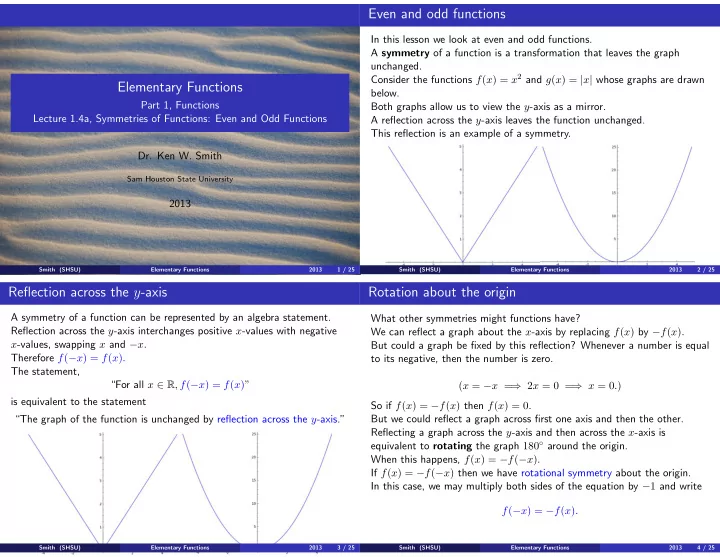
In this lesson we look at even and odd functions. A symmetry of a function is a transformation that leaves the graph unchanged. Consider the functions f(x) = x2 and g(x) = |x| whose graphs are drawn below. Both graphs allow us to view the y-axis as a mirror. A reflection across the y-axis leaves the function unchanged. This reflection is an example of a symmetry.
Smith (SHSU) Elementary Functions 2013 2 / 25
Reflection across the y-axis
A symmetry of a function can be represented by an algebra statement. Reflection across the y-axis interchanges positive x-values with negative x-values, swapping x and −x. Therefore f(−x) = f(x). The statement, “For all x ∈ R, f(−x) = f(x)” is equivalent to the statement “The graph of the function is unchanged by reflection across the y-axis.”
Smith (SHSU) Elementary Functions 2013 3 / 25
Rotation about the origin
What other symmetries might functions have? We can reflect a graph about the x-axis by replacing f(x) by −f(x). But could a graph be fixed by this reflection? Whenever a number is equal to its negative, then the number is zero. (x = −x = ⇒ 2x = 0 = ⇒ x = 0.) So if f(x) = −f(x) then f(x) = 0. But we could reflect a graph across first one axis and then the other. Reflecting a graph across the y-axis and then across the x-axis is equivalent to rotating the graph 180◦ around the origin. When this happens, f(x) = −f(−x). If f(x) = −f(−x) then we have rotational symmetry about the origin. In this case, we may multiply both sides of the equation by −1 and write f(−x) = −f(x).
Smith (SHSU) Elementary Functions 2013 4 / 25