Would A Business Judgment Rule Help Directors Sleep Better at - - PowerPoint PPT Presentation

would a business judgment rule help directors sleep
SMART_READER_LITE
LIVE PREVIEW

Would A Business Judgment Rule Help Directors Sleep Better at - - PowerPoint PPT Presentation

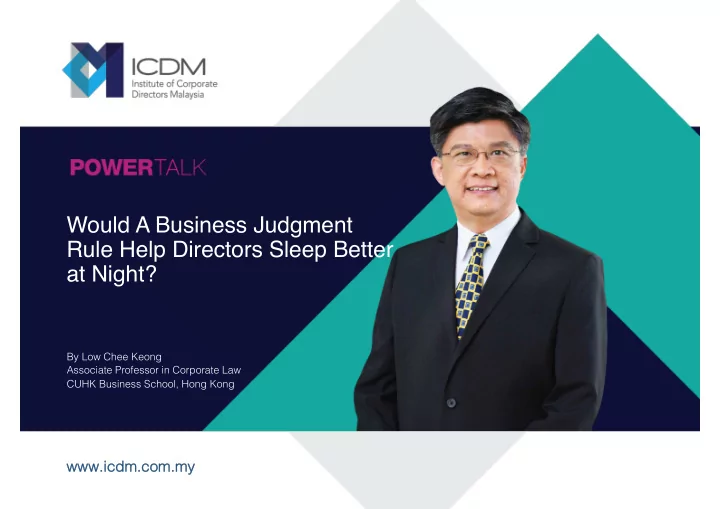
Would A Business Judgment Rule Help Directors Sleep Better at Night? By Low Chee Keong Associate Professor in Corporate Law CUHK Business School, Hong Kong www. www.ic icdm.com.my IN THE BEGINNING Their Lordships accept that it

slide-1
SLIDE 1

Would A Business Judgment Rule Help Directors Sleep Better at Night?

By Low Chee Keong Associate Professor in Corporate Law CUHK Business School, Hong Kong

www. www.ic icdm.com.my

slide-2
SLIDE 2

2

IN THE BEGINNING …

Their Lordships … accept that it would be wrong for the court to substitute its opinion for that of the management, or indeed to question the correctness of the management’s decisions … if bona fide arrived at. … nor will courts of law assume to act as a kind of supervisory board over decisions within the powers of management honestly arrived at.

Lord Wilberforce Howard Smith Ltd v Ampol Petroleum [1974] AC 821 at 832

slide-3
SLIDE 3

3

ONLINE POLLING

Step #1 Go to www.slido.com Step #2 Enter Event Name as powertalk2 Step #3 Select Polls

slide-4
SLIDE 4

4

Do you think that the current duties expected of directors are :

Too onerous Just right Too lenient

WITH THAT IN MIND …

A B C

slide-5
SLIDE 5

5

Do you think that it is not easy to successfully sue a director for breach of duty to the company?

Yes No

WITH THAT IN MIND…

A B

slide-6
SLIDE 6

6

The ‘Objective’ Directors must exercise the knowledge, skills and experience that would reasonably be expected of a director carrying

  • ut the same functions.

The ‘Plus’ The director must also bring his or her own general knowledge, skills and expertise to the table.

SECTION 213(2) ‘OBJECTIVE PLUS’

slide-7
SLIDE 7

7

S & E

A B C

A’ B’ C’

slide-8
SLIDE 8

8

CASE STUDIES

COMPANY A COMPANY B COMPANY C

slide-9
SLIDE 9

9

Do you think that the current duties expected of directors are :

Too onerous Just right Too lenient

ON REFLECTION ….

A B C

slide-10
SLIDE 10

10

Do you think that it is not easy to successfully sue a director for breach of duty to the company?

Yes No

WITH THAT IN MIND…

A B

slide-11
SLIDE 11

11

SECTION 214 COMPANIES ACT

A director who makes a business judgment is deemed to meet the requirements

  • f the duty under subsection 213(2) and the equivalent duties under the

common law and in equity if the director –

  • makes the business judgment for a proper purpose and in good faith;
  • does not have a material personal interest in the subject matter of the

business judgment;

  • is informed about the subject matter of the business judgment to the extent

the director reasonably believes to be appropriate under the circumstances; and

  • reasonably believes that the business judgment is in the best interest of the

company.

slide-12
SLIDE 12

12

Do you think that the Business Judgment Rule is:

Too complicated Just right Too simplistic

WITH THAT IN MIND …

A B C

slide-13
SLIDE 13

13

Do you think that the Business Judgment Rule would be of any benefit to directors?

Yes No

WITH THAT IN MIND…

A B

slide-14
SLIDE 14

14

THE RATIONALE The Delaware Yankee ALI – A Different Yankee The Aussie way

slide-15
SLIDE 15

15

THE DELAWARE YANKEE The Delaware Yankee ALI – A Different Yankee The Aussie way

A ‘Safe Harbour Rule’ that is strictly not a rule

‘a presumption that in making a business decision the directors of a corporation acted on an informed basis, in good faith and in the honest belief that the action was taken in the best interests of the corporation’

Aronson v Lewis 473 A.2d 805 (Del. 1984) at 812

Conserves judicial resources by protecting decisions made

  • free of disabling conflicts of

interest

  • with exercise of some (not

necessarily reasonable) care

  • on a rational (not necessarily

reasonable) basis

Cede & Co v Technicolor, Inc 634 A.2d 345 (Del. 1993)

slide-16
SLIDE 16

16

ALI – A DIFFERENT YANKEE The Delaware Yankee ALI – A Different Yankee The Aussie way

  • An affirmative or independent judgment
  • Must be informed with some care – not due care
  • An absence of disabling conflicts of interest
  • A rational basis for the decision
  • Good faith – the ‘smell test’ surrogate J
slide-17
SLIDE 17

17

Section 180(2) Corporations Act

  • must make a decision: sec 180(3)
  • judgment in good faith for proper purpose
  • no material personal interest
  • informed about the subject matter
  • possesses a rational belief that the decision

is in the best interest of company

ASIC v Rich (2009) 75 ASCR 1 ASIC v Mariner Corporation (2015) FCA 589

THE AUSSIE WAY

slide-18
SLIDE 18

18

LET’S PAUSE AND PONDER

A. DELAWARE B. ALI C. AUSSIE

Which model do you prefer? Why?

slide-19
SLIDE 19

19

  • Courts are ill equipped to review business

decisions a process which is compounded by corporate ownership landscape with dominance of family & state

  • Fusion to allow directors to have two bites of the cherry

§ The Yankee to scrutinise the decision making process § The Aussie to assess the general state of knowledge

  • NOT a legal transplant but Malaysia (Boleh)-centric

THE MALAYSIAN HYBRID

slide-20
SLIDE 20

20

LET’S RETHINK …

A. DELAWARE B. ALI C. AUSSIE

Which model do you prefer?

D. MALAYSIAN HYBRID

slide-21
SLIDE 21

21

Do you think that the Business Judgment Rule is:

Too complicated Just right Too simplistic

WITH THAT IN MIND …

A B C

slide-22
SLIDE 22

22

Do you think that the Business Judgment Rule would be of any benefit to directors?

Yes No

WITH THAT IN MIND…

A B

slide-23
SLIDE 23

23

Low Chee Keong & Low Tak Hay

The Business Judgment Rule: A Safe Harbour for Directors?

Journal of the Malaysian Judiciary 159- 191 (January 2018)

Available at http://www.jac.gov.my/images/journal_malaysian_judiciary/jan2018.pdf

FURTHER READING

slide-24
SLIDE 24

24

Low Chee Keong & Low TakYip

When is the Board Accountable for Delegation and Reliance? A Case Study of the MTR Corporation

[2016] Vol 30 Australian Journal of Corporate Law 285-303

Available at https://papers.ssrn.com/sol3/papers.cfm?abstract_id=2487710

MORE READING

slide-25
SLIDE 25

25

THANK YOU

slide-26
SLIDE 26

26

Panel Discussion

CHEE KEONG LOW Associate Professor in Corporate Law, CUHK Business School PHILIP T.N. KOH Senior Partner, Mah-Kamariyah & Philip Koh Moderated by KAMARUL BAHRIN HARON Deputy Editor-in-Chief, ASTRO AWANI DATUK YVONNE CHIA Chairman, Standard Chartered Bank Malaysia