Workshop on Geometric Control of Mechanical Systems Francesco Bullo - - PDF document

workshop on geometric control of mechanical systems
SMART_READER_LITE
LIVE PREVIEW

Workshop on Geometric Control of Mechanical Systems Francesco Bullo - - PDF document

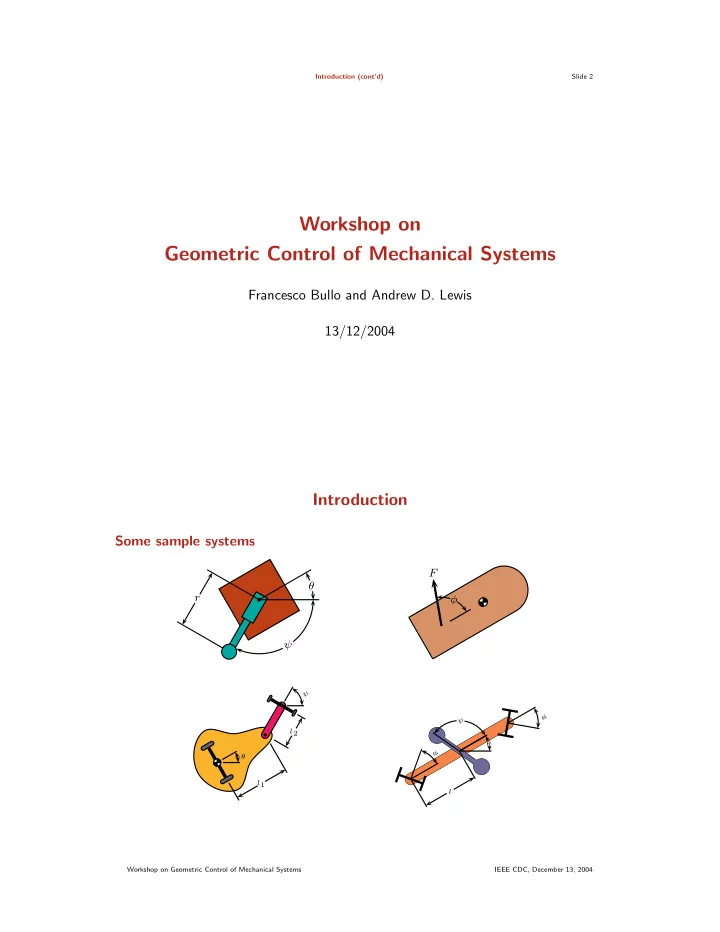
Introduction (contd) Slide 2 Workshop on Geometric Control of Mechanical Systems Francesco Bullo and Andrew D. Lewis 13/12/2004 Introduction Some sample systems F r l 2 l 1 l Workshop on Geometric


slide-1
SLIDE 1

Introduction (cont’d) Slide 2

Workshop on Geometric Control of Mechanical Systems

Francesco Bullo and Andrew D. Lewis 13/12/2004

Introduction

Some sample systems

θ ψ r F φ

l1 l2 θ ψ φ φ ψ θ l Workshop on Geometric Control of Mechanical Systems IEEE CDC, December 13, 2004

slide-2
SLIDE 2

Introduction (cont’d) Slide 4

Sample problems (vaguely)

  • Modeling: Is it possible to model the four systems in a unified way, that allows

for the development of effective analysis and design techniques?

  • Analysis: Some of the usual things in control theory: stability, controllability,

perturbation methods.

  • Design: Again, some of the usual things: motion planning, stabilization,

trajectory tracking. Sample problems (concretely) Start from rest.

  • 1. Describe the set of reachable states.

(a) Does it have a nonempty interior? (b) If so, is the original state contained in the interior?

  • 2. Describe the set of reachable positions.
  • 3. Provide an algorithm to steer from one position at rest

to another position at rest.

  • 4. Provide a closed-loop algorithm for stabilizing a speci-

fied configuration at rest.

  • 5. Repeat with thrust direction fixed.

F φ F

π 2

Workshop on Geometric Control of Mechanical Systems IEEE CDC, December 13, 2004

slide-3
SLIDE 3

Introduction (cont’d) Slide 6

The literature, historically

  • Abraham and Marsden [1978], Arnol’d [1978], Godbillon [1969]: Geometrization
  • f mechanics in the 1960’s.
  • Agrachev and Sachkov [2004], Jurdjevic [1997], Nijmeijer and van der Schaft

[1990]: Geometrization of control theory in the 1970’s, 80’s, and 90’s by Agrachev, Brockett, Hermes, Krener, Sussmann, and many others.

  • Brockett [1977]: Lagrangian and Hamiltonian formalisms, controllability,

passivity, some good examples.

  • Crouch [1981]: Geometric structures in control systems.
  • van der Schaft [1981/82, 1982, 1983, 1985, 1986]: A fully-developed

Hamiltonian foray: modeling, controllability, stabilization.

  • Takegaki and Arimoto [1981]: Potential-shaping for stabilization.
  • Bonnard [1984]: Lie groups and controllability.

The literature, historically (cont’d)

  • Bloch and Crouch [1992]: Affine connections in control theory, controllability.
  • Bates and ´

Sniatycki [1993], Bloch, Krishnaprasad, Marsden, and Murray [1996], Koiller [1992], van der Schaft and Maschke [1994]: Geometrization of systems with constraints.

  • Bloch, Reyhanoglu, and McClamroch [1992]: Controllability for systems with

constraints.

  • Baillieul [1993]: Vibrational stabilization.
  • Arimoto [1996], Ortega, Loria, Nicklasson, and Sira-Ramirez [1998]: Texts on

stabilization using passivity methods.

  • Bloch, Chang, Leonard, and Marsden [2001], Bloch, Leonard, and Marsden

[2000], Ortega, Spong, G´

  • mez-Estern, and Blankenstein [2002]: Energy shaping.
  • Bloch [2003]: Text on mechanics and control.

Workshop on Geometric Control of Mechanical Systems IEEE CDC, December 13, 2004

slide-4
SLIDE 4

Slide 8

The literature, historically (cont’d) Today’s topics.

  • Lewis and Murray [1997]: Controllability.
  • Bullo and Lewis [2003], Bullo and Lynch [2001]: Low-order controllability,

kinematic reduction, and motion planning.

  • Bullo [2001, 2002]: Series expansions, averaging, vibrational stabilization.
  • Mart´

ınez, Cort´ es, and Bullo [2003]: Trajectory tracking using oscillatory controls. What we will try to do today

  • Present a unified methodology for modeling, analysis, and design for mechanical

control systems.

  • The methodology is differential geometric, generally speaking, and affine

differential geometric, more specifically speaking. Follows: Geometric Control of Mechanical Systems: Modeling, Analysis, and Design for Simple Mechanical Control Systems Francesco Bullo and Andrew D. Lewis Springer–Verlag, 2004

  • Warning! We will be much less precise during the workshop than we are in the

book.

  • We make no claims that the methodology presented is better than alternative

approaches.

Workshop on Geometric Control of Mechanical Systems IEEE CDC, December 13, 2004

slide-5
SLIDE 5

Geometric modeling of mechanical systems (cont’d) Slide 10

Geometric modeling of mechanical systems

Differential geometry essential: Advantages

  • 1. Prevents artificial reliance on spe-

cific coordinate systems.

  • 2. Identifies key elements of system

model.

  • 3. Suggests methods of analysis and

design. Disadvantages

  • 1. Need to know differential geome-

try. Manifolds

  • Manifold M, covered with charts

{(Ua, φa)}a∈A satisfying overlap condition.

  • Around any point x ∈ M a chart (U, φ)

provides coordinates (x1, . . . , xn).

  • Continuity and differentiability are checked in

coordinates as usual.

M Ua Ub φa Rn φb Rn φab Workshop on Geometric Control of Mechanical Systems IEEE CDC, December 13, 2004

slide-6
SLIDE 6

Geometric modeling of mechanical systems (cont’d) Slide 12

Manifolds (cont’d) Manifolds we will use today.

  • 1. Euclidean space: Rn.
  • 2. n-dimensional sphere: Sn = {x ∈ Rn+1 | xRn+1 = 1}.
  • 3. m × n matrices: Rm×n.
  • 4. General linear group: GL(n; R) = {A ∈ Rn×n | det A = 0}.
  • 5. Special orthogonal group:

SO(n) = {R ∈ GL(n; R) | RRT = In, det R = 1}.

  • 6. Special Euclidean group: SE(n) = SO(n) × Rn.

The manifolds Sn, GL(n; R), and SO(n) are examples of submanifolds, meaning (roughly) that they are manifolds contained in another manifold, and acquiring their manifold structure from the larger manifold (think surface).

M U φ Rn γ2 γ1 x [γ1]x = [γ2]x

Tangent bundles

  • Formalize the idea of

“velocity.”

  • Given a curve t → γ(t)

represented in coordinates by t → (x1(t), . . . , xn(t)), its “velocity” is t → ( ˙ x1(t), . . . , ˙ xn(t)).

  • Tangent vectors are equivalence classes of curves.
  • The tangent space at x ∈ M: TxM = {tangent vector at x}.
  • The tangent bundle of M: TM = ∪x∈MTxM.
  • The tangent bundle is a manifold with natural coordinates denoted by

((x1, . . . , xn), (v1, . . . , vn)).

Workshop on Geometric Control of Mechanical Systems IEEE CDC, December 13, 2004

slide-7
SLIDE 7

Geometric modeling of mechanical systems (cont’d) Slide 14 M U Rn φ

Vector fields

  • Assign to each point x ∈ M

an element of TxM.

  • Coordinates (x1, . . . , xn)

vector fields { ∂

∂x1 , . . . , ∂ ∂xn } on

chart domain.

  • Any vector field X is given in coordinates by X = Xi ∂

∂xi (note use of

summation convention). Flows

  • Vector field X and chart (U, φ)
  • .d.e.:

˙ x1(t) = X1(x1(t), . . . , xn(t)) . . . ˙ xn(t) = Xn(x1(t), . . . , xn(t)).

  • Solution of o.d.e.

curve t → γ(t) satisfying γ′(t) = X(γ(t)).

  • Such curves are integral curves of X.
  • Flow of X: (t, x) → ΦX

t (x) where t → ΦX t (x) is the integral curve of X

through x.

Workshop on Geometric Control of Mechanical Systems IEEE CDC, December 13, 2004

slide-8
SLIDE 8

Geometric modeling of mechanical systems (cont’d) Slide 16

Lie bracket

  • Flows do not generally commute.
  • i.e., given X and Y , it is not generally true that ΦX

t

  • ΦY

s = ΦY s ◦ΦX t .

  • The Lie bracket of X and Y :

[X, Y ](x) = d dt

  • t=0Φ−Y

√ t ◦Φ−X √ t

  • ΦY

√ t ◦ΦX √ t(x).

Measures the manner in which flows do not commute. Mechanical exhibition of the Lie bracket [f1, f2]

Workshop on Geometric Control of Mechanical Systems IEEE CDC, December 13, 2004

slide-9
SLIDE 9

Geometric modeling of mechanical systems (cont’d) Slide 18

Vector fields as differential operators

  • Vector field X and function f : M → R

Lie derivative of f with respect to X: L Xf(x) = d dt

  • t=0f(ΦX

t (x)).

  • In coordinates: L Xf = Xi ∂f

∂xi (directional derivative).

  • One can show that L XL Y f − L Y L Xf = L [X,Y ]f

[X, Y ] = ∂Y i ∂xj Xj − ∂Xi ∂xj Y j ∂ ∂xi .

Ospatial s3 s2 s1 r Obody b1 b2 b3

Configuration manifold

  • Single rigid body:

positions

  • f body

(Obody − Ospatial) ∈ R3

  • b1

b2 b3

  • ∈ SO(3).
  • Q = SO(3) × R3 for a single rigid body.
  • For k rigid bodies,

Qfree = (SO(3) × R3) × · · · × (SO(3) × R3)

  • k copies

This is a free mechanical system.

Workshop on Geometric Control of Mechanical Systems IEEE CDC, December 13, 2004

slide-10
SLIDE 10

Geometric modeling of mechanical systems (cont’d) Slide 20

Configuration manifold (cont’d)

  • Most systems are not free, but consist of bodies that are interconnected.

Definition 1 An interconnected mechanical system is a collection B1, . . . , Bk

  • f rigid bodies restricted to move on a submanifold Q of Qfree. The manifold Q is

the configuration manifold.

  • Coordinates for Q are denoted by (q1, . . . , qn). Often called “generalized

coordinates.”

  • For j ∈ {1, . . . , k}, Πj : Q → SO(3) × R3 gives configuration of jth body. This

is the forward kinematic map.

s2 s1 Ospatial (x, y) b1 b2 Obody θ

Configuration manifold (cont’d) Example 2 Planar rigid body:

  • Q = SO(2) × R2 ≃ S1 × R2.
  • Coordinates (θ, x, y).
  • Π1(θ, x, y) =

   cos θ − sin θ sin θ cos θ 1    

  • =R1∈SO(3)

, (x, y, 0)

=r1∈R3

  • .
  • Workshop on Geometric Control of Mechanical Systems

IEEE CDC, December 13, 2004

slide-11
SLIDE 11

Geometric modeling of mechanical systems (cont’d) Slide 22 θ1 θ2 s2 s1 b1,1 b1,2 b2,1 b2,2

Configuration manifold (cont’d) Example 3 Two-link manipulator:

  • Q = SO(2) × SO(2) ≃ S1 × S1.
  • Coordinates (θ1, θ2).
  • Π1(θ1, θ2) = (R1, r1) and

Π2(θ1, θ2) = (R2, r2), where R1 =     cos θ1 − sin θ1 sin θ1 cos θ1 1     , R2 =     cos θ2 − sin θ2 sin θ2 cos θ2 1     , r1 = r1R1s1, r2 = ℓ1R1s1 + r2R2s1.

  • s3

s2 s1 (x, y) φ ρ θ b3 b1 b2

Configuration manifold (cont’d) Example 4 Rolling disk:

  • Q = R2 × S1 × S1.
  • Coordinates (x, y, θ, φ).
  • Π1(x, y, θ, φ) =

   cos φ cos θ sin φ cos θ sin θ cos φ sin θ sin φ sin θ − cos θ − sin φ cos φ    

  • =R1∈SO(3)

, (x, y, ρ)

=r1∈R3

  • .
  • Workshop on Geometric Control of Mechanical Systems

IEEE CDC, December 13, 2004

slide-12
SLIDE 12

Geometric modeling of mechanical systems (cont’d) Slide 24

Velocity

  • Rigid body B undergoing motion t → (R(t), r(t)):
  • 1. Translational velocity: t → ˙

r(t);

  • 2. Spatial angular velocity: t →

ω(t) ˙ R(t)R−1(t);

  • 3. Body angular velocity: t →

Ω(t) R−1(t) ˙ R(t).

  • Both

ω(t) and Ω(t) lie in so(3) define ω(t), Ω(t) ∈ R3 by the rule     −a3 a2 a3 −a1 −a2 a1     (a1, a2, a3). Inertia tensor

  • Rigid body B with mass distribution µ.
  • Mass: µ(B) =
  • B dµ.
  • Centre of mass: xc =
  • B x dµ.
  • Inertia tensor about xc: Ic : R3 → R3 defined by

Ic(v) =

  • B

(x − xc) × (v × (x − xc)) dµ.

Workshop on Geometric Control of Mechanical Systems IEEE CDC, December 13, 2004

slide-13
SLIDE 13

Geometric modeling of mechanical systems (cont’d) Slide 26

Kinetic energy

  • Rigid body B undergoing motion t → (R(t), r(t)).
  • Assume Obody is at the center of mass (xc = 0).
  • Kinetic energy:

KE(t) = 1 2

  • B

˙ r(t) + ˙ R(t)x2

R3 dµ

Proposition 5 KE(t) = KEtrans(t) + KErot(t) where KEtrans(t) = 1

2µ(B)˙

r(t)2

R3,

KErot = 1

2 Ic(Ω(t)), Ω(t)R3 .

Kinetic energy (cont’d)

  • Interconnected mechanical system with configuration manifold Q.
  • vq ∈ TQ.
  • t → γ(t) ∈ Q a motion for which γ′(0) = vq.
  • jth body undergoes motion t → Πj ◦γ(t) = (Rj(t), rj(t)).
  • Define

Ωj(t) = R−1

j (t) ˙

Rj(t).

  • Define KEj(vq) = 1

2µj(Bj)˙

rj(0)2

R3 + 1 2 Ij,c(Ωj(0)), Ωj(0)R3.

  • This defines a function KEj : TQ → R which gives the kinetic energy of the jth

body.

  • The kinetic energy is the function KE(vq) = k

j=1 KEj(vq).

Workshop on Geometric Control of Mechanical Systems IEEE CDC, December 13, 2004

slide-14
SLIDE 14

Geometric modeling of mechanical systems (cont’d) Slide 28

Symmetric bilinear maps

  • Need a little algebra to describe KE.
  • Let V be a R-vector space. Σ2(V) is the set of maps B : V × V → R such that
  • 1. B is bilinear and
  • 2. B(v1, v2) = B(v2, v1).
  • Basis {e1, . . . , en} for V: Bij = B(ei, ej), i, j ∈ {1, . . . , n}, are components of

B.

  • [B] is the matrix representative of B.
  • An inner product on V is an element G of Σ2(V) with the property that

G(v, v) ≥ 0 and G(v, v) = 0 if and only if v = 0. Example 6 V = Rn, GRn the standard inner product, {e1, . . . , en} the standard basis: (GRn)ij = δij.

  • Kinetic energy metric

Proposition 7 There exists an assignment q → G(q) of an inner product on TqQ with the property that KE(vq) = 1

2G(q)(vq, vq).

  • G is the kinetic energy metric and is an example of a Riemannian metric.
  • G is a crucial element in any geometric model of a mechanical system.

Workshop on Geometric Control of Mechanical Systems IEEE CDC, December 13, 2004

slide-15
SLIDE 15

Geometric modeling of mechanical systems (cont’d) Slide 30

Kinetic energy metric (cont’d) Example 8 Planar rigid body: I1,c =     ∗ ∗ ∗ ∗ J     , Ω1(t) = (R−1

1 (t) ˙

R1)

∨ = (0, 0, ˙

θ), KE = 1

2m( ˙

x2 + ˙ y2) + 1

2J ˙

θ2, [G] =     J m m     .

  • Kinetic energy metric (cont’d)

Example 9 Two-link manipulator: I1,c =     ∗ ∗ ∗ ∗ J1     , I2,c =     ∗ ∗ ∗ ∗ J2     , Ω1(t) = (R−1

1 (t) ˙

R1)

∨ = (0, 0, ˙

θ1), Ω2(t) = (R−1

2 (t) ˙

R2)

∨ = (0, 0, ˙

θ2), KE = 1

8(m1 + 4m2)ℓ2 1 ˙

θ2

1 + 1 8m2ℓ2 2 ˙

θ2

2

+ 1

2m2ℓ1ℓ2 cos(θ1 − θ2) ˙

θ1 ˙ θ2 + 1

2J1 ˙

θ2

1 + 1 2J2 ˙

θ2

2,

[G] =  J1 + 1

4(m1 + 4m2)ℓ2 1 1 2m2ℓ1ℓ2 cos(θ1 − θ2) 1 2m2ℓ1ℓ2 cos(θ1 − θ2)

J2 + 1

4m2ℓ2 2

  .

  • Workshop on Geometric Control of Mechanical Systems

IEEE CDC, December 13, 2004

slide-16
SLIDE 16

Geometric modeling of mechanical systems (cont’d) Slide 32

Kinetic energy metric (cont’d) Example 10 Rolling disk: I1,c =     Jspin Jspin Jroll     , Ω1(t) = (R−1

1 (t) ˙

R1)

∨ = (− ˙

θ sin φ, ˙ θ cos φ, − ˙ φ), KE = 1

2m( ˙

x2 + ˙ y2) + 1

2Jspin ˙

θ2 + 1

2Jroll ˙

φ2, [G] =        m m Jspin Jroll        .

  • Kinetic energy metric (cont’d)
  • This whole procedure can be automated in a symbolic manipulation language.
  • Snakeboard example:

φ φ ψ θ ℓ s2 s1 bc,1 bc,2 bf,1 bf,2 bb,1 bb,2 br,1 br,2

  • Here Q = R2 × S1 × S1 × S1 with coordinates (x, y, θ, ψ, φ).

Workshop on Geometric Control of Mechanical Systems IEEE CDC, December 13, 2004

slide-17
SLIDE 17

Geometric modeling of mechanical systems (cont’d) Slide 34

Euler-Lagrange equations

  • Free mechanical system with configuration manifold Q and kinetic energy metric

G.

  • Question: What are the governing equations?
  • Answer: The Euler–Lagrange equations.
  • Define the Lagrangian L(vq) = 1

2G(vq, vq).

  • Choose local coordinates ((q1, . . . , qn), (v1, . . . , vn)) for TQ.
  • The Euler–Lagrange equations are

d dt ∂L ∂vi

  • − ∂L

∂qi = 0, i ∈ {1, . . . , n}.

  • The Euler–Lagrange equations are “first-order” necessary conditions for the

solution of a certain variational problem. Euler–Lagrange equations

  • Let us expand the Euler–Lagrange equations for L = 1

2Gij(q) ˙

qi ˙ qj: d dt ∂L ∂vi

  • − ∂L

∂qi = Gij

  • ¨

qj + Gjk∂Gkl ∂qm − 1 2 ∂Glm ∂qk

  • ˙

ql ˙ qm = Gij

  • ¨

qj +

G

Γj

lm ˙

ql ˙ qm , where

G

Γi

jk = 1

2Gil∂Glj ∂qk + ∂Glk ∂qj − ∂Gjk ∂ql

  • ,

i, j, k ∈ {1, . . . , n}.

  • Question: What are these functions

G

Γi

jk?

Workshop on Geometric Control of Mechanical Systems IEEE CDC, December 13, 2004

slide-18
SLIDE 18

Geometric modeling of mechanical systems (cont’d) Slide 36

Affine connections Definition 11 An affine connection on Q is an assignment to each pair of vector fields X and Y on Q of a vector field ∇XY , where the assignment satisfies: (i) (X, Y ) → ∇XY is R-bilinear; (ii) ∇fXY = f∇XY for all vector fields X and Y , and all functions f; (iii) ∇X(fY ) = f∇XY + (L Xf)Y for all vector fields X and Y , and all functions f. The vector field ∇XY is the covariant derivative of Y with respect to X.

  • Affine connections (cont’d)
  • Question: What really “characterizes” ∇?
  • Coordinate answer: Let (q1, . . . , qn) be coordinates. Define n3 functions Γi

jk,

i, j, k ∈ {1, . . . , n}, on the chart domain by ∇

∂ ∂qj

∂ ∂qk = Γi

jk

∂ ∂qi , j, k ∈ {1, . . . , n}.

  • Γi

jk, i, j, k ∈ {1, . . . , n}, are the Christoffel symbols for ∇ in the given

coordinates.

Workshop on Geometric Control of Mechanical Systems IEEE CDC, December 13, 2004

slide-19
SLIDE 19

Geometric modeling of mechanical systems (cont’d) Slide 38

Affine connections (cont’d)

  • A connection is “completely determined” by its Christoffel symbols:

∇XY = ∂Y i ∂qj Xj + Γi

jkXjY k ∂

∂qi . Theorem 12 Let G be a Riemannian metric on a manifold Q. Then there exists a unique affine connection

G

∇, called the Levi-Civita connection, such that (i) L X(G(Y, Z)) = G(

G

∇XY, Z) + G(Y,

G

∇XZ) and (ii)

G

∇XY −

G

∇Y X = [X, Y ]. Furthermore, the Christoffel symbols of

G

∇ are

G

Γi

jk, i, j, k ∈ {1, . . . , n}.

Return to Euler–Lagrange equations

  • Had shown that

d dt ∂L ∂vi

  • − ∂L

∂qi = 0 ¨ qi +

G

Γi

jk ˙

qj ˙ qk = 0.

  • Interpretation of ¨

qi + Γi

jk ˙

qj ˙ qk.

  • 1. Covariant derivative of γ′ with respect to itself:

∇γ′(t)γ′(t) = (¨ qi + Γi

jk ˙

qj ˙ qk) ∂

∂qi .

  • 2. Curves t → γ(t) satisfying ∇γ′(t)γ′(t) = 0 are geodesics and can be thought
  • f as being “acceleration free.”
  • 3. Mechanically,

G

∇γ′(t)γ′(t)

  • acc’n

=

  • force

mass

.

  • “Bottom-line”:

G

∇γ′(t)γ′(t) can be computed, and gives access to significant mathematical tools.

Workshop on Geometric Control of Mechanical Systems IEEE CDC, December 13, 2004

slide-20
SLIDE 20

Geometric modeling of mechanical systems (cont’d) Slide 40

Forces

  • Some linear algebra: If V is a R-vector space, V∗ is the set of linear maps from

V to R. This is the dual space of V.

  • Denote α(v) = α; v for α ∈ V∗ and v ∈ V.
  • If {e1, . . . , en} is a basis for V, the dual basis for V∗ is denoted by {e1, . . . , en}

and defined by ei(ej) = δi

j.

  • The dual space of TqQ is denoted by T∗

qQ, and called the cotangent space.

  • The dual basis to { ∂

∂q1 , . . . , ∂ ∂qn } is denoted by {dq1, . . . , dqn}.

  • A covector field assigns to each point q ∈ Q an element of T∗

qQ.

Example 13 The differential of a function is df(q) ∈ T∗

qQ defined by

df(q); X(q) = L Xf(q). In coordinates, df = ∂f

∂qi dqi.

  • Forces (cont’d)
  • Newtonian forces on a rigid body: force f applied to the center of mass and a

pure torque τ.

  • Need to add these to the Euler–Lagrange equations in the right way.
  • Use the idea of infinitesimal work done by a (say) force f in the direction w:

f, wR3.

  • For torques, the analogue is τ, ωR3 where

ω is the spatial representation of the angular velocity.

  • Interconnected mechanical system with configuration manifold Q, q ∈ Q,

wq ∈ TqQ. Determine force as element of T∗

qQ by its action on wq.

Workshop on Geometric Control of Mechanical Systems IEEE CDC, December 13, 2004

slide-21
SLIDE 21

Geometric modeling of mechanical systems (cont’d) Slide 42

Forces (cont’d)

  • Fix body j with Newtonian force f j and torque τ j.
  • Let t → γ(t) satisfy γ′(0) = wq, and let t → (Rj(t), rj(t)) = Πj ◦γ(t).
  • Let

ωj(t) = ˙ Rj(t)R−1

j (t) be the spatial angular velocity.

  • Define Ff j,τ j ∈ T∗

qQ by

  • Ff j,τ j; wq
  • =
  • f j, ˙

rj(0)

  • R3 + τ j, ωj(0)R3 .
  • Sum over all bodies to get total external force F ∈ T∗

qQ: F = k j=1 Ff j,τ j.

Forces (cont’d)

  • Note that the forces may depend on time (e.g., control forces) and velocity

(e.g., dissipative forces). A force is a map F : R × TQ → T∗Q satisfying F(t, vq) ∈ T∗

qQ.

  • Thus can write F = Fi(t, q, v)dqi.
  • Question: How do forces appear in the Euler–Lagrange equations?
  • Answer: Like this:

d dt ∂L ∂vi

  • − ∂L

∂qi = Fi. Why? Because this agrees with Newton.

Workshop on Geometric Control of Mechanical Systems IEEE CDC, December 13, 2004

slide-22
SLIDE 22

Geometric modeling of mechanical systems (cont’d) Slide 44

Forces (cont’d)

  • Given a force F : R × TQ → T∗Q, define a vector force G♯(F): R × TQ → TQ

by G(G♯(F)(t, vq), wq) = F(t, vq); wq .

  • In coordinates, G♯(F) = GijFj

∂ ∂qi .

  • The Euler–Lagrange equations subject to force F are then equivalent to

G

∇γ′(t)γ′(t)

  • acc’n

= G♯(F)(t, γ′(t))

  • force

mass b1 b2 F 1 φ h F 2

Forces (cont’d) Example 14 Planar rigid body: f 1,1 = F(cos(θ + φ), sin(θ + φ), 0), τ 1,1 = F(0, 0, −h sin φ), f 2,1 = (0, 0, 0), τ 2,1 = τ(0, 0, 1), F 1 = F

  • cos(θ + φ)dx + sin(θ + φ)dy − h sin φdθ
  • ,

F 2 = τdθ. Equations of motion easily computed.

  • Workshop on Geometric Control of Mechanical Systems

IEEE CDC, December 13, 2004

slide-23
SLIDE 23

Geometric modeling of mechanical systems (cont’d) Slide 46 θ1 θ2 ag F 1 F 2 s2 s1 b1,1 b1,2 b2,1 b2,2

Forces (cont’d) Example 15 Two-link manipulator: τ 1,1 = τ1(0, 0, 1), τ 1,2 = (0, 0, 0), τ 2,1 = −τ2(0, 0, 1), τ 2,2 = τ2(0, 0, 1), F 1 = τ1dθ1, F 2 = τ2(dθ2 − dθ1). Gravitational force and equations of motion easily computed.

  • F 2

F 1 s3 s2 s1 b3 b1 b2

Forces (cont’d) Example 16 Rolling disk: τ 1,1 = τ1(0, 0, 1), τ 2,1 = τ2(− sin θ, cos θ, 0), F 1 = τ1dθ, F 2 = τ2dφ. Equations of motion cannot be computed yet, because we have not dealt

  • with. . . nonholonomic constraints.
  • Workshop on Geometric Control of Mechanical Systems

IEEE CDC, December 13, 2004

slide-24
SLIDE 24

Geometric modeling of mechanical systems (cont’d) Slide 48

Distributions and codistributions

  • A distribution (smoothly) assigns to each point q ∈ Q a subspace Dq of TqQ.
  • A codistribution (smoothly) assigns to each point q ∈ Q a subspace Λq of T∗

qQ.

  • We shall always consider the case where the function q → dim(Dq)

(resp. q → dim(Λq)) is constant, although there are important cases where this does not hold.

  • Given a distribution D, define a codistribution ann(D) by

ann(D)q = {αq | αq(vq) = 0 for all vq ∈ Dq}.

  • Given a codistribution Λ, define a distribution coann(Λ) by

coann(Λ)q = {vq | αq(vq) = 0 for all αq ∈ Λq}. Nonholonomic constraints

  • An interconnected mechanical system with configuration manifold Q, kinetic

energy metric G and external force F.

  • A nonholonomic constraint restricts the set of admissible velocities at each

point q to lie in a subspace Dq, i.e., it is defined by a distribution D.

s3 s2 s1 (x, y) φ ρ θ b3 b1 b2

Example 17 At a configuration q with coordinates (x, y, θ, φ), the admissible velocities satisfy ˙ x = ρ ˙ φ cos θ ˙ y = ρ ˙ φ sin θ. Thus Dq has {X1(q), X2(q)} as basis, where X1 = ρ cos θ ∂ ∂x + ρ sin θ ∂ ∂y + ∂ ∂φ, X2 = ∂ ∂θ.

  • Workshop on Geometric Control of Mechanical Systems

IEEE CDC, December 13, 2004

slide-25
SLIDE 25

Geometric modeling of mechanical systems (cont’d) Slide 50

Nonholonomic constraints (cont’d)

  • Question: What are the equations of motion for a system with nonholonomic

constraints?

  • Answer: Determined by the Lagrange–d’Alembert Principle.
  • We will skip a lot of physics and metaphysics, and go right to the affine

connection formulation, originally due to Synge [1928]. Nonholonomic constraints (cont’d)

  • Let D⊥ be the G-orthogonal complement to D, let PD be the G-orthogonal

projection onto D, and let P ⊥

D be the G-orthogonal projection onto D⊥.

  • Define an affine connection

D

∇ by

D

∇XY =

G

∇XY + (

G

∇XP ⊥

D)(Y ).

(Not obvious) Theorem 18 The following are equivalent: (i) t → γ(t) is a trajectory for the system subject to the external force F; (ii)

D

∇γ′(t)γ′(t) = PD(G♯(F)(t, γ′(t))).

Workshop on Geometric Control of Mechanical Systems IEEE CDC, December 13, 2004

slide-26
SLIDE 26

Geometric modeling of mechanical systems (cont’d) Slide 52

Affine connection control systems

  • Control force assumption: Directions in which control forces are applied depend
  • nly on position, and not on time or velocity.

There exists covector fields F 1, . . . , F m such that the control force takes the form Fcon = m

a=1 uaF a.

  • Control forces appear in equations of motion after application of G♯ and

(possibly) projection by PD. Model effects of input forces by vector fields Y1, . . . , Ym. Model uncontrolled external forces by vector force Y .

  • Nothing to be gained by assuming that affine connection comes from physics.

Use arbitrary affine connection ∇.

  • Control equations:

∇γ′(t)γ′(t) =

m

  • a=1

ua(t)Ya(γ(t)) + Y (t, γ′(t)), Affine connection control systems (cont’d) Definition 19 A forced affine connection control system is a 6-tuple Σ = (Q, ∇, D, Y, Y = {Y1, . . . , Ym}, U) where (i) Q is a manifold, (ii) ∇ is an affine connection such that ∇XY takes values in D if Y takes values in D, (iii) D is a distribution, (iv) Y is a vector force taking values in D, (v) Y1, . . . , Ym are D-valued vector fields, and (vi) and U ⊂ Rm. Take away “forced” if Y = 0.

  • Workshop on Geometric Control of Mechanical Systems

IEEE CDC, December 13, 2004

slide-27
SLIDE 27

Geometric modeling of mechanical systems (cont’d) Slide 54

Affine connection control systems (cont’d) Definition 20 A control-affine system is a triple Σ = (M, C = {f0, f1, . . . , fm}, U) where (i) M is a manifold, (ii) f0, f1, . . . , fm are vector fields on M, and (iii) U ⊂ Rm.

  • Control equations:

γ′(t) = f0(γ(t))

  • drift

vector field

+

m

  • a=1

ua(t) fa(γ(t))

  • control

vector field

. Affine connection control systems (cont’d)

  • Affine connection control systems are control-affine systems.
  • 1. The state manifold is M = TQ.
  • 2. The drift vector field is denoted by S and called the geodesic spray.

Coordinate expression: f0 = S = vi ∂ ∂qi − Γi

jkvjvk ∂

∂vi

  • cf. ¨

qi + Γi

jk ˙

qj ˙ qk = 0

  • .
  • 3. The control vector fields are the vertical lifts vlft(Ya) of the vector fields Ya,

a ∈ {1, . . . , m}. Coordinate expression: fa = vlft(Ya) = Y i

a

∂ ∂vi .

  • Can add external force to drift to accommodate forced affine connection control

systems.

Workshop on Geometric Control of Mechanical Systems IEEE CDC, December 13, 2004

slide-28
SLIDE 28

Geometric modeling of mechanical systems (cont’d) Slide 56

Representations of control equations

  • Global representation:

∇γ′(t)γ′(t) =

m

  • a=1

ua(t)Ya(γ(t)) + Y (t, γ′(t)).

  • Natural local representation:

¨ qi + Γi

jk ˙

qj ˙ qk =

m

  • a=1

uaY i

a + Y i,

i ∈ {1, . . . , m}. Representations of control equations (cont’d)

  • Global first-order representation:

Υ′(t) = S(Υ(t)) + vlft(Y )(t, Υ(t)) +

m

  • a=1

ua(t)vlft(Ya)(Υ(t)).

  • Natural first-order local representation:

˙ qi = vi, i ∈ {1, . . . , n}, ˙ vi = − Γi

jkvjvk + Y i + m

  • a=1

uaY i

a,

i ∈ {1, . . . , n}.

Workshop on Geometric Control of Mechanical Systems IEEE CDC, December 13, 2004

slide-29
SLIDE 29

Geometric modeling of mechanical systems (cont’d) Slide 58

Representations of control equations (cont’d)

  • Let X = {X1, . . . , Xn} be vector fields defined on a chart domain U with the

property that, for each q ∈ U, {X1(q), . . . , Xn(q)} is a basis for TqQ.

  • For q ∈ U and wq ∈ TqQ, write wq = viXi(q); {v1, . . . , vn} are

pseudo-velocities.

  • The generalized Christoffel symbols are

∇XjXk =

X

Γi

jkXi,

j, k ∈ {1, . . . , n}.

  • Poincar´

e local representation: ˙ qi = Xi

jvj,

i ∈ {1, . . . , n}, ˙ vi = −

X

Γi

jkvjvk − ˜

Y i +

m

  • a=1

ua ˜ Y i

a,

i ∈ {1, . . . , n}, where ˜ · means components with respect to the basis X . Representations of control equations (cont’d)

  • In the case when ∇ =

D

∇, this simplifies when we choose {X1, . . . , Xn} such that {X1(q), . . . , Xk(q)} forms a G-orthogonal basis for Dq.

X

Γδ

αβ(q) =

1 Xδ(q)2

G

G(

G

∇XαXβ(q), Xδ(q)), α, β, δ ∈ {1, . . . , k}. Significant advantages in symbolic computation.

  • orthogonal Poincar´

e representation: ˙ qi = Xi

αvα,

i ∈ {1, . . . , n}, ˙ vδ = −

X

Γδ

αβvαvβ +

1 Xδ2

G

  • F; Xδ +

m

  • a=1

ua F a; Xδ

  • ,

δ ∈ {1, . . . , k}.

Workshop on Geometric Control of Mechanical Systems IEEE CDC, December 13, 2004

slide-30
SLIDE 30

Controllability theory (cont’d) Slide 60

Representations of control equations (cont’d)

  • Seems unspeakably ugly, but is easily automated in symbolic manipulation

language.

  • Snakeboard example.

Controllability theory

  • 1. Definitions of controllability and background for control-affine systems
  • 2. Accessibility theorem
  • 3. Controllability definitions and theorems for ACCS
  • 4. Good/bad conditions
  • 5. Examples
  • 6. Snakeboard using Mma
  • 7. Series expansions

Workshop on Geometric Control of Mechanical Systems IEEE CDC, December 13, 2004

slide-31
SLIDE 31

Controllability theory (cont’d) Slide 62

Reachable sets for control-affine systems

  • A control-affine system Σ = (M, C = {f0, f1, . . . , fm}, U)
  • A controlled trajectory of Σ is a pair (γ, u), where u: I → U is locally

integrable, and γ : I → M is the locally absolutely continuous γ′(t) = f0(γ(t)) +

m

  • a=1

ua(t)fa(γ(t))

  • Ctraj(Σ, T) is set of controlled trajectories (γ, u) for Σ defined on [0, T]
  • Define the various sets of points that can be reached by trajectories of a

control-affine system. For x0 ∈ M, the reachable set fof Σ from x0 is RΣ(x0, T) = {γ(T) | (γ, u) ∈ Ctraj(Σ, T), γ(0) = x0} , RΣ(x0, ≤ T) =

  • t∈[0,T ]

RΣ(x0, t). Controllability notions for control-affine systems Σ = (M, C = {f0, f1, . . . , fm}, U) is C∞-control-affine system, x0 ∈ M

  • Σ is accessible from x0 if there exists T > 0 such that int(RΣ(x0, ≤t)) = ∅ for

t ∈ ]0, T]

  • Σ is controllable from x0 if, for each x ∈ M, there exists a T > 0 and

(γ, u) ∈ Ctraj(Σ, T) such that γ(0) = x0 and γ(T) = x

  • Σ is small-time locally controllable (STLC) from x0 if there exists T > 0 such

that x0 ∈ int(RΣ(x0, ≤t)) for each t ∈ ]0, T]

x0 RΣ(x0, ≤T ) x0 RΣ(x0, ≤T ) x0 RΣ(x0, ≤T )

not accessible accessible controllable (STLC)

Workshop on Geometric Control of Mechanical Systems IEEE CDC, December 13, 2004

slide-32
SLIDE 32

Controllability theory (cont’d) Slide 64

Involutive closure

  • D is a smooth distribution if it has smooth generators
  • a distribution is involutive if it is closed under the operation of Lie bracket
  • inductively define distributions Lie(l)(D), l ∈ {0, 1, 2, . . . } by

Lie(0)(D)x = Dx Lie(l)(D)x = Lie(l−1)(D)x + span

  • [X, Y ](x)
  • X takes values in Lie(l1)(D)

Y takes values in Lie(l2)(D), l1 + l2 = l − 1

  • the involutive closure Lie(∞)(D) is the pointwise limit

Theorem 21 (Under smoothness and regularity assumptions) Lie(∞)(D) contains D and is contained in every involutive distribution containing D Accessibility results for control-affine systems

  • Σ = (M, C , U) is an analytic control-affine system
  • we say Σ satisfies the Lie algebra rank condition (LARC) at x0 if

Lie(∞)(C )x0 = Tx0M ⇐ ⇒ rank Lie(∞)(C )x0 = n

  • a control set U is proper if 0 ∈ int(conv(U))

Theorem 22 If U is proper, then Σ is accessible from x0 if and only if Σ satisfies LARC at x0 It is not known if there are useful necessary and sufficient conditions for STLC. Available results include a sufficient condition given as the “neutralization of bad bracket by good brackets of lower order”

Workshop on Geometric Control of Mechanical Systems IEEE CDC, December 13, 2004

slide-33
SLIDE 33

Controllability theory (cont’d) Slide 66

Examples of accessible control-affine systems

z y x
  • r

      ˙ x ˙ y ˙ φ ˙ θ        =        ρ cos φ ρ sin φ 1        u1 +        1        u2

(unicycle dynamics, simplest wheeled robot dynamics)

(x r ; y r )

      ˙ xr ˙ yr ˙ θ ˙ φ        =        cos θ sin θ

1 ℓ tan φ

       u1 +        1        u2 Summary

  • notions of accessibility and STLC
  • tool: Lie bracket and involutive closure
  • necessary and sufficient conditions for configuration accessibility

Workshop on Geometric Control of Mechanical Systems IEEE CDC, December 13, 2004

slide-34
SLIDE 34

Controllability theory (cont’d) Slide 68

Trajectories and reachable sets of mechanical systems

  • (time-independent) general simple mechanical control system

Σ = (Q, G, V, F, D, F = {F 1, . . . , F m}, U)

  • a controlled trajectory for Σ is pair (γ, u), with u: I → U and γ : I → Q,

satisfying γ′(t0) ∈ Dγ(0t) for some t0 ∈ I and

D

∇γ′(t)γ′(t) = −PD(grad V (γ(t))) + PD(G♯(F(γ′(t)))) +

m

  • a=1

ua(t)PD(G♯(F a(γ(t)))).

  • Ctraj(Σ, T) is set of [0, T]-controlled trajectories for Σ on Q
  • reachable sets from states with zero velocity:

RΣ,TQ(q0, T) = {γ′(T) | (γ, u) ∈ Ctraj(Σ, T), γ′(0) = 0q0} , RΣ,Q(q0, T) = {γ(T) | (γ, u) ∈ Ctraj(Σ, T), γ′(0) = 0q0} , RΣ,TQ(q0, ≤T) =

  • t∈[0,T ]

RΣ,TQ(q0, t), RΣ,Q(q0, ≤T) =

  • t∈[0,T ]

RΣ,Q(q0, t). Controllability notions for mechanical systems Σ = (Q, G, V, F, D, F, U) is general simple mechanical control system with F time-independent, U proper, and q0 ∈ Q

  • Σ is accessible from q0 if there exists T > 0 such that intD(RΣ,TQ(q0, ≤t)) = ∅

for t ∈ ]0, T]

  • Σ is configuration accessible from q0 if there exists T > 0 such that

int(RΣ,Q(q0, ≤t)) = ∅ for t ∈ ]0, T]

  • Σ is small-time locally controllable (STLC) from q0 if there exists T > 0 such

that 0q0 ∈ intD(RΣ,TQ(q0, ≤t)) for t ∈ ]0, T].

  • Σ is small-time locally configuration controllable (STLCC) from q0 if there

exists T > 0 such that q0 ∈ int(RΣ,Q(q0, ≤t)) for t ∈ ]0, T].

Workshop on Geometric Control of Mechanical Systems IEEE CDC, December 13, 2004

slide-35
SLIDE 35

Controllability theory (cont’d) Slide 70

Controllability for mechanical systems: linearization results

  • Let Σ = (Rn, M, K, F ) be a linear mechanical control system, i.e.,

M and K are square n × n matrices and F is n × m, M ¨ x(t) + Kx(t) = F u(t) Theorem 23 The following two statements are equivalent:

  • 1. Σ is STLC from 0 ⊕ 0
  • 2. the following matrix has maximal rank
  • M −1F

M −1K · (M −1F ) · · · (M −1K)n−1 · (M −1F )

  • Corresponding linearization result where, in coordinates,

M = G(q0), K = Hess V (q0), and no dissipation Corollary 24 If Σ = (Q, G, V = 0, F, U) is underactuated at q0, then its linearization about 0q0 is not accessible from the origin. The symmetric product

  • given manifold Q with affine connection ∇
  • the symmetric product corresponding to ∇ is the operation that assigns to

vector fields X and Y on Q the vector field X : Y = ∇XY + ∇Y X

  • In coordinates

X : Y k = ∂Y k ∂qi Xi + ∂Xk ∂qi Y i + Γk

ij

  • XiY j + XjY i

Workshop on Geometric Control of Mechanical Systems IEEE CDC, December 13, 2004

slide-36
SLIDE 36

Controllability theory (cont’d) Slide 72

Symmetric product as a Lie bracket

  • Given vector field Y on Q, its vertical lift vlft(Y ) is vector field on TQ

Y = Y i ∂ ∂qi ≈      Y 1 . . . Y n      , vlft(Y ) = Y i ∂ ∂vi ≈   0 Y   = 0 ⊕ Y

  • Recall: The drift vector field S and called the geodesic spray:

S = vi ∂ ∂qi − Γi

jkvjvk ∂

∂vi

  • remarkable Lie bracket identities:

[S, vlft(Y )](0q) = − Y (q) ⊕ 0q [vlft(Ya), [S, vlft(Yb)]](vq) = vlft(Ya : Yb)(vq) Symmetric closure

  • take smooth input distribution Y
  • a distribution is geodesically invariant if it is closed under the operation of

symmetric product

  • inductively define distributions Sym(l)(Y), l ∈ {0, 1, 2, . . . } by

Sym(0)(Y)q = Yq Sym(l)(Y)q = Sym(l−1)(Y)q + span

  • X : Y (q)
  • X takes values in Sym(l1)(Y), Y takes values in Sym(l2)(Y), l1 + l2 = l − 1
  • the symmetric closure Sym(∞)(Y) is the pointwise limit

Theorem 25 (Under smoothness and regularity assumptions) Sym(∞)(Y) contains Y and is contained in every geodesically invariant distribution containing Y

Workshop on Geometric Control of Mechanical Systems IEEE CDC, December 13, 2004

slide-37
SLIDE 37

Controllability theory (cont’d) Slide 74

Accessibility results for mechanical systems

  • Σ = (Q, ∇, D, Y = {Y1, . . . , Ym}, U) is an analytic ACCS
  • U proper
  • q0 point in Q

Theorem 26

  • 1. Σ is accessible from q0 if and only if

Sym(∞)(Y)q0 = Dq0 and Lie(∞)(D)q0 = Tq0Q

  • 2. Σ is configuration accessible from q0 if and only if

Lie(∞)(Sym(∞)(Y))q0 = Tq0Q Key result in proof: If CΣ = {S, vlft(Y1), . . . , vlft(Ym)}, then, for q0 ∈ Q, Lie(∞)(CΣ)0q0 ≃ Lie(∞)(Sym(∞)(Y))q0 ⊕ Sym(∞)(Y)q0 Notions for sufficient test Consider iterated symmetric products in the vector fields {Y1, . . . , Ym}:

  • 1. A symmetric product is bad if it contains an even number of each of the

vector fields Y1, . . . , Ym, and otherwise is good. E.g., Ya : Yb : Ya : Yb is bad, Ya : Yb : Yc is good

  • 2. The degree of a symmetric product is the total number of input vector fields

comprising the symmetric product. E.g., Ya : Yb : Ya : Yb has degree 4

  • 3. If P is a symmetric product and if σ is a permutation on {1, . . . , m},

define σ(P) as symmetric product where each Ya is replaced with Yσ(a)

Workshop on Geometric Control of Mechanical Systems IEEE CDC, December 13, 2004

slide-38
SLIDE 38

Controllability theory (cont’d) Slide 76

Controllability mechanisms

given control forces {F 1, . . . , F m} accessible accelerations {Y1, . . . , Ym} Ya = PD(G−1F a)

⊃ ⊃

  • access. velocities Sym(∞)(Y1, . . . , Ym)

{Yi, Yj : Yk , Yj : Yk : Yh , . . . } Lie(∞)(V1, . . . , Vℓ): configurations accessible via decoupling v.f.s decoupling v.f.s {V1, . . . , Vℓ} Vi, Vi : Vi ∈ {Y1, . . . , Ym}

  • access. confs Lie(∞)(Sym(∞)(Y1, . . . , Ym))

{Yi, Yj : Yk , [Yj, Yk], [Yj : Yk , Yh], . . . }

Controllability for ACCS

  • ACCS Σ = (Q, ∇, D, Y, U), q0 ∈ Q, U proper
  • Σ satisfies bad vs good condition if for every bad symmetric product P
  • σ∈Sm

σ(P)(q0) ∈ spanR {P1(q0), . . . , Pk(q0)} where P1, . . . , Pk are good symmetric products of degree less than P Theorem 27 rank Sym(∞)(Y)q0 is maximal bad vs good STLC= small-time locally controllable (q0, 0)

u

− → (qf, vf) can reach open set

  • f configurations and velocities

rank Lie(∞)(Sym(∞)(Y))q0 = n bad vs good STLCC= small-time locally configura- tion controllable (q0, 0)

u

− → (qf, vf) can reach open set

  • f configurations

Workshop on Geometric Control of Mechanical Systems IEEE CDC, December 13, 2004

slide-39
SLIDE 39

Controllability theory (cont’d) Slide 78

Summary for control-affine systems

  • notions of accessibility and STLC
  • tool: Lie bracket and involutive closure
  • necessary and sufficient conditions for accessibility

Summary for ACCS

  • notions of configuration accessibility and STLCC
  • tool: symmetric product and symmetric closure
  • necessary and sufficient conditions for accessibility

θ ψ r

Controllability examples

  • Y1 is internal torque and

Y2 is extension force.

  • Both inputs: not

accessible, configuration accessible, and STLCC (satisfies sufficient condition).

  • Y1 only: configuration accessible but not STLCC.
  • Y2 only: not configuration accessible.

Workshop on Geometric Control of Mechanical Systems IEEE CDC, December 13, 2004

slide-40
SLIDE 40

Controllability theory (cont’d) Slide 80

F φ

  • Y1 is component of

force along center axis, and Y2 is component of force perpendicular to center axis.

  • Y1 and Y2: accessible and STLCC (satisfies sufficient condition).
  • Y1 and Y3: accessible and STLCC (satisfies sufficient condition).
  • Y1 only or Y3 only: not configuration accessible.
  • Y2 only: accessible but not STLCC.
  • Y2 and Y3: configuration accessible and STLCC (but fails sufficient

condition).

s3 s2 s1 (x, y) φ ρ θ b3 b1 b2

  • Y1 is “rolling” input

and Y2 is “spinning” input.

  • Y1 and Y2: configuration

accessible and STLCC (satisfies sufficient condition).

  • Y1 only: not configuration accessible.
  • Y2 only: not configuration accessible.

Workshop on Geometric Control of Mechanical Systems IEEE CDC, December 13, 2004

slide-41
SLIDE 41

Controllability theory (cont’d) Slide 82

φ φ ψ θ l

  • Y1 rotates wheels and

Y2 rotates rotor.

  • Y1 and Y2: configuration

accessible and STLCC (satisfies sufficient condition).

  • Y1 only: not configuration accessible.
  • Y2 only: not configuration accessible.

l1 l2 θ ψ

  • Single input at joint.
  • Configuration

accessible, but not STLCC.

Workshop on Geometric Control of Mechanical Systems IEEE CDC, December 13, 2004

slide-42
SLIDE 42

Slide 84

Series expansion for affine connection control systems Σ = (Q, ∇, D, Y = {Y1, . . . , Ym}, U) is an analytic ACCS ∇γ′(t)γ′(t) = Y (t, γ(t)) γ′(0) = 0 γ′(t) =

+∞

  • k=1

Vk(t, γ(t))

absolute, uniform convergence

V1(t, q) = t Y (s, q)ds Vk(t, q) = −1 2

k−1

  • j=1

t Vj(s, q) : Vk−j(s, q) ds Series: comments γ′(t) =

+∞

  • k=1

Vk(t, γ(t))    V1(t, q) = t

0 Y (s, q)ds

Vk+1(t, q) = − 1

2

t

0 Va(s, q) : Vk−a(s, q) ds

Error bounds: Vk = O(Y kt2k−1) In abbreviated notation V1 = Y , V2 = −1 2

  • Y : Y
  • ,

V3 = 1 2

  • Y : Y
  • : Y
  • so that

γ′(t) = Y (t, γ(t)) − 1 2

  • Y : Y
  • (t, γ(t)) + 1

2

  • Y : Y
  • : Y
  • (t, γ(t)) + O(Y 4t7)

Workshop on Geometric Control of Mechanical Systems IEEE CDC, December 13, 2004

slide-43
SLIDE 43

Kinematics reductions and motion planning (cont’d) Slide 86

Kinematic reductions and motion planning

  • 1. Motion planning problems for driftless systems and ACCS
  • 2. How to reduce the MPP for ACCS to the MPP for a driftless system
  • 3. Kinematic reductions: notion, theorems and examples
  • 4. Kinematic controllability
  • 5. Inverse kinematics and example solutions
  • 6. Motion planning problems with animations

Motion planning for driftless systems

  • (M, {X1, . . . , Xm}, U) is driftless system:

γ′(t) =

m

  • a=1

Xa(γ(t))ua(t) where u are U-valued integrable inputs — let U be a set of inputs

  • U -motion planning problem is:

Given x0, x1 ∈ M, find u ∈ U , defined on some interval [0, T], so that the controlled trajectory (γ, u) with γ(0) = x0 satisfies γ(T) = x1

Workshop on Geometric Control of Mechanical Systems IEEE CDC, December 13, 2004

slide-44
SLIDE 44

Kinematics reductions and motion planning (cont’d) Slide 88

Motion planning for driftless systems: cont’d

  • Examples of U -motion planning problem
  • 1. motion planning problem with continuous inputs
  • 2. motion planning problem using primitives:

U = {e1, . . . , em, −e1, . . . , −em} U is collection of piecewise constant U-valued functions Then, γ is concatenation of integral curves, possibly running backwards in time, of the vector fields X1, . . . , Xm. Each curves is a primitive

  • Motion planning using primitives Consider (M, {X1, . . . , Xm}, Rm).

If Lie(∞)(X) = TM, then, for each x0, x1 ∈ M, there exist k ∈ N, t1, . . . , tk ∈ R, and a1, . . . , ak ∈ {1, . . . , m} such that x1 = Φ

Xak tk

  • · · · ◦Φ

Xa1 t1

(x0) Technical conditions: smoothness, complete vector fields, M connected Motion planning for ACCS

  • (Q, ∇, D, {Y1, . . . , Ym}, U) is affine connection control system (ACCS)

∇γ′(t)γ′(t) =

m

  • a=1

ua(t)Ya(γ(t))

  • U is set of U-valued integrable inputs
  • U -motion planning problem is:

Given q0, q1 ∈ Q, find u ∈ U , defined on some interval [0, T], so that the controlled trajectory (γ, u) with γ′(0) = 0q0 has the property that γ′(T) = 0q1

Workshop on Geometric Control of Mechanical Systems IEEE CDC, December 13, 2004

slide-45
SLIDE 45

Kinematics reductions and motion planning (cont’d) Slide 90

How to reduce the MPP for ACCS to the MPP for a driftless system Key idea: Kinematic Reductions Goal: (low-complexity) kinematic representations for mechanical control systems Consider an ACCS, i.e., systems with no potential energy, no dissipation

  • 1. ACCS model with accelerations as control inputs mechanical systems:

∇γ′(t)γ′(t) =

m

  • a=1

Ya(γ(t))ua(t) Y = span {Y1, . . . , Ym}

  • 2. driftless = kinematic model with velocities as control inputs

γ′(t) =

  • b=1

Vb(γ(t))wb(t) V = span {V1, . . . , Vℓ} ℓ is the rank of the reduction When can a second order system follow the solution of a first order?

  • f

ex: Can follow any straight line and can turn 2 preferred velocity fields (plus, configuration controllability)

  • f
dy dx F 2 F 1 h
  • 1
  • 2
  • 3
(x; y )
  • r
y x

Ok ? ? ?

Workshop on Geometric Control of Mechanical Systems IEEE CDC, December 13, 2004

slide-46
SLIDE 46

Kinematics reductions and motion planning (cont’d) Slide 92

Kinematic reductions V = span {V1, . . . , Vℓ} is a kinematic reduction if any curve q: I → Q solving the (controlled) kinematic model can be lifted to a solution

  • f the (controlled) dynamic model.

rank 1 reductions are called decoupling vector fields Theorem 28 The kinematic model induced by {V1, . . . , Vℓ} is a kinematic reduction of (Q, ∇, D, {Y1, . . . , Ym}, U) if and only if (i) V ⊂ Y (ii) V : V ⊂ Y Examples of kinematic reductions

  • r
y x

Two rank 1 kinematic reductions (decoupling vector fields) no rank 2 kinematic reductions

Workshop on Geometric Control of Mechanical Systems IEEE CDC, December 13, 2004

slide-47
SLIDE 47

Kinematics reductions and motion planning (cont’d) Slide 94

Three link planar manipulator with passive link

  • 1
  • 2
  • 3
(x; y )

Actuator Decoupling Kinematically configuration vector fields controllable (0,1,1) 2 yes (1,0,1) 2 yes (1,1,0) 2 yes

When is a mechanical system kinematic? When are all dynamic trajectories executable by a single kinematic model? A dynamic model is maximally reducible (MR) if all its controlled trajectory (starting from rest) are controlled trajectory of a single kinematic reduction. Theorem 29 (Q, ∇, D, {Y1, . . . , Ym}, U) is maximally reducible if and only if (i) the kinematic reduction is the input distribution Y (ii) Y : Y ⊂ Y

Workshop on Geometric Control of Mechanical Systems IEEE CDC, December 13, 2004

slide-48
SLIDE 48

Kinematics reductions and motion planning (cont’d) Slide 96

Examples of maximally reducible systems

z y x
  • r

      ˙ x ˙ y ˙ φ ˙ θ        =        ρ cos φ ρ sin φ 1        v +        1        ω

(unicycle dynamics, simplest wheeled robot dynamics)

(x r ; y r )

      ˙ xr ˙ yr ˙ θ ˙ φ        =        cos θ sin θ

1 ℓ tan φ

       v +        1        ω Kinematic controllability Objective: controllability notions and tests for mechanical systems and reductions Consider: (Q, ∇, D, {Y1, . . . , Ym}, U) V1, . . . , Vℓ decoupling v.f.s rank Lie(∞)(V1, . . . , Vℓ) = n KC= locally kinematically controllable (q0, 0)

u

− → (qf, 0) can reach open set of configurations by concatenating motions along kinematic reductions rank Sym(∞)(Y) = n, “bad vs good” STLC= small-time locally controllable (q0, 0)

u

− → (qf, vf) can reach open set

  • f configurations and velocities

rank Lie(∞)(Sym(∞)(Y)) = n, “bad vs good” STLCC= small-time locally configuration controllable (q0, 0)

u

− → (qf, vf) can reach open set

  • f configurations

Workshop on Geometric Control of Mechanical Systems IEEE CDC, December 13, 2004

slide-49
SLIDE 49

Kinematics reductions and motion planning (cont’d) Slide 98

Controllability mechanisms

given control forces {F 1, . . . , F m} accessible accelerations {Y1, . . . , Ym} Ya = PD(G−1F a)

⊃ ⊃

  • access. velocities Sym(∞)(Y1, . . . , Ym)

{Yi, Yj : Yk , Yj : Yk : Yh , . . . } Lie(∞)(V1, . . . , Vℓ): configurations accessible via decoupling v.f.s decoupling v.f.s {V1, . . . , Vℓ} Vi, Vi : Vi ∈ {Y1, . . . , Ym}

  • access. confs Lie(∞)(Sym(∞)(Y1, . . . , Ym))

{Yi, Yj : Yk , [Yj, Yk], [Yj : Yk , Yh], . . . }

Controllability inferences STLC = small-time locally controllable STLCC = small-time locally configuration controllable KC = locally kinematically controllable MR-KC = maximally reducible, locally kinematically controllable

STLC STLCC KC MR-KC

There exist counter-examples for each missing implication sign.

Workshop on Geometric Control of Mechanical Systems IEEE CDC, December 13, 2004

slide-50
SLIDE 50

Kinematics reductions and motion planning (cont’d) Slide 100

Cataloging kinematic reductions and controllability of example systems

System Picture Reducibility Controllability planar 2R robot single torque at either joint: (1, 0), (0, 1) n = 2, m = 1 (1, 0): no reductions (0, 1): maximally reducible accessible not accessible or STLCC roller racer single torque at joint n = 4, m = 1 no kinematic reductions accessible, not STLCC planar body with single force

  • r torque

n = 3, m = 1 decoupling v.f. reducible, not accessible planar body with single gen- eralized force n = 3, m = 1 no kinematic reductions accessible, not STLCC planar body with two forces n = 3, m = 2 two decoupling v.f. KC, STLC robotic leg n = 3, m = 2 two decoupling v.f., maxi- mally reducible KC planar 3R robot, two torques: (0, 1, 1), (1, 0, 1), (1, 1, 0) n = 3, m = 2 (1, 0, 1) and (1, 1, 0): two de- coupling v.f. (0, 1, 1): two decoupling v.f. and maximally reducible (1, 0, 1) and (1, 1, 0): KC and STLC (0, 1, 1): KC rolling penny n = 4, m = 2 fully reducible KC snakeboard n = 5, m = 2 two decoupling v.f. KC, STLCC 3D vehicle with 3 generalized forces n = 6, m = 3 three decoupling v.f. KC, STLC

Workshop on Geometric Control of Mechanical Systems IEEE CDC, December 13, 2004
slide-51
SLIDE 51

Kinematics reductions and motion planning (cont’d) Slide 102

Summary

  • relationship between trajectories of dynamic and of kinematic models of

mechanical systems

  • kinematic reductions (multiple, low rank), and maximally reducible systems
  • controllability mechanisms, e.g., STLC vs kinematic controllability

Trajectory design via inverse kinematics Objective: find u such that (qinitial, 0)

u

− → (qtarget, 0) Assume:

  • 1. (Q, ∇, D, {Y1, . . . , Ym}, U) is kinematically controllable
  • 2. Q = G and decoupling v.f.s {V1, . . . , Vℓ} are left-invariant

Workshop on Geometric Control of Mechanical Systems IEEE CDC, December 13, 2004

slide-52
SLIDE 52

Kinematics reductions and motion planning (cont’d) Slide 104

Left invariant vector fields on matrix Lie groups

  • Matrix Lie groups are manifolds of matrices closed under the operations of

matrix multiplication and inversion

  • Example: SO(3) =
  • R ∈ R3×3

RRT = I3, det(R) = +1

  • left invariant vector fields have the following properties:

1. ˙ R(t) = XV (R(t)) = R(t) · V for some matrix V (linear dependence)

  • 2. flow of left invariant vector field is equal to left multiplication

ΦXV

t

(R0) = R0 · exp(tV )

  • 3. exp(tV ) ∈ SO(3), that is, V ∈ so(3) set of skew symmetric matrices
  • 4. For e1, e2, e3 the standard basis of R3,
  • e1 =

    −1 1     ,

  • e2 =

    −1 1     ,

  • e3 =

    −1 1     Trajectory design via inverse kinematics Objective: find u such that (qinitial, 0)

u

− → (qtarget, 0) Assume:

  • 1. (Q, ∇, D, {Y1, . . . , Ym}, U) is kinematically controllable
  • 2. Q = G and decoupling v.f.s {V1, . . . , Vℓ} are left-invariant

= ⇒ matrix exponential exp: g → G gives closed-form flow = ⇒ composition of flows is matrix product Objective: select a finite-length combination of k flows along {V1, . . . , Vℓ} and coasting times {t1, . . . , tk} such that q−1

initialqtarget = gdesired = exp(t1Va1) · · · exp(tkVak).

No general methodology is available = ⇒ catalog for relevant example systems SO(3), SE(2), SE(3), etc

Workshop on Geometric Control of Mechanical Systems IEEE CDC, December 13, 2004

slide-53
SLIDE 53

Kinematics reductions and motion planning (cont’d) Slide 106

Inverse-kinematic planner on SO(3) Any underactuated controllable system on SO(3) is equivalent to V1 = ez = (0, 0, 1) V2 = (a, b, c) with a2 + b2 = 0 Motion Algorithm: given R ∈ SO(3), flow along (ez, V2, ez) for coasting times t1 = atan2 (w1R13 + w2R23, −w2R13 + w1R23) t2 = acos R33 − c2 1 − c2

  • t3 = atan2 (v1R31 + v2R32, v2R31 − v1R32)

where z =  1 − cos t2 sin t2  ,  w1 w2   =  ac b cb −a   z,  v1 v2   =  ac −b cb a   z

Local Identity Map = R

IK

− → (t1, t2, t3)

FK

− → exp(t1ez) exp(t2V2) exp(t3ez) Inverse-kinematic planner on SO(3): simulation The system can rotate about (0, 0, 1) and (a, b, c) = (0, 1, 1) Rotation from I3 onto target rotation exp(π/3, π/3, 0) As time progresses, the body is translated along the inertial x-axis

Workshop on Geometric Control of Mechanical Systems IEEE CDC, December 13, 2004

slide-54
SLIDE 54

Kinematics reductions and motion planning (cont’d) Slide 108

Inverse-kinematic planner for Σ1-systems SE(2) First class of underactuated controllable system on SE(2) is Σ1 = {(V1, V2)| V1 = (1, b1, c1), V2 = (0, b2, c2), b2

2 + c2 2 = 1}

Motion Algorithm: given (θ, x, y), flow along (V1, V2, V1) for coasting times (t1, t2, t3) = (atan2 (α, β) , ρ, θ − atan2 (α, β))

where ρ =

  • α2 + β2 and

 α β   =   b2 c2 −c2 b2      x y   −  −c1 b1 b1 c1    1 − cos θ sin θ    

Identity Map = (θ, x, y)

IK

− → (t1, t2, t3)

FK

− → exp(t1V1) exp(t2V2) exp(t3V1) Inverse-kinematic planner for Σ2-systems SE(2) Second and last class of underactuated controllable system on SE(2): Σ2 = {(V1, V2)| V1 = (1, b1, c1), V2 = (1, b2, c2), b1 = b2 or c1 = c2} Motion Algorithm: given (θ, x, y), flow along (V1, V2, V1) for coasting times t1 = atan2

  • ρ,
  • 4 − ρ2
  • + atan2 (α, β)

t2 = atan2

  • 2 − ρ2, ρ
  • 4 − ρ2
  • t3 = θ − t1 − t2

where ρ=

  • α2 + β2,

 α β   =  c1 − c2 b2 − b1 b1 − b2 c1 − c2      x y   −  −c1 b1 b1 c1    1 − cos θ sin θ    

Local Identity Map = (θ, x, y)

IK

− → (t1, t2, t3)

FK

− → exp(t1V1) exp(t2V2) exp(t3V1)

Workshop on Geometric Control of Mechanical Systems IEEE CDC, December 13, 2004

slide-55
SLIDE 55

Kinematics reductions and motion planning (cont’d) Slide 110

Inverse-kinematic planners on SE(2): simulation Inverse-kinematics planners for sample systems in Σ1 and Σ2. The systems parameters are (b1, c1) = (0, .5), (b2, c2) = (1, 0). The target location is (π/6, 1, 1). Inverse-kinematic planners on SE(2): snakeboard simulation snakeboard as Σ2-system

Workshop on Geometric Control of Mechanical Systems IEEE CDC, December 13, 2004

slide-56
SLIDE 56

Kinematics reductions and motion planning (cont’d) Slide 112

Inverse-kinematic planners on SE(2) × R: simulation 4 dof system in R3, no pitch no roll kinematically controllable via body-fixed constant velocity fields: V1= rise and rotate about inertial point; V2= translate forward and dive The target location is (π/6, 10, 0, 1) Inverse-kinematic planners on SE(3): simulation kinematically controllable via body-fixed constant velocity fields: V1= translation along 1st axis V2= rotation about 2nd axis V3= rotation about 3rd axis V3 : 0 → 1: rotation about 3rd axis V2 : 1 → 2: rotation about 2nd axis V1 : 2 → 3: translation along 1st axis V3 : 3 → 4: rotation about 3rd axis V2 : 4 → 5: rotation about 2nd axis V3 : 5 → 6: rotation about 3rd axis

xg zg yg x0 z0 y0 1 2 3 4 5 6

Workshop on Geometric Control of Mechanical Systems IEEE CDC, December 13, 2004

slide-57
SLIDE 57

Analysis and design of oscillatory controls for ACCS (cont’d) Slide 114

Summary

  • relationship between trajectories of dynamic and of kinematic models of

mechanical systems

  • kinematic reductions (multiple, low rank), and maximally reducible systems
  • controllability mechanisms, e.g., STLC vs kinematic controllability
  • systems on matrix Lie groups
  • inverse-kinematics planners

Analysis and design of oscillatory controls for ACCS

  • 1. Introduction to Averaging
  • 2. Survey of averaging results
  • 3. Two-time scale averaging analysis for mechanical systems
  • 4. Analysis via the Averaged Potential
  • 5. Control design via Inversion Lemma
  • 6. Tracking results and examples

Workshop on Geometric Control of Mechanical Systems IEEE CDC, December 13, 2004

slide-58
SLIDE 58

Analysis and design of oscillatory controls for ACCS (cont’d) Slide 116

Introduction to averaging

  • Oscillations play key role in animal and robotic locomotion
  • oscillations generate motion in Lie bracket directions useful for trajectory design
  • objective is to study oscillatory controls in mechanical systems:

∇γ′(t)γ′(t) = Y (t, γ(t)), T Y (t, q)dt = 0, q ∈ Q.

  • oscillatory signals: periodic large-amplitude, high-frequency

Survey of results on averaging

  • Early developments: Lagrange, Jacobi, Poincar´

e

  • Oscillatory Theory:
  • Dynamical Systems: Bogoliubov Mitropolsky, Guckenheimer Holmes, Sanders

Verhulst, . . .

  • Control Systems: Bloch, Khalil . . .
  • Related Work:
  • General ODE’s: Kurzweil-Jarnik, Sussmann-Liu,
  • (Electro)Mechanical Systems: Hill, Mathieu, Bailleiul, Kapitsa, Levi . . .
  • Series Expansions: Magnus, Chen, Brockett, Gilbert, Sussmann, Kawski . . .
  • Time-dependent vector fields: Agrachev, Gramkrelidze, . . .
  • Small-amplitude averaging and high-order averaging: Sarychev, Vela, . . .

Workshop on Geometric Control of Mechanical Systems IEEE CDC, December 13, 2004

slide-59
SLIDE 59

Analysis and design of oscillatory controls for ACCS (cont’d) Slide 118

Averaging for systems in standard form

  • for ǫ > 0, system in standard form

γ′(t) = ǫX(t, γ(t)), γ(0) = x0

  • assume X is T-periodic, define the averaged vector field

X(x) = 1 T T X(τ, x)dτ.

  • define the averaged trajectory t → η(t) ∈ M by

η′(t) = ǫX(η(t)), η(0) = x0 Theorem 30 (First-order Averaging Theorem) γ(t) − η(t) = O(ǫ) for all t ∈ [0, t0 ǫ ] If X has linearly asymptotically stable point, then estimate holds for all time Averaging for systems in standard oscillatory form

  • for ǫ > 0, system in standard oscillatory form

γ′(t) = X(t, γ(t)) + 1 ǫ Y t ǫ, t, γ(t)

  • ,

γ(0) = x0

  • Assumptions:
  • 1. Y is T-periodic and zero-mean in first argument
  • 2. the vector fields x → Y (τ, t, x), at fixed (τ, t), are commutative
  • Useful constructions:
  • 1. given diffeomorphism φ and vector field X, the pull-back vector field

φ∗X = Tφ−1 ◦X ◦φ

  • 2. given extended state xe = (t, x), define Xe(xe) = (1, X(xe)), and

Ye(τ, xe) = (0, Y (τ, xe))

  • 3. define F as two-time scale vector field by

(1, F(τ, xe)) =

  • (ΦYe

0,τ)∗Xe

  • (xe)

Workshop on Geometric Control of Mechanical Systems IEEE CDC, December 13, 2004

slide-60
SLIDE 60

Analysis and design of oscillatory controls for ACCS (cont’d) Slide 120

Averaging for systems in standard oscillatory form: cont’d

  • define F as average with respect to τ
  • for fixed λ0, compute the trajectories

ξ′(t) = F(t, ξ(t)) η′(t, λ0) = Y (t, λ0, η(t)) with initial conditions: ξ(0) = x0 and η(0) = ξ(t) (note τ → η(τ, t) equals ξ(t) plus zero-mean oscillation) Theorem 31 (Oscillatory Averaging Theorem) γ(t) − η(t/ǫ, t) = O(ǫ) for all t ∈ [0, t0] Two-time scale averaging for mechanical systems

  • for ǫ ∈ R+, consider the forced ACCS (Q, ∇, Y, D, Y = {Y1, . . . , Ym}, Rm):

∇γ′(t)γ′(t) = Y (t, γ′(t)) +

m

  • a=1

1 ǫ uat ǫ, t

  • Ya(γ(t))

where Y is an affine map of the velocities

  • assume the two-time scale inputs u = (u1, . . . , um): ¯

R+ × ¯ R+ → Rm are T-periodic and zero-mean in their first argument

  • define the symmetric positive-definite curve Λ: ¯

R+ → Rm×m by Λab(t) = 1

2

  • U(a)U(b)(t) − U (a)(t)U (b)(t)
  • ,

a, b ∈ {1, . . . , m} where U(a)(τ, t) = τ ua(s, t)ds, U (a)(t) = 1 T T U(a)(τ, t)dτ

Workshop on Geometric Control of Mechanical Systems IEEE CDC, December 13, 2004

slide-61
SLIDE 61

Analysis and design of oscillatory controls for ACCS (cont’d) Slide 122

  • define the averaged ACCS

∇ξ′(t)ξ′(t) = Y (t, ξ′(t)) −

m

  • a,b=1

Λab(t) Ya : Yb (ξ(t)) with initial condition ξ′(0) = γ′(0) +

m

  • a=1

U (a)(0)Ya(γ(0)) Theorem 32 (Oscillatory Averaging Theorem for ACCS) there exists ǫ0, t0 ∈ R+ such that, for all t ∈ [0, t0] and for all ǫ ∈ (0, ǫ0), γ(t) = ξ(t) + O(ǫ), γ′(t) = ξ′(t) +

m

  • a=1
  • U(a)( t

ǫ, t) − U (a)(t)

  • Ya(ξ(t)) + O(ǫ).

If oscillatory inputs depend only on fast time, and if the averaged ACCS has linearly asymptotically stable equilibrium configuration, then estimate holds for all time Averaging analysis with potential control forces

  • when is the averaged system again a simple mechanical system?
  • consider simple mechanical control system (Q, G, V, Fdiss, F, Rm)
  • 1. no constraints
  • 2. F = {dφ1, . . . , dφm}, where φa : Q → R for a ∈ {1, . . . , m}
  • 3. Fdiss is linear in velocity
  • define input vector fields

Ya(q) = grad φa(q), (grad φa)i = Gij ∂φa ∂qj Lemma 33 symmetric product between vector fields satisfies

  • grad φa : grad φb

= grad

  • φa : φb

where symmetric product between functions (Beltrami bracket) is:

  • φa : φb

=

  • dφa, dφb

= Gij ∂φa ∂qi ∂φb ∂qj

Workshop on Geometric Control of Mechanical Systems IEEE CDC, December 13, 2004

slide-62
SLIDE 62

Analysis and design of oscillatory controls for ACCS (cont’d) Slide 124

Averaging via the averaged potential

G

∇γ′(t)γ′(t) = − grad V (γ(t)) + G♯(Fdiss(γ′(t))) +

m

  • a=1

1 ǫ uat ǫ

  • grad(φa)(γ(t)),

G

∇ξ′(t)ξ′(t) = − grad Vavg(ξ(t)) + G♯(Fdiss(ξ′(t))) Vavg = V +

m

  • a,b=1

Λab

  • φa : φb

. Example: stabilizing a two-link manipulator via oscillations

  • 1
  • 2

π/2 20 40

time (sec) θ1, θ2 (rad) u = −θ1 + 1 ǫ cos t ǫ

  • Two-link damped manipulator with oscillatory control at first joint. The averaging

analysis predicts the behavior. (the gray line is θ1, the black line is θ2).

Workshop on Geometric Control of Mechanical Systems IEEE CDC, December 13, 2004

slide-63
SLIDE 63

Analysis and design of oscillatory controls for ACCS (cont’d) Slide 126

Summary

  • averaging theorem for standard form
  • averaging theorem for standard oscillatory form
  • averaging for mechanical systems with oscillatory controls
  • analysis via the averaged potential

Design of oscillatory controls via approximate inversion

  • Objective: design oscillatory control laws for ACCS
  • stabilization and tracking for systems that are not linearly controllable
  • setup: consider ACCS (Q, ∇, Y, D, Y = {Y1, . . . , Ym}, Rm) where Y is an affine

map of the velocities

  • define averaging product A[0,T ] as the map taking a pair of two-time scale

vector fields into a time-dependent vector field by A[0,T ](V, W)(t, q) = − 1 2T T τ1 V (τ2, t, q)dτ2 : τ1 W(τ2, t, q)dτ2

  • dτ1

+ 1 2T 2 T τ1 V (τ2, t, q)dτ2dτ1 : T τ1 W(τ2, t, q)dτ2dτ1

  • .

Workshop on Geometric Control of Mechanical Systems IEEE CDC, December 13, 2004

slide-64
SLIDE 64

Analysis and design of oscillatory controls for ACCS (cont’d) Slide 128

Basis-free restatement of averaging theorem Corollary 34 For ǫ ∈ R+, consider governing equations ∇γ′(t)γ′(t) = Y (t, γ′(t)) + 1 ǫ W t ǫ, t, γ(t)

  • ,

(i) W takes values in Y (ii) q → W(τ, t, q), for (τ, t) ∈ ¯ R+ × ¯ R+, are commutative Then, the averaged forced affine connection system is ∇ξ′(t)ξ′(t) = Y (t, ξ′(t)) + A[0,T ](W, W)(t, ξ(t)) Problem 35 (Inversion Objective) Given any time-dependent vector field X, compute two vector fields taking values in Y

  • 1. WX,slow is time-dependent
  • 2. WX,osc is two-time scales, periodic and zero-mean in fast time scale

such that WX,slow + A[0,T ](WX,osc, WX,osc) = X (1) Controllability assumption and constructions

  • Controllability Assumption: for all a ∈ {1, . . . , m}, Ya : Ya ∈ Y

(i) smooth functions σb

a, a, b ∈ {1, . . . , m}, such that, for all a ∈ {1, . . . , m}

Ya : Ya =

m

  • b=1

σb

aYb

(ii) for T ∈ R+ and i ∈ N, define ϕi : R → R by ϕi(t) = 4πi T cos 2πi T t

  • (iii) define the lexicographic ordering as the bijective map

lo:

  • (a, b) ∈ {1, . . . , m}2

a < b

  • → {1, . . . , 1

2m(m − 1)} given by

lo(a, b) = a−1

j=1(n − j) + (b − a)

Workshop on Geometric Control of Mechanical Systems IEEE CDC, December 13, 2004

slide-65
SLIDE 65

Analysis and design of oscillatory controls for ACCS (cont’d) Slide 130

Inversion algorithm

  • For an ACCS with Controllability Assumption, assume

X(t, q) =

m

  • a=1

ηa(t, q)Ya(q) +

m

  • b,c=1,b<c

ηbc(t, q) Yb : Yc (q)

  • Then Inversion Objective (1) is solved by

WX,slow(t, q) =

m

  • a=1

ua

X,slow(t, q)Ya(q),

WX,osc(τ, t, q) =

m

  • a=1

ua

X,osc(τ, t, q)Ya(q)

where ua

X,slow(t, q) = ηa(t, q) + m

  • b=1
  • b − 1 +

m

  • i=b+1

(ηbi(t, q))2 4

  • σa

b (q)

+

m

  • b=a+1

1 2ηab L Yaηab − L Ybηab (t, q), ua

X,osc(τ, t, q) = a−1

  • i=1

ϕlo(i,a)(τ) − 1 2

m

  • i=a+1

ηai(t, q)ϕlo(a,i)(τ) Tracking via oscillatory controls Consider ACCS (Q, ∇, Y, D = TQ, Y = {Y1, . . . , Ym}, Rm) satisfying Controllability Assumption and span {Ya, Yb : Yc | a, b, c ∈ {1, . . . , m}} = TQ Problem 36 (Vibrational Tracking) given reference γref, find oscillatory controls such that closed-loop trajectory equals γref up to an error of order ǫ Vibrational tracking is achieved by oscillatory state feedback ua

X,slow(t, vq) = ua ref(t) + m

  • b=1
  • b − 1 +

m

  • c=b+1

(ubc

ref(t))2

4

  • σa

b (q),

ua

X,osc(τ, t, vq) = a−1

  • c=1

ϕlo(c,a)(τ) − 1 2

m

  • c=a+1

uac

ref(t)ϕlo(a,c)(τ)

where the fictitious inputs are defined by ∇γ′

ref(t)γ′

ref(t)−Y (t, γ′ ref(t)) = m

  • a=1

ua

ref(t)Ya(γref(t))+ m

  • b,c=1

b<c

ubc

ref(t) Yb : Yc (γref(t))

Workshop on Geometric Control of Mechanical Systems IEEE CDC, December 13, 2004

slide-66
SLIDE 66

Analysis and design of oscillatory controls for ACCS (cont’d) Slide 133

Example: A second-order nonholonomic integrator Consider ¨ x1 = u1 , ¨ x2 = u2 , ¨ x3 = u1x2 + u2x1 , Controllability assumption ok. Design controls to track (xd

1(t), xd 2(t), xd 3(t)):

u1 = ¨ xd

1 +

1 √ 2ǫ

  • ¨

xd

3 − ¨

xd

1xd 2 − ¨

xd

2xd 1

  • cos

t ǫ

  • u2 = ¨

xd

2 −

√ 2 ǫ cos t ǫ

  • 10

20 30 40 50 −1 1 10 20 30 40 50 −1 1 10 20 30 40 50 −1 1

t x1 x2 x3

Example: A planar vertical takeoff and landing (PVTOL) aircraft

z x
  • mg
w 1 + mg w 2 =2
  • 4
w 2 =2
  • 4

˙ x = cos θvx − sin θvz ˙ z = sin θvx + cos θvz ˙ θ = ω ˙ vx − vzω = −g sin θ + (−k1/m)vx + (1/m)u2 ˙ vz + vxω = −g(cos θ − 1) + (−k2/m)vz + (1/m)u1 ˙ ω = (−k3/J)ω + (h/J)u2

Q = SE(2) : Configuration and velocity space via (x, z, θ, vx, vz, ω). x and z are horizontal and vertical displacement, θ is roll angle. The angular velocity is ω and the linear velocities in the body-fixed x (respectively z) axis are vx (respectively vz). u1 is body vertical force minus gravity, u2 is force on the wingtips (with a net horizontal component). ki-components are linear damping force, g is gravity

  • constant. The constant h is the distance from the center of mass to the wingtip,

m and J are mass and moment of inertia.

Workshop on Geometric Control of Mechanical Systems IEEE CDC, December 13, 2004

slide-67
SLIDE 67

Analysis and design of oscillatory controls for ACCS (cont’d) Slide 134

Oscillatory controls ex. #2: PVTOL model Controllability assumption ok. Design controls to track (xd(t), zd(t), θd(t)):

z x
  • mg
w 1 + mg w 2 =2
  • 4
w 2 =2
  • 4

u1 = J h ¨ θd + k3 h ˙ θd − √ 2 ǫ cos t ǫ

  • u2 = h

J − f1 sin θd + f2 cos θd − J √ 2 hǫ

  • f1 cos θd + f2 sin θd

cos t ǫ

  • ,

where we let c = J

h ¨

θd + k3

h ˙

θd and

f1 = m¨ xd +

  • k1 cos2 θd + k2 sin2 θd

˙ xd + sin(2θd) 2 (k1 − k2) ˙ zd + mg sin θd − c cos θd , f2 = m¨ zd + sin(2θd) 2 (k1 − k2) ˙ xd +

  • k1 sin2 θd + k2 cos2 θd

˙ zd + mg(1 − cos θd) − c sin θd .

PVTOL simulations: trajectories and error

5 10 15 20 25 −1 1 5 10 15 20 25 −1 1 z 5 10 15 20 25 −0.5 0.5

t x θ

0.01 0.02 0.03 0.04 0.05 0.06 0.07 0.08 0.09 0.1 0.2 0.4 0.6 0.8 1 1.2 1.4 Error in x Error in z Error in θ

Error ǫ

Trajectory design at ǫ = .01. Tracking errors at t = 10.

Workshop on Geometric Control of Mechanical Systems IEEE CDC, December 13, 2004

slide-68
SLIDE 68

Slide 136

Summary

  • averaging theorem for standard form
  • averaging theorem for standard oscillatory form
  • averaging for mechanical systems with oscillatory controls
  • analysis via the averaged potential
  • inversion based on controllability
  • fairly complete solution to stabilization and tracking problems

Summary

  • 1. Introduction
  • 2. Modeling of simple mechanical systems
  • 3. Controllability
  • 4. Kinematic reductions and motion planning
  • 5. Analysis and design of oscillatory controls
  • 6. Open problems. . .

Workshop on Geometric Control of Mechanical Systems IEEE CDC, December 13, 2004

slide-69
SLIDE 69

Slide 138

Open problems

Modeling

  • 1. variable-rank distributions in nonholonomic mechanics
  • 2. affine nonholonomic constraints
  • 3. Riemannian geometry of systems with symmetry
  • 4. infinite-dimensional systems
  • 5. control forces that are not basic
  • 6. tractable symbolic models for systems with many degrees of freedom

Controllability

  • 1. linear controllability of systems with gyroscopic and/or dissipative forces
  • 2. controllability along relative equilibria
  • 3. acccessibility from non-zero initial conditions
  • 4. weaker sufficient conditions for controllability

Workshop on Geometric Control of Mechanical Systems IEEE CDC, December 13, 2004

slide-70
SLIDE 70

Slide 139

Kinematic reductions and motion planning

  • 1. understanding when the kinematic reduction allows for low-complexity

calculation of motion plans for underactuated systems

  • 2. motion planning with locality constraints
  • 3. relationship with theory of consistent abstractions
  • 4. feedback control to stabilize trajectories of the kinematic reductions
  • 5. design of stabilization algorithms based on kinematic reductions

Analysis and design of oscillatory controls

  • 1. series expansions from non-zero initial conditions
  • 2. motion planning algorithms based on small-amplitude controls
  • 3. higher-order averaging and inversion + relationship with higher order

controllability

  • 4. analysis of locomotion gaits

Workshop on Geometric Control of Mechanical Systems IEEE CDC, December 13, 2004

slide-71
SLIDE 71

Slide 139

References

Abraham, R. and Marsden, J. E. [1978] Foundations of Mechanics, second edi- tion, Addison Wesley, Reading, MA, ISBN 0-8053-0102-X. Agrachev, A. A. and Sachkov, Y. [2004] Control Theory from the Geometric Viewpoint, volume 87 of Encyclopaedia of Mathematical Sciences, Springer- Verlag, New York–Heidelberg–Berlin, ISBN 3-540-21019-9. Arimoto, S. [1996] Control Theory of Non-linear Mechanical Systems: A Passivity-Based and Circuit-Theoretic Approach, number 49 in Oxford Engi- neering Science Series, Oxford University Press, Walton Street, Oxford, ISBN 0-19-856291-8. Arnol’d, V. I. [1978] Mathematical Methods of Classical Mechanics, first edition, number 60 in Graduate Texts in Mathematics, Springer-Verlag, New York– Heidelberg–Berlin, ISBN 0-387-90314-3, second edition: [Arnol’d 1989]. — [1989] Mathematical Methods of Classical Mechanics, second edition, num- ber 60 in Graduate Texts in Mathematics, Springer-Verlag, New York– Heidelberg–Berlin, ISBN 0-387-96890-3. Baillieul, J. [1993] Stable average motions of mechanical systems subject to periodic forcing, in Dynamics and Control of Mechanical Systems (Waterloo, Canada), M. J. Enos, editor, volume 1, pages 1–23, Fields Institute, Waterloo, Canada, ISBN 0-821-89200-2. Bates, L. M. and ´ Sniatycki, J. Z. [1993] Nonholonomic reduction, Reports on Mathematical Physics, 32(1), 444–452. Bloch, A. M. [2003] Nonholonomic Mechanics and Control, volume 24 of In- terdisciplinary Applied Mathematics, Springer-Verlag, New York–Heidelberg– Berlin, ISBN 0-387-095535-6. Bloch, A. M., Chang, D. E., Leonard, N. E., and Marsden, J. E. [2001] Controlled Lagrangians and the stabilization of mechanical systems. II. Potential shaping, IEEE Transactions on Automatic Control, 46(10), 1556–1571. Bloch, A. M. and Crouch, P. E. [1992] Kinematics and dynamics of nonholonomic control systems on Riemannian manifolds, in Proceedings of the 32nd IEEE Conference on Decision and Control, pages 1–5, Tucson, AZ. Bloch, A. M., Krishnaprasad, P. S., Marsden, J. E., and Murray, R. M. [1996] Nonholonomic mechanical systems with symmetry, Archive for Rational Me- chanics and Analysis, 136(1), 21–99.

Workshop on Geometric Control of Mechanical Systems IEEE CDC, December 13, 2004

slide-72
SLIDE 72

Slide 139

Bloch, A. M., Leonard, N. E., and Marsden, J. E. [2000] Controlled Lagrangians and the stabilization of mechanical systems. I. The first matching theorem, IEEE Transactions on Automatic Control, 45(12), 2253–2270. Bloch, A. M., Reyhanoglu, M., and McClamroch, N. H. [1992] Control and sta- bilization of nonholonomic dynamic systems, IEEE Transactions on Automatic Control, 37(11), 1746–1757. Bonnard, B. [1984] Controllabilit´ e de syst` emes m´ ecaniques sur les groupes de Lie, SIAM Journal on Control and Optimization, 22(5), 711–722. Brockett, R. W. [1977] Control theory and analytical mechanics, in The 1976 Ames Research Center (NASA) Conference on Geometric Control Theory (Moffett Field, CA), C. Martin and R. Hermann, editors, pages 1–48, Math Sci Press, Brookline, MA, ISBN 0-915692-721-X. Bullo, F. [2001] Series expansions for the evolution of mechanical control sys- tems, SIAM Journal on Control and Optimization, 40(1), 166–190. — [2002] Averaging and vibrational control of mechanical systems, SIAM Journal

  • n Control and Optimization, 41(2), 542–562.

Bullo, F. and Lewis, A. D. [2003] Low-order controllability and kinematic re- ductions for affine connection control systems, SIAM Journal on Control and Optimization, to appear. Bullo, F. and Lynch, K. M. [2001] Kinematic controllability and decoupled tra- jectory planning for underactuated mechanical systems, IEEE Transactions on Robotics and Automation, 17(4), 402–412. Crouch, P. E. [1981] Geometric structures in systems theory, IEE Proceedings.

  • D. Control Theory and Applications, 128(5), 242–252.

Godbillon, C. [1969] G´ eom´ etrie Diff´ erentielle et M´ echanique Analytique, Collec- tion M´

  • ethodes. Math´

ematique, Hermann, Paris. Jurdjevic, V. [1997] Geometric Control Theory, number 51 in Cambridge Stud- ies in Advanced Mathematics, Cambridge University Press, New York–Port Chester–Melbourne–Sydney, ISBN 0-521-49502-4. Koiller, J. [1992] Reduction of some classical nonholonomic systems with sym- metry, Archive for Rational Mechanics and Analysis, 118(2), 113–148. Lewis, A. D. and Murray, R. M. [1997] Controllability of simple mechanical control systems, SIAM Journal on Control and Optimization, 35(3), 766–790. Mart´ ınez, S., Cort´ es, J., and Bullo, F. [2003] Analysis and design of oscillatory control systems, IEEE Transactions on Automatic Control, 48(7), 1164–1177.

Workshop on Geometric Control of Mechanical Systems IEEE CDC, December 13, 2004

slide-73
SLIDE 73

Slide 139

Nijmeijer, H. and van der Schaft, A. J. [1990] Nonlinear Dynamical Control Systems, Springer-Verlag, New York–Heidelberg–Berlin, ISBN 0-387-97234- X. Ortega, R., Loria, A., Nicklasson, P. J., and Sira-Ramirez, H. [1998] Passivity- Based Control of Euler-Lagrange Systems: Mechanical, Electrical and Elec- tromechanical Applications, Communications and Control Engineering Series, Springer-Verlag, New York–Heidelberg–Berlin, ISBN 1-85233-016-3. Ortega, R., Spong, M. W., G´

  • mez-Estern, F., and Blankenstein, G. [2002] Sta-

bilization of a class of underactuated mechanical systems via interconnection and damping assignment, IEEE Transactions on Automatic Control, 47(8), 1218–1233. Synge, J. L. [1928] Geodesics in nonholonomic geometry, Mathematische An- nalen, 99, 738–751. Takegaki, M. and Arimoto, S. [1981] A new feedback method for dynamic control

  • f manipulators, Transactions of the ASME. Series G. Journal of Dynamic

Systems, Measurement, and Control, 103(2), 119–125. van der Schaft, A. J. [1981/82] Hamiltonian dynamics with external forces and

  • bservations, Mathematical Systems Theory, 15(2), 145–168.

— [1982] Controllability and observability of affine nonlinear Hamiltonian sys- tems, IEEE Transactions on Automatic Control, 27(2), 490–492. — [1983] Symmetries, conservation laws, and time reversibility for Hamiltonian systems with external forces, Journal of Mathematical Physics, 24(8), 2095– 2101. — [1985] Controlled invariance for Hamiltonian systems, Mathematical Systems Theory, 18(3), 257–291. — [1986] Stabilization of Hamiltonian systems, Nonlinear Analysis. Theory, Methods, and Applications, 10(10), 1021–1035. van der Schaft, A. J. and Maschke, B. M. [1994] On the Hamiltonian formula- tion of nonholonomic mechanical systems, Reports on Mathematical Physics, 34(2), 225–233.

Workshop on Geometric Control of Mechanical Systems IEEE CDC, December 13, 2004