Workplace Wellbeing Team Number: 23 4 CHALLENGES OF WORKPLACE - - PowerPoint PPT Presentation

workplace wellbeing team number 23
SMART_READER_LITE
LIVE PREVIEW

Workplace Wellbeing Team Number: 23 4 CHALLENGES OF WORKPLACE - - PowerPoint PPT Presentation

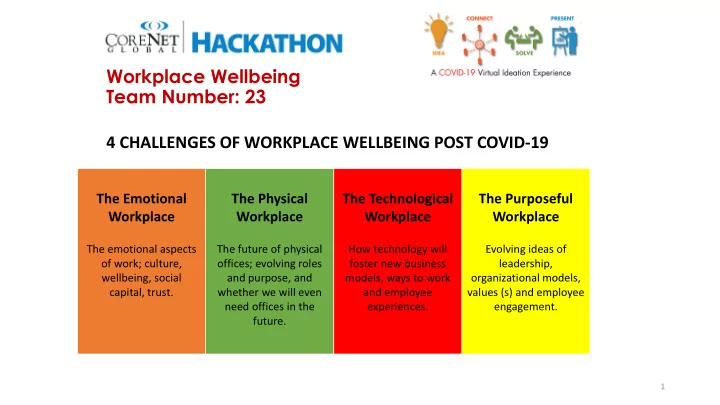
Workplace Wellbeing Team Number: 23 4 CHALLENGES OF WORKPLACE WELLBEING POST COVID-19 The Emotional The Physical The Technological The Purposeful Workplace Workplace Workplace Workplace The emotional aspects The future of physical How


slide-1
SLIDE 1

Workplace Wellbeing Team Number: 23

The Emotional Workplace

The emotional aspects

  • f work; culture,

wellbeing, social capital, trust.

The Physical Workplace

The future of physical

  • ffices; evolving roles

and purpose, and whether we will even need offices in the future.

The Technological Workplace

How technology will foster new business models, ways to work and employee experiences.

The Purposeful Workplace

Evolving ideas of leadership,

  • rganizational models,

values (s) and employee engagement.

4 CHALLENGES OF WORKPLACE WELLBEING POST COVID-19

1

slide-2
SLIDE 2

Workplace Wellbeing Team Number: 23

2

slide-3
SLIDE 3

Workplace Wellbeing Team Number: 23

3

slide-4
SLIDE 4

Workplace Wellbeing Team Number: 23

This example was provided by Agilquest. The grey workstations have been blocked out by management leaving the green workplaces available.

4

slide-5
SLIDE 5

Workplace Wellbeing Team Number: 23

Source: Bill Lennerz, Co-founder of the NCI Charrette System and Principal of CDI Collaborative Design + Innovation. The slide shows a Collaborative Employee Engagement process with rapid feedback loops.

5

slide-6
SLIDE 6

Workplace Wellbeing Team Number: 23

Guidance for Building Operations During the COVID-19 Pandemic By Lawrence J. Schoen, P.E., Fellow/Life Member ASHRAE

The HVAC systems in most non-medical buildings play only a small role in infectious disease transmission, including COVID-19.1 Knowledge is emerging about COVID-19, the virus that causes it (SARS-CoV-2), and how the disease spreads. Reasonable, but not certain, inferences about spread can be drawn from the SARS outbreak in 2003 (a virus genetically similar to SARS-CoV-2) and, to a lesser extent, from transmission of other viruses. Preliminary research has been recently released, due to the urgent need for information, but it is likely to take years to reach scientific consensus. Even in the face of incomplete knowledge, it is critically important for all of us, especially those of us in positions of authority and influence, to exercise our collective responsibility to communicate and reinforce how personal choices about social distancing and hygiene affect the spread of this disease and its impact not just on ourselves, but on our societal systems and economy. The consequences of

  • verwhelming the capacity of our health-care systems are enormous and potentially tragic. The sooner we “flatten the curve,”2 the sooner we can return to safer and normal economic and personal lives.

According to the WHO (World Health Organization), “The COVID-19 virus spreads primarily through droplets of saliva or discharge from the nose when an infected person coughs or sneezes….” Talking and breathing can also release droplets and particles.3 Droplets generally fall to the ground or other surfaces in about 1 m (3 ft), while particles (aka aerosols), behave more like a gas and can travel through the air for longer distances, where they can transmit to people and also settle on surfaces. The virus can be picked up by hands that touch contaminated surfaces (called fomite transmission) or be re-entrained into the air when disturbed on surfaces. SARS infected people over long distances in 2003,4 SARS-CoV-2 has been detected as an aerosol in hospitals,5 and there is evidence that at least some strains of it remain suspended and infectious for 3 hours,6 suggesting the possibility of aerosol transmission. However, other mechanisms of virus dissemination are likely to be more significant, namely,

  • direct person to person contact
  • indirect contact through inanimate objects like doorknobs
  • through the hands to mucous membranes such as those in the nose, mouth and eyes
  • droplets and possibly particles spread between people in close proximity

For this reason, basic principles of social distancing (1 to 2 m or 3 to 6.5 ft), surface cleaning and disinfection, handwashing and other strategies of good hygiene are far more important than anything related to the HVAC system.7 In the middle-Atlantic region of the United States where I work, malls, museums, theaters, gyms and other places where groups of people gather are closed and there are “stay at home”8 orders. This is a “game” of chance, and the fewer individuals who come in close contact with each other, the lower the probability for spread of the disease. Since symptoms do not become apparent for days or weeks, each of us must behave as though we are infected.

6
slide-7
SLIDE 7

Workplace Wellbeing Team Number: 23

Other public buildings, considered essential to varying degrees, remain open. These include food, hardware and drug stores, and of course, hospital and health-care facilities (which are beyond the scope of this article). Anecdotally, some universities are allowing some or all faculty, staff and graduate students to conduct essential research and online classes. Banks and other service organizations are open to staff and are receiving customers by appointment only, and private and government workplaces are open with work at home for some or all encouraged or mandated. For those buildings that remain open, in addition to the policies described above, non-HVAC actions include:

  • Increase disinfection of frequently touched surfaces.9
  • Install more hand sanitation dispensers, assuming they can be procured.
  • Supervise or shut down food preparation and warming areas, including the office pantry and coffee station.
  • Close or post warning signs at water fountains in favor of bottle filling stations and sinks, or even better, encourage employees to bring their water from home.

Once the basics above are covered, a few actions related to HVAC systems are suggested, in case some spread of the virus can be affected:

  • Increase outdoor air ventilation (use caution in highly polluted areas); with a lower population in the building, this increases the effective dilution ventilation per person.
  • Disable demand-controlled ventilation (DCV).
  • Further open minimum outdoor air dampers, as high as 100%, thus eliminating recirculation (in the mild weather season, this need not affect thermal comfort or humidity, but clearly becomes more difficult in

extreme weather).

  • Improve central10 air filtration to the MERV-1311 or the highest compatible with the filter rack, and seal edges of the filter12 to limit bypass.
  • Keep systems running longer hours, if possible 24/7, to enhance the two actions above.
  • Consider portable room air cleaners with HEPA filters.
  • Consider UVGI (ultraviolet germicidal irradiation), protecting occupants from radiation,13 particularly in high-risk spaces such as waiting rooms, prisons and shelters.

Construction sites present unique challenges. Much, but not all, construction work has the recommended social distancing; much, but not all, is outdoors or in partially enclosed and therefore well-ventilated buildings; and many, but not all, workers already use personal protective equipment such as masks14 and gloves. Governments in some locations have mandated closure of construction sites, while in others work proceeds.15 Engineers who perform field observations, commissioning or special inspections must consider what work can be postponed, performed remotely, or conducted using photographic documentation, and what personal precautions to take when site visitation is unavoidable. If you, the reader, are called upon to advise building operators, please use the above general guidance, and be sure to combine it with knowledge of the specific HVAC system type in a building and the purpose and use of the facility. Like all hazards, risk can be reduced but not eliminated, so be sure to communicate the limitations of the HVAC system and our current state of knowledge about the virus and its spread. We all have a role to play to control the spread of this disease. HVAC is part of it and even more significant are social distancing, hygiene and the influence we can have on personal behavior. From ASHRAE Journal Newsletter, March 24, 2020

7

slide-8
SLIDE 8

Workplace Wellbeing Team Number: 23

In new report, CIDRAP at the University of Minnesota outlines COVID-19 realities, advises on next steps

Seeing a need for recommendations to help navigate the COVID-19 pandemic based on current realities and restrictions — not on technology we hope to one day have — the Center for Infectious Disease Research and Policy (CIDRAP) at the University of Minnesota yesterday published the first report in a multipart series titled, "COVID-19: The CIDRAP Viewpoint." In the first report, "The future of the COVID-19 pandemic: lessons learned from pandemic influenza," noted CIDRAP Medical Director Kristine Moore, M.D., M.P.H., Harvard University epidemiologist Marc Lipsitch, D.Phil., and U.S. historian and 1918 pandemic influenza expert John Barry, M.A., join CIDRAP Director Michael Osterholm, Ph.D., M.P.H., to paint a picture of the pandemic and detail how it's behaving more like past influenza pandemics than like any coronavirus has to date. And, because of that, certain inferences can be drawn — such as the fact that it may well last 18 to 24 months, especially given that

  • nly 5% to 15% of the U.S. population is likely infected at this point.

8

slide-9
SLIDE 9

Workplace Wellbeing Team Number: 23

Key recommendations from the report:

  • States, territories, and tribal health authorities should plan for the worst-case scenario (which involves a large second peak of cases in the fall of 2020), including no vaccine availability or herd immunity.
  • Government agencies and healthcare delivery organizations should develop strategies to ensure adequate protection for healthcare workers when disease incidence surges.
  • Government officials should develop concrete plans, including triggers for reinstituting mitigation measures, for dealing with disease peaks when they occur.
  • Risk communication messaging from government officials should incorporate the concept that this pandemic will not be over soon and that people need to be prepared for possible periodic resurgences of

disease over the next two years. "We realize that other expert groups have produced detailed plans for reopening the country after stay-at-home orders and other important mitigations steps are eased," said Osterholm, University of Minnesota Regents Professor, McKnight Presidential Endowed Chair in Public Health. "So with this report we sought to add key information and address issues that haven't garnered the attention they deserve — not to duplicate efforts. And the steps we recommend are based on our current reality and the best available data. "For example, the first CIDRAP Viewpoint report lays out three scenarios for how cases might ebb and flow in the coming months. We are now on virus time, and no one knows exactly how this virus will

  • behave. But, based on what scientists have recorded so far and on previous influenza pandemics, we illustrate some of the possibilities.

"The goal is to help planners envision some of the situations that might present themselves later this year or next year so that they can take key steps now, while there's still time." Osterholm added, "The key message of this report is that the COVID-19 pandemic likely will not end any time soon, if any of the scenarios we have outlined come to pass. We need to be prepared to deal with this pandemic and its 'aftershocks' for 18 months or more. It’s also likely that the virus will remain with us once the pandemic is over—likely in a less severe form and following more of a seasonal pattern." Future reports in the "COVID-19: The CIDRAP Viewpoint" series will address crisis communication, testing, contact tracing, surveillance, supply chains, and epidemiology issues and key areas for research. COVID-19 is a respiratory illness that was first identified in Wuhan, China, in December 2019. Just this week, confirmed U.S. cases topped 1 million, and the global total has now topped 3.2 million confirmed infections, including more than 225,000 deaths. The Viewpoint reports are made possible with support from the University of Minnesota Office of the Vice President for Research and the Bentson Foundation.

9

slide-10
SLIDE 10

Workplace Wellbeing Team Number: 23

The following recommendations are being made by Ehvert Engineering for Renovations and New Construction to protect from the virus in the second and further waves:

  • Design for a pathogen-free workplace
  • Determine if displacement ventilation is possible and if so prepare both Displacement Ventilation and traditional ventilation plan
  • Collaborate with designers and prospective occupants to determine desired workplace layouts at the outset
  • Test droplet dispersion of sneezing and coughing via CFD and iterate to optimal designs of those desired workplace layouts via one
  • r two collaboration feedback loops
  • Design ventilation in zones consistent with desired workplace layouts ensuring 100% fresh air throughout at all times, with

economizers to conserve energy.

  • Look at possibilities of conditioning each occupant's own air if feasible
  • Optimize both interior people-facing surfaces as well as internal air flow surfaces with materials that deactivate viruses
  • Use HEPA filters to achieve pathogen-free design target perhaps in conjunction with copper or other deactivation material
  • Make sure control system for HVAC system is an open system, so that feedback loops from occupant sensors, reservation systems or

event detection cameras (sneezing and coughing) can be used to increase the air changes in compromised spaces

  • Recognize that the office workplace must be designed, engineered, built and commissioned as a Critical System which if it doesn't

work, can seriously damage the health of the occupants. Examine what changes may be required in the Design, Specification, Construction and Commissioning process to meet that obligation

DAY 2- STAYING AT WORK IN THE FUTURE -- HARDENING THE SITE

10