
SLIDE 1
OSH Brief No. 3c
Why is lighting in the workplace important?
From the workers’ perspective, poor lighting at work can lead to eye‐strain, fatigue, headaches, stress and
- accidents. On the other hand, too much light can also
cause safety and health problems such as “glare” headaches and stress. Both can lead to mistakes at work, poor quality and low productivity. Various studies suggest that good lighting at the workplace pays dividends in terms of improved productivity, and a reduction in errors. For example, in the ILO Manual, Improving Working Conditions and Productivity in the Garment Industry, it indicates that improved lighting in some factories resulted in a 10% increase in productivity and a 30% reduction in errors. Improvements in lighting do not necessarily mean that you need more lights and therefore use more electricity – it is often a case of:
- making better use of existing lights;
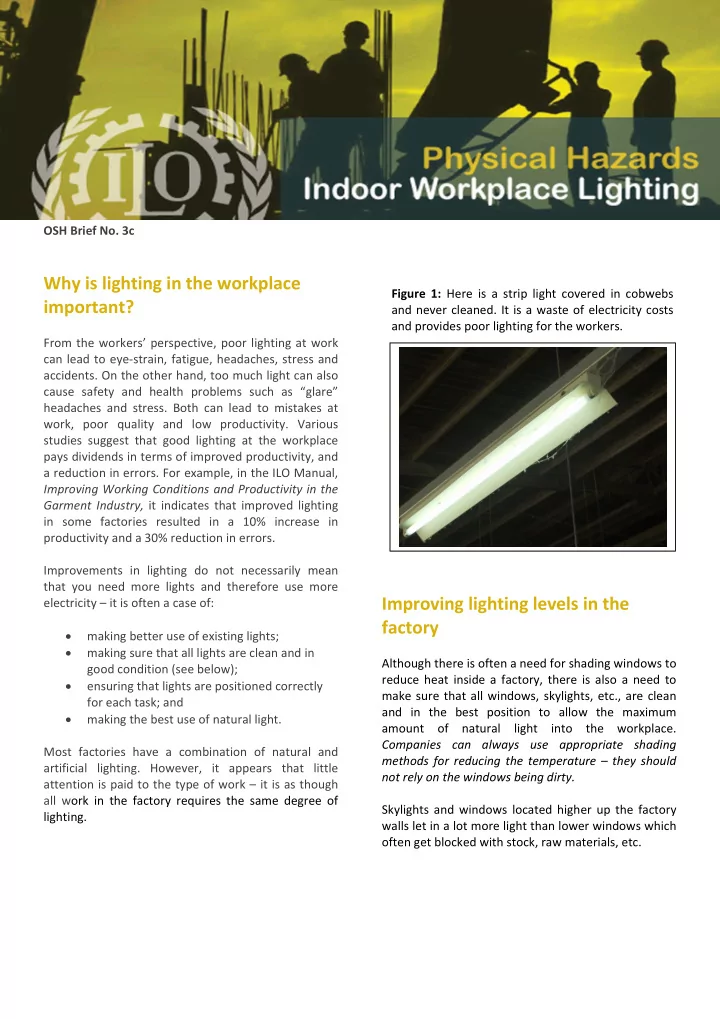
- making sure that all lights are clean and in
good condition (see below);
- ensuring that lights are positioned correctly
for each task; and
- making the best use of natural light.
Most factories have a combination of natural and artificial lighting. However, it appears that little attention is paid to the type of work – it is as though all work in the factory requires the same degree of lighting.
Improving lighting levels in the factory
Although there is often a need for shading windows to reduce heat inside a factory, there is also a need to make sure that all windows, skylights, etc., are clean and in the best position to allow the maximum amount of natural light into the workplace. Companies can always use appropriate shading methods for reducing the temperature – they should not rely on the windows being dirty. Skylights and windows located higher up the factory walls let in a lot more light than lower windows which
- ften get blocked with stock, raw materials, etc.