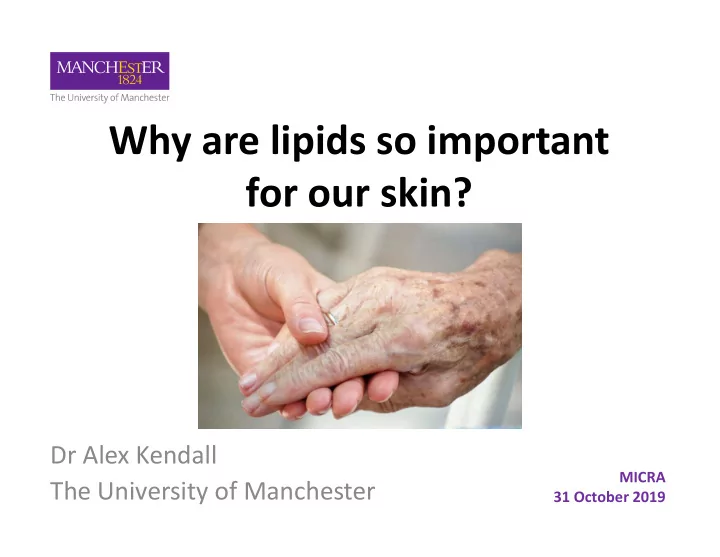
SLIDE 1 Why are lipids so important for our skin?
Dr Alex Kendall The University of Manchester
MICRA 31 October 2019
SLIDE 2 What is a lipid?
- Lipids are commonly called fats but they are
much more than that.
- A very diverse group of substances that have a
common property: they do not dissolve in water.
Steroid hormones Waxes Cholesterol Fats and
Vitamins
SLIDE 3 Essential oils Triglycerides Fish oils and fatty acids Omega-3 fatty acids Vitamin A
Lipids can be obtained through our diet…
SLIDE 4 Cholesterol Prostaglandins Vitamin D
…or made by our body
SLIDE 5 Lipids are important throughout our bodies
- Energy storage
- Cell membranes
- Cell signalling
- Inflammation
SLIDE 6
Lipids have crucial roles in skin
SLIDE 7
Skin surface lipids
SLIDE 8 Sebum lipids coat the skin
- Waxes, triglycerides, fatty acids
- Waterproof the skin and enable terrestrial
survival
- Maintain skin’s pH
- Regulate the microbiome
- Protect against UV
SLIDE 9
The skin barrier
SLIDE 10
Large, complex lipids form the skin’s cement
Ceramides, cholesterol, fatty acids
SLIDE 11 Ceramides
- Large, complex lipids
- Made in all cells
– Signalling roles
- Skin has special ceramides
– Form the barrier against water loss
products aim to increase ceramide levels
SLIDE 12
Inflammation
SLIDE 13 Small lipids regulate inflammation
- Fatty acids in your diet are incorporated into
your cells
- Cells can turn these fatty acids into an array of
small bioactive compounds
SLIDE 14 What we eat determines what lipids we make
- Polyunsaturated fatty acids
- Omega-6 and omega-3
Arachidonic acid – omega 6 Eicosapentaenoic acid – omega 3
SLIDE 15
Omega-6 fatty acid products
SLIDE 16
Omega-3 fatty acid products
SLIDE 17
Prostaglandins regulate skin inflammation
Arachidonic acid Prostaglandins Inflammation
SLIDE 18
Aspirin blocks prostaglandin production
Arachidonic acid Prostaglandins Inflammation
SLIDE 19
Fatty acids are then metabolised down different pathways
Arachidonic acid Prostaglandins Inflammation Other lipids Immune cell response
SLIDE 20
Prostaglandins from fish oil are anti-inflammatory
Eicosapentaenoic acid Prostaglandins Resolution of inflammation
SLIDE 21
- Our bodies produce natural
cannabis-like compounds
energy storage, stress, pain, sleep
skin inflammation
Anandamide
Endocannabinoids
SLIDE 22 Lipids also contribute to skin disease
Atopic dermatitis Psoriasis Irritant contact dermatitis Acne vulgaris Wound healing Sunburn Dandruff
SLIDE 23 How do we study this?
Tape strips Suction blister fluid Biopsies
SLIDE 24 Lipidomics
- Mass spectrometry
- Extract lipids from samples and identify and
quantify hundreds of species
- Allows comparison between health and
disease, changes over time, assessment of treatments
SLIDE 25
Our current project
SLIDE 26
Determining the critical relationship between human epidermal lipids and microbiota in sustaining healthy skin ageing
SLIDE 27 Skin changes as we age
– Decline in production, altered lipid profile
– Change in total number and types of bacteria present
– Thinning, loss of elasticity, more susceptible to damage
SLIDE 28
How are these changes linked?
We are trying to establish the relationship between epidermal lipids and the skin microbiome in healthy skin ageing
SLIDE 29 Project questions
- Q1: How do the lipid composition of the
epidermis and skin function change as we age?
- Q2: How does ageing affect the types and
numbers of microbiota at different body sites?
- Q3: What is the sequence of events mediating
the age-related changes?
SLIDE 30 Volunteers
- Aiming to recruit 120 volunteers by June 2020
- Healthy volunteers with no skin conditions
- 60 aged 18-40
– 30 male, 30 female
– 30 male, 30 female
SLIDE 31
Sampling sites
Forehead Armpit Buttock
Sebaceous (oily) Moist Dry, protected from UV damage
SLIDE 32
Samples and measurements
Tape strips Swabs Skin pH Skin water loss Biopsy
SLIDE 33 Interested in volunteering?
- Single visit to Salford Royal Hospital
- Complete a food diary for 3 days before visit
- Volunteers are reimbursed for inconvenience
- For further information and contact details
please come and talk to us! Thank you!