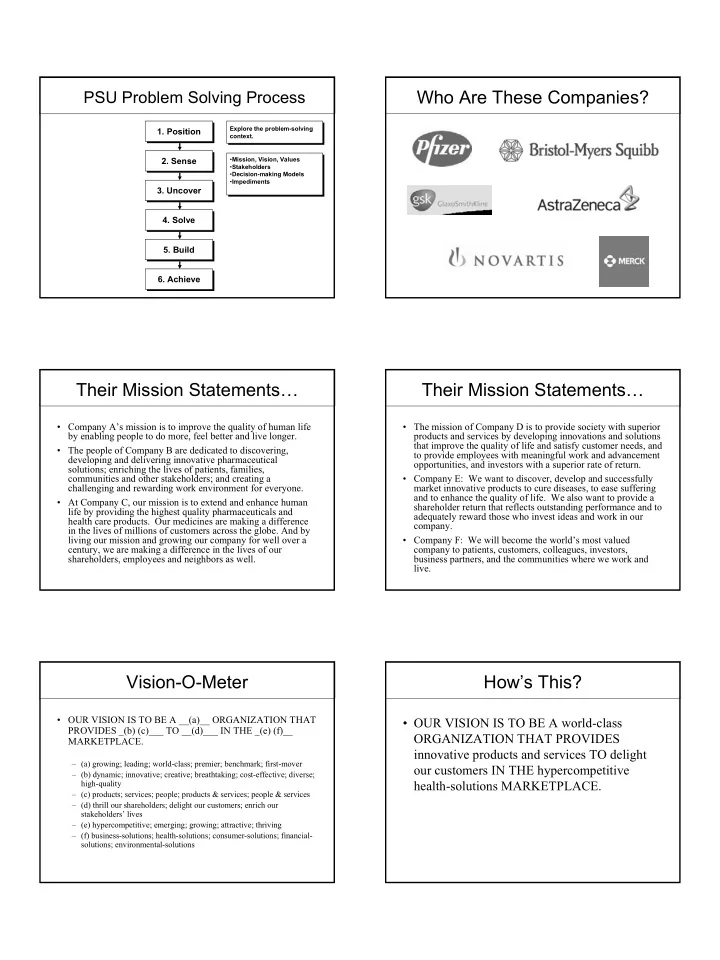
Who Are These Companies? PSU Problem Solving Process Explore the - - PDF document

who are these companies
SMART_READER_LITE
LIVE PREVIEW

Who Are These Companies? PSU Problem Solving Process Explore the - - PDF document

Who Are These Companies? PSU Problem Solving Process Explore the problem-solving 1. Position context. Mission, Vision, Values 2. Sense Stakeholders Decision-making Models Impediments 3. Uncover 4. Solve 5. Build 6. Achieve


slide-1
SLIDE 1
  • 1. Position
  • 6. Achieve
  • 3. Uncover
  • 5. Build
  • 2. Sense
  • 4. Solve

Explore the problem-solving context.

PSU Problem Solving Process

  • Mission, Vision, Values
  • Stakeholders
  • Decision-making Models
  • Impediments

Who Are These Companies? Their Mission Statements…

  • Company A’s mission is to improve the quality of human life

by enabling people to do more, feel better and live longer.

  • The people of Company B are dedicated to discovering,

developing and delivering innovative pharmaceutical solutions; enriching the lives of patients, families, communities and other stakeholders; and creating a challenging and rewarding work environment for everyone.

  • At Company C, our mission is to extend and enhance human

life by providing the highest quality pharmaceuticals and health care products. Our medicines are making a difference in the lives of millions of customers across the globe. And by living our mission and growing our company for well over a century, we are making a difference in the lives of our shareholders, employees and neighbors as well.

Their Mission Statements…

  • The mission of Company D is to provide society with superior

products and services by developing innovations and solutions that improve the quality of life and satisfy customer needs, and to provide employees with meaningful work and advancement

  • pportunities, and investors with a superior rate of return.
  • Company E: We want to discover, develop and successfully

market innovative products to cure diseases, to ease suffering and to enhance the quality of life. We also want to provide a shareholder return that reflects outstanding performance and to adequately reward those who invest ideas and work in our company.

  • Company F: We will become the world’s most valued

company to patients, customers, colleagues, investors, business partners, and the communities where we work and live.

Vision-O-Meter

  • OUR VISION IS TO BE A __(a)__ ORGANIZATION THAT

PROVIDES _(b) (c)___ TO __(d)___ IN THE _(e) (f)__ MARKETPLACE.

– (a) growing; leading; world-class; premier; benchmark; first-mover – (b) dynamic; innovative; creative; breathtaking; cost-effective; diverse; high-quality – (c) products; services; people; products & services; people & services – (d) thrill our shareholders; delight our customers; enrich our stakeholders’ lives – (e) hypercompetitive; emerging; growing; attractive; thriving – (f) business-solutions; health-solutions; consumer-solutions; financial- solutions; environmental-solutions

How’s This?

  • OUR VISION IS TO BE A world-class

ORGANIZATION THAT PROVIDES innovative products and services TO delight

  • ur customers IN THE hypercompetitive

health-solutions MARKETPLACE.

slide-2
SLIDE 2

Strategic Leadership

Architecture for alignment and implementation Strategy Mission Vision

Definitions

  • Vision statements:

– A simple statement or understanding of what the firm will be in the future. – An attractive, ideal future that is credible yet not readily available.

  • Mission Statements (business purpose):

– The organization’s core broad purpose and reason for existence – What a firm is and what it stands for – fundamentals values and purpose

Common Themes Of Vision

  • Vision has broad appeal
  • Vision deals with change
  • Vision encourages faith and hope
  • Vision reflects high ideals
  • Vision defines the destination and the

journey

Judging Vision Statements

  • What makes a good statement?

– graphic – paints a picture – directional – focused, flexible, feasible – desirable – easy to communicate

  • What makes bad statement?

– vague or incomplete – bland or unmotivating – not distinctive – too many superlatives – too generic or broad

How Do These Measure Up?

Be the world’s beer company. Through all of

  • ur products, services and relationships, we

will add to life’s enjoyment.

How Do These Measure Up?

To be the company that best understands and satisfies the product, service and self- fulfillment needs of women - globally.

slide-3
SLIDE 3

How Do These Measure Up?

Helping people around the world eat and live better.

How Do These Measure Up?

Provide a global trading platform where practically anyone can trade practically anything.

Mission Versus Vision

  • Vision is…

– “where we are going and why”

  • Mission is…

– “who we are, what we do, and why we are here”

  • Mission is…

– …defined by the buyer needs it seeks to satisfy, the customer groups and market segments it is endeavoring to serve, and the resources and technologies it is deploying in trying to please its customers.

Trader Joe’s

At Trader Joe's, our mission is to bring our customers the best food and beverage values and the information to make informed buying decisions. There are more than 2000 unique grocery items in our label, all at honest everyday low prices. We work hard at buying things right: Our buyers travel the world searching for new items and we work with a variety of suppliers who make interesting products for us, many of them exclusive to Trader Joe’s. All our private label products have their own "angle," i.e., vegetarian, Kosher, organic or just plain decadent, and all have minimally processed ingredients.

Mission or Vision? The Essence Of Vision

  • Vision can often be captured in a slogan:

– “We will clothe the world by marketing the most appealing and widely worn casual clothing in the world.”

  • Levi Strauss & Company

– “To make London the safest major city in the world.”

  • Scotland Yard

– “To halt environmental abuse and promote environmental solutions.”

  • Greenpeace
slide-4
SLIDE 4

The Real World

  • Do you really need both a mission statement and a

vision statement?

– You’ll be lucky to find one of them, and many companies combine them.

  • Who really cares about this?

– Customers? Employees? Shareholders?

  • Where do values fit in? What are values?

– Beliefs and ideology that guide business activities. – Principles, standards and qualities.

Core Business Values

  • 3M

– sponsoring innovation – protecting the creative individual – solving problems in a way that makes people's lives better

  • WalMart – the three beliefs

– respect the individual – service to our customers – strive for excellence

Context and Problem-Solving

  • Mission, Vision and

Values should inform good problem solving and decision making.

– eVineyard.com – Alternatives? – Decision?

PSU Mission Ben & Jerry’s

BA 301, Nobles, Fall 2008

Group Activity 1.1

  • Read and complete Activity 1.1
  • Review and discuss the PSU and Ben & Jerry’s statements as a

group

  • Develop and write down a group consensus as to their quality.
  • Do you think they accurately reflect the two organizations?
  • For PSU – does it matter to you? Why or why not?
  • Think of a recent PSU decision – is it consistent with the

mission/vision? Why or why not?

  • Write a mission statement for your BA 301 group.
slide-5
SLIDE 5

BA 301, Nobles, Fall 2008

  • 1. Position
  • 6. Achieve
  • 3. Uncover
  • 5. Build
  • 2. Sense
  • 4. Solve

Explore the problem-solving context.

PSU Problem Solving Process

  • Mission, Vision, Values
  • Stakeholders
  • Decision-making Models
  • Impediments

BA 301, Nobles, Fall 2008

Who Are You Responsible To?

  • According to Milton Friedman – owners and

shareholders - STAKEHOLDERS

  • Emphasis on sustainable development and

social responsibility has expanded the range of corporate stakeholders

– CSR (Corporate Social Responsibility)

  • Today’s manager must have a broader

perspective on his/her constituency

BA 301, Nobles, Fall 2008

What Has Driven This Change?

Business allegations…

  • Little concern for the consumer
  • Cares nothing about the deteriorating social order
  • Has no concept of acceptable ethical behavior
  • Indifferent to the problems of minorities and the

environment

What responsibility does business have to society?

BA 301, Nobles, Fall 2008

Corporate Social Responsibility

"Corporate Social Responsibility is the continuing commitment by business to behave ethically and contribute to economic development while improving the quality of life of the workforce and their families as well as of the local community and society at large." World Business Council for Sustainable Development "A concept whereby companies integrate social and environmental concerns in their business operations and in their interaction with their stakeholders on a voluntary basis." European Commission “Managements’ obligation to make choices and take actions that will contribute to the welfare and interests of society as well as the

  • rganization.”

BA 301, Nobles, Fall 2008

There Have Been Practical Results

  • From the 1950’s to the present, the concept of

CSR has gained considerable acceptance and the meaning has been broadened to include specific issues, such as:

– product safety – honesty in advertising – employee rights – affirmative action – environmental sustainability – ethical behavior

BA 301, Nobles, Fall 2008

A Range of Responsibilities

  • The social responsibility of business

encompasses the economic, legal, ethical and discretionary (philanthropic) expectations that society has of organizations at a given point in

  • time. (Archie Carroll)
slide-6
SLIDE 6

BA 301, Nobles, Fall 2008

A Four-Part Definition of CSR

Understanding the Four Components

Responsibility Societal Expectation Examples Economic Required Be profitable. Maximize sales, minimize costs Legal Required Obey laws and regulations Ethical Expected Do what is right, fair, and just Philanthropic Desired/ Expected Be a good corporate citizen

BA 301, Nobles, Fall 2008

The Pyramid of CSR

Philanthropic Responsibilities Be a good corporate citizen. Ethical Responsibilities Be ethical. Legal Responsibilities Obey the law. Economic Responsibilities Be profitable.

BA 301, Nobles, Fall 2008

The CSR Equation

Economic Responsibilities Legal Responsibilities Ethical Responsibilities Philanthropic Responsibilities

+ + + = Total Corporate CSR

BA 301, Nobles, Fall 2008

CSR, Stakeholders and Problem-Solving

  • Again, what does this have to do with

problem-solving?

– CSR has broadened the list of relevant stakeholders. – The needs and objectives of these stakeholders must be considered as context for decision-making and problem-solving. – Your task (specifically in the research paper) is to define and prioritize these stakeholders.

BA 301, Nobles, Fall 2008

Who Are Business Stakeholders?

Primary Stakeholders

Have a direct stake in the

  • rganization and its success

Secondary Stakeholders

Have a public or special interest stake in the

  • rganization

BA 301, Nobles, Fall 2008

Business Stakeholders - Broad

slide-7
SLIDE 7

BA 301, Nobles, Fall 2008

1. Who are our stakeholders? 2. What are our stakeholders’ stakes? 3. What opportunities and challenges do our stakeholders present to the firm? 4. What economic, legal, ethical, and philanthropic responsibilities does the firm have to stakeholders? 5. What strategies or actions should our firm take to best address stakeholder challenges and

  • pportunities?

Key Questions In Stakeholder Management

BA 301, Nobles, Fall 2008

A Multiple Bottom-Line Perspective

Consumer Stakeholders’ “Bottom Line” Employee Stakeholders’ “Bottom Line” Community Stakeholders’ “Bottom Line” Owner Stakeholders’ “Bottom Line” Other Stakeholders’ “Bottom Line”

Corporate Social Performance

BA 301, Nobles, Fall 2008

So What?

  • Think about CSR and multiple stakeholders for

your term paper project.

– Problems and their solutions typically involve a broad set of stakeholders – You have to think about the multiple bottom line.

  • Economic performance
  • Social performance
  • Environmental performance

BA 301, Nobles, Fall 2008

Activity 1.2

  • Objective – understand how changing missions and

stakeholders can affect decisions

  • Three different registration options for college

– Online – Semester abroad – Traditional

  • Read Mission A – choose an option and discuss how

and why the mission and stakeholders affects the choice.

  • Do the same for Mission B
  • Takes notes and don’t forget to discuss the exercise

and decisions for the scribe report

Summer 2010 Group Topics

  • PSU Administration - Problem Topics

– Continuing cuts in state funding (11,4) – Lower than desired ongoing alumni support (9,10) – Dissatisfied students/morale/complaints (8,5) – Low national brand recognition (6,1,2) – Difficulties in attracting high quality tenure track faculty (3,7)

Summer 2010 Group Topics

  • PSU Administration - Problem Topics

– Continuing cuts in state funding (8,6) – Lower than desired ongoing alumni support (10,1) – Dissatisfied students/morale/complaints (5,2) – Low national brand recognition (3,4) – Difficulties in attracting high quality tenure track faculty (9,7)

slide-8
SLIDE 8

BA 301, Nobles, Fall 2008

  • 1. Position
  • 6. Achieve
  • 3. Uncover
  • 5. Build
  • 2. Sense
  • 4. Solve

Explore the problem-solving context.

PSU Problem Solving Process

  • Mission, Vision, Values
  • Stakeholders
  • Decision-making Models
  • Impediments

BA 301, Nobles, Fall 2008

Understanding Decision Making

BA 301, Nobles, Fall 2008

What Affects Decision Making?

  • The personality/style of the decision maker
  • Complexity or urgency
  • The scale, scope or potential impact
  • Type – strategic or tactical
  • Accepted decision models
  • Personal or organizational bias

BA 301, Nobles, Fall 2008

Decision-Making Styles

  • Rational thinking

– Using knowledge, skills and experience – Applying logic to reach conclusions – Analyzing issues to understand the whole picture

  • Intuitive thinking

– Conclusions by hunch – Being led by emotion and sensitivity – Using imagination to create new ideas

BA 301, Nobles, Fall 2008

Rational or Intuitive

  • Gene Hackman was?
  • Denzel was?

BA 301, Nobles, Fall 2008

slide-9
SLIDE 9

BA 301, Nobles, Fall 2008

Sometimes, Just Trust Your Instincts

BA 301, Nobles, Fall 2008

Types Of Decisions

  • Programmed

– Things that have occurred often enough such that you can have rules and guidelines. – Examples?

  • Non-programmed

– Situations that are unique, poorly defined, unstructured, have important consequences, or all

  • f the above.

– Examples?

BA 301, Nobles, Fall 2008

Decision-Making Models

  • There are a number of accepted models for
  • rganizational decision-making:

The Classical Model (rational) The Administrative Model The Political Model

  • Why does it help to understand these models?
  • It helps to understand organizational tendencies when

faced with decision-making in the context of problem- solving.

  • For example, if you assume a rational model when the

political model is more prevalent, you may encounter roadblocks and difficulties.

BA 301, Nobles, Fall 2008

Decision-Making Models

  • Clear-cut problems and

goals

  • Condition of certainty
  • Full information about

alternatives and outcomes

  • Rational choice by

individual for maximizing

  • utcomes
  • Vague problems and

goals

  • Condition of uncertainty
  • Limited information

about alternatives and

  • utcomes
  • Satisficing choice for

resolving problem using intuition

  • Pluralistic; conflicting

goals

  • Condition of

uncertainty & ambiguity

  • Inconsistent

viewpoints; ambiguous information

  • Bargaining and

discussion among coalition members

Classical Administrative Political

BA 301, Nobles, Fall 2008

Sometimes…

  • Decision opportunities are like garbage cans:

– Problems and solutions are dropped into the “can” independent of one another – Problems, solutions and decision-makers are not necessarily related to one another – Often it seems as if the solutions, the time needed, and the problems rely on chance alignments for completion.

  • The real-world is often not rational, and

decisions are made “seat of the pants.

BA 301, Nobles, Fall 2008

slide-10
SLIDE 10

BA 301, Nobles, Fall 2008

  • 1. Position
  • 6. Achieve
  • 3. Uncover
  • 5. Build
  • 2. Sense
  • 4. Solve

Explore the problem-solving context.

PSU Problem Solving Process

  • Mission, Vision, Values
  • Stakeholders
  • Decision-making Models
  • Impediments

BA 301, Nobles, Fall 2008

Smart People Can Make Bad Decisions

  • Intuition, gut feel, experience, instinct – good
  • r bad?

– Patterns, rules of thumb, prioritization – Quicker problem solving & decision-making – Good in automatic processes

  • But, it can often lead to the wrong solution

– Cognitive bias can lead to inaccurate and irrational decisions – judgment error

BA 301, Nobles, Fall 2008

Cognitive Bias

  • Cognition is the process of thought.

– To become acquainted with…

  • Cognitive Bias is our tendency to make errors

in judgment based on cognitive factors – things we know or understand, or think we know or understand.

  • Cognitive Bias might distort the way we

perceive reality.

BA 301, Nobles, Fall 2008

What Can We Do To Avoid It?

  • Recognize how easy it is to make simple

mistakes by using intuition alone.

  • Learn to spot the most common decision-

making biases.

  • Learn simple methods for combating these

biases in judgment.

BA 301, Nobles, Fall 2008

Judgment Error #1

  • Rank order the following causes of death in the United States

between 1990 and 2000, placing a 1 next to the most common, etc.

– Tobacco – Poor diet and physical inactivity – Motor vehicle accidents – Firearms (guns) – Illicit drug use

  • Now, estimate the number of deaths caused by each of these

during that timeframe.

  • Availability Bias (a cognitive bias)

– Things that are more “available” to us, are likely to be interpreted as more frequent or important. – Managers doing performance appraisals often fall victim to this bias.

BA 301, Nobles, Fall 2008

Judgment Error #2

  • Mark is finishing his MBA at a prestigious university.

He is very interested in the arts and at one time considered a career as a musician. Where is he more likely to take a job?

– In arts management? – With a consulting firm?

  • Representativeness Bias

– Many people overlook the “base-rate” data when making these types of judgments.

  • Prospective entrepreneurs spend too much time

imagining their success and far too little time considering the base rate for business failures.

slide-11
SLIDE 11

BA 301, Nobles, Fall 2008

Judgment Error #3

  • Think about the last four digits of your social security

number.

– How many doctors are there in New York? – Research shows that there is typically a 0.4 correlation between your answer and the SSN number.

  • This is an anchoring bias – the brain is “anchored” to

a number or idea.

– Think about how this affects negotiation… – Who threw out the first number? – What about salary negotiations?

BA 301, Nobles, Fall 2008

Judgment Error #4

  • Look at this series of numbers. It conforms to

a rule. What is the rule? Propose a new set of numbers.

– 2, 4, 6

  • The rule – three ascending numbers.

– Confirmation bias – a tendency to collect confirming rather than disconfirming information.

  • Thing about buying a new car, hiring a new

employee, starting research on a new product line?

BA 301, Nobles, Fall 2008

Judgment Error #5

  • Consider these facts:

– 80 percent of students believed they were in the top 30 percent of safe drivers. – A survey asked 829,000 high school students to rate their

  • wn ability to “get along with others,” and less than 1

percent rated themselves as below average. Further, 60 percent rated themselves in the top 10 percent, and 25 percent rated themselves in the 1 percent.

  • This is Overconfidence bias – most of us are
  • verconfident in our estimation abilities, and do not

acknowledge our true uncertainty.

BA 301, Nobles, Fall 2008

Judgment Error #6

  • Consider the following:

– What is the probability of tossing a “tail”?

  • 0.5

– What is the probability of HHHHH?

  • 0.5x0.5x0.5x0.5x0.5

– After four heads in a row, what is the probability

  • f a fifth head?
  • 0.5 (counterintuitive to many people)

– Probability bias – intuition overcomes rationality

BA 301, Nobles, Fall 2008

Avoiding Bias

  • 1. Do not jump to conclusions.
  • 2. Do not assume a relationship is a cause;

record and test your decision outcomes.

  • 3. Do not base your conclusion only on your

experience.

  • 4. Do not just look to support your case; look

for non-supporting evidence too.

  • 5. Do not fall prey to overconfidence; get

confidence evidence and ranges.

BA 301, Nobles, Fall 2008

http://en.wikipedia.org/wiki/List_of_cognitive_biases

  • anchoring - the tendency to rely too heavily, or "anchor," on one trait or piece of information when making decisions.
  • bandwagon effect - the tendency to do (or believe) things because many other people do (or believe) the same.
  • belief bias - the tendency to base assessments on personal beliefs (see also belief perseverance and Experimenter's regress)
  • bias blind spot - the tendency not to compensate for one's own cognitive biases.
  • confirmation bias - the tendency to search for or interpret information in a way that confirms one's preconceptions.
  • contrast effect - the enhancement or diminishment of a weight or other measurement when compared with recently observed

contrasting object.

  • disconfirmation bias - the tendency for people to extend critical scrutiny to information which contradicts their prior beliefs

and accept uncritically information that is congruent with their prior beliefs.

  • endowment effect - the tendency for people to value something more as soon as they own it.
  • hyperbolic discounting - the tendency for people to have a stronger preference for more immediate payoffs relative to later

payoffs, the closer to the present both payoffs are.

  • illusion of control - the tendency for human beings to believe they can control or at least influence outcomes which they

clearly cannot.

  • impact bias - the tendency for people to overestimate the length or the intensity of the impact of future feeling states.
  • just-world phenomenon - the tendency for people to believe the world is "just" and so therefore people "get what they

deserve."

  • loss aversion - the tendency for people to strongly prefer avoiding losses than acquiring gains (see also sunk cost effects)
  • mere exposure effect - the tendency to express undue liking for things merely because they are familiar with them.
  • color psychology - the tendency for cultural symbolism of certain colors to affect affective reasoning.
  • planning fallacy - the tendency to underestimate task-completion times.
  • pseudocertainty effect - the tendency to make risk-averse choices if the expected outcome is positive, but risk-seeking

choices to avoid negative outcomes.

  • rosy retrospection - the tendency to rate past events more positively than they had actually rated them when the event
  • ccurred.
  • selective perception - the tendency for expectations to affect perception.
  • status quo bias - the tendency for people to like things to stay relatively the same.
  • Von Restorff effect - the tendency for an item that "stands out like a sore thumb" to be more likely to be remembered than
  • ther items.
slide-12
SLIDE 12

BA 301, Nobles, Fall 2008

Group Activity Notes

  • Get together in your groups and discuss personal

experiences with organizational decision models and cognitive bias.

– In your own work environment, is there an obvious decision-making model in place? Does it change depending on the situation? Provide examples. – Discuss and reflect on personal examples of cognitive bias. – Discuss the Cognitive Bias quiz. Were you surprised by the results, and why or why not?

BA 301, Nobles, Fall 2008

  • 1. Position
  • 6. Achieve
  • 3. Uncover
  • 5. Build
  • 2. Sense
  • 4. Solve

Explore the problem-solving context.

PSU Problem Solving Process

  • Mission, Vision, Values
  • Stakeholders
  • Decision-making Models
  • Impediments

BA 301, Nobles, Fall 2008

PSU Student Problems

  • Parking
  • Crowded classrooms
  • What to do post graduation
  • Tuition/Books/$$
  • Housing – lack of - cost
  • Transportation to and from
  • Food – cost/variety
  • University Studies
  • Time management
  • Poor/unqualified professors
  • Classroom facilities/poor quality/not enough
  • Group projects
  • Scheduling conflicts/registration process
  • Financial aid
  • Computer access
  • Too much alcohol
  • Weather
  • Fluorescent lighting
  • Pigeons in the park blocks