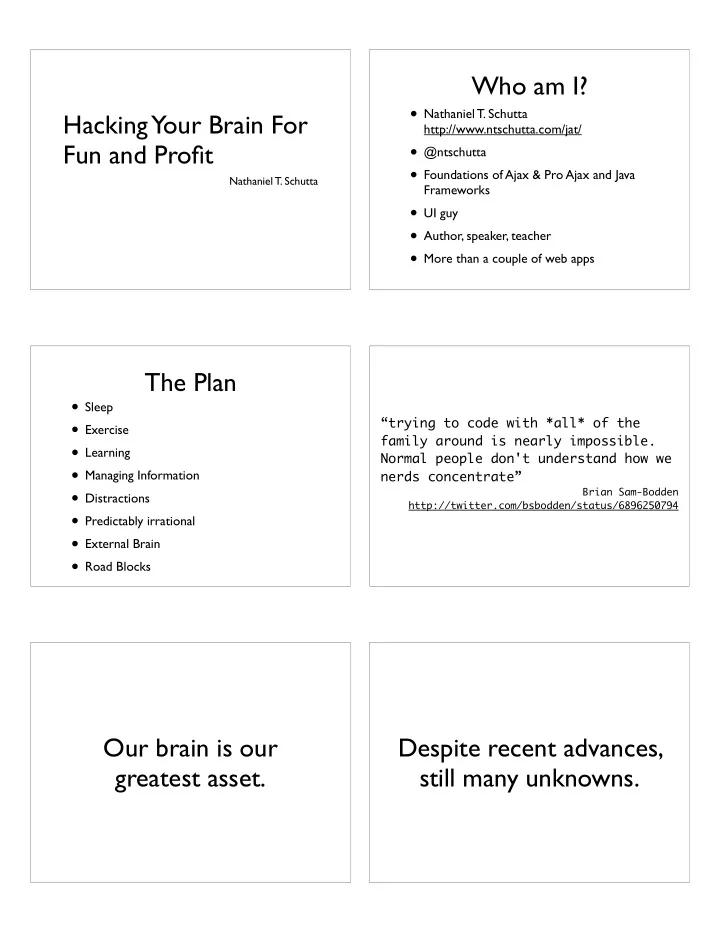
SLIDE 1 Hacking Your Brain For Fun and Profit
Nathaniel T. Schutta
Who am I?
http://www.ntschutta.com/jat/
- @ntschutta
- Foundations of Ajax & Pro Ajax and Java
Frameworks
- UI guy
- Author, speaker, teacher
- More than a couple of web apps
The Plan
- Sleep
- Exercise
- Learning
- Managing Information
- Distractions
- Predictably irrational
- External Brain
- Road Blocks
“trying to code with *all* of the family around is nearly impossible. Normal people don't understand how we nerds concentrate”
Brian Sam-Bodden http://twitter.com/bsbodden/status/6896250794
Our brain is our greatest asset. Despite recent advances, still many unknowns.
SLIDE 2
Learn more daily. Listener brain patterns mirror those of speaker.
http://www.scientificamerican.com/blog/post.cfm? id=of-two-minds-listener-brain-pattern-2010-07-27
Words are powerful.
http://www.wnyc.org/shows/radiolab/episodes/2010/09/10
Often via freak accidents. Croatian teenager...
http://bit.ly/9t7JW9
Neural decoding?
http://www.newscientist.com/article/mg20427323.500- brain-scanners-can-tell-what-youre-thinking-about.html
SLIDE 3 Simple steps, big payback.
“programming is much easier after a night's sleep, especially if you were doing something incredibly stupid the night before”
Kent Beck
https://twitter.com/kentbeck/status/9345238812
70% < 8 hours, 40% < 7 hours. Sleep matters. We’re not sure why we sleep.
SLIDE 4
Quite vulnerable... Not about “rest.” Brain is incredibly active. Key to learning. Aids memory formation.
http://www.sciencedaily.com/releases/ 2009/09/090915174506.htm
SLIDE 5
Transfer of information. Use it to solve problems. Lack of sleep hurts performance. Naps improve it.
http://dilbert.com/fast/2009-05-26/
SLIDE 6
Think no one naps? 35% of men 18-49 take daily naps. 26 minutes = 34% improvement. At 3 p.m., brain really wants to nap. Bad time for meetings. Part of some cultures.
SLIDE 7
Sleep deprivation severely affects the brain. Effects felt within 24 hours. Blood pressure rises. Trouble metabolizing glucose. Immune system suppressed. Body temp drops.
SLIDE 8
1959, Peter Tripp - stayed awake for 8 days.
http://www.youtube.com/watch? v=mXrANL9aqz8&feature=related
To raise money for charity. Hallucinations, paranoia. Randy Gardner stayed up. For 11 days. For the science fair...
SLIDE 9
After 5 days, mimicked Alzheimer's. Hallucinations, paranoia. Interrogation technique. Skip a night? 30% loss in cognitive skill. Contributes to obesity.
SLIDE 10 Feel hungrier. Leptin goes down, ghrelin goes up. Sparks cravings, longer to feel full. Consistently getting
Like skipping 2 nights. Worse, people didn’t realize they were impaired.
http://www.spokane.wsu.edu/ResearchOutreach/ Sleep/documents/2003SLP-VanDongen-etal.pdf
SLIDE 11 Some people need less... Insomniac gene?
http://www.sciencedaily.com/releases/ 2009/09/090916153136.htm
Sleep deprivation is
http://www.flickr.com/photos/kevcole/2327954530/ kevincole http://www.flickr.com/photos/steve_brace/217149481/ Stevie-B
1/10 are early chronotype.
SLIDE 12
2/10 are late chronotype. When are you at your best? Does that work in your office? We evolved by walking. A lot.
SLIDE 13
Up to 12 miles a day. Any of you walk 12 miles a day? Brain loves glucose. 2% of mass, 20% of energy. Generates a lot of waste. Exercise improves blood flow.
SLIDE 14 “Paves new highways.” Flushes free radicals. Stimulates Brain Derived Neurotrophic Factor. Improves brain function. Exercisers significantly
Leads to bigger brains.
SLIDE 15
At least in seniors ;)
http://www.futurity.org/top-stories/ exercise-leads-to-bigger-brain-in-seniors/
Moderate exercise led to substantial improvements. How do we get more exercise? Walking desks. Besides, chairs kill.
http://news.yahoo.com/s/bw/1019b4177071221162
SLIDE 16
Walking conference rooms! Walking meetings. Boeing. Mayo clinic: “office of the future.” Learning. Change is constant.
SLIDE 17
Must be able to learn. How do we do that? Cramming doesn’t work. Elaborate, meaningful, context. Stories, examples. Repeat to remember.
SLIDE 18
Spaced repetition. Spaced Education.
http://harvardmagazine.com/2009/11/ spaced-education-boosts-learning
Increases knowledge and retention. SpacedEd.
http://www.spaceded.com/
Questions repeat. Timing is key.
SLIDE 19
We forget. Actually good that we do. Information decay is predictable. Not the same for everyone. Or every fact. Computers can help.
SLIDE 20
Piotr Wozniak.
http://www.wired.com/medtech/health/ magazine/16-05/ff_wozniak
SuperMemo.
http://www.supermemo.com/
There is an open source alternative. Mnemosyne.
http://www.mnemosyne-proj.org/
Learning with lists.
http://lifehacker.com/5192079/ smartfm-boosts-learning-with-lists
smart.fm
https://smart.fm/login
SLIDE 21 Skills acquisition. Shu Ha Ri.
http://www.aikidofaq.com/essays/tin/shuhari.html
“Learn the principle, abide by the principle, and dissolve the principle.”
Bruce Lee
Understanding evolves. William Schutz. Simplistic, complex, profoundly simple.
SLIDE 22
Looks easy at first... Lots of confusion! Quest continues. Dreyfus model. 5 stages. Novice - recipes.
SLIDE 23
Advanced beginner - moves beyond rules. Competent - can troubleshoot. Proficient - self correct. Expert - intuition. Rules are key for beginners. Rules *kill* experts.
SLIDE 24 Expert = 10 years? Most folks are advanced beginners. Dunning-Kruger effect.
http://en.wikipedia.org/wiki/Dunning-Kruger_effect
Cognitive bias. Lake Wobegon. Incompetent people
SLIDE 25
Competent people underestimate. Confidence trumps expertise...
http://www.newscientist.com/article/mg20227115.500- humans-prefer-cockiness-to-expertise.html
Hmmmm... Managing information. Infotention.
http://www.sfgate.com/cgi-bin/blogs/ rheingold/detail?blogid=108&entry_id=46677
SLIDE 26 There’s a lot of bits out there. New languages, technologies, approaches. Books, articles, blogs, podcasts, Twitter...
http://www.flickr.com/photos/paulsynnott/2874663697/ gwaar
How do you keep up? Attention is precious.
SLIDE 27 http://sethgodin.typepad.com/seths_blog/2011/07/ paying-attention-to-the-attention-economy.html
“Attention is a bit like real estate, in that they're not making any more of it. Unlike real estate, though, it keeps going up in value.”
— Seth Godin
Don’t waste it. Be selective. Can’t read it all. In fact, you’ll miss almost everything.
http://www.npr.org/blogs/monkeysee/2011/04/21/135508305/the- sad-beautiful-fact-that-were-all-going-to-miss-almost-everything
Cull or surrender.
SLIDE 28
Consider an information diet. Pick the areas you care about. Go deep on that. Skim the rest. “Selective Ignorance.” Use your friends ;)
SLIDE 29
Prune aggressively. If you’re not reading it, delete it. If they’re not updating... A/B stream.
SLIDE 30
Take advantage of dead space. Bring articles to meetings. Read while waiting. Listen on the way to work. Or while you workout! Books on “CD.”
SLIDE 31 Turn off the TV? Average American - 151 hours of TV a month.
http://blog.nielsen.com/nielsenwire/online_mobile/tv- internet-and-mobile-usage-in-us-continues-to-rise/
Two hundred billion hours annually (U.S.) 2,000 Wikipedias a year. 100 million hours a weekend watching ads. That’s a Wikipedia a
http://www.shirky.com/herecomeseverybody/ 2008/04/looking-for-the-mouse.html
SLIDE 32
It isn’t just TV though. 200 million minutes...
http://www.wired.co.uk/magazine/archive/2011/04/ features/how-rovio-made-angry-birds-a-winner?page=all
A DAY! 16 years...every hour. That’s a lot of surplus.
SLIDE 33
Does the Internet Make You Smarter?
http://online.wsj.com/article/ SB10001424052748704025304575284973472694334.html
Socrates feared the invention of writing...
http://classics.mit.edu/Plato/phaedrus.html
Imagine what even a small change might mean. Distractions. We can’t multitask.
SLIDE 34
Our kids...maybe.
http://www.nytimes.com/2010/01/10/ weekinreview/10stone.html
16 to 18 - 7 tasks early 20s - 6 tasks 30s - 5.5 tasks Doesn’t work. Well, if it involves thought at least.
SLIDE 35
Driving and cell phones? Texting = 23x crash risk.
http://www.nytimes.com/2009/07/28/ technology/28texting.html
Driving and distractions.
http://www.nytimes.com/2009/07/19/ technology/19distracted.html
Sure, you can walk and chew gum... but probably can’t text and walk...
http://www.nytimes.com/2010/01/17/ technology/17distracted.html?hp
IM, email, phone call, music, work?
SLIDE 36
Variable reinforcement!
http://www.codinghorror.com/blog/archives/001302.html
Linda Stone. Continuous partial attention.
http://continuouspartialattention.jot.com/WikiHome
Interruptions kill flow. 15 minutes to reload.
SLIDE 37
Think about debugging. You’ve created a model in your head. And I stop by to ask about the game. Sorry about that.
SLIDE 38
In context vs. out. Project rooms work. Its all in context. Easy to tune out. Adjacent possible. Turn off interruptions.
SLIDE 39 Email, IM, etc. Freedom.
http://macfreedom.com/
Stay on target!
http://www.economist.com/node/16295664
Run apps full page.
http://www.hogbaysoftware.com/products/writeroom
Set expectations.
SLIDE 40
Immediate response? Really? Email apnea.
http://www.huffingtonpost.com/linda-stone/ just-breathe-building-th_b_85651.html
Zero inbox.
http://video.google.com/videoplay? docid=973149761529535925
Email bankruptcy.
http://www.43folders.com/2006/07/28/email-bankruptcy
Better, change corporate policy...
http://news.yahoo.com/tech-firm-implements- employee-zero-email-policy-165311050.html
SLIDE 41 GTD. No meeting Friday. Quiet time/office hours. How about scheduling meetings for < 1 hour?
http://appft1.uspto.gov/netacgi/nph-Parser?Sect1=PTO1&Sect2=HITOFF&d=PG01&p=1&u=%2Fnetahtml%2FPTO %2Fsrchnum.html&r=1&f=G&l=50&s1=%2220090119148%22.PGNR.&OS=DN/20090119148&RS=DN/20090119148
Pomodoro technique.
SLIDE 42 Pick a task.
25 Minutes.
http://www.flickr.com/photos/28481088@N00/2641260615/ by tanakawho
Work. Take a break! Rinse and repeat.
Take a longer break!
SLIDE 43
http://www.pomodorotechnique.com/
Treat yourself.
http://www.dilbert.com/fast/2008-11-20/
Change blindness.
http://www.youtube.com/watch? v=38XO7ac9eSs&feature=player_embedded
Rare things are hard to find...
http://www.npr.org/templates/story/ story.php?storyId=122561355&ps=cprs
SLIDE 44
Needles really are hard to find in haystacks! Prevalence effect. We miss rare things. Beginners Eyes. Predictably Irrational. Loss aversion.
http://www.psychologyofgames.com/2010/01/04/ loss-aversion-achievements-and-trial-conversions/
SLIDE 45
Losses hurt more than gains. Can you say stock market? 15 c vs 1 c... 73% choose truffle. What about 14 c vs free? Same deal right?
SLIDE 46
Nope. 69% choose the kiss...versus 27%. $10 gift card...free? Or $20 gift card for $7? Most take the free one... FREE is powerful. With free, we overlook the downside.
SLIDE 47
Anchoring. Social vs. market norms. Ask a friend to help you move... Offer him $10. What happens? Pick up late? It’ll cost you.
SLIDE 48
Guilt vs. “pay the fine.” Delicate balance. Once a market transaction, hard to go back. Companies want a social contract... But then they cut benefits, picnics, etc. Can’t have it both ways.
SLIDE 49
Play matters.
http://lindastone.net/2010/01/03/ finding-ourselves-through-play/
External Brain. We forget. Computers don’t. Neither does paper. Ideas happen.
SLIDE 50
Just hits you. Be prepared. Capture them when they happen. Pen and paper. Hipster PDA, Moleskine, index card.
http://www.43folders.com/2004/09/03/ introducing-the-hipster-pda
SLIDE 51
“I’ll remember that later.” Probably won’t. Write it down. Ideas beget ideas... Capture them and you’ll get more! You’ll surprise yourself.
SLIDE 52
Developer notebooks.
http://gusmueller.com/blog/archives/ 2009/03/developer_notebooks.html
Haven’t I done this before? Write it down!
http://www.pocketmod.com/ http://www.moleskine.com/index_eng.php http://fieldnotesbrand.com/
We get stuck.
SLIDE 53 What is going on here? Explain it to a coworker.
http://www.flickr.com/photos/clairity/2377357636/ *clairity*
Doodle. Daydream - helps you solve problems!
http://www.sciencedaily.com/releases/ 2009/05/090511180702.htm
Take a walk.
SLIDE 54
Or go for a run! Indirection can help. Check your assumptions. Grab a cube toy. Put the problem down. Still nothing?
SLIDE 55
Sleep on it. R-mode processing. Search and retrieve. Non-verbal. Not directly controllable. Runs in the background.
SLIDE 56
Unpredictable results! Answer can come days later. Distract the L-mode. Prime the pump...hop in the shower. Brains are very powerful tools. Simple steps.
SLIDE 57 Big payoff! Books
- Brain Rules
- A Whole New Mind
- Mind Hacks
- Your Brain: The Missing Manual
- Lifehacker
- Nudge
Books
- Predictably Irrational
- Sway
- The Black Swan
- Getting Things Done
- Pragmatic Thinking and Learning
- Drive
Websites
- http://www.brainrules.net/
- http://lifehacker.com/
- http://www.43folders.com/izero
- http://www.mindhacks.com/
Questions?!?
SLIDE 58 Thanks!
Please complete your surveys.