Thank You Team Fromm! v Derek v Carla v Scott v Dawa v Herbert v - - PDF document

thank you team fromm
SMART_READER_LITE
LIVE PREVIEW

Thank You Team Fromm! v Derek v Carla v Scott v Dawa v Herbert v - - PDF document

6/25/20 Exploring the Golden State A Readers Journey Through California History Thank You Team Fromm! v Derek v Carla v Scott v Dawa v Herbert v Alfredo 1 6/25/20 Thank You Fromm Students! Rough Course Schedule v June 3: Discoveries v


slide-1
SLIDE 1

6/25/20 1

Exploring the Golden State

A Readers’ Journey Through California History

Thank You Team Fromm!

vDerek vCarla vScott vDawa vHerbert vAlfredo

slide-2
SLIDE 2

6/25/20 2

Thank You Fromm Students!

Rough Course Schedule

vJune 3: Discoveries vJune 10: Gilded Age Writers vJune 17: Progressive Era vJune 24: War and Postwar

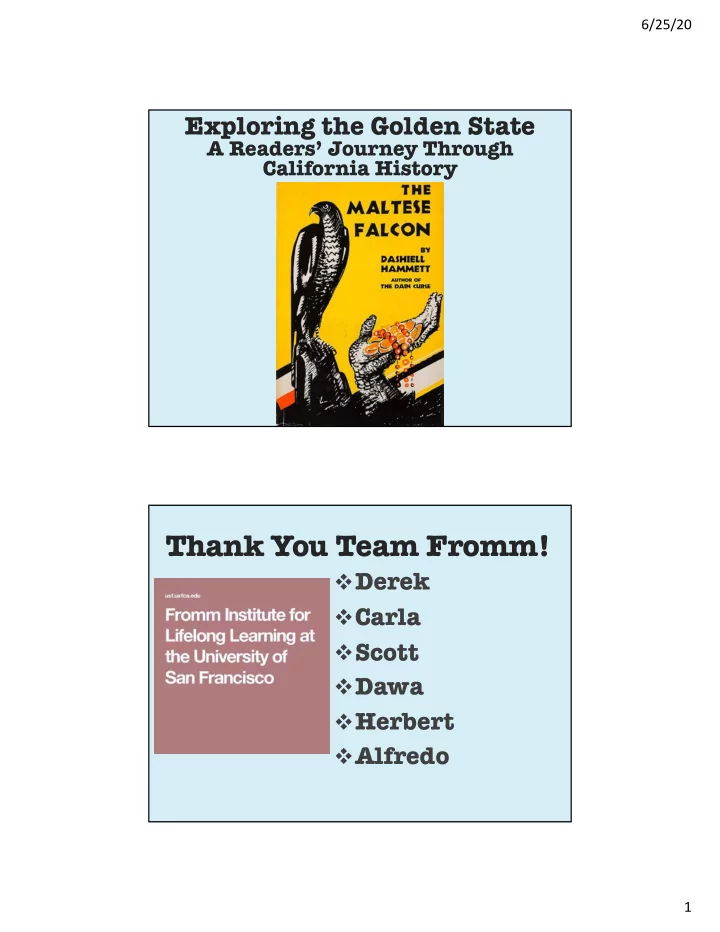
slide-3
SLIDE 3

6/25/20 3

Rough Class Schedule:

v Intro and Questions (1:00-1:10) v Steinbeck (1:10 to 1:20) v John Fante (1:20 to 1:30) v Hammett & Chandler (1:30-1:55) v Break (1:55 to 2:00) v The Exiles (2:00-2:05) v The Seekers (2:10 to 2:20) v Science Fiction (2:20 to 2:25) v Wallace Stegner (2:25 to 2:30) v Charles Bukowski (2:30 to 2:35)

slide-4
SLIDE 4

6/25/20 4

slide-5
SLIDE 5

6/25/20 5

slide-6
SLIDE 6

6/25/20 6

slide-7
SLIDE 7

6/25/20 7

Peak Steinbeck, 1935-1939

v Tortilla Flat, 1935 v In Dubious Battle,

1936

v Of Mice and Men,

1937

v Grapes of Wrath,

1939 (Pulitzer Prize)

slide-8
SLIDE 8

6/25/20 8

Derailed by Life

v Demoralized by

politically-charged readings of his work

v Reactionaries called

him a Marxist

v Many on the left

called him bourgeois, sentimental

John and Carol Split (1941) John Leaves California (1942) Divorce from Gwyn (1948)

Carol and John

Gwyn Conger and John

slide-9
SLIDE 9

6/25/20 9

Ed’s Shocking Death, May 11, 1948

He was never again the writer he had once been in the 1930s

v He got off track v Years of false

starts, distractions

v Paid considerable

alimony and child support by writing for magazines

slide-10
SLIDE 10

6/25/20 10

“To Carol, who willed it”

v Many years later, on

the eve of Steinbeck’s 1962 Nobel Prize acceptance speech, he received a telegram from Carol

v “Congratulations,” she

  • wrote. “I always knew

that it would come to you someday.”

slide-11
SLIDE 11

6/25/20 11

John wrote back to Carol, telling her he had expected her note. He always knew she was still in his camp in the way that mattered most.

slide-12
SLIDE 12

6/25/20 12

Why John Fante Matters

v Struggling writer

in Depression-era Los Angeles

v Gifted novelist,

short story writer

v Best known for

Ask the Dust (1939)

Fante’s books reveal a forgotten Los Angeles, from Angel’s Flight to the vanished downtown scene.

slide-13
SLIDE 13

6/25/20 13

The Struggles of John Fante

v Scraped by on a

series of menial jobs

v Most notable in a

tuna cannery

v Grew obsessed with

tuna canning

Fante’s Struggles

v Wrote an unpublished

story, “Fish Cannery”

v Featured extensive

tuna cannery scenes

v A script: Miracle of the

Fishes, a “melodrama

  • f the tuna fishing

industry”

slide-14
SLIDE 14

6/25/20 14

The outline of his unpublished “epic” changed over the years. Then, nothing happened. Fante warned his editor: “DON’T tell Steinbeck!”

The So-Cal Steinbeck, 1938-1940

v Published three well

received works

v Novels Wait until

Spring (1938) & Ask the Dust (1939)

v Short stories Dago

Red (1940)

slide-15
SLIDE 15

6/25/20 15

Fante’s Best: Ask the Dust (1939)

Ask the Dust A California classic. But, because it’s about Los Angeles, and not New York, it’s too often overlooked

slide-16
SLIDE 16

6/25/20 16

Then, Once Again, Nothing Happened

vHack screenwriting

to support family, cover gambling & bar debts

vObsessions with

golf, pinball, wasted productive years

The Struggles of John Fante

v Compounding woes, he

had an anti-talent for book titles

v Proposed calling one

“Ah, Poor America!”

v Wanted to title another

“Odyssey of a Wop”

slide-17
SLIDE 17

6/25/20 17

As a serious writer, he was forgotten for four decades.

Fante is Enjoying a Renaissance

slide-18
SLIDE 18

6/25/20 18

Los Angeles Poet Charles Bukowski put Fante back on the map

slide-19
SLIDE 19

6/25/20 19

Why “Dash” Matters

vAuthor of iconic

“hard-boiled” detective novels and short stories

vScreenwriter &

political activist

“Dash” and Film

vSignificant

influence on films

vGenres of private-

eye/detective fiction, mystery thrillers, and film- noir

slide-20
SLIDE 20

6/25/20 20

Many of his novels were set in San Francisco 891 Post Street Sam Spade’s Apartment

slide-21
SLIDE 21

6/25/20 21

Timing is Everything

vWarner released the

“talkie” The Jazz Singer (Oct. 1927)

vHenceforth, few

silent films would be made

slide-22
SLIDE 22

6/25/20 22

Fiction & Hollywood

vProducers grew

desperate for crackling dialogue

vHe sent everything to

Hollywood, 1928-

vHenceforth crafted

filmable plots

Lived in “the real world”

vSuffered decades of

debilitating illness,

  • bscurity, poverty

vWent to Hollywood &

stopped writing

vChose to go to prison

rather than testify

slide-23
SLIDE 23

6/25/20 23

Raymond Chandler, 1888-1959

v Began writing at 44 v Mostly set in Los

Angeles

v The Big Sleep, 1939 v Farewell, My Lovely,

1940

v The Lady in the Lake,

1943

v The Long Goodbye, 1954

Chandler Becomes a Writer

v Like many writers,

Chandler seems to have been unsuited for any other career

v He tried, and failed,

at bookkeeping

v For one, he drank far

too much

slide-24
SLIDE 24

6/25/20 24

Chandler’s Work

v If Chandler doesn’t

make you love LA, no novelist can

v Critics disparaged him;

readers loved him

v Chandler immerses the

reader in a vivid, evocative Los Angeles

slide-25
SLIDE 25

6/25/20 25

Chandler Redefined Los Angeles as a Noir Place

v Prided himself as the

“first to write about Southern California in a realistic way”

v “To write about a

place you have to love it or hate it or do both by turns.”

Questions About Hammett and Chandler?

slide-26
SLIDE 26

6/25/20 26

Eugene O’Neill and Carla Monterey at Tao House, Danville, 1937-1943

  • 1. Touch of the Poet, 1939
  • 2. More Stately Mansions,

1939

  • 3. Iceman Cometh, 1939
  • 4. Hughie, 1941
  • 5. Long Day’s Journey Into

Night, 1941

  • 6. Moon for the

Misbegotten, 1943

Tao House Today, Danville

slide-27
SLIDE 27

6/25/20 27

Theodor Adorno at Berkeley The Authoritarian Personalilty (1950)

slide-28
SLIDE 28

6/25/20 28

Aldous Huxley in Los Angeles

v Left England,

1937, for Los Angeles

v In LA for 26 years

from 1937 (age 43) until his death in 1963 (age 69)

Aldous Huxley

vThe Doors of

Perception (1954)

vInterprets his own

psychedelic experience with hallucinogens

slide-29
SLIDE 29

6/25/20 29

slide-30
SLIDE 30

6/25/20 30

Henry Miller at Big Sur, 1944-1963

vCreative new phase;

artistic rebirth

vStayed for 20 years! v“I get an idea a day

here”

vOlder, if reluctant,

influence on Beats

slide-31
SLIDE 31

6/25/20 31

Productive Big Sur Years

v Air-Conditioned

Nightmare, 1945

v Remember to

Remember, 1947

v 3-part autobiography

Rosy Crucifixion: Sexus, 1945; Plexus, 1949; Nexus, 1960

The Outside World Suddenly Intruded, 1961-1963

v Tropic of Cancer, 1934

(US release, 1961)

v Tropic of Capricorn, 1939

(US release, 1962)

v Notoriety meant

intrusions, sleeplessness

v Left Big Sur in 1963,

moved to Los Angeles

slide-32
SLIDE 32

6/25/20 32

Jack Kerouac: Complicated Iconoclast

vA gentle soul,

French Catholic, reclusive

vLiterary pioneer

  • f spontaneous

prose

slide-33
SLIDE 33

6/25/20 33

Jack’s “Comeback Novel” Big Sur (1962)

v Unsparingly depicted

self-destruction

v Torn between desire

for solitude & fellowship

v Protagonist divides

time between Big Sur and North Beach

Big Sur (1962)

vHarrowing account

  • f alcoholism

vHis character seeks

salvation

vThe real Jack, too vHe died of, at 47, of

alcoholism

slide-34
SLIDE 34

6/25/20 34

Why Ray Bradbury Matters

vCalifornia’s

foremost science fiction writer

vA Los Angeles

upbringing

vA Los Angeles

fixture

Ray Bradbury

v Characters from

marginalized groups

v Mexican Americans v African Americans v Gays and lesbians

slide-35
SLIDE 35

6/25/20 35

Why Bradbury Matters

v Concerned about

technology and dehumanization

v Staunch defender &

advocate of reading

v Technology

undermining democratic society

Fahrenheit 451

vToday things are

more bleak than he could ever have imagined

vNot necessary to

burn books because no one wants to read them anyway

slide-36
SLIDE 36

6/25/20 36

Why Philip K. Dick Matters

Astonishing output: 44 novels! 120 short stories Largely posthumous fame Blade Runner (1982) Total Recall (1990) Minority Report (2002) Scanner Darkly (2006) Adjustment Bureau (2011) Man in the High Castle (2015)

Recurrent elements:

v Alternate realities v Predatory corporations v Authoritarianism v Perceptions v Human nature v Consciousness v Doppelgängers

slide-37
SLIDE 37

6/25/20 37

Posthumous Fame

v Devoted much of his

creative energy in the 1950s to a series of realist novels

v None of them published

in his time

v Later characterized as

equal to Updike & Roth

Why Wallace Stegner Matters

vNovelist, historian,

short story writer, environmentalist

vOften called “The

Dean of Western Writers”

slide-38
SLIDE 38

6/25/20 38

slide-39
SLIDE 39

6/25/20 39

Wallace Stegner

vPulitzer Prize,

1972, for Angle

  • f Repose

vControversy

requires an explanation

slide-40
SLIDE 40

6/25/20 40

Why Charles Bukowski Matters

v We can no longer just

call him up at his home in LA

v But, before his death

in 1994, you could

v He welcomed the

interruptions

His poem “462-0614” read like an open invitation:

v“I don’t write out of

  • knowledge. When the

phone rings I too would like to hear words that might ease some of this. That’s why my number’s listed.”

slide-41
SLIDE 41

6/25/20 41

An Impish, Self-Effacing Charm

v “I get many letters.

They often say: ‘Bukowski, you are so f___ed up and you still survive. I decided not to kill myself.’ . . . So in a way I save people.”

Why Bukowski Matters

v“So these are my

readers, you see? The defeated, the demented and the damned—and I am proud of it.”

slide-42
SLIDE 42

6/25/20 42

Anticipated a Prolific Afterlife

v In 1970, he wrote to

his editor: “just think, someday after I’m dead and they start going for my poems and stories, you’ll have a hundred stories and a thousand poems on hand. You just don’t know how lucky you are.”

The Afterlife of Bukowski

vHis 1994 death has

not impeded his productivity

vHe’s been more

prolific since death

vTen posthumous

poetry collections; more to come

slide-43
SLIDE 43

6/25/20 43

Bukowski Lives On

vHas accomplished

something rare:

vA prodigious, totally

distinctive, much- beloved body of work

vSomething few poets

can even dream of

A testament to Bukowski’s enduring popularity:

v At a time when

most poetry books can’t be given away, his are annually ranked among those most frequently stolen from bookstores and libraries