WHEELCHAIR TENNIS INSTRUCTOR WORKSHOP Toronto, March 31 2019 - - PowerPoint PPT Presentation

wheelchair tennis
SMART_READER_LITE
LIVE PREVIEW

WHEELCHAIR TENNIS INSTRUCTOR WORKSHOP Toronto, March 31 2019 - - PowerPoint PPT Presentation

WHEELCHAIR TENNIS INSTRUCTOR WORKSHOP Toronto, March 31 2019 WELCOME! GREAT TO HAVE YOU HERE! It aint Rocket Science! Few (really) new concepts for coaches to learn. Same court size and rules grips strokes (one


slide-1
SLIDE 1

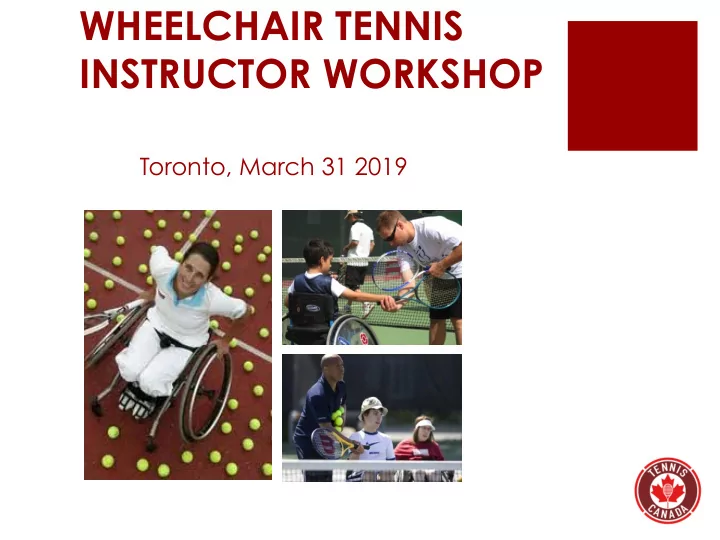
WHEELCHAIR TENNIS INSTRUCTOR WORKSHOP

Toronto, March 31 2019

slide-2
SLIDE 2

WELCOME! GREAT TO HAVE YOU HERE!

¡ It ain’t Rocket Science!

¡ Few (really) new concepts for coaches to learn. Same ¡ court size and rules ¡ grips ¡ strokes (one exception: “ the pronated backhand” ) ¡ tactics ¡ corrective techniques ¡ teaching methodologies ¡ progressions, phases of play ¡ etc. ¡ Biggest difference? MOBILITY! ¡ Mix of presentation format and on court sessions ¡ Recertification opportunity - 100% attendance required ¡ Ask Away!

Lets have fun!....and learn a few things along the way

slide-3
SLIDE 3

Purpose of course

¡ to provide certified Tennis Canada Instructors, teachers, occupational therapists and other persons of interest with tools to help organize dynamic, safe, fun, and active learning environments so introductory wheelchair players can learn and play. ¡ ‘Supplemental’ course designed to be used in conjunction with the Tennis Canada Instructor Course information and materials.

slide-4
SLIDE 4

Its ‘only’ about changing lives!

slide-5
SLIDE 5

COURSE OVERVIEW

¡ Introduction/ Try Out/ Video ¡ Wheelchair Tennis 101 ¡ Development Pathway (Game Based Approach)

¡ Developing Mobility

¡ Tactical Development ¡ Sample Beginners Lesson ¡ Serves/Returns/Match play ¡ Summary & Reflections

slide-6
SLIDE 6

Who Are You? Why Are You Here? QUICK INTRODUCTIONS

slide-7
SLIDE 7

Who Am I?

¡ National Coach Wheelchair Tennis ¡ Scope: Development and High Performance ¡ Former player ¡ 3 time Paralympian for Germany (Barcelona 92, Sydney 2000, Athens 2004) ¡ Ranked #1 in the world 1993/1994 ¡ World Champion 1993 ¡ Coaching experience with German Tennis Federation, ITF (Development Fund) and BC Wheelchair Sports ¡ My “story”

slide-8
SLIDE 8

LONDON 2012 - “ We are Stars”

slide-9
SLIDE 9

Coaches’ quotes

“Coaching wheelchair tennis goes beyond just teaching tennis. The experience of seeing how the players are able to connect to the ball is

  • amazing. The smiles and sense of

accomplishment that shows on their faces are priceless. But there is another dimension; wheelchair tennis is such a good vehicle to connect so called “able bodied” coaches/volunteers with disabled persons - it opens a new doorway for the human spirit.”

  • Albert Fong, Little Aces Mississauga

Community Champion -

slide-10
SLIDE 10

Ok, let start with something simple...

slide-11
SLIDE 11

Go Out and Play!

slide-12
SLIDE 12

MODULE 1: Tennis Canada DVD

slide-13
SLIDE 13

History and Organization

¡ 1976 Brad Parks establishes game in USA ¡ Late 70s & 80s: game expands to Europe, Asia and Canada ¡ 1988: International Wheelchair Tennis Federation is founded ¡ 1997: Wheelchair Tennis integrated into International Tennis Federation (ITF) Canada ¡ Beginnings late 70s ¡ 1988: Canadian Wheelchair Sports Association (CWSA) incorporates Tennis ¡ 1998: Tennis Canada integration

slide-14
SLIDE 14

International Organization

¡ ITF manages tournament circuit

¡ +/- 160 events worldwide (6 sanctioned events in Canada) ¡ Grand Slam – Super Series - ITF 1,2,3 & Future Series ¡ World Team Cup (Netherlands 2018, Israel 2019) ¡ Paralympics (Tokyo 2020) ¡ Para Pan Am Games (Lima, Peru 2019)

¡ ITF Wheelchair Tennis Development Fund (WTDF) supports International Development of the Game ¡ Keeper of the Rules and Regulations

slide-15
SLIDE 15

Organization in Canada

¡ Department within Tennis Canada

¡ Director (Janet Petras, BC) ¡ National Coach (Kai Schrameyer, BC)+ Touring Coach (Christian Gingras, QC)

¡ High Performance:

¡ Canadian Tournament Circuit (6 events) ¡ Birmingham Nationals (Calgary 2017 & 2018) ¡ National team ¡ Training camps ¡ High Performance Committee

¡ Development : Partnership with

¡ Provincial Tennis Associations (PTA)

¡ Provincial Wheelchair Sports Associations (PWSA)

slide-16
SLIDE 16

Participation

¡ Permanently mobility related disability

Congenital vs Acquired injuries A disability can occur through: ¡ Spinal cord injury(chart p 3) – complete or incomplete ¡ Amputation ¡ Disease

¡ Open (Paraplegics and Amputees) and Quad (Quadriplegic) divisions ¡ Integration Philosophy

slide-17
SLIDE 17

Rating System

Play Tennis Canada rating system ¡ Levels 1.0-7.0 ¡ Top Open player = 4.0-4.5 ¡ Top Quad player + 3.0-3.5 ¡ Beginner wheelchair = .1/.5/1.0

slide-18
SLIDE 18

Equipment

¡ Facilities requirements: ¡ all surfaces ¡ accessibility (courts and washrooms) ¡ Rackets ¡ Straps (muscle replacements): chest waist, legs ¡ Tape (quad players) ¡ Equipment for Heat (Quads) …..oh, and the wheelchairs!

slide-19
SLIDE 19

Anatomy of Wheelchair

¡ Sports chairs v. everyday chairs ¡ Materials ¡ Cost ¡ Frame ¡ Seat ¡ Seat Cushion ¡ Wheels (Camber) ¡ Tires ¡ Casters ¡ Push rims ¡ Foot Plate

slide-20
SLIDE 20

Rules

¡ 2 bounce rule

¡ Wheelchair Considered Part of Body ¡ Service Rules ¡ ‘Up and Down’ Doubles ¡ Power Wheelchairs

slide-21
SLIDE 21

Coaches’ ¡quotes ¡

“Without ¡prejudice ¡and ¡with ¡all ¡respect ¡to ¡the ¡Able ¡Bodied ¡greats ¡ that ¡ play ¡ and ¡ have ¡ played ¡ on ¡ all ¡ the ¡ Interna;onal ¡ Circuits. ¡ My ¡ Tennis ¡ Champion ¡ is ¡ Lee ¡ Carter ¡ (former ¡ Canadian ¡ Nr ¡ 1). ¡ He`s ¡ been ¡ my ¡inspira;on ¡from ¡the ¡very ¡first ¡day ¡I ¡saw ¡him ¡hop ¡into ¡his ¡sport ¡

  • chair. ¡Since ¡that ¡day ¡I ¡have ¡challenged ¡myself ¡to ¡be ¡as ¡dedicated, ¡

persistent, ¡pa;ent, ¡and ¡understanding ¡in ¡acquiring ¡knowledge ¡of ¡the ¡ Sport ¡and ¡Resources. ¡ ¡ ¡ ¡ ¡. ¡” ¡ ¡ ¡-­‑ ¡Marlon ¡Goldburn, ¡Tennis ¡coach ¡Winnipeg, ¡MB ¡-­‑ ¡ ¡

slide-22
SLIDE 22

Active Break: Warm Up Games

¡ « Sharks « ¡ « Tree Tag « ¡ « Pac-Man « ¡ « Grab the leash » ¡ « Know your lines « ¡ Balloon Games ¡ Coordination Games

slide-23
SLIDE 23

https://www.youtube.com/watch? v=nMoy93EKp9w

slide-24
SLIDE 24

Development Pathway

Teaching Tennis as a Game ¡ 2 primary ways to teach tennis: Model v. Game Based ¡ Tennis is a Game and needs to be played as such ¡ Get them playing and then learn to play better (link strokes to mobility & play) ¡ Technique as a means to execute Tactics: ‘what’ before ‘how’ ¡ Goal is to get players to be able to play as quickly and as self sufficiently as possible ¡ Challenge to apply this to Wheelchair Tennis ¡ The Solution:

¡ Scaled version of the Game (Throw Tennis, Floor Tennis , ROG Tennis) ¡ Development Programs

slide-25
SLIDE 25

Developing Technique

What the Player Does (Efficiency/Conformity) 5 Fundamentals

¡ Grip ¡ Set-up ¡ Impact Point ¡ Hitting Zone ¡ Recovery

What the Ball Does (Effectiveness) Ball Controls

¡ Height

¡ Direction ¡ Distance ¡ Speed ¡ Spin

¡ The first 3 are the most relevant for starter players

slide-26
SLIDE 26

Developing Technique

¡ P.A.S Principles

(What the racquet does at impact controls the ball):

¡ Path of racquet ¡ Angle of racquet ¡ Speed of racquet

slide-27
SLIDE 27

Development Pathway

Using a game-based Approach ¡ Development Programs: 1. Rally Program: Create a Comfort Zone 2. Reception Program: Expand the comfort zone 3. Projection Program: Challenge the opponent’s comfort zone 4. Tactical Programs: Phases and Zones of Play

slide-28
SLIDE 28

Development Pathway

¡ Scale the game so it is easier to play & move ¡ ROG Tennis Process:

¡ Red Tennis (1/2 court) (foam or felt balls) ¡ Orange Tennis (3/4 court) (low-compression) ¡ Green (Full Court) (Transition balls)

slide-29
SLIDE 29

Development Pathway

Or Organiz ganize e Point

  • int-P
  • Play

lay

1.

  • 1. MEET & GR

GREET 2.

  • 2. WA

WARM-UP

  • UP

3.

  • 3. PLA

LAY & PRA PRACTICE CTICE 4.

  • 4. WR

WRAP-UP

  • UP

Pract actice ice Act ctiv ivit ity

Run an activity that highlights one of the 5 Fundamentals or PAS Principles

Or Organiz ganize e Point

  • int-P
  • Play

lay

slide-30
SLIDE 30

Key elements to a successful lesson

¡ Scale the game so it is easier to play & move ¡ Define an outcome (i.e. being able to maintain a baseline rally) and set a topic: ball control (effectiveness)or fundamental (conformity) ¡ Create an appropriate challenge ¡ Introduce Measurements ¡ Ensure sufficient volume! ¡ Provide Feedback MAKE IT FUN!

slide-31
SLIDE 31

MODULE 1:

slide-32
SLIDE 32

Coaches’ ¡quotes ¡

“I ¡was ¡amazed ¡at ¡how ¡quickly ¡the ¡kids ¡in ¡wheelchairs ¡improved ¡week ¡ aQer ¡week, ¡no ¡maRer ¡what ¡the ¡level ¡of ¡their ¡disability. ¡ ¡Witnessing ¡ their ¡delight ¡in ¡playing ¡tennis ¡and ¡con;nued ¡improvement ¡is ¡what ¡ inspired ¡me ¡the ¡most. ¡” ¡ ¡ ¡-­‑ ¡Brian ¡Pound, ¡BTC ¡Champion ¡of ¡the ¡Year ¡2011, ¡Winnipeg, ¡MB ¡-­‑ ¡

slide-33
SLIDE 33

1:44:52……………………1:46:33

slide-34
SLIDE 34

Movement in a Chair

¡ Biggest difference to able bodied tennis ¡ Circular (continuous) Mobility is crucial! Always in motion ¡ Racquet never leaves the hand! ¡ Reverse mobility is key

slide-35
SLIDE 35

Movement in a Chair

¡ Neutral Position

¡ Contact Points: ¡ Playing hand: Squeeze racket between hand and push rim ¡ Racket never laid on lap! ¡ Technique is secondary. Importance of solid contact points

slide-36
SLIDE 36

Movement in a Chair

¡ Maneuvering

¡ Pushing ¡ short thrusts to start, longer thrusts when player is in motion ¡ Pushing motion from about ‘12 – 3’ ¡ Breaking/Slowing down ¡ Grabbing both wheels firmly ¡ Leaning back ¡ Turning ¡ Execution as Push and Pull turn

slide-37
SLIDE 37

Movement in a Chair

¡ Preparation

¡ Transition from Pushing (arms as engine) to stroking ¡ Timing is Crucial! ¡ Too early: no positional adjustments possible ¡ Too late: stroke becomes uncontrollable ‘slap’ ¡ Unit Turn

slide-38
SLIDE 38

Movement in a Chair

¡ Recovery

¡ Return to ‘hub’ to prepare to intercept next shot ¡ In Turns v. Out Turns ¡ Note: very rarely will pushing backwards be the best choice! ¡ Natural Momentum v. Tactical Considerations ¡ Concept of ‘Reverse Mobility’

slide-39
SLIDE 39

Movement in a Chair

¡ Reverse Mobility is EVERYTHING !

slide-40
SLIDE 40

Shingo Kunieda - The Roger Federer of Wheelchair Tennis

slide-41
SLIDE 41

Pronated backhand

slide-42
SLIDE 42

Tactical Development - Singles

¡ Keep the ball in play ¡ Place the ball:

¡ To the opponent’s weak side ¡ Straight at the opponent ¡ Behind the opponent ¡ High bouncing balls through heavy topspin (underutilized strategy!) ¡ Drop Shots ¡ Finish Point at net after aggressive approach shot

slide-43
SLIDE 43

Tactical Development – Doubles

¡ Both Players back ¡ 1 Up, 1 Back ¡ Both players in continuous motion and communication to maximize court coverage

slide-44
SLIDE 44

Conducting a Beginner's Lesson

¡ warm up (time and space permitting) ¡ stroke progression (ball feed or cooperative) from throw tennis, floor tennis to self rally and cooperative rally (if level of participants allows it ¡ Conclude with a Game of “Maniac Tennis”

slide-45
SLIDE 45

Coaches’ ¡quotes ¡

“This ¡past ¡season ¡at ¡UTSC ¡I ¡had ¡the ¡privilege ¡of ¡implemented ¡and ¡ running ¡a ¡wheelchair ¡tennis ¡program ¡every ¡Thursday ¡from ¡6-­‑8pm. ¡I ¡ would ¡say ¡these ¡two ¡hours ¡were ¡the ¡most ¡rewarding ¡and ¡enjoyable ¡ that ¡ I ¡ taught ¡ the ¡ en;re ¡ season. ¡ The ¡ group ¡ that ¡ aRended ¡ were ¡ so ¡ eager ¡to ¡learn ¡and ¡just ¡plain ¡have ¡FUN, ¡doing ¡something ¡completely ¡ new ¡to ¡them. ¡We ¡all ¡felt ¡at ¡the ¡end ¡of ¡the ¡season ¡that ¡we ¡couldn't ¡ wait ¡for ¡the ¡next ¡year ¡to ¡start. ¡” ¡ ¡ ¡-­‑ ¡DusBn ¡Sexton, ¡Tennis ¡coach ¡UTSC ¡, ¡ON ¡-­‑ ¡ ¡

slide-46
SLIDE 46

Coaches ¡Quote ¡

  • “Apart ¡from ¡my ¡kids ¡wheelchair ¡tennis ¡has ¡been ¡

the ¡ ¡best ¡thing ¡that ¡has ¡happen ¡in ¡my ¡life.” ¡ ¡ ¡ ¡ ¡ Steve ¡Manley, ¡BC ¡provincial ¡ ¡ wheelchair ¡tennis ¡coach ¡

slide-47
SLIDE 47

“My son Trevor loves wheelchair

  • tennis. Every week he can't wait to go

and also because he has friends to play with. He also has made some new friends because of the sport. It helps strengthen his upper body which is some thing he needs being in wheelchair all the time. He can also play this sport with friends and family who are not disabled and it doesn't matter how good one is at it. Trevor plays sledge hockey but this is only with other kids who are handicapped. He can't just play with his brother as he could with tennis. It's harder to find ice time, but with tennis one can play any time and it is great to have a summer

  • sport. Thanks so much for starting the

kids wheelchair tennis. “ Kim Schaffels, mother of participant Trevor

slide-48
SLIDE 48

“ M i s s i s s a u g a L i t t l e A c e s Wheelchair Tennis is a place to be yourself, to discover yourself, to challenge yourself, and be comfortable with who you are because you are with a team of warm, caring, passionate staff, v o l u n t e e r s , p a r e n t s a n d

  • participants. Albert is a kind,

dedicated, hardworking leader who can draw everyone together to reach a common goal... to create a wonderful, thriving environment like no other, a special place to be yourself, to discover yourself, to challenge yourself, and be comfortable with who you are and to achieve what you thought was unachievable... ” Jenny Lai, mother of 15 year old participant Puisand Lai

slide-49
SLIDE 49

“I've heard some parents comment on how much their child looks forward to the tennis, the interaction with the other children and how it builds their self-

  • confidence. The children are very motivated by the volunteers and have a lot of

"fun". Some children even ask to "rally" with the adult volunteers. They get a huge kick out of it when they hit a great shot that the volunteer can't return. Some to the children are in pain from procedures, but seem to forget about it for the short while that they are on the court. “ Suzanne Adorjan, program volunteer.

slide-50
SLIDE 50

Q ¡& ¡A ¡