SLIDE 1
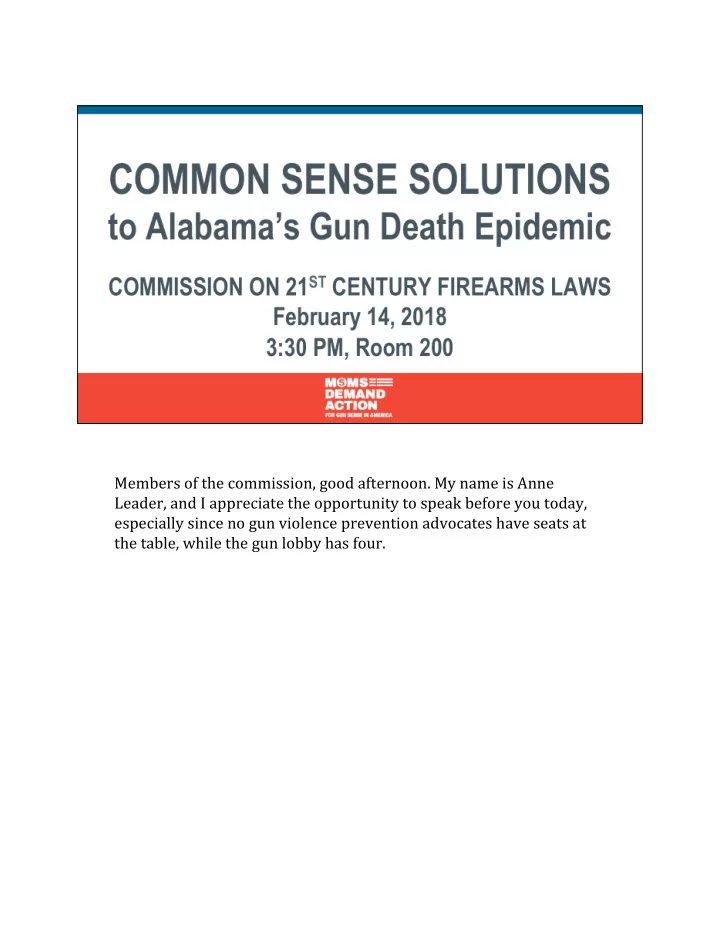
Members of the commission, good afternoon. My name is Anne Leader, and I appreciate the opportunity to speak before you today, especially since no gun violence prevention advocates have seats at the table, while the gun lobby has four.
SLIDE 2
Our first speaker today is Andrew Karwoski, Counsel for Everytown for Gun Safety – Andrew? https://everytown.org
SLIDE 3
I will now turn the podium over to my colleague Sunny Schnitzer, Program Lead for City Gun Violence Prevention
SLIDE 4 Thank you both for sharing this important data with us. As volunteers for Moms Demand Action for Gun Sense in America, we are grateful for your work. Like you, we volunteers know that common sense legislation saves
- lives. Before we discuss how, I’d like to share a few highlights with
you in recognition of our organization’s fifth anniversary. https://momsdemandaction.org
SLIDE 5
As many of you may know, Moms Demand Action for Gun Sense in America was started as a Facebook group the day after the Sandy Hook Elementary School shooting by a stay-at-home mother of five who could not remain silent about gun violence any longer. https://momsdemandaction.org/about/
SLIDE 6
Since then, we have grown to become a nonpartisan, grassroots movement with over 4 million supporters that mobilizes moms, dads, families, and everyday Americans to save lives from gun violence by advocating for stronger gun laws while respecting the 2nd Amendment
SLIDE 7
In 2015, Moms Demand Action joined forces with Mayors Against Illegal Guns to form Everytown for Gun Safety
SLIDE 8 We have one goal – to create an America free from everyday gun
- violence. We do this by giving Americans the tools they need to get
the facts.
SLIDE 9
For example, our Gun Law Navigator allows anyone to learn more about the gun laws in their state and to be able to compare them to gun laws in other states. https://everytownresearch.org/navigator/
SLIDE 10
Our work is Evidence Based: We conduct groundbreaking research and have a multifaceted approach to addressing gun violence https://everytown.org/learn/
SLIDE 11
Data from the U.S. Centers for Disease Control and Prevention show that on an average day, 96 Americans are killed with guns. To calculate this figure, Everytown relies on a five-year-average of data from the CDC, whose National Vital Statistics System contains the most comprehensive data, currently available through 2016. Each year, nearly 13,000 American gun deaths are homicides. "Fatal Injury Reports," Injury Prevention & Control: Data & Statistics (WONDERWISQARS), accessed December 23, 2017January 3 2017,' http://1.usa.gov/1plXBux’
SLIDE 12
Even more are gun suicides. An average of 62% of firearm deaths in the United States each year. Many of our volunteers are motivated to do this work because of a friend’s or relative’s gun suicide, including me. When I was in the 10th grade my friend Rachel shot and killed herself with a gun that had been left unsecured in her home.
SLIDE 13
Perhaps most tragically, American children are 11 times more likely to die from gun violence than children in other developed countries. 11 times. On an average day in America, seven children and teens are killed with guns. In 2016 alone, 3,155 Americans under age 19 died as the result of gun violence. 1,102 of those were suicides. Richardson, Erin G., and David Hemenway, “Homicide, Suicide, and Unintentional Firearm Fatality: Comparing the United States With Other High-Income Countries, 2003,” Journal of Trauma, Injury, Infection, and Critical Care, January 2011. 2016, United States Firearm Deaths and Rates per 100,000; All Races, Both Sexes, Ages 0 to 19; ICD-10 Codes: W32-W34,X72-X74,X93- X95,Y22-Y24, Y35.0,*U01.4
13
SLIDE 14
Because of these sobering statistics, and because of the seemingly daily news stories of children getting their hands on guns and taking them to school, Moms Demand Action has developed the Be SMART program to bring together parents and other adults concerned about kids, guns, and safety. Since the inception of BeSMART, over 1,000 volunteers have delivered our message in 39 states. In Alabama, we have trained 20 presenters and have given presentations to Rotary Clubs, Kiwanis groups, churches, neighborhood associations, and law enforcement. We will host a table and give a presentation at the 2018 State PTA convention this April. If you would like us to bring a presentation to your community, please let us know! http://besmartforkids.org ; alabama@momschapterleaders.org
SLIDE 15
The U.S. has the highest reported rate of unintentional child gun deaths in the world. Each dot on this map represents a shooting by a child age 17 and under. Each red dot represents a death, and each pink dot represents an injury. Since Everytown began tracking this data in 2015, there have been at least 858 unintentional child shootings – 523 injuries and 335 deaths This map is updated regularly can be viewed at http://everytownresearch.org/notanaccident/ .
SLIDE 16 including 7-year-old Trenton Levi Thomas of Concord Alabama. On New Year’s Day of this year, Levi came across a gun in the bedroom of a friend’s house. He began handling it, causing it to unintentionally
- discharge. Levi was rushed to the hospital but died from his injuries.
He was in the first grade at Greenwood Elementary School in Jefferson County. https://everytownresearch.org/notanaccident/4000/#4000 http://www.curriejefferson.com/sitemaker/memsol_data/ 2006/2055334/2055334_profile_pic.png; http://www.wbrc.com/story/37171211/child-who-died-after- accidental-shooting-identified
16
SLIDE 17 In the five years since Moms Demand Action formed, support for gun violence prevention measures is at an all-time high. A poll taken in April 2017 shows that an overwhelming majority of Alabama voters, eighty-nine percent, support a background check on every gun sale. The independent, apolitical, and non-partisan research firm SurveyUSA interviewed 1,100 state of Alabama adults 04/26/17 through 04/30/17. Of the adults, 965 are registered to vote. Of the registered voters, 852 report having voted in the 11/08/16 general
- election. https://www.surveyusa.net/about/
SLIDE 18 89% of Alabama voters also believe that gun owners should be required to get a permit to carry hidden, loaded handguns in public
- places. Such popularity raises serious questions about why the
legislature is once again pursuing Permitless Carry. The independent, apolitical, and non-partisan research firm SurveyUSA interviewed 1,100 state of Alabama adults 04/26/17 through 04/30/17. Of the adults, 965 are registered to vote. Of the registered voters, 852 report having voted in the 11/08/16 general
- election. https://www.surveyusa.net/about/
SLIDE 19
More recent polls, conducted by Gallup in October 2017, and Quinnipiac the following month, show that an overwhelming 95 percent of Americans support a background check on every gun sale. http://news.gallup.com/poll/220637/americans-widely-support- tighter-regulations-gun-sales.aspx https://poll.qu.edu/images/polling/us/us11152017_ucp261.pdf/
SLIDE 20 This momentum has translated into new state gun safety laws across the country, defeats of dangerous legislation, the election in 2017 of gun sense champions in Virginia and New Jersey, and countless cultural and corporate leaders rising to stand with the vast majority
- f Americans who know we must do more to end gun violence.
SLIDE 21
At the national level, Moms Demand Action has... grown from a Facebook page to a Chapter in all 50 states and D.C., with over 1,600 volunteer leaders
SLIDE 22 We helped pass background check bills in 8 states: California, Colorado, Connecticut, Delaware, Nevada, New York, Oregon, and
- Washington. In states that require a background check for all
handgun sales,
SLIDE 23
53% fewer law enforcement officers are shot and killed in the line of duty, and Everytown compared the number of law enforcement officers feloniously killed in the line of duty with guns that were not their own between 2011 and 2015 in states that did or did not require background checks for unlicensed handgun sales. Data on deaths were obtained from the FBI’s Law Enforcement Officers Killed and Assaulted database in December 2016. Population data for law enforcement officers (“Police Protection - Persons with Power of Arrest”) were taken from the United States Census Bureau.
23
SLIDE 24
47 percent fewer women are shot to death by their intimate partners. Since 2013, 25 states – both red and blue – have passed laws to keep guns away from domestic abusers, including in Rhode Island, Everytown for Gun Safety (2017). Background Checks Reduce Gun Violence and Save Lives, available at: http://everytownresearch.org/background-checks-reduce-gun- violence-and-save-lives
SLIDE 25
where Governor Gina Raimondo, shown here with the Moms Demand Action volunteers who worked tirelessly to see this bill become law, signed legislation last October that prohibits gun possession by anyone convicted of a misdemeanor domestic violence crime as well as those subject to court-issued final protective orders. The new law also requires that these gun owners must turn in their firearms within 24 hours of becoming prohibited from possessing them.
SLIDE 26 Alabama is among the 28 states that prohibit people who have been convicted of domestic violence misdemeanors from having
- firearms. Our state was a leader in this regard, passing this law in
- 2015. Alabama also prohibits all people under final domestic
violence restraining orders from having firearms. All maps are compiled based on information collected in Everytown’s Gun Law Navigator https://everytownresearch.org/navigator/country.html
SLIDE 27
Unfortunately, Alabama is not one of the 14 states that require domestic violence misdemeanants to turn in their weapons once they have become prohibited from having them. States that have implemented this policy show a 25% reduction in intimate partner homicides in their cities. Zeoli, A. M., & Webster, D. W. (2010). Effects of domestic violence policies, alcohol taxes and police staffing levels on intimate partner homicide in large US cities. Injury prevention, 16(2), 90-95.
SLIDE 28
Nor does Alabama require surrender from those under final restraining orders. Failure to require surrender of weapons from convicted domestic abusers and those under final restraining orders render our domestic violence laws less effective than they should be. Other laws that could strengthen our protections of Domestic Violence victims include:
SLIDE 29
Extending the definition of Domestic Violence victim to include not just spouses but also boyfriends and girlfriends, which is currently in force in 17 states and DC. In 2016, 42% of Alabama’s domestic violence victims were a girlfriend or an ex-girlfriend.
SLIDE 30
We could also extend state law regarding final domestic violence restraining orders to include abusive boyfriends and girlfriends, like these 18 states and the District of Columbia
SLIDE 31
We could join the 18 states that prohibit convicted stalkers from having firearms.
SLIDE 32
23 states and DC prohibit convicted abusive boyfriends and girlfriends, from carrying concealed guns in public – Alabama should too.
SLIDE 33
23 states and DC prohibit those under final domestic violence restraining orders, from carrying concealed guns in public – Alabama should too.
SLIDE 34
Alabama, unlike 28 states and DC, does not disqualify convicted stalkers from carrying concealed guns in public. Why are we so concerned about the connection between Domestic Violence and guns?
SLIDE 35
Because American women are 16 times more likely to be killed with a gun as women in other high-income countries. Grinshteyn, E., & Hemenway, D. (2016). Violent death rates: the US compared with other high-income OECD countries, 2010. The American journal of medicine, 129(3), 266-273. https://everytownresearch.org/documents/2017/07/gun-laws- violence-women-infographic.pdf
35
SLIDE 36
And, the majority of mass shootings, 54%, are related to domestic or family violence. For example, the shooter in Sutherland Springs was court martialed in 2012 for assaulting his wife and fracturing his stepson’s skull, rendering him prohibited from having a gun. The military failed to report to FBI. Everytown for Gun Safety. (2017). Mass Shootings in the United States: 2009-2016, available at https://everytownresearch.org/reports/mass-shootings-analysis/
SLIDE 37 To review, despite our 2015 law that prohibits domestic abusers from buying or having a gun, Alabama does not enforce the surrender of firearms owned by convicted domestic abusers. Alabama is NOT among the states that prohibit convicted stalkers or boyfriends and girlfriends who are convicted of domestic abuse or placed under final domestic violence restraining orders from carrying concealed guns in public. Rather than strengthen our laws, Alabama is considering doing away with our Concealed Carry Permitting law. How would a law enforcement officer know if a convicted abuser is carrying a concealed weapon illegally without a required permit? If our permitting system becomes optional, more people, including convicted domestic violence abusers and those under final restraining
- rders, will be able to evade background checks and subsequently
carry firearms in public. More on that later…
SLIDE 38
Moms Demand Action volunteers across the country have helped defeat hundreds of bills that would have forced guns onto our campuses and into our K-12 schools, that would have expanded Stand Your Ground, and that would have dismantled concealed-carry permitting systems. Unfortunately, laws proven to risk public safety, like expanding Stand Your Ground to churches and making Alabama a Permitless-Carry state, are under consideration in the Alabama legislature as we speak. But our volunteers are here to tell you that we do not support these bills, and we will fight their passage into law.
SLIDE 39 In less than four years, the Alabama chapter of Moms Demand Action has grown from a handful of volunteers to several thousand
- supporters. We started in 2014 with groups in Birmingham and
- Mobile. In 2015 a group formed in Auburn.
And in 2017 we added new groups in Montgomery and Tuscaloosa. We will have our first meeting in Huntsville on Sunday, March 4. https://www.facebook.com/pg/MomsDemandActionAL/events/
SLIDE 40
Our growth has been rapid and exciting. For example, in just 2 years, the Auburn local group, where I volunteer, has grown from 17 Wear Orange marchers in December 2015 to a last-minute vigil for the victims of the Orlando nightclub shooting 6 months later, to a robust team of dedicated leaders, volunteers, and supporters who participate in multiple events each month.
SLIDE 41
Alabama now has more than 2,300 supporters across the state. This includes: 651 active volunteers 24 volunteer leaders, and 5 local groups, with a 6th on its way
SLIDE 42 Alabama has been a trendsetter in the nationwide movement known as Wear Orange, which honors gun violence awareness every year on June 2nd. Did you know that the idea to turn monuments orange in honor of Gun Violence Awareness started in Alabama? Mobile was the first city to turn its skyline orange in 2015, when 30,000 people across the country chose to WearOrange. In 2016, WearOrange grew eightfold. Last year, Mobile and Montgomery lit up their skylines along with
- ver 170 other buildings and landmarks nationwide. More than
200,000 people participated in Wear Orange Day, with the hashtag WearOrange trending nationally.
SLIDE 43
More than 400 influencers, corporate, and non-profit partners joined the Wear Orange coalition last year. Mayors from more than 200 cities and more than 400 federal and state officials – 600 all, including Mayor Scott McBrayer of Homewood, seen here at the left – participated in Wear Orange. An estimated 11,000 attendees participated in over 250 events around the country, including 4 events in Alabama. We will be hosting events across the state on June 2nd. All of you are welcome to attend and join us in honoring survivors and raising awareness for gun violence and how to prevent it.
SLIDE 44 Alabama has also honored victims and survivors of gun violence by participating in Moms Demand Action’s Mother’s Dream Quilt project. Alabama was the first state to create a full Mother’s Dream Quilt on its
- wn, and we are hosting our third quilting bee in Opelika on March 10
at Lewis Cooper Memorial Library. All are welcome to attend. No sewing experience needed. www.mothersdreamquilt.org
SLIDE 45
This year, we hosted vigils to honor the 5-year mark of the Sandy Hook elementary school shooting. In Tuscaloosa,
45
SLIDE 46
University of Alabama hockey player Jonathan Lovorn, who is from Newtown, Connecticut, wore his jersey whose number was chosen in honor of the 26 Sandy Hook victims. He and a fellow classmate, also from Newtown, lit candles as part of the service. Both students remarked how touched they were that a group in Alabama was honoring their hometown back in Connecticut.
SLIDE 47
So, what is the state gun violence in Alabama? 2016 mortality data from the Centers for Disease Control ranks Alabama as the second deadliest state in the nation for gun death. Only Alaska, one of 12 states that currently allow permitless carry, has a higher gun death rate per capita. We cannot continue to allow so many of our fellow Alabamians die by gunshot. It is time for a change. Centers for Disease Control and Prevention. National Centers for Injury Prevention and Control, Web-based Injury Statistics Query and Reporting System (WISQARS).
SLIDE 48
As previously mentioned, 2016 mortality data from the CDC, ranks Alabama 2nd for gun death in the nation with 21.39 deaths per 100,000 residents
SLIDE 49
Since 2009, gun deaths in the U.S. have risen almost 17%. According to the CDC, the national rate of gun death, which includes suicides, homicides, and unintentional shootings, increased from 10.05 per 100,000 in 2009 to 11.73 per 100,000 in 2016. 2009 = 10.05 2010 = 10.07 2011 = 10.16 2012 = 10.45 2013 = 10.38 2014 = 10.25 2015 = 11.01 2016 = 11.73
SLIDE 50
The CDC data shows an over 23% jump in Alabama gun deaths between 2009 and 2016, 6.5 points higher than the national rate.
SLIDE 51
A comparison of the four states deemed most comparable to Alabama by this commission for the purposes of evaluating Permitless Carry shows that–like Alabama–Mississippi, Missouri, West Virginia, and Kansas all have high rates of gun death, with Mississippi, Missouri, and West Virginia ranking among the top twelve. All four states have seen significant increases in gun death since 2009. It is our conclusion that rather than emulate these permitless carry states,
SLIDE 52
we instead look to states like Minnesota, a state which also has a high household gun ownership rate and a comparable population density to Alabama. Minnesota maintains strong gun violence prevention laws, including requiring Concealed Carry permits, and has a relatively low rate of gun death per capita.
SLIDE 53
Minnesota has 42 laws on its books key to public safety and gun violence prevention, including the requirement that prohibited domestic abusers turn in their guns, a required concealed-carry permit, and required hands-on safety training to carry a concealed gun in public. https://everytownresearch.org/navigator/index.html
53
SLIDE 54
Alabama only has 19 important gun safety laws. Presently, of the three Minnesota laws just cited, Alabama only as a concealed-carry permit requirement, which is under threat of being dismantled by SB3/HB231. Minnesota’s rate of gun death is 64% lower than Alabama’s.
54
SLIDE 55
we instead look to states like Minnesota, a state which also has a high household gun ownership rate and a comparable population density to Alabama. Minnesota maintains strong gun violence prevention laws, including requiring Concealed Carry permits, and has a relatively low rate of gun death per capita.
SLIDE 56
Hawaii, which has a nearly identical rate of gun ownership as Alabama, has 58 important gun laws on the books, including a concealed carry permit, a requirement that prohibited domestic abusers must turn in their guns, and a background check required on all gun sales. Hawaii’s rate of gun death is almost 79% lower than Alabama’s. Hawaii is more densely populated than Alabama 222 vs 95 persons per square mile. 45.10% of Hawaiian households own guns compared to 48.90% in Alabama.
56
SLIDE 57
What are some solutions for the gun violence in Alabama?
SLIDE 58 Background checks are a systematic way to keep guns out of the wrong hands and save lives. Since enacted, they have blocked over 3 million sales to people with felony convictions, domestic abusers, fugitives, and other people prohibited by law from having guns. But under current federal law, background checks are only required
- n gun sales at licensed dealers. This loophole in the system makes it
easy for millions of guns to change hands each year with no background check, and no questions asked. In fact, an estimated 22 percent of gun transfers take place without a background check—often between strangers who meet online, or at gun shows. As we have seen, some states have closed this loophole, with nineteen states and Washington, DC going beyond federal law by requiring background checks for all handgun sales.
SLIDE 59
As mentioned earlier, states that require background checks for all handgun sales see 47% fewer women shot to death by intimate partners and 53% fewer law enforcement officers shot and killed in the line of duty. These states also see 47% fewer suicides by gun and 48% less illegal gun trafficking. https://everytownresearch.org/background-checks-reduce-gun- violence-and-save-lives/
SLIDE 60
Conversely, in Missouri, one of the four permitless states that have been held up as a potential exemplar for Alabama, we have seen an increase in gun crime since their background check protections were rolled back. Prior to 2007, Missouri required every handgun buyer to pass a criminal background check and to obtain a purchase permit. Though federal law still requires licensed dealers in Missouri to run a background check, felons, convicted domestic abusers, and other people legally prohibited from buying guns can evade background checks through purchases from unlicensed sellers, including at gun shows or online. Bureau of Alcohol, Tobacco, Firearms and Explosives, “Missouri,” Firearms Trace Data - 2013, accessed April 10, 2015.
SLIDE 61 Repealing the background check requirement on all sales has made it easer for criminals to buy guns in Missouri. Since the 2007 repeal, the share of crime guns recovered in Missouri that were originally purchased in the state has grown by 28%. Art Thomm has suggested that the 69% increase in overall homicides in St. Louis county in the first half of 2017 was due to gang activity, drug activity, high unemployment, low education, and because these murders took place in an urban environment. However, according to
- St. Louis Police, only 1 in 5 homicides in 2016 involved a documented
gang member as a victim or suspect, and even in these cases, it was unclear “how much of a role, if any, gang membership played in these crimes.” Moreover, St. Louis Police estimate that only about 6% of the city’s approximately 2,100 aggravated assaults with guns involved a documented gang member as a victim or a suspect. http://www.stltoday.com/news/local/crime-and-courts/gangs-in-st- louis-may-not-be-driving-violence-in/article_312eecae-330a-58cc-
SLIDE 62 Illegal gun trafficking has also increased in Missouri. A key indicator
- f illegal gun trafficking is the “time to crime” – how long it takes after
a retail gun sale for the weapon to turn up at a crime scene. A gun with a time to crime of under two years is more likely to have been
- trafficked. After the repeal of Missouri’s background check
requirement, the share of guns recovered at Missouri crime scenes within two years of their retail sale nearly doubled. Bureau of Alcohol, Tobacco, Firearms and Explosives, “Missouri,” Firearms Trace Data - 2013, accessed April 10, 2015. See also: Webster DW, Vernick JS, McGinty EE, Alcorn T. “Preventing the Diversion of Guns to Criminals through Effective Firearm Sales Laws.” Pages 109-122 in Reducing Gun Violence in America: Informing Policy with Evidence and Analysis, Daniel W. Webster and Jon S. Vernick,
- Eds. Baltimore, MD: Johns Hopkins University Press, 2013.
https://everytownresearch.org/evidence-from-missouri-that- background-checks-work/
SLIDE 63 Furthermore, the repeal of Missouri’s requirement for a background check on every sale has been associated with a 25% increase in gun
- homicides. Missouri now has one of the highest gun homicide rates in
the nation, which has gotten worse since the state instituted permitless carry starting January 1, 2017. Daniel Webster, Cassandra Kercher Crifasi, and Jon S. Vernick, “Erratum To: Effects of the Repeal of Missouri’s Handgun Purchaser Licensing Law on Homicides,” Journal of Urban Health 91, no. 3 (June 2014): doi:10.1007/s11524-014-9865-8; U.S. Centers for Disease Control and Prevention, “Fatal Injury Reports,” Injury Prevention & Control: Data & Statistics (WISQARS), accessed April 10, 2015, http://1.usa.gov/1plXBux.
SLIDE 64
Of the 10 states with the lowest rates of gun death per capita, shown here in green, all but Maine and Minnesota
SLIDE 65
all but Maine and Minnesota have closed the loopholes in the federal background check system.
SLIDE 66
Of the 10 states with the highest rates of gun death per capita, shown here in red, none have closed the loopholes.
SLIDE 67
Three of them are permitless carry states
67
SLIDE 68 19 states and DC have closed the loopholes in our background check system and require checks on all handgun sales. These states see significantly lower rates of intimate partner homicide, gun suicide, illegal gun trafficking, and law enforcement
- fficers shot and killed in the line of duty.
68
SLIDE 69
7 of these states are among the lowest 10 in the nation for gun death per capita.
69
SLIDE 70
And all but three have lower than average rates of gun death.
70
SLIDE 71
12 states in the nation are Permitless Carry states and allow citizens to carry concealed, loaded weapons without a permit.
71
SLIDE 72
Eight of the twelve Permitless Carry states have higher than average rates of gun death. Maine, New Hampshire and Vermont, bordered by Canada to the north and states with strong gun laws to the south, have relatively low rates of gun death per capita. ND = 11.88 VT = 11.02 NH = 9.28 ME = 8.23
72
SLIDE 73
This final map shows in green those states that require background checks on every gun sale or that fall within the bottom ten states for gun death per capita. Those shown in red are permitless carry states or fall within the top ten states for gun death per capita.
73
SLIDE 74
As the Alabama Commission on 21st Century Firearms considers recommendations regarding Permitless Carry and other bills before the legislature this session, we hope that it will recommend gun violence prevention policies to help lower Alabama’s high gun death rate, second in the nation only to Alaska, and not policies that will make it more difficult for law enforcement to keep people with dangerous histories from carrying firearms in public. Thank you