Resident Presentations 2019-2020 PGY-3 Presentations Two - - PDF document

resident presentations 2019 2020
SMART_READER_LITE
LIVE PREVIEW

Resident Presentations 2019-2020 PGY-3 Presentations Two - - PDF document

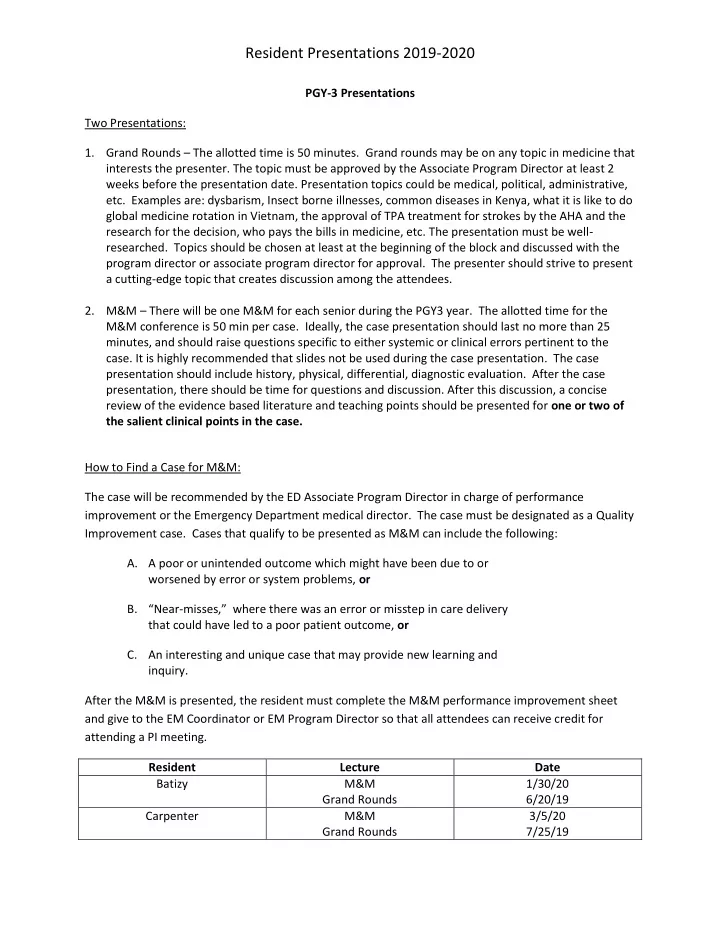
Resident Presentations 2019-2020 PGY-3 Presentations Two Presentations: 1. Grand Rounds The allotted time is 50 minutes. Grand rounds may be on any topic in medicine that interests the presenter. The topic must be approved by the Associate


slide-1
SLIDE 1

Resident Presentations 2019-2020

PGY-3 Presentations Two Presentations:

  • 1. Grand Rounds – The allotted time is 50 minutes. Grand rounds may be on any topic in medicine that

interests the presenter. The topic must be approved by the Associate Program Director at least 2 weeks before the presentation date. Presentation topics could be medical, political, administrative,

  • etc. Examples are: dysbarism, Insect borne illnesses, common diseases in Kenya, what it is like to do

global medicine rotation in Vietnam, the approval of TPA treatment for strokes by the AHA and the research for the decision, who pays the bills in medicine, etc. The presentation must be well-

  • researched. Topics should be chosen at least at the beginning of the block and discussed with the

program director or associate program director for approval. The presenter should strive to present a cutting-edge topic that creates discussion among the attendees.

  • 2. M&M – There will be one M&M for each senior during the PGY3 year. The allotted time for the

M&M conference is 50 min per case. Ideally, the case presentation should last no more than 25 minutes, and should raise questions specific to either systemic or clinical errors pertinent to the

  • case. It is highly recommended that slides not be used during the case presentation. The case

presentation should include history, physical, differential, diagnostic evaluation. After the case presentation, there should be time for questions and discussion. After this discussion, a concise review of the evidence based literature and teaching points should be presented for one or two of the salient clinical points in the case. How to Find a Case for M&M: The case will be recommended by the ED Associate Program Director in charge of performance improvement or the Emergency Department medical director. The case must be designated as a Quality Improvement case. Cases that qualify to be presented as M&M can include the following:

  • A. A poor or unintended outcome which might have been due to or

worsened by error or system problems, or

  • B. “Near-misses,” where there was an error or misstep in care delivery

that could have led to a poor patient outcome, or

  • C. An interesting and unique case that may provide new learning and

inquiry. After the M&M is presented, the resident must complete the M&M performance improvement sheet and give to the EM Coordinator or EM Program Director so that all attendees can receive credit for attending a PI meeting. Resident Lecture Date Batizy M&M Grand Rounds 1/30/20 6/20/19 Carpenter M&M Grand Rounds 3/5/20 7/25/19

slide-2
SLIDE 2

Resident Presentations 2019-2020

Duncan M&M Grand Rounds 12/5/19 4/30/20 Enriquez M&M Grand Rounds 11/7/19 4/2/20 Eriksson M&M Grand Rounds 10/10/19 3/12/20 Granata M&M Grand Rounds 3/26/20 8/29/19 Henschel M&M Grand Rounds 8/1/19 12/12/19 Ho M&M Grand Rounds 4/23/20 9/26/19 Monterroso M&M Grand Rounds 1/2/20 5/28/20 Patten M&M Grand Rounds 6/27/19 11/14/19 Shah M&M Grand Rounds 9/12/19 2/20/20 Sitzmann M&M Grand Rounds 8/15/19 1/16/20 Trinh M&M Grand Rounds 5/21/20 10/17/19

slide-3
SLIDE 3

Resident Presentations 2019-2020

PGY-2 Presentations Two Presentations:

  • 1. Pediatric Topic – One of your choice. You should check with the Associate Program Director or

Program Director to make sure that your topic has not been presented in the last 12 months by another resident. The topic should be limited to a specific area of pediatrics. The presentation should be 25 minutes long. You may play a game but you must discuss this with the Associate Program Director. They are fun but they require much more work. There has to be learning

  • material. Additionally, you will be required to do a presentation as a part of your PICU rotation and

you may be able to use the same topic for this presentation.

  • 2. Evidence-Based Medicine – We will choose a theme for the year – expect an email as your

presentation is approaching. Identify a clinical problem or a question that you’ve encountered in the care of patients passing through Intake. Conduct a literature search on that problem or question and pick an article that you want to present. You must receive approval from the associate program director 2 at least 2 weeks prior to the presentation date. Critique the quality of the information gathered, i.e. are the claims in the article supported by the research. Present the case and the EBM article to support care of the patient. Are there any useful findings in everyday practice? Frequently Asked Questions: Why are we studying this? As new diagnostic tests and treatments become available, physicians have to consider if the way they are practicing medicine is still appropriate. With the increase in medical literature both in printed form and through the Internet, and the increased availability of this information for patients, it is important that physicians learn how to appraise the literature for themselves. They can then apply useful information to their practice. How do I develop a good clinical question? A good clinical question that can be used to search the medical literature has four main parts: Who is the patient or what is the problem being addressed? What is the intervention? What are the alternatives? What are the outcomes? Example: In children under 3 years old (1), is a single Rocephin shot (2) more effective than oral antibiotics (3) to treat recurrent otitis media (4)?

slide-4
SLIDE 4

Resident Presentations 2019-2020

What are the criteria for article selection? All articles should be peer-reviewed and published in a medical/scientific journal. For this exercise, the studies should be limited to experimental designs (randomized controlled trials), the more scientifically convincing epidemiological/observational studies (cohort or case control designs),

  • r some combination of any of the 3 designs.

Keep in mind that many times information from more than one article is necessary to make a good clinical or research-based decision on any particular topic; however, this exercise is only requiring the selection of one article. Articles should be patient oriented (POEM) instead of disease oriented. What is a POEM? POEMS (Patient Oriented Evidence that Matters) refer to medical research that emphasizes outcomes that are important to patients: morbidity and mortality. DOES (Disease Oriented Evidence) emphasize intermediate outcomes. Finally, you may want to ask the advice or perspective of a specialist in the field. Resident Lecture Date Aparicio EBM Pediatrics 5/28/20 9/26/19 Camacho EBM Pediatrics 6/27/19 10/10/19 Chenpanas EBM Pediatrics 12/5/19 4/9/20 Guerrero EBM Pediatrics 9/26/19 1/9/20 Guillen EBM Pediatrics 1/16/20 4/23/20 Guzman-Burgueno EBM Pediatrics 5/7/20 8/22/19 Helm EBM Pediatrics 7/25/19 11/21/19 Henson EBM Pediatrics 10/24/19 2/13/20 Kim EBM Pediatrics 8/22/19 12/19/19 Nichta EBM Pediatrics 9/12/19 6/4/20 Songey EBM Pediatrics 11/7/19 3/12/20 Wells EBM Pediatrics 3/5/20 6/20/19 Zappa EBM Pediatrics 2/13/20 7/18/19

slide-5
SLIDE 5

Resident Presentations 2019-2020

PGY-1 Presentations Two Presentations:

  • 1. Medicine Case - One of your choice. You should check with the Program Director and/or the

Associate Program Director to make sure that your topic has not been presented in the last 12 months by another resident. The topic should be limited to a specific area of medicine. The case should include the history, physical, differential, the diagnostic evaluation, the diagnosis and the teaching points of the case. The first 5 minutes should be the patient presentation. A faculty member will then discuss what the differential and the logic that they used to decide the diagnosis from the differential. The resident will then announce the diagnosis and present a few teaching points about the diagnosis. Since a faculty member is going to be involved, the slides must be complete with the presentation at least 2 weeks in advance so that the faculty member has time to form the differential and decide on a diagnosis.

  • 2. Procedure presentation – You will be assigned a Transitional Year resident to work with and then

present on SLACK. You will be assigned a procedure that you must teach the residents about. The info includes:

 Indications – first day of the week  Contraindications – second day of the week  Benefits & risks (be able to discuss the informed consent) -third day of the week  A link to show the demonstration of the procedure (you may make your own video) – fourth day of the week  A checklist should be made concerning the different steps of the procedure. Examples are available from the Program Director or Coordinator. This is to be sent to the Program Director – fifth day of the week

Resident Lecture Date Liu Medicine Case Procedure 8/15/19 Block 9 Bacon Medicine Case Procedure 9/12/19 Block 10 Trumble Medicine Case Procedure 10/24/19 Block 11 Donn Medicine Case Procedure 11/14/19 Block 12 Starnes Medicine Case Procedure 12/5/19 Block 13 Niechayev Medicine Case 1/2/20

slide-6
SLIDE 6

Resident Presentations 2019-2020

Procedure Block 1 Vega Medicine Case Procedure 2/6/20 Block 2 Guerrero Medicine Case Procedure 3/19/20 Block 3 Gill Medicine Case Procedure 4/9/20 Block 4 Castrillon Medicine Case Procedure 5/7/20 Block 6 Khalifa Medicine Case Procedure 6/4/20 Block 5 Lee Medicine Case Procedure 8/1/19 Block 7 Khushigian Medicine Case Procedure 8/29/19 Block 8