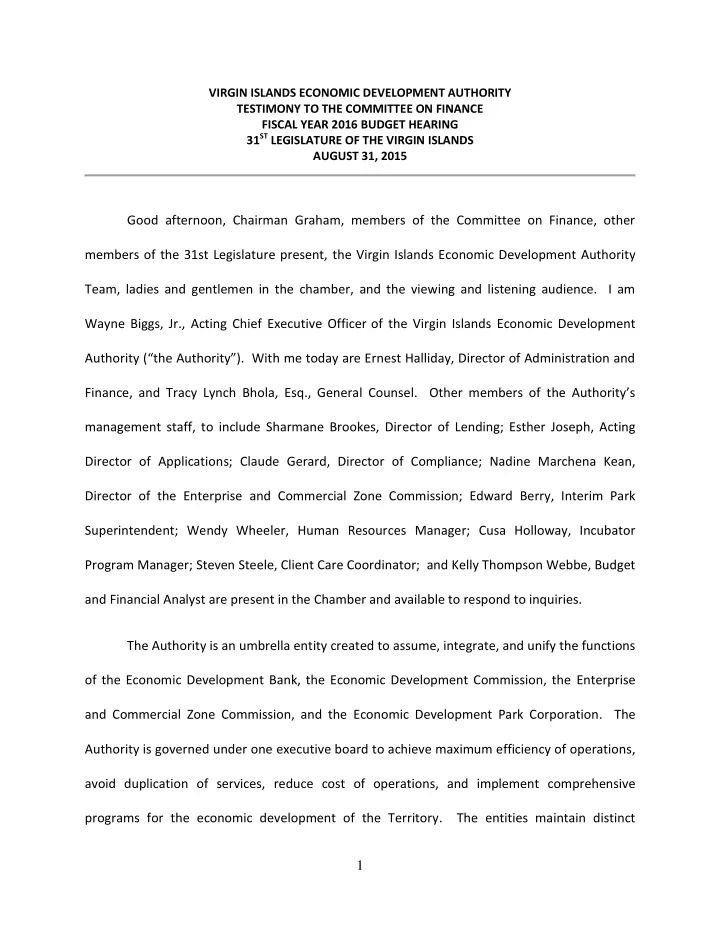
Good afternoon, Chairman Graham, members of the Committee on Finance, - - PDF document

good afternoon chairman graham members of the committee
SMART_READER_LITE
LIVE PREVIEW

Good afternoon, Chairman Graham, members of the Committee on Finance, - - PDF document

VIRGIN ISLANDS ECONOMIC DEVELOPMENT AUTHORITY TESTIMONY TO THE COMMITTEE ON FINANCE FISCAL YEAR 2016 BUDGET HEARING 31 ST LEGISLATURE OF THE VIRGIN ISLANDS AUGUST 31, 2015 Good afternoon, Chairman Graham, members of the Committee on Finance,


slide-1
SLIDE 1

1

VIRGIN ISLANDS ECONOMIC DEVELOPMENT AUTHORITY TESTIMONY TO THE COMMITTEE ON FINANCE FISCAL YEAR 2016 BUDGET HEARING 31ST LEGISLATURE OF THE VIRGIN ISLANDS AUGUST 31, 2015

Good afternoon, Chairman Graham, members of the Committee on Finance, other members of the 31st Legislature present, the Virgin Islands Economic Development Authority Team, ladies and gentlemen in the chamber, and the viewing and listening audience. I am Wayne Biggs, Jr., Acting Chief Executive Officer of the Virgin Islands Economic Development Authority (“the Authority”). With me today are Ernest Halliday, Director of Administration and Finance, and Tracy Lynch Bhola, Esq., General Counsel. Other members of the Authority’s management staff, to include Sharmane Brookes, Director of Lending; Esther Joseph, Acting Director of Applications; Claude Gerard, Director of Compliance; Nadine Marchena Kean, Director of the Enterprise and Commercial Zone Commission; Edward Berry, Interim Park Superintendent; Wendy Wheeler, Human Resources Manager; Cusa Holloway, Incubator Program Manager; Steven Steele, Client Care Coordinator; and Kelly Thompson Webbe, Budget and Financial Analyst are present in the Chamber and available to respond to inquiries. The Authority is an umbrella entity created to assume, integrate, and unify the functions

  • f the Economic Development Bank, the Economic Development Commission, the Enterprise

and Commercial Zone Commission, and the Economic Development Park Corporation. The Authority is governed under one executive board to achieve maximum efficiency of operations, avoid duplication of services, reduce cost of operations, and implement comprehensive programs for the economic development of the Territory. The entities maintain distinct

slide-2
SLIDE 2

2 identities and function independently of one another, only to the extent necessary to execute their specific mandates, but in all other cases operate in an integrated fashion. We are here this afternoon to present the Authority’s Fiscal Year 2016 (“FY 2016”) budget request for your consideration and that of your honorable colleagues. Our FY 2016 budget request is $4.8M, which is $56,000 or 1% less than what was appropriated for Fiscal Year 2015. We are going to manage this reduction through cost- efficient strategies that emphasize data analysis through the use of technology and an introduction of other cost saving measures. We expect to chart a path for improving the quality

  • f life for residents while expanding the tax base.

During this fiscal year, we have delivered improved services in almost every area of the

  • rganization and we continue to work towards increasing our efficiencies.

At this time, I am very pleased to share some of our team’s accomplishments. FINANCIAL ACCOUNTABILITY The Authority continues to perform with integrity at the highest level of accountability and efficiency, having again earned an unqualified audit opinion. An unqualified audit opinion is the highest rating any entity can receive from external auditors. This means that federal grantor agencies and other financial institutions will have the utmost confidence to continue partnership relations.

slide-3
SLIDE 3

3 ECONOMIC DEVELOPMENT BANK (EDB) Last year, as a result of Act 7632 the Government Development Bank and the Small Business Development Agency, two independent lending arms within the Authority, were unified as one entity and renamed the Economic Development Bank (“EDB”). The main

  • bjectives of the EDB are to provide financial and technical resources, including but not limited

to, loan guarantees, medium and long-term credit, and equity infusions to minority, small, medium, and large businesses located in the Territory. The EDB has implemented additional measures to improve its operations, based on the recommendations of the 2013 Inspector General Audit. Those recommendations included, but were not limited to, the establishment of policies and procedures for identifying non- performing loans that can be liquidated in order to present a more accurate financial position

  • f the EDB. We have taken the following steps:

 A loan officer will contact the borrower and start collection action within 10 days of a delinquency;  Prior to loans being referred to local collection agencies all efforts to collect are exhausted in-house using various methods such as deferments, interest only payments, reduced payments, loan restructuring, etc.; and  After 150 days of delinquency, loans are transferred to local collection agencies for further collection efforts which could include legal action. Due to these implementations in the collection process, the delinquency rate has been steadily declining.

slide-4
SLIDE 4

4 Thus far in FY 2015, the EDB has collected $769,776 in loan payments compared to total collections of $774,793 in FY 2014. Hence, at current trends we project total collections of $923,731, which is a 20% increase over last year’s amount. Fifteen (15) direct loan requests, totaling $1.5M are presently being reviewed by the

  • EDB. If approved, this will enhance EDB’s overall portfolio, as well as create a potential 20 new

jobs and retain 21 jobs. STATE SMALL BUSINESS CREDIT INITIATIVE (SSBCI) FUNDING Approximately three (3) years ago, the Territory was awarded $13,168,350 by the U.S. Department of the Treasury to provide direct support for use in programs designed to increase access to credit for small businesses and small manufacturers. Initially, the State Small Business Credit Initiative (“SSBCI”) progressed slowly because the local banks showed little to no interest in the program. Through persistence, dedication and hard work, the Authority has solidified partnerships with the local banks by providing $4,919,920 in financial support to 29 businesses, which resulted in $13,723,540 in local bank

  • loans. These new loans have the potential to create 115 new jobs and save 422 jobs

throughout the Territory. These jobs represent a broad cross-sector of industry types, to include, health, tourism, construction, hospitality and retail. The good news is the Territory has recently received the second of three funding installments in the amount of $4,345,555, which brings the total funding received for this program to $8,691,111. There is $3,515,000 in SSBCI requests from local banks in the pipeline

slide-5
SLIDE 5

5 that will support $7,030,000 in small business loans. The new loan requests should generate approximately 62 new jobs and retain an additional 15 jobs throughout the Territory. This wave of activity is signaling confidence by business owners as they hedge their bets

  • n a more robust economy through the use of this loan program to access capital to expand

their businesses and/or create new business opportunities. VIEDA DISASTER SMALL-MIDSIZED ENTERPRISES INCUBATION PROGRAM The Authority’s Disaster Small-Midsized Enterprises Incubation Program, known locally as the Incubator Program, is funded by a $1M grant from the U.S. Department of Commerce Economic Development Administration. The amount is matched with $200K from the Authority’s operating budget. The grant funds extend over a three-year period and will be expiring in January 2016. The Incubator Program continues to be a driving force for St. Croix’s small business

  • community. We have been able to develop and execute several programs to benefit

entrepreneurs who were either starting their first business or expanding their existing business. Being a strategic resource for the small businesses has helped to integrate other Authority’s products and services into the small business community. The visibility of the Incubator Program has heightened awareness of all divisions within the Authority. The Incubator serves as an informal business university, mentoring entrepreneurs through the process of launching a new business or growing an existing business. The Incubator provides seminars and specialized technical assistance. By providing the

slide-6
SLIDE 6

6 entrepreneurs with readily available complimentary support services and programs, such as legal assistance, bookkeeping, and marketing they will be able to produce sustainable

  • businesses. The program also promotes resource collaboration between local government

agencies and community-based organizations. Throughout this fiscal year, the Incubator program held several community outreach activities, such as:  Small Business Camps – There were two intensive three-day business workshops with 115 participants. The business camps also included 16 weeks of follow-up coaching.  Entrepreneurs Incubator Institute – A yearlong training program that provided 30 new and established entrepreneurs with monthly four-hour sessions on various business related topics.  Pre/Post Disaster Small Business Planning Seminar - This seminar assisted small business owners with creating disaster and business resiliency plans to reduce the likelihood of business closures after a natural disaster.  Small Business Innovative Research (SBIR) and Small Business Technology Transfer (STTR) Seminar – This seminar provides federal funding to small business owners to create and develop products that can be used by the federal government agencies. INCUBATOR SUCCESS STORIES  Nearix, LLC entered into an MOU with UVI to provide internships and also to produce the first UVI student Hackathon, which was held in February 2015.

slide-7
SLIDE 7

7  Island Services Group, LLC completed the Spanish Town Solar Farm Project. This company is currently working on a solar project at the new Margaritaville Hotel in St. Thomas.  Neighborhood Pharmacy, LLC opened in Frederiksted in August 2015. It was successful in securing a small business loan from the Authority’s EDB to assist with opening the business.  Netwave Unlimited Services is a Fiber Optic Technician/Installer Training Program

  • provider. Due to the overwhelming success of the program on St. Croix, the business

has expanded and is now offering classes on St. Thomas. The success of participants of the Incubator Program has resulted in the creation of 66 jobs for residents throughout the Territory. ECONOMIC DEVELOPMENT COMMISSION (EDC) The Economic Development Commission (“EDC”) is charged with the promotion, growth, development and diversification of the economy of the Territory. The EDC’s objective focuses on the development of the human and economic resources in order to create and/or preserve good paying jobs for its citizens and to expand the local tax base. The EDC consists of two (2) related functions – the Applications Division, which is the first point of contact for businesses seeking economic development benefits, and the Compliance Unit, which is responsible for monitoring beneficiaries to ensure that they comply with the terms and conditions of the agreements and other requirements of law.

slide-8
SLIDE 8

8 EDC APPLICATIONS DIVISION The Applications Division received a total of 15 new applications for economic development benefits through July 2015. Of this total, 10 are in the financial and business management sector while the others represent a broad range of business types to include recreational and manufacturing companies. Seven (7) existing beneficiaries submitted requests to either modify or extend their existing EDC certificates. If all 15 of the new applicants are approved, their presence could significantly impact the economy. Within the next five (5) years, these prospective companies will expend over $18.2M in capital investments, as well as, create 132 new jobs. These companies will pay $8.6M in wages and contribute an estimated $1.5M in direct payments to the local tax base. During the same period, twenty-eight (28) EDC applicants appeared before the Economic Development Commission Board for consideration of benefits. Sixteen (16) of the companies were recommended to the governor and twelve (12) were approved. As a direct result of Act No. 7651, the Board also considered thirteen (13) beneficiary requests for extensions of benefits of which eleven (11) were approved. There were thirteen (13) companies that activated their EDC Certificates during this period, which had an immediate impact on the economy. Collectively, these businesses will invest approximately $18.4M over a 5-year span, add or maintain approximately 265 jobs, pay wages and incur other payroll costs of about $27.3M, make in excess of $413K in charitable contributions, and add an estimated $40M to the tax base.

slide-9
SLIDE 9

9 The interest in our EDC Program is strong. There has been an increase in the number of inquiries relative to the EDC program and we are currently in negotiations with five (5) investors with robust interest in doing business in the Territory. EDC COMPLIANCE DIVISION The Compliance Division has adopted an approach that goes beyond just making sure beneficiaries adhere to the terms and conditions of their EDC Certificates. We have established a culture that promotes compliance through collaboration, innovation and partnership. We believe that through teamwork, open communication, creativity and fairness, the program has the greatest chance for success. The Division’s activities include conducting audits of the beneficiaries to ensure compliance with their EDC Certificates. As of July 2015, the Division has conducted compliance audits on eleven (11) companies. Compliance audits of beneficiaries are a continuous process. Our goal is to review companies annually and conduct audits on a two-year cycle. To this end, we are in the process of adding one compliance officer in each district to strengthen the Division. The strategy is to reduce the caseload per compliance officer, which will permit us to conduct more timely audits and provide better client care service. As part of our customer care initiative, compliance orientations are conducted with new

  • beneficiaries. It ensures that companies fully understand what is expected of them during the

benefit period. The compliance staff also conducts site visits to the beneficiaries’ businesses for follow-up training and/or verification of information, as needed. We intend to increase on-site

slide-10
SLIDE 10

10 presence in an effort to strengthen the bond between EDC Beneficiaries and the Authority while improving relationships amongst all stakeholders. Inspector General Audit Report In January of this year, the office of the Inspector General concluded its compliance audit of the Virgin Islands EDC Tax-Incentive Program. The audit revealed that although the EDC tax-incentive program had a positive impact in promoting the growth, development and diversification of the Territory’s economy, there were some areas that required improvement. I am pleased to report that the Compliance Division is aggressively addressing the findings of the Inspector General. The caseload distribution for compliance officers has been redistributed to facilitate the move to a two-year compliance cycle. The Senior Compliance Officer position was established and filled. The Senior Compliance Officer is charged with expediting complex or sensitive compliance reviews, and acts as the senior officer within the unit in regards to planning and guidance. Candidates have been selected to fill two (2) compliance positions (one vacant, one new) in the St. Croix District and we are in the process of filling the new position in St. Thomas. Finally, the Compliance Division is in the process of developing a “self compliance binder” for distribution to existing and new beneficiaries. This binder will be a reporting guide providing instructions to the beneficiaries on “how to” submit pertinent information and supporting documents required to perform the compliance audit.

slide-11
SLIDE 11

11 THE ENTERPRISE AND COMMERCIAL ZONE COMMISSION (EZC) The Enterprise and Commercial Zone Commission (“EZC”) was created to revitalize designated distressed areas in the Territory that were once socially and economically vibrant

  • communities. In order to achieve this important mandate, the EZC provides support and

guidance by offering tax incentives and helping to reduce or eliminate fiscal and regulatory barriers to economic growth and development. Through the tax credit program, owners of properties are encouraged to renovate and to erect structures in the zones to increase business and residential activities. This year, eight (8) applications were received requesting tax credits for renovation or construction in the zones estimated at $2.9M. These investments will create thirty-two (32) jobs for our residents. The EZC accomplishes its mandates through the collaboration of public, private and non- profit entities. The EZC sets its sights on accomplishing various goals. To date, the EZC has surveyed over 984 buildings within the Frederiksted and Savanne-Downstreet Zones with the assistance of three (3) summer interns. Through these surveys, we were able to gather information on the condition and ownership of properties, which will enable us to determine the priorities with regard to future community development. We continually seek to strengthen relationships with our stakeholder organizations. We recognize they are important resources in community development. These organizations include Our Town Frederiksted, Frederiksted Economic Development Association (FEDA), St. Croix Foundation, Christiansted Community Alliance, Garden Street Long Path Association, We

slide-12
SLIDE 12

12 From Upstreet, Community Action Now and the Downstreet People Inc. Members from each of these organizations attended the EZC second annual stakeholders’ conference, which was held in February of this year. The EZC worked hand-in-hand with community stakeholders to create town and neighborhood plans in conformity with the law. In addition to the plans for Frederiksted and Christiansted completed in previous fiscal years, the EZC has completed the Garden Street Plan and will be submitting it to the Governor in the near future. Three (3) submissions for the Upstreet Plan were voted on by community residents and we are awaiting the architects’ written comprehensive plan. A charrette for the Savanne and Downstreet Plans was also held and the plans are in the process of being developed. Work has begun on the implementation of the Frederiksted and Christiansted Plans. This implementation phase includes applying for grants and working with partners and investors to implement critical elements of these plans. Many of the buildings within the zones are owned by multiple owners and often by multiple generations. This is a challenge we attempt to reduce through the Estate Planning Conference held annually in both districts. This year we provided information to over 125 residents. Over time, many of the buildings within the zones have become derelict and

  • abandoned. The EZC is seeking innovative ways to help restore them. This includes the

concept referred to as the Save A Building Program. The idea is to bring together the multiple

  • wners of a building to form a corporation that will be eligible to receive low interest loans to
slide-13
SLIDE 13

13 finance the rehabilitation and upkeep of these properties. We are in the process of applying for a grant to conduct a feasibility study for this concept. The EZC will also be applying for a grant to fund a feasibility study, in conjunction with the Department of Agriculture, for a food processing plant. A food processing plant can extend the shelf-life of a food product and create additional opportunities for export. The EZC is also assisting local manufacturers to market and sell their products locally. The first Business-to-Business event was held in July where local manufacturers were able to meet storeowners who were interested in buying their products. Some of the stores that purchased locally made Virgin Islands products as a result of this event include the Medicine Shoppe Pharmacy, the Owl and the Seahorse and Phantasea Botanical Garden. ECONOMIC DEVELOPMENT PARK CORPORATION (EDPC) The Economic Development Park Corporation (“EDPC”) is chartered as a public corporation to acquire and operate industrial parks in the Territory and to complement activities of the Economic Development Commission (“EDC”). There are two industrial parks –

  • ne on St. Thomas located above the motor pool in Contant and the other known as the

William D. Roebuck Industrial Park in Frederiksted on St. Croix. The Economic Development Park Corporation does not receive any funding from government appropriations. It is self- supported by revenues generated from its tenants. However, additional funding will be needed to make necessary capital improvements to retrofit the Park to an energy efficient and technology-driven modern facility.

slide-14
SLIDE 14

14 At the beginning of this fiscal year, the St. Thomas Park, with 20,000 sq. ft. of rentable space was 75% occupied. Today, it is fully rented. At the William D. Roebuck Industrial Park, the total rental space is approximately 157,000 sq. ft. Approximately 106,320 sq. ft. or 69% is currently occupied. The occupancy level is expected to increase by another 17,080 sq. ft. or 11% by the end of the calendar year as we have commitments from four (4) potential tenants. The goal is to fill the Parks with good tenants whose business activities support the purpose of economic development – that is, to increase job growth, capital formation and the expansion of the local tax base. The opportunity exists to transform the Parks into infrastructures with modern technology incorporated into the business model to attract world class business ventures to the

  • Territory. We envision the William D. Roebuck Industrial Park serving as the corporate business

center for high-value manufacturing and technology entities. INDUSTRIAL PARK ENERGY FEASIBILITY ASSESSMENT Through the U.S. Department of Energy’s Office of American Affairs, an assessment is currently underway at no cost to the Authority to estimate the energy efficiency potential and cost of repurposing the William D. Roebuck Industrial Park to an efficient, resilient and attractive facility for future clean energy commerce and training. This assessment includes several adjacent stakeholders such as the Golden Grove Adult Correctional Facility, the Virgin Islands Police Department Headquarters and the Virgin Islands Waste Management Authority, Anguilla Landfill. The ultimate goal of the assessment and

slide-15
SLIDE 15

15 analysis is to determine whether the Park and its neighbors can achieve a high level of efficiency using clean energy technology while at the same time reducing their energy consumption and cost over the long haul. MARKETING AND PUBLIC RELATIONS The role of the Marketing/Public Relations is to position, promote and communicate the benefits of the Authority’s programs. This is accomplished through promotion of the U.S. Virgin Islands to potential investors and/or advisors, and local promotion of the Authority’s programs that are structured to support indigenous economic growth in the Territory.  External Marketing Initiatives – Our external marketing initiatives continue to focus on four (4) key areas:

  • 1. Product and Proposition Development - Work was done on developing specific

products and propositions to attract more investment interest. A list of projects pursued during the first ten months of this fiscal year includes:

  • Hotel/resort development inventory and documentation
  • University of the Virgin Islands/Industry Collaboration
  • St. Croix Logistics Hub Development
  • Maritime – maintenance, bunkering, yacht services, etc.
  • STARS Act – promoting film and music production
  • 2. Investment Lead Generation and Development – Investment attraction to the

Territory is a primary marketing activity for the Authority and is accomplished through a disciplined sector/company targeting approach. The approach involves an

slide-16
SLIDE 16

16 investment in detailed research to identify the right companies that have the appropriate structure to relocate to the Territory. Here is a summary of key milestones over the first ten (10) months of this fiscal year:

  • 1,200 companies qualified in key target sectors (Financial Services,

IT/E-commerce, Back Office Processing, High Value Manufacturing, Hotel/Resorts and Maritime)

  • 150 potential projects were identified of which 20 are “hot” projects

with active interaction

  • 9 investor site visits hosted on St. Thomas and St. Croix.
  • 13 EDC applications received
  • 3. Marketing Events - The Authority organizes and attends a number of industry events

and conferences during the year to showcase the Territory and recruit investment through panel presentations and sponsorship, and to meet directly with investors and influencers at these events. Here is a list of events that occurred this year:

  • Investment Advisor Forum – U.S. Virgin Islands – October 2014
  • Caribbean Central America Action Annual Meeting – Miami, Florida

– December 2014

  • Shared Services Week – Orlando, Florida – February 2015
  • Caribbean Clean Energy Technology Symposium (CCETS) - U.S. Virgin

Islands – March 2015

slide-17
SLIDE 17

17

  • Investment Briefing Breakfast at the CCETS – U.S. Virgin Islands –

March 2015

  • Caribbean Hotel and Resort Investment Summit – Miami, Florida –

April 2015

  • USVI Investment Forum – U.S. Virgin Islands – July 2015
  • 4. Marketing Communications - Ongoing communications and record-keeping are

critical to managing hundreds of company relations and advance investment projects into the Territory. This fiscal year, we have:

  • Launched a new EDC investor focused micro-site
  • Developed and implemented a Customer Relationship Management

System (CRM) for client record-keeping and reporting

  • Updated fact sheets and investor profiles to reflect management

changes at the Authority

  • Leveraged

the Ambassador Network to develop company relationships and create new investor profiles.  Local Marketing and Public Relations Initiatives - These include:

  • U.S. Virgin Islands Airport Advertisements - These advertisements

remain at the USVI airports for a second year following a contract renewal.

  • Advertisements - Ads have been published in local newspapers to

promote Authority activities.

slide-18
SLIDE 18

18

  • Media Articles - A total of at least 25 positive media articles were

generated and published as of June 30, 2015 in local newspapers, and in regional publications that include The Reporter, the Caribbean Journal and Caribbean News Now! along with 19 pre-event announcements in local newspapers as a result of 44 Authority news releases or media advisories that were issued.

  • TV News Coverage - Television news coverage by CBS-TV2 News on

at least two major positive stories – the Small Business Camp and the Authority’s Breakfast Presentation on the Economic Development Commission tax incentive program at the Caribbean Clean Energy Technology Symposium (CCETS) held in March 2015.

  • Features on VIEDA events aired on VI Access Channel - Small Business

Camp Weekend hosted by the Incubator Program; and the Authority’s Open House hosted by the Enterprise and Commercial Zone Commission at E’s Garden Teahouse and Things in Garden Street (a client of the EDB).

  • VIEDA: Focus on the Marketplace - This radio show is a platform to

discuss the programs and activities. The Authority sponsored radio segment “Why Didn’t I Think of That?” informs the general public about the innovative minds that pursued patents for new inventions. It is our hope that this segment inspires a new generation of entrepreneurs.

slide-19
SLIDE 19

19 FISCAL YEAR 2016 BUDGET PRIORITIES Our primary focus in FY 2016 is to build on the foundation of the past. We want to excel at harnessing and analyzing data from which we can gain insight to make intelligent forecasts and decisions that build an economy that drives economic growth and prosperity that improves the quality of life and expands the local tax base. We have reviewed the CEDS Report of 2015 and the results of recent studies conducted by professional consulting firms to identify opportunities for recruiting and developing new businesses that promote both job creation and private investments in the Territory. The

  • verarching strategies that will guide the Authority in FY 2016 to build an economy for growth

and sustainability include the following: Attracting New Businesses to the Territory By updating the laws governing the EDC Program and its rules and regulations we can improve the program effectiveness and remain attractive to companies that want to take advantage of our tax benefit package and invest in the Territory. Our Board of Directors and the senior management of the Authority have reviewed and are proposing certain changes to the law that is in the process of being forwarded to the Governor. We will be working diligently, through our consultants, for the relaxation of the residency requirements and adjustment of the income sourcing rules. According to one study, if these restrictions were lifted by Congress, the Territory can attract on average 16 additional EDC applicants each year, which may result in more than $304M added to the Gross Territorial Product (GTP). This

slide-20
SLIDE 20

20 increase in the number of EDC firms will result in approximately 1,764 new jobs (direct, indirect and induced) annually. Use of Technology to Generate Data for Decision Making and Improve Efficiencies In today’s fast-paced environment, companies are using technology to collect tremendous amounts of data with relative ease. The data is usually meaningless until they are analyzed and decisions are made timely. We are committed to the full computerization of the Authority’s activities so that employees can concentrate on data analysis rather than on data collection. This creates a level of efficiency that will allow us to respond quickly to changes to economic conditions thereby allowing more time to provide good customer care to our clients. These technological advancements also mean that we will be able to share updated information with

  • ur strategic partners as they too rely on timely and accurate data for good decision-making.

Targeted Industries In order to attract the industry sectors that create jobs, pay higher wages and make significant capital investments, we have to address long-term issues that are affecting the Territory’s competitive position. These include:  low levels of education in the workforce  high cost of electricity and transportation  insufficient investment in public infrastructure There lies the argument for identifying target industries according to short and long- term needs and likelihood of success. There are sectors which would fit well into the Territory

slide-21
SLIDE 21

21 – but over the long-term, major improvements to the education and workforce system, utility rate structures, and transportation costs will have to be resolved. Economic development cannot focus only on the long-term, but must also focus on identifying target industries that can be pursued over the next 12-15 months. The target sectors that we will continue to pursue in FY 2016 include:  Financial Services  Business Process Outsourcing  High-Value Manufacturing  Transportation and Logistics  Information Technology  Agribusiness Supporting Entrepreneurs and Small Businesses Small business is the backbone of every economy, because they create jobs, hire and invest locally. Therefore, in FY 2016, we intend to provide greater assistance to increase the number of new businesses and to provide the required financing for those businesses that wish to expand or just need working capital in order to stay afloat. The Authority administers a number of programs to help the small entrepreneurs:  State Small Business Credit Initiative Program (SSBCI). The final $4.4M installment

  • f a $13.1M grant from the U.S. Department of the Treasury will be available as

collateral to support small business loans that are approved by our local banks in FY

slide-22
SLIDE 22

22

  • 2016. Along with the second tranche that was received recently, these funds will be

leveraged to spur economic activity throughout the Territory.  Incubator Program. Through the Incubator Program, we will continue to offer one-

  • n-one coaching and technical assistance to prospective and existing entrepreneurs.

We will continue to create avenues for small businesses to develop into viable and sustainable economic entities. EDB stands ready to offer financial assistance to those businesses needing financial support.  Disaster Loan Program. The United States EDA awarded $2M in a federal grant matched with $400K of local funding to support natural disaster resiliency and economic diversification in the Territory. We are getting the word out to our small entrepreneurs that money is available as we seek to diversify the economy.  Energy Loan Program. The Authority received $609K in grant funds from the VI Energy Office to be loaned to small businesses to reduce the high cost of energy by installing energy efficient technology. This level of assistance offered to small businesses will help to reduce the cost of doing business and increase their long- term viability.  Small Business Promotion Program. We will continue to assist eligible small businesses succeed in the local and international marketplace by marketing their products domestically and abroad using the premier virtual mall that was created using STEP funds.

slide-23
SLIDE 23

23 In addition to those highlighted above, we will continue to pursue prior initiatives such as the EB-5 Program, Tax Increment Financing, Marine Economic Development, STARS ACT, and Hotel Development Act. CONCLUSION We are encouraged and optimistic because there are signs that the economy is

  • improving. Our data reveals that economic activity in the Territory is on an upswing. The

number of continued inquiries indicate high interest in the EDC program by outside companies who are considering relocating and/or expanding their operations in the Territory; the local banks are providing access to capital as a result of the Authority’s SSBCI program and the EDB has seen an increase in financing request from local applicants who are eager to start or expand their own businesses; based on the overwhelming interest and participation, residents are showing their entrepreneurial spirit in the Incubator Program. The Authority’s Team is committed to delivering on our promises and I thank the entire staff for their service and dedication. I would be remised if I did not acknowledge and recognize their hard work and quality customer care service that led to the Authority being voted the “Best Government Agency” in the Virgin Islands Daily News Readers Poll – Best of the VI 2015

  • n both St. Croix and St. Thomas. I also want to thank the Governing Board of Directors for

their direction and guidance over the past couple of months as they, too, understand the importance of our mandate. I am available to answer your questions at this time.

slide-24
SLIDE 24

24 Thank you.