What is What is gambling, and gambling, and Chinese American - - PDF document

what is what is gambling and gambling and
SMART_READER_LITE
LIVE PREVIEW

What is What is gambling, and gambling, and Chinese American - - PDF document

NICOS Chin NICO S Chinese H Healt alth Coal Coalition Problem Gambling: A Hidden Mission: ion: To Enhance the Health and Well-Being of San Francisco's Chinese Community. Addiction in the Asian Founded in 1985 American Community


slide-1
SLIDE 1

1

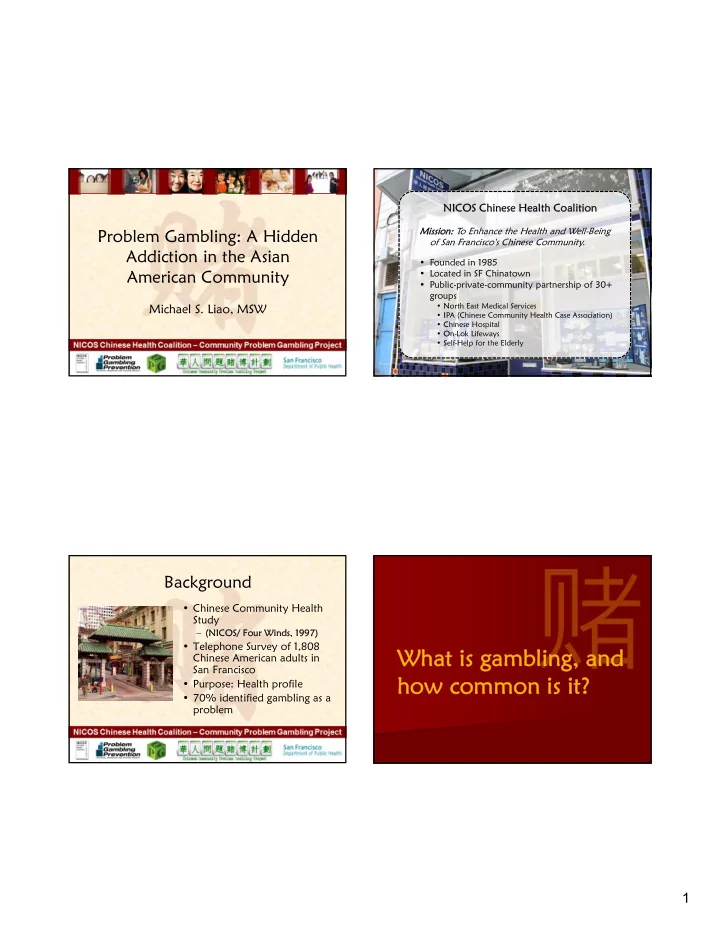
Problem Gambling: A Hidden Addiction in the Asian American Community

Michael S. Liao, MSW

NICO NICOS Chin S Chinese H Healt alth Coal Coalition

Mission: ion: To Enhance the Health and Well-Being

  • f San Francisco's Chinese Community.
  • Founded in 1985
  • Located in SF Chinatown
  • Public-private-community partnership of 30+

groups

  • North East Medical Services
  • IPA (Chinese Community Health Case Association)
  • Chinese Hospital
  • On-Lok Lifeways
  • Self-Help for the Elderly

Background

  • Chinese Community Health

Study

– (NICO (NICOS/ Four Four Winds Winds, 1997 1997)

  • Telephone Survey of 1,808

Chinese American adults in San Francisco

  • Purpose: Health profile
  • 70% identified gambling as a

problem

What is What is gambling, and gambling, and how common is it? how common is it?

slide-2
SLIDE 2

2

Gambling refers to any game of chance

  • r skill that involves a financial risk

Types of Gamblers

  • Socia

Social/C /Cas asua ual

  • 社交賭博
  • At-R

At-Ris isk

  • 高危賭博
  • Prob

Problem

  • 問題賭博
  • Gambling

Gambling Dis Disord rder

  • 賭博性疾患,

, 嗜賭症, , 賭癮

16.9% 70% 9,5% 2.2% 1.5%

Gambling Disorder

Source: California Prevalence Study (Volberg et al. 2006)

American P American Psychiatric ychiatric Association: DMS-5 Association: DMS-5 Criteria Criteria

DSM-5: Gambling Disorder

  • Substance-Related and Addictive Disorders
  • Persistent and recurrent problematic

gambling behavior leading to clinically significant impairment or distress, as indicated by the individual exhibiting four (or more) of the following in a 12 month period:

slide-3
SLIDE 3

3

Signs of Gambling Disorder

1. 1. Toler Toleranc nce: Gambles with increasing amounts of money to achieve excitement. 2.

  • 2. Withdr

Withdrawa awal: Is restless or irritable when attempting to cut down or stop gambling. 3.

  • 3. Inability to

ility to Sto Stop: : Repeated unsuccessful efforts to control, cut back, or stop gambling. 4.

  • 4. Preoc

eoccupatio cupation: n: Thinking about gambling all the time.

Signs of Gambling Disorder

5.

  • 5. Esc

Escape pe: Often gambles when feeling distressed. 6.

  • 6. Chase:

Chase: After losing money gambling, often returns another day to get even. 7.

  • 7. Lies

Lies to conceal the extent of involvement with gambling. 8.

  • 8. Neg

Neglect: t: Jeopardized/ lost significant relationships, job, or

  • ther opportunities because of

gambling. 9.

  • 9. Bail O

Bail Out: t: Relies on others to provide money.

ONE+

Exhibiting any one of these signs may indicate that gambling has become a problem

FOUR+

Exhibiting four or more signs means that a licensed mental health professional could make a diagnosis of gambling disorder

Seeing Signs?

Asian Americans & Asian Americans & Problem Gambling

  • blem Gambling
slide-4
SLIDE 4

4

Problem Gambling among Asian Americans

  • Highe

Higher rates of p rates of probl

  • blem

m gambl gambling ng and addic and addicted gam gambling f foun und:

  • Chinese community members - 14.5% problem gambling;

21% pathological gambling (Wong and Toy, 1999)

  • API University Students - 12.8% probable gambling

disorder (Zhao, Lee, Kuwatani, 2016)

  • API high school students – 11% probable pathological

gambling (Chiu & Woo, 2012)

  • Risk

sk F Factors:

  • rs:
  • Being male, younger, earlier onset of gambling, more

recent immigrant, experience of trauma

Challenges

Cultural Acceptance Immigration-Related Issues Stigma / Help-seeking Behavior Lack of culturally & linguistically appropriate resources Environmental Prevalence Target Marketing

Health Impacts Health Impacts of

  • f

Problem Gambling

  • blem Gambling

Problem Gambler Medical Utilization, Help Seeking Patterns

  • Evans and Delfabbro (2005) found that

PGs did not view treatment services as an

  • ption, but rather as a “last resort”
  • Morasco et al. (2006) found that PGs are

more likely to be treated in the ER in the past year

slide-5
SLIDE 5

5

Symptoms Potential Causes

Tachycardia (Morasco et.al, 2006) Hypertension (Lorenz & Yaffee, 1986) Angina (Morasco et.al, 2006) Headaches (Bergh & Kuhlhorn, 1994,

Lorenz & Yaffee, 1986)

Insomnia (Lorenz & Yaffee, 1986) Skin Problems Gastrointestinal problems such as nausea, ulcers, and colitis (Bergh &

Kuhlhorn, 1994, Lorenz & Yaffee, 1986)

Alteration of heart rhythms Decreased blood flow to the heart Increased body tension Exacerbation of skin conditions Irritation and disruption of the digestive system Cirrhosis and other liver diseases

(Morasco et.al, 2006)

Increased prevalence of alcohol abuse

Physical Health Issues

Neur Neurobiological

  • biological

Basis of Gambling Basis of Gambling Addiction ddiction

This Is Your Brain on Gambling

fMRI of subject anticipating a monetary win in simulated game fMRI of subject anticipating a small amount of cocaine

Breiter et al., 2001

NAc

Are brains of problem gamblers different?

Controls Pathological Gamblers Reuter et al., 2005

slide-6
SLIDE 6

6

  • Pathological Gamblers exhibit lower activity in

prefrontal cortex compared to Non-PGs

  • In performing neuro-cognitive tests, PGs showed

similar dysfunctions in prefrontal cortex as Methamphetamine addicts

Are brains of problem gamblers different?

Potenza et al., 2003

What Can I What Can I do? do?

What Can You Do?

  • Asses

Assess! Ask the right questions: (Brief B

ief Biosoc

  • social

ial Ga Gambli mbling ng Screen BBGS Screen BBGS) 1) During the past 12 months, have you become restless irritable or anxious when trying to stop/cut down on gambling?當您嘗試減少或停止賭博時﹐您是否感到渾身不自 在或脾氣暴躁呢﹖ 2) During the past 12 months, have you tried to keep your family or friends from knowing how much you gambled?是 否曾經對家人或朋友隱瞞自己參與賭博的程度 ﹖ 3) During the past 12 months did you have such financial trouble as a result of your gambling that you had to get help with living expenses from family, friends or welfare? 是 否曾經應因為賭博帶來的經濟絕境而需要倚靠家人,朋友或 社會福利組織來提供金錢 ﹖

What Can You Do?

  • Educat

Educate! e! Provide information. To avoid gambling excessively, learn the facts:

  • Randomness | 隨機性
  • Independence of Events | 事件的獨立性
  • House Advantage | 莊家優勢
  • Set a money limit
  • Set a time limit
  • Leave credit/debit cards at home
  • Avoid borrowing money
  • Have a plan, win or lose

The HOUSE (gambling operator) ALWAYS wins! (in the long run)

slide-7
SLIDE 7

7

彩票號碼Lottery Tickets

2, 10, 18, __, __, __

以下哪三個號嗎最適合用來填滿以上彩票空位來贏得大獎? Which of the following three numbers would best complete the lottery ticket section to provide us with the greatest chance of winning the jackpot? A) A) 19 19, 2 , 20, , 21 B) B) 27, 27, 39, 39, 44 44 C) C) 23, 23, 33, 33, 43 43 D) 20, 20, 30, 30, 40 40 E) E) 任何以上的選擇 | Any | Any of

  • f the Abov

Above

What Can You Do?

  • Educat

Educate! e! Provide information. To avoid gambling excessively, learn the facts:

  • Randomness
  • Independence of Events
  • House Advantage
  • Set a money limit
  • Set a time limit
  • Leave credit/debit cards at home
  • Avoid borrowing money
  • Have a plan, win or lose

The HOUSE (gambling operator) ALWAYS wins! (in the long run)

Tips for family members

DON’ DON’T

– Give gambler money directly – Enable / rescue / fix – Create more drama – Take on burden by yourself

DO DO

– Seek resources for financial planning and stress management – Limit gambler’s access to $$ – Find support

What Can You Do?

  • Refer!

Refer! Provide information about available community resources:

  • Helplines

1-800 1-800-GAMB MBLE LER R

 Calif lifornia C Counci cil o

  • n Proble

lem Ga Gambli ling  English, Cantonese, Mandarin, Spanish, 24/7, statewide

1-8 1-888- 88-96 968- 8-78 7888 88

 NI NICOS Chine COS Chinese He Heal alth Coal Coalition - n - Statewid atewide C e Chinese Pro e Problem G m Gambling ng Hel Helpline  English, Chinese (Mandarin, Cantonese, other dialects), 24/7, SF Bay Area  Includes referrals to mental health as well as financial and legal counseling

slide-8
SLIDE 8

8

Califo California rnia Pro Problem lem Gambl Gambling Resour Resources

Training & outreach

Problem Gambling Technical Assistance & Training (PGTAT) Project

CalGETS Treatment Initiative Bilingual face-to-face counseling

Available throughout CA in over 30 languages/ dialects

Telephone counseling

8 Asian languages/ dialects: Cantonese, Mandarin, Teo-Chow, Taiwanese, Korean, Hindi, Punjabi, Vietnamese

Intensive Outpatient + Residential SoCal & NorCal locations Referrals & resources

Signing up for self-exclusion programs, finding GA meetings, free brochures & booklets, linking to state-sponsored treatment services, referrals to other legal/ financial resources, etc.

All services are cost-free!

Medication Study Duration Results Mood Stabilizers: AI Subtype; high-impulsivity & low planning Lithium (796 mg) Valproate (847 mg) Carbamezapine (600 mg) Pallanti et al. 2002 Haller & Hinterhuber ’94 14 weeks 12 weeks 65% completed Lithium arm 84% completed Valproate arm Gambling cessation @ week 2 Serotonergic System: SRIs & SSRIs: EV Subtype; Comorbid Depression, Obsessive Thoughts Clomipramine (125 mg) Citalopram (35 mg) Nefazodone (346 mg) Paroxetine (57 mg) Paroxetine (10-60 mg) Fluvoxamine (220 mg) Fluvoxamine (195 mg) Fluvoxamine (200 mg) Hollander et al. 1992 Zimmerman et al. 2002 Pallanti et al. 2002 Kim et al. 2002 Grant et al. 2003 Hollander et al. 1998 Hollander et al. 2000 Blanco et al. 2002 10 weeks 12 weeks 8 weeks 1 wk; 8 wks 1 wk; 16 wks 8 weeks 1 wk; 8 wks 24 weeks 90% reduction vs. 24% placebo 53% reduction (86% complete) 62% reduction (75% complete) 12% placebo; 60% red. vs 23% p 8% placebo; 59% red. vs 49% p 70% reduction vs 42% placebo 70% reduction vs 46% placebo 73% reduction vs 59% placebo Opioid Receptor Antagonists: EV/AI Subtypes; Comorbid substance addiction; “urge” or “craving” is strong characteristic Naltrexone (100 mg) Naltrexone (50 mg)+ Naltrexone (157 mg) Naltrexone (188 mg) Kim 1998 Crockford et al. 1998 Kim & Grant, 2001 Kim et al. 2001 36 weeks 4 weeks 6 weeks 1 wk; 12 wks No gambling urges or behaviors Decreased urges to gamble & drink Decreased gambling beh & urges 27% placebo; 75% red vs 24% p Norepinephrine & Dopamine Reuptake Inhibitor Bupropion (150-450 mg) Dannon et al. 2005 12 weeks 75% rated as full responders

  • Treat!

Treat! Medications can help as an adjunct to conventional talk therapy:

What Can You Do?

  • Treat!

Treat! Prescribe diets and lifestyle changes that will improve physical health:

  • Low blood sugar can increase cravings for

addictive behaviors

  • Low blood sugar can also produce withdrawal-like

symptoms and lead to relapse

  • Exercise training increases serotonin levels – in turn

improving sleep, reducing depression & stress

  • Research shows mindfulness practices integrated

into conventional treatment significantly reduces relapse and increases ability to cope with stress

NICOS NICOS Chine Chinese e Healt Health Coali Coalition T el: 4 l: 415-788 788-6426

  • 6426

Helpline: 1 Helpline: 1-888-968-788 888-968-7888 ( 8 (Chinese hinese & & English) English) Email: michael Email: michaelliao@ni

  • @nicosch

coschc.org .org