I ndexi ng strategi es for goal speci fi c retri eval of - - PowerPoint PPT Presentation

i ndexi ng strategi es for goal speci fi c retri eval of
SMART_READER_LITE
LIVE PREVIEW

I ndexi ng strategi es for goal speci fi c retri eval of - - PowerPoint PPT Presentation

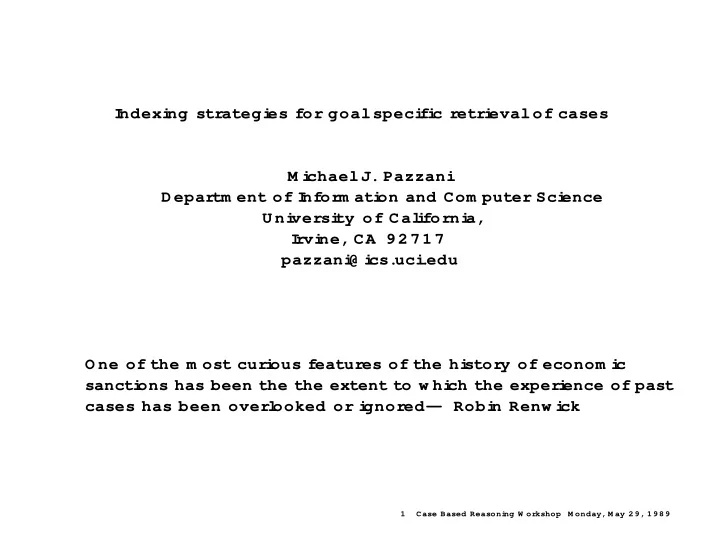
I ndexi ng strategi es for goal speci fi c retri eval of cases M i chael J. Pazzani D epar tm ent of I nfor m ati on and Com puter Sci ence U ni versi ty of Cal i forni a, I rvi ne, CA 92717 pazzani @ i


slide-1
SLIDE 1

I ndexi ng strategi es for goal speci fi c retri eval

  • f

cases M i chael J. Pazzani D epar tm ent

  • f

I nfor m ati

  • n

and Com puter Sci ence U ni versi ty

  • f

Cal i forni a, I rvi ne, CA 92717 pazzani @ i cs. uci . edu O ne

  • f

the m ost curi

  • us

features

  • f

the hi story

  • f

econom i c sancti

  • ns

has been the the extent to w hi ch the exper i ence

  • f

past cases has been

  • verl
  • oked
  • r

i gnored-

  • Robi

n Renw i ck

1 Case Based Reasoni ng W orkshop M onday, M ay 29, 1989

slide-2
SLIDE 2

O utl i ne I . Probl em : retri eval

  • f

i ndi vi dual cases for m ul ti pl e purposes A . Expl anati

  • n
  • B. Predi

cti

  • n

I I . W hy i ndexi ng i s the ri ght w ay to thi nk about retri eval A . Psychol

  • gi

cal

  • 1. Reconstructi

ve m em ory

  • 2. Encodi

ng speci fi ci ty & l evel s

  • f

processi ng

  • B. Com putati
  • nal

Retri evi ng rel evant rather than si m i l ar cases I I I . I ndexi ng strategi es for goal speci fi c retri eval

  • f

cases A . Retri eval

  • f

i ndi vi dual and general i zed cases

  • 1. Type
  • f

pr

  • cessi

ng done at stor age ti m e

  • 2. Content
  • f

retri eval cue

  • 3. G oal
  • f

retri eval

  • B. I

ndi ces

  • 1. Surface

(rather than abstract) features

  • 2. Strategi

c goal (expl ai n vs. predi ct)

  • 3. Featur

e to be expl ai ned

  • r

pr edi cted

2 Case Based Reasoni ng W orkshop M onday, M ay 29, 1989

slide-3
SLIDE 3

Question: What would happen if the United States refused to sell computers to South Korea unless South Korea stopped exporting automobiles to Canada?

OCCAM1:

The goal of the United States that South Korea not sell automobiles to Canada will fail and South Korea will purchase computers from a country which exports

  • computers. This happened when the United

States did not sell grain to the Soviet Union after the Soviet Union invaded

  • Afghanistan. Argentina sold grain to the

Soviet Union. Also, Australia did not sell uranium to France after France exploded nuclear weapons in the South Pacific. South Africa sold uranium to France.

  • 1. O CCA M’

s

  • utput

i s edi ted sl i ghtl y, by addi ng tense i nf

  • r

m ati

  • n

to ver bs.

3 Case Based Reasoni ng W orkshop M onday, M ay 29, 1989

slide-4
SLIDE 4

Question: What would the United States do if Turkey invaded Cyprus?

OCCAM:

The United States would refuse to sell a commodity to Turkey if Turkey invaded

  • Cyprus. This happened when Greece invaded
  • Bulgaria. The League of Nations refused to

sell food to Greece. Also, when the Soviet Union invaded Afghanistan, the United States refused to sell grain to the Soviet Union.

4 Case Based Reasoni ng W orkshop M onday, M ay 29, 1989

slide-5
SLIDE 5

W hy i ndexi ng i s the ri ght w ay to thi nk about retri eval : Reconstructi ve m em ory (Bartl ett, 1932; Schank 1980; Kol

  • dner

1984)

  • A

case i s

  • rgani

zed i n m em ory by the know l edge structures that gui ded the com pr ehensi

  • n
  • f

case. Corol l ary: A case w i l l be i ndexed i n m ul ti pl e pl aces i f m ore than

  • ne

know l edge structure i s accessed duri ng com prehensi

  • n
  • O nl

y those aspects

  • f

a case w hi ch di ffer from those

  • f

the know l edge structure used for com prehensi

  • n

are stored. D i fferi ng features becom e i ndi ces that al l

  • w

retri eval

  • f

the case w hen that feature i s present i n the retri eval cue (or i nferred from i nform ati

  • n

i n the retri eval cue)

  • A s

m ore cases are added to m em ory, addi ti

  • nal

know l edge structures are created to

  • rgani

ze new experi ences.

5 Case Based Reasoni ng W orkshop M onday, M ay 29, 1989

slide-6
SLIDE 6

W hy i ndexi ng i s the ri ght w ay to thi nk about retri eval : Experi m ental Evi dence

  • Sem anti

c m em ory (Freedm an & Loftus, 1971) Categor y (e. g. vegetabl e) & attr i bute (e. g. , gr een) Subj ects presented w i th category before attri bute retri eve exem pl ar m ore rapi dl y than attri bute before category.

  • Epi

sodi c M em ory (Rei ser, Bl ack & A bel son, 1987) A cti vi ty (e. g. Eati ng at a Restaurant) & acti

  • n

(di dn’ t get w hat you w ant) Subj ects presented w i th acti vi ty before acti

  • n

retri eve exem pl ar m ore rapi dl y than acti

  • n

before acti vi ty.

6 Case Based Reasoni ng W orkshop M onday, M ay 29, 1989

slide-7
SLIDE 7

The effect

  • f

processi ng task

  • Level

s

  • f

processi ng (Crai k & Lockhart, 1972) Retri evabi l i ty affected by depth

  • f

processi ng duri ng storage Jacoby & D al l as (1981): Subj ects study w ord l i st: Subj ects answ er questi

  • n

1. A ppearance: I s i t i n capi tal l etters 2. Sound: D oes i t rhym e w i th “teach” 3. M eani ng: I s i t a form

  • f

com m uni cati

  • n

I n test phase: subj ects veri fy that they studi ed w ord. Success Rate: M eani ng 50% < Sound 63% < M eani ng 86%

  • Encodi

ng Speci fi ci ty (Tul vi ng, 1983) Retri eval affected by si m i l ari ty betw een storage and retri eval context Recogni ti

  • n

fai l ure

  • f

recal l abl e w ords. Sei fert (1988) found pri m i ng

  • f

story recal l rel ated to processi ng goal at storage and retri eval

7 Case Based Reasoni ng W orkshop M onday, M ay 29, 1989

slide-8
SLIDE 8

W hy i ndexi ng i s the ri ght w ay to i m pl em ent CBR: Retri eve the m ost rel evant rather than the m ost si m i l ar case

  • A n

i ndex i s a feature

  • f

a case i denti fi ed at storage ti m e that descri bes the si tuati

  • ns

i n w hi ch the case shoul d be retri eved.

  • Proposal

s by W al tz and Thagard & H ol yoak cannot account for si tuati

  • ns

i n w hi ch there i s a uni que i tem speci fi ed by the retri eval cue i n m em ory, but i t i s not retri eved. “Can you thi nk

  • f

an i nci dent i n w hi ch the US threatened a thi rd-w orl d country and a U S adversary hel ped

  • ut?”

“Can you thi nk

  • f

an i nci dent i n w hi ch an Engl i sh speaki ng country threatened an A fri can country and a country that exports pal l adi um hel ped

  • ut?”
  • Proposal

by W al tz assum es that the m em ory processes cannot di sti ngui sh m ost si m i l ar case (accordi ng to the surface features) from the m ost rel evant.

8 Case Based Reasoni ng W orkshop M onday, M ay 29, 1989

slide-9
SLIDE 9

Experi m ental Com pari son

  • f

nearest nei ghbor vs. EBL I nput: D escri pti

  • n
  • f

10

  • r

15 econom i c sancti

  • ns

i nci dents. Test: Predi ct success/fai l ure

  • f

fi ve hypotheti cal i nci dents. 1961 USSR vs. Albania 1976 US vs. Ethiopia threat: Refuse to sell grain threat: Stop aid (57 million) demand: Stop economic ties with China demand: Stop human rights violations

  • utcome: (fail) China sells Albania
  • utcome: (fail) Soviets provide aid

Canadian wheat at lower price 1980 US vs. USSR 1983 Australia vs. France threat: Cut off grain sales threat: Not sell uranium demand: Withdraw troops from demand: Stop nuclear tests Afghanistan

  • utcome: (fail) France buys from
  • utcome: (failure) Buy grain from

South Africa at higher price Argentina at a higher price

9 Case Based Reasoni ng W orkshop M onday, M ay 29, 1989 5 10 15 50 60 70 80 90 100

EBI N earest

N um ber

  • f

Exam pl es A ccuracy

slide-10
SLIDE 10

W hat m akes a good i ndex? I .Rel evant surface features A . H undred step rul e- D eep f eatur es (e. g. , m or al s) cannot be com puted i n ti m e

  • B. “M oral

s and effects are the

  • utputs
  • f

the retri eval process, not i ts i nputs”

  • C. Rel

evant surface features are those surface features that al l

  • w

the sol uti

  • n

to a probl em to be i nferred. I I . A feature rel evant for

  • ne

task m ay not be rel evant for a di fferent task. Processi ng task at storage ti m e becom es part

  • f

i ndex A . Expl anatory I ndi ces “What could cause the price of oil to rise?”

  • B. Predi

cti ve I ndi ces “What would happen if the US refused to sell com- puters to South Korea if South Korea continues to export automobiles to Canada?”

10 Case Based Reasoni ng W orkshop M onday, M ay 29, 1989

slide-11
SLIDE 11

W hat m akes a good i ndex? I I I . D i fferent features

  • f

the sam e case can be expl ai ned

  • r

pr edi cted. The featur e that needs to be expl ai ned

  • r

pr edi cted becom es par t

  • f

the i ndex. A . Predi cti ng the resul t

  • f

an acti

  • n

What would happen if the United States refused to sell computers to South Korea unless South Korea stopped exporting automobiles to Canada?

  • B. Predi

cti ng w hat acti

  • n

w i l l

  • ccur

What would the United States do if Turkey invaded Cyprus? Sum m ary: A n i ndex consi sts

  • f

a tri pl e

  • featur

e and val ue

  • f

a case (or gener al i zed case)

  • descri

pti

  • n
  • f

task :explain or :predict

  • feature

to be expl ai ned

  • r

predi cted.

11 Case Based Reasoni ng W orkshop M onday, M ay 29, 1989

slide-12
SLIDE 12

D eri vi ng I ndi ces I .Feature and val ue (W hat features are predi cti ve) A . A nal yti cal l y: EBL

  • B. Em pi

ri cal l y: SBL I I . Task A . A nal yti cal l y: antecedent/consequent

  • f

dom ai n know l edge

  • B. Em pi

ri cal l y: predi cti veness vs predi ctabi l i ty I I I . Featur e to be pr edi cted (O r expl ai ned) D eterm i ned by processi ng goal

12 Case Based Reasoni ng W orkshop M onday, M ay 29, 1989

slide-13
SLIDE 13

D eterm i ni ng I ndi ces for US-USSR grai n em bargo: Processi ng goal : Expl ai n resul t (USSR buys grai n from A rgenti na) 1. Threat

  • >

I ncreased dem and 2. I ncreased dem and

  • >

W i l l i ngness to pay hi gher pri ce 3. Purchase

  • >

Possess

13 Case Based Reasoni ng W orkshop M onday, M ay 29, 1989

(state type (demand-increase) actor ?X: (polity economic-health (strong))

  • bject ?Y: (commodity availability (common)))

(act type (sell) actor (polity exports ?Y) to ?X

  • bject ?Y

price (money value (>market))) enables

slide-14
SLIDE 14

I ndexi ng i n m em ory by rel evant features

14 Case Based Reasoni ng W orkshop M onday, M ay 29, 1989

coerce (coerce actor (polity exports =OBJECT economy (free)) target (polity economic-health (strong) economy (free) imports =OBJECT) ... response (act type (sell) actor (polity business-rel =TARGET exports =OBJECT)

  • bject =OBJECT

price (money value (>market)) to =TARGET)

  • utcome (goal-outcome type (failure))

actor response target

  • utcome

...

slide-15
SLIDE 15

Resul ts after 15 cases

15 Case Based Reasoni ng W orkshop M onday, M ay 29, 1989

root act coerce agency s1 s2 s3 s4 s5 s6 s7 83-1 80-1 81-3 65-3 82-3 62-1 61-1 68-2 76-3 48-4 33-1 25-1 21-1 61-2 s8 60-3

slide-16
SLIDE 16

Concl usi

  • n
  • I

ndexi ng expl ai ns desi rabl e aspects

  • f

hum an m em ory retri eval

  • Retri

eval

  • f

rel evant exem pl ars by surface features

  • Encodi

ng speci fi ci ty (goal speci fi c retri eval )

  • Cri

ti ci sm by W al tz i ndexi ng caused by m i sunderstandi ng:

  • The

“occasi

  • nal

, breakthrough i nsi ght” that requi res m ore than 100 steps can resul t i n a structure that i s retri eved i n l ess than a 100 steps.

  • I

ndexi ng by those surface features w hose presence i m pl i es a deep feature constructs effi ci ent recogni zers.

  • H i

erarchi cal m em ory search i s not i nherentl y seri al

  • M assi

vel y paral l el m em ory searches (even w i thout i ndexi ng) can m ake use

  • f

speci al l y m arked surface features at storage ti m e.

16 Case Based Reasoni ng W orkshop M onday, M ay 29, 1989