What is Unix? Unix is a multi-user Operating System Pros Intro To - - PowerPoint PPT Presentation

what is unix
SMART_READER_LITE
LIVE PREVIEW

What is Unix? Unix is a multi-user Operating System Pros Intro To - - PowerPoint PPT Presentation

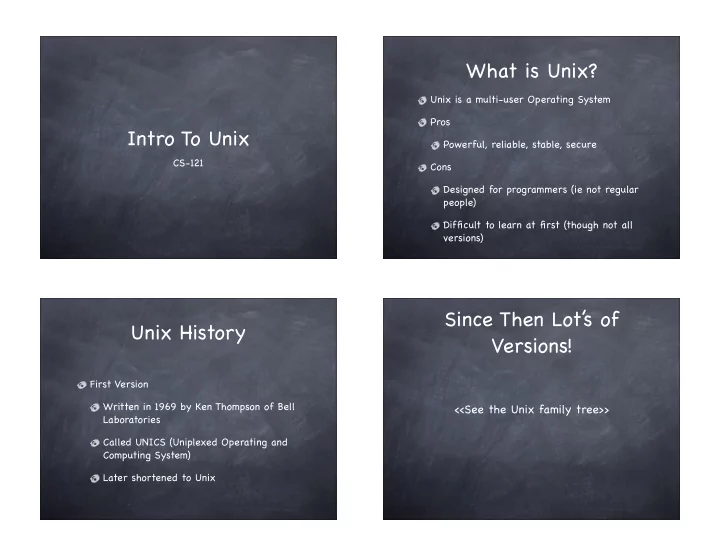
What is Unix? Unix is a multi-user Operating System Pros Intro To Unix Powerful, reliable, stable, secure CS-121 Cons Designed for programmers (ie not regular people) Difficult to learn at first (though not all versions) Since Then Lot


slide-1
SLIDE 1

Intro To Unix

CS-121

What is Unix?

Unix is a multi-user Operating System Pros Powerful, reliable, stable, secure Cons Designed for programmers (ie not regular people) Difficult to learn at first (though not all versions)

Unix History

First Version Written in 1969 by Ken Thompson of Bell Laboratories Called UNICS (Uniplexed Operating and Computing System) Later shortened to Unix

Since Then Lot’ s of Versions!

<<See the Unix family tree>>

slide-2
SLIDE 2

About Unix

Designed from the ground up to be multi- user Different users have different privileges If a user’ s program crashes it should not affect other users etc. Resources: Memory, CPU Time, Disk-space can all be managed between users

Components in Unix

Kernel: The OS itself a program that manages resources and access to the hardware Shell: A program that allows the user to interact with the computer/OS Graphics Shells Command line shells

We’ll be using these pretty standard across all versions of Unix

Interacting with Unix

Things to know about Unix Unix is case sensitive (for file names for commands for everything CaPiTaLiZaTioN Matters) There’ s a singe file hierarchy (ie no A: B: C:) Everything start at the root directory /. The file separator is / (not \)

Example File Hierarchy

slide-3
SLIDE 3

Important Directory Names

. (dot) : The current directory .. (dot dot) : The parent directory ~ (tilde) : Your home directory. A directory which you own. The current directory when you log in.

Command Line Shells

Different users can use different shells: You can switch at anytime. sh : Shell (first shell ever written) ksh : The Korn shell csh : The sea shell tcsh : The “terrific” C shell bash : The Bourne-again shell

We’ll be using this one in

  • class. Default

for Idaho Unix

  • accounts. Lots
  • f neat

features. “easy” to use!

Common Unix Commands

ls : Shows files in the current directory cat file : Prints the specified file to screen cd dir : Changes the current directory pwd : Print the current directory cp file1 file2: Copy file1 to file2

These commands are described in detail in your jargon glossary

Some commands are small programs located in /bin/ Other commands are “built-in” to the shell.

Common Unix Commands

mv file1 file2 : Move (rename) file1 to file2 rm file : Delete (Remove) a file mkdir dir : Make a new directory man command : Find out information about a specific command. ie: man ls

These commands are described in detail in your jargon glossary

slide-4
SLIDE 4

Running a program from the current directory

When you run a program from the current directory you have to specify the full path for security reasons. So to run: program in your current directory you type ./program

Other Unix Programs:Editors

An editor is a word-processor like program that allows you to edit text files. Many Editors Available in Unix vi pico emacs

We’ll be learning emacs -- very powerful: editor takes a while to learn. We’ll go over it in class.

Other Unix Programs: Compilers

A compiler translates a description of a program in a text file into machine code. Different compilers for different programming languages: Pascal, Fortran, C, C+ +, etc. We’ll be using g++, to compile a program in a file called program.cpp we input g++ program.cpp -o program

Login in to your Unix Account

We login to our uidaho Unix accounts using ssh (The secure shell) Secure shell is a shell that works on your current computer and sends all commands to another shell (in our case bash) running remotely on another computer. ssh is secure because everything is encrypted between both machines.

slide-5
SLIDE 5

Login in to your Unix Account

From Home Download (Links are on the website) Putty - Putty is a simple ssh client for windows use it to login remotely to Unix machines Psftp - is used to transfer files between machines

Login in to your Unix Account

From any ITs Windows Lab: Start->Programs->SSH Secure Shell->SSH Client (this may very sightly from one machine to another).

No Graphics Shell with Putty!

You can’t point and click. All of your commands will have to be accessed from the keyboard.

If you want a graphics shell..

If you run any kind of Unix OS: Linux, Mac OS X etc. Just open up a terminal and type: ssh -X will7759@sunsol.uidaho.edu here will7759 is your user name You MUST be running X11 (which is essentially your graphics shell) X11 comes free with all Unix OS

slide-6
SLIDE 6

If you want a graphics shell on Windows

If you run Windows you can use cygwin Cygwin is a Unix emulation layer for windows. It includes X11

When using a graphics shell..

You need a very fast internet connection Cable and DSL may be Okay But not dial-up :-(

Login in Example Working with Files

CS-120

slide-7
SLIDE 7

Review: I/O using cin, cout

cin, cout : Standard input and standard

  • utput.

We can do simple I/O operations by simply redirecting input or output on the command line in Unix. ./my_program < input_file > output_file

cerr, the other standard stream

Besides cin, and cout -- there is cerr cerr is like cout except that it is meant to

  • utput error messages

cerr is useful : when you redirect output, you’ll still see an error on the screen

Redirecting cerr

To redirect both cout and cerr from Unix do ./program &> output_file.txt

Redirecting stderror/ stdoutput

./program 2>err.out 1>output.out

slide-8
SLIDE 8

Redirecting Output to Another program

./program1 | ./program2 Examples ls | less ls lists all directories less shows input one page at a time