Web-Based Information Publishing On the Web Systems Publishing - - PowerPoint PPT Presentation

web based information publishing on the web systems
SMART_READER_LITE
LIVE PREVIEW

Web-Based Information Publishing On the Web Systems Publishing - - PowerPoint PPT Presentation

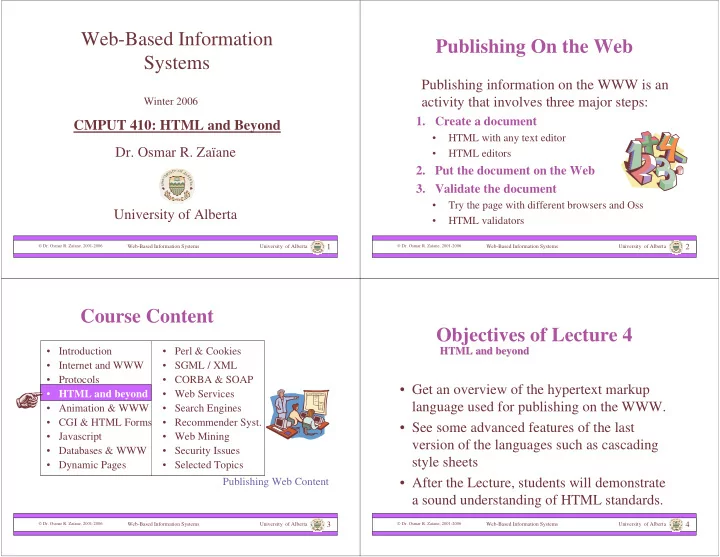
Web-Based Information Publishing On the Web Systems Publishing information on the WWW is an activity that involves three major steps: Winter 2006 1. Create a document CMPUT 410: HTML and Beyond HTML with any text editor Dr. Osmar R.


slide-1
SLIDE 1

Web-Based Information Systems University of Alberta

 Dr. Osmar R. Zaïane, 2001-2006

1

Web-Based Information Systems

  • Dr. Osmar R. Zaïane

University of Alberta

Winter 2006

CMPUT 410: HTML and Beyond

Web-Based Information Systems University of Alberta

 Dr. Osmar R. Zaïane, 2001-2006

2

Publishing On the Web

Publishing information on the WWW is an activity that involves three major steps:

  • 1. Create a document
  • HTML with any text editor
  • HTML editors
  • 2. Put the document on the Web
  • 3. Validate the document
  • Try the page with different browsers and Oss
  • HTML validators

Web-Based Information Systems University of Alberta

 Dr. Osmar R. Zaïane, 2001-2006

3

  • Perl & Cookies
  • SGML / XML
  • CORBA & SOAP
  • Web Services
  • Search Engines
  • Recommender Syst.
  • Web Mining
  • Security Issues
  • Selected Topics

Course Content

  • Introduction
  • Internet and WWW
  • Protocols
  • HTML and beyond
  • Animation & WWW
  • CGI & HTML Forms
  • Javascript
  • Databases & WWW
  • Dynamic Pages

Publishing Web Content

Web-Based Information Systems University of Alberta

 Dr. Osmar R. Zaïane, 2001-2006

4

Objectives of Lecture 4

  • Get an overview of the hypertext markup

language used for publishing on the WWW.

  • See some advanced features of the last

version of the languages such as cascading style sheets

  • After the Lecture, students will demonstrate

a sound understanding of HTML standards.

HTML and beyond HTML and beyond

slide-2
SLIDE 2

Web-Based Information Systems University of Alberta

 Dr. Osmar R. Zaïane, 2001-2006

5

Outline of Lecture 4

  • What is HTML?
  • Basic HTML
  • Building Lists
  • Tables
  • Frames
  • Image Maps
  • Validating HTML pages
  • Cascading Style Sheets

Web-Based Information Systems University of Alberta

 Dr. Osmar R. Zaïane, 2001-2006

6

Web Publishing with HTML

  • HTML stands for HyperText Markup Language.
  • Language format based on SGML.
  • Non-proprietary language.
  • Based on a set of tags that indicate how

document-content should be rendered.

  • There are many versions of HTML and different

browsers have their own add-ons.

Web-Based Information Systems University of Alberta

 Dr. Osmar R. Zaïane, 2001-2006

7

History of HTML

  • HTML was originally developed by Tim Berners-Lee in

CERN in 1990. HTML+ (1993) was later abandoned.

  • HTML 2.0, now obsolete, was ratified by the IETF in 1994.
  • HTML 3.0 was abandoned due to lack of compromise

between major browsers

  • HTML 3.2 (less than HTML 3.0) along with HTML 4.0, it is the

most used standard today (since 1997)

  • HTML 4.0 (end of 1997) brought new enhancements.
  • XHTML 1.0 is a combination of HTML4 and XML (used in our textbook).
  • XHTML 1.1 is the latest recommendation of the W3C.

Web-Based Information Systems University of Alberta

 Dr. Osmar R. Zaïane, 2001-2006

8

Major Syntax Components

  • <TAG parameters="values"> text </TAG>
  • <TAG parameters="values">
  • You may have many parameters or no parameters

at all.

  • HTML is not case sensitive
  • Values can be case sensitive
  • Tags for changing appearance of text, tags for

structuring sections, tags for embedding objects, etc.

slide-3
SLIDE 3

Web-Based Information Systems University of Alberta

 Dr. Osmar R. Zaïane, 2001-2006

9

Do We Have to Know HTML?

  • There are many HTML editors and publishing software

that generate HTML.

  • We can create web pages without knowing HTML.
  • However, HTML editors do not generate correct HTML and

the generated HTML is not easy to update.

  • Many HTML editors do not deal with style sheets and

JavaScript that can add neat functionalities.

  • In order to write web-based application one need to

know HTML since server-side scripts and programs generate HTML.

Web-Based Information Systems University of Alberta

 Dr. Osmar R. Zaïane, 2001-2006

10

Outline of Lecture 4

  • What is HTML?
  • Basic HTML
  • Building Lists
  • Tables
  • Frames
  • Image Maps
  • Validating HTML pages
  • Cascading Style Sheets

Web-Based Information Systems University of Alberta

 Dr. Osmar R. Zaïane, 2001-2006

11

Page Structure

<!DOCTYPE HTML PUBLIC "-//W3C//DTD HTML 4.0 Transitional//EN"> <HTML> <HEAD> <TITLE>title text here</TITLE> </HEAD> <BODY BGCOLOR=“#00FF00”> Text and tags come here </BODY> </HTML>

title text here

Head Body

Web-Based Information Systems University of Alberta

 Dr. Osmar R. Zaïane, 2001-2006

12

What Comes in the Head?

<HEAD> …… </HEAD> Header section of the HTML page Optional Head elements:

  • <TITLE> …</TITLE>

Title of page

  • <BASE HREF="…">

Starting location for relative URLs

  • <SCRIPT …>…</SCRIPT>

Embedded script programs

  • <STYLE …>…</STYLE>

Specify cascading style sheets

  • <LINK …>

Creates associations between pages Useful for printing linked pages

  • <META…>

Records document information Name and Content <META Name="author" Content="O. Zaiane"> HTTP-EQUIV <META HTTP-EQUIV="Expires" Content="Sun, 31 Dec 2000 23:59"> <HTTP-EQUIV="PRAGMA" CONTENT="NO-CACHE"> Refresh and set-cookies are other example

  • And many others
slide-4
SLIDE 4

Web-Based Information Systems University of Alberta

 Dr. Osmar R. Zaïane, 2001-2006

13

What Comes in the Body?

<BODY …> …… </BODY> Body section of the HTML page Optional parameters for BODY tag:

  • BACKGROUND

Specifies URL of an image to display in the background

  • BGCOLOR

Specifies the color of the background

  • TEXT

Specifies the color of the text

  • LINK

Specifies the color of the unvisited hyperlinks

  • VLINK

Specifies the color of the visited hyperlinks

  • ALINK

Specifies the color of the links currently selected <BODY BCKGROUND="http://www.somewhere.ca/image.gif" BGCOLOR="#FFFF00" TEXT="#000000" LINK="#0000FF" VLINK="#800000" ALINK="#008080"> … </BODY>

http://devedge.netscape.com/library/manuals/1998/htmlguide/colortab.html

Web-Based Information Systems University of Alberta

 Dr. Osmar R. Zaïane, 2001-2006

14

Some HTML Tags

Headers: <H1>Header 1</H1> <H2>Header 2</H2> <H3>Header 3</H3> <H4>Header 4</H4> <H5>Header 5</H5> <H6>Header 6</H6> <H? ALIGN=left|right|center>...</H?> Horizontal line: <HR> <HR SIZE=4> <HR WIDTH="50%">

title text here

Some useful tags: Header 1

Header 2

Header 3

Header 4

Header 5

Header 6 Web-Based Information Systems University of Alberta

 Dr. Osmar R. Zaïane, 2001-2006

15

Some HTML Tags – con’t

Line breaks and Paragraphs: Line 1 and <BR>Line 2 <P>Paragraph</P> <P ALIGN=left|right|center>...</P> Can also use <DIV>…</DIV> See also <NOBR>…</NOBR> and <WBR> Bold Text and Underlined Text: <B>Bold Text</B> (or <STRONG>…</STRONG>) <TT>Teletype text</TT> <U>Underlined text</U> <S>Striked text</S> (or <STRIKE>…</STRIKE>) <I>Italic Text</I> <BLINK>blinking text</BLINK>

title text here

Some useful tags:

Line 1 and Line 2 Paragraph Bold Text Teletype text Underlined text Striked text Italic Text

Web-Based Information Systems University of Alberta

 Dr. Osmar R. Zaïane, 2001-2006

16

Some HTML Tags – con’t

Descriptive markup: <ADDRESS>Contact info</ADDRESS> <BLOCKQUOTE>some text</BLOCKQUOTE> <CODE>some code</CODE> <VAR>myVar</VAR>

Rendering depends upon browser

also <KBD>…</KBD> <DFN>…</DFN> <CITE>…</CITE> etc.

Text sections: <PRE>Text is unchanged &amp; 1&lt;2</PRE> <XMP>Interpretation off 2>1</XMP>

title text here

Some useful tags:

Contact info some text Some code myVar

Text unchanged & 1<2 Interpretation off 2>1

Special characters in HTML

is used to enclose to text to be presented literally. It is unfortunately an obsolete HTML element since 4.0.

slide-5
SLIDE 5

Web-Based Information Systems University of Alberta

 Dr. Osmar R. Zaïane, 2001-2006

17

Some HTML Tags – con’t

Hyperlinks: <A HREF="http://www.ualberta.ca" TARGET="_TOP"> This a link to UofA</A> <A NAME="section1">text section 1</A> Font sizes and Colours: <FONT SIZE=4>this is size 4,</FONT> <FONT SIZE=5>while this is size 5</FONT> <FONT COLOR="red">This is red</FONT> <FONT COLOR="white">and this is white</FONT> <FONT COLOR="cyan" SIZE=4 FACE="arial">all parameters</FONT>

title text here

Some useful tags:

This a link to UofA text section 1

This is size 4, while

this is size 5 This is red and this is white

all parameters http, mailto, ftp, file, about

Use URL with # to link internally

Web-Based Information Systems University of Alberta

 Dr. Osmar R. Zaïane, 2001-2006

18

Some HTML Tags – con’t

More on sizes: <BIG>this is bigger,</BIG> <SMALL>this smaller</SMALL> <BASEFONT SIZE=3> The 11<SUP>th</SUP> is in superscript and x<SUB>2</SUB> is subscript

title text here

Some useful tags: this is bigger

this is smaller

The 11th is superscript and x2 is subscript

Web-Based Information Systems University of Alberta

 Dr. Osmar R. Zaïane, 2001-2006

19

Some HTML Tags – con’t

Embedding images: <IMG SRC="MyFile.gif" WIDTH=100 HEIGHT=200> <IMG SRC="MyFile.gif" ALIGN="right">text comes here <IMG SRC="MyFile.gif" ALIGN="left">text comes here <IMG SRC="MyFile.gif" ALIGN="top">text comes here <IMG SRC="MyFile.gif" ALIGN="bottom">text comes here <IMG SRC="MyFile.gif" ALIGN="middle">text comes here <IMG SRC="MyFile.gif" ALT="alternative text"> Other parameters: HSPACE, VSPACE, BORDER, USEMAP, ISMAP, LOWSRC, NAME

title text here

Some useful tags:

text comes here text comes here text comes text comes here here text comes here [alternative text]

Web-Based Information Systems University of Alberta

 Dr. Osmar R. Zaïane, 2001-2006

20

Some HTML Tags – con’t

Embedding objects: Embedding video, audio, VRML, and other formats via Plug-ins < EMBED SRC="…" …> …</EMBED> with generic attributes such as WIDTH and HEIGHT as well as plug-in- specific attributes such as AUTOSTART, etc. Embedding applets <APPLET CODE="…" WIDTH=xxx HEIGHT=yyy …> <PARAM NAME="…" VALUE=“…”> … </APPLET> Embedding ActiveX components <OBJECT CLASSID="…" …> … </OBJECT> (compromises security,

good only for intranets)

Some useful tags:

slide-6
SLIDE 6

Web-Based Information Systems University of Alberta

 Dr. Osmar R. Zaïane, 2001-2006

21

Outline of Lecture 4

  • What is HTML?
  • Basic HTML
  • Building Lists
  • Tables
  • Frames
  • Image Maps
  • Validating HTML pages
  • Cascading Style Sheets

Web-Based Information Systems University of Alberta

 Dr. Osmar R. Zaïane, 2001-2006

22

Some HTML – con’t

Ordered lists: <OL> <LI>element 1</LI> <LI>element 2</LI> <LI>element 3</LI> </OL> <OL TYPE=A START=4 COMPACT> <LI>element 1</LI> <LI>element 2</LI> <LI>element 3</LI> </OL>

title text here

Some useful tags:

  • 1. element 1
  • 2. element 2
  • 3. element 3
  • D. element 1
  • E. element 2
  • F. element 3

TYPE: 1 Arabic numbers A Alphabetic uppercase a Alphabetic lowercase I Roman numeral uppercase i Roman numeral lowercase

<LI TYPE="xxx" VALUE="yyy">…</LI>

Web-Based Information Systems University of Alberta

 Dr. Osmar R. Zaïane, 2001-2006

23

Some HTML – con’t

Unordered lists: <UL> <LI>element 1</LI> <LI>element 2</LI> <LI>element 3</LI> </UL> <UL TYPE=SQUARE> <LI>element 1</LI> <LI>element 2</LI> <LI>element 3</LI> </UL>

title text here

Some useful tags:

  • element 1
  • element 2
  • element 3
  • element 1
  • element 2
  • element 3

<LI TYPE="xxx">…</LI>

TYPE: DISC

  • CIRCLE
  • SQUARE

Web-Based Information Systems University of Alberta

 Dr. Osmar R. Zaïane, 2001-2006

24

Some HTML – con’t

Definition lists: <DL COMPACT> <DT>definition term1 </DT> <DD>element 1 description comes here </DD> <DT>definition term2 </DT> <DD>element 2 description comes here </DD> </DL> Definition lists with image bullets: <DL> <DT><IMG SRC="soccer.gif" ALT="*"> element 1 <DT><IMG SRC="soccer.gif" ALT="*"> element 2 </DL>

title text here

Some useful tags:

definition term1 element 1 description comes here definition term2 element 2 description comes here element 1 element 2

slide-7
SLIDE 7

Web-Based Information Systems University of Alberta

 Dr. Osmar R. Zaïane, 2001-2006

25

Outline of Lecture 4

  • What is HTML?
  • Basic HTML
  • Building Lists
  • Tables
  • Frames
  • Image Maps
  • Validating HTML pages
  • Cascading Style Sheets

Web-Based Information Systems University of Alberta

 Dr. Osmar R. Zaïane, 2001-2006

26

Basic Structure of Tables

Tables: <TABLE BORDER=1 WIDTH=100%> <TR> <TH>Title1</TH><TH>Title 2</TH> </TR> <TR> <TD>data 1</TD><TD>data 2</TD> <TR> <TR> <TD>data 3</TD><TD>data 4</TD> </TR> </TABLE>

title text here

Title 1 Title 2 data 1 data 2 data 3 data 4

In XHTML, there are also tags to identify the head, body and foot of a table:

<THEAD></THEAD>, <TBODY></TBODY>, <TFOOT></TFOOT>

Web-Based Information Systems University of Alberta

 Dr. Osmar R. Zaïane, 2001-2006

27

Tables in Tables

<TABLE BORDER=1 WIDTH=100%> <TR> <TH>Title1</TH><TH>Title 2</TH> </TR><TR> <TD>data 1</TD><TD>data 2</TD> </TR><TR> <TD>data 3</TD> <TD><TABLE><TR><TD>1</TD> <TD>2</TD> </TR> </TABLE> </TD> </TR> </TABLE>

title text here

Title 1 Title 2 data 1 data 2 data 3 1 2

Web-Based Information Systems University of Alberta

 Dr. Osmar R. Zaïane, 2001-2006

28

Table Parameters

  • BORDER
  • ALIGN
  • WIDTH
  • CELLSPACING
  • CELLPADDING
  • BGCOLOR
  • <CAPTION ALIGN=...>…</CAPTION>
  • BORDERCOLOR (non standard)
  • FRAME (non standard)
slide-8
SLIDE 8

Web-Based Information Systems University of Alberta

 Dr. Osmar R. Zaïane, 2001-2006

29

Rows and Cells Parameters

  • TR
  • ALIGN
  • VALIGN
  • BGCOLOR
  • TH and TD
  • COLSPAN
  • ROWSPAN
  • ALIGN
  • VALIGN
  • BGCOLOR
  • WIDTH
  • HEIGHT
  • NOWRAP

Web-Based Information Systems University of Alberta

 Dr. Osmar R. Zaïane, 2001-2006

30

Tables and Page Layout

<TABLE BORDER=0 WIDTH="100%"> <TR> <TD rowspan=2><IMG SRC=MyFile.gif> </TD> <TD> Line1</TD> </TR> <TR> <TD> Line 2 </TD> </TR> <TR> <TD>data 1</TD> <TD>data 2</TD> </TR> </TABLE>

title text here

Line 1 Line 2

Borderless tables can be useful for web page layout.

data 2 data 1

Web-Based Information Systems University of Alberta

 Dr. Osmar R. Zaïane, 2001-2006

31

Outline of Lecture 4

  • What is HTML?
  • Basic HTML
  • Building Lists
  • Tables
  • Frames
  • Image Maps
  • Validating HTML pages
  • Cascading Style Sheets

Web-Based Information Systems University of Alberta

 Dr. Osmar R. Zaïane, 2001-2006

32

The Frames

  • Frames present a different template for HTML

documents They were introduced as a standard in

HTML 3.2.

  • Rather than HEAD and BODY, the document has

HEAD and FRAMESET.

  • The FRAMESET divides the document in a set of

frames, each referring to a URL.

  • Frames contain sub documents, however, while a

frame is an HTML document per se, the set of frames is also a document. (Web document view)

slide-9
SLIDE 9

Web-Based Information Systems University of Alberta

 Dr. Osmar R. Zaïane, 2001-2006

33

The Frames

top parent self

<!DOCTYPE HTML PUBLIC "-//W3C//DTD HTML 4.0 Transitional//EN"> <HTML> <HEAD> <TITLE>title text here</TITLE> </HEAD> <FRAMESET ROWS="50,*"> <FRAME SRC="MyPage.html"> <FRAMESET COLS="*,*"> <FRAME SRC="P1.html"> <FRAME SRC="P2.html"> </FRAMESET> </FRAMESET> <NOFRAME> <BODY>You need another browser</BODY> </NOFRAME> </HTML>

Head Frames

title text here

Web-Based Information Systems University of Alberta

 Dr. Osmar R. Zaïane, 2001-2006

34

The Different Framesets

Having rows: <FRAMESET ROWS=row1Size, row2Size, row3Size,…> Size could be number of pixels, a percentage, or undetermined <FRAMESET ROWS="50,*"> <FRAMESET ROWS="10%,*">

<FRAMESET ROWS="*,*"> = <FRAMESET ROWS="50%,50%">

Having columns: <FRAMESET COLS=col1Size, col2Size,col3Size,…> <FRAMESET COLS="*,*"> Other parameters: FRAMEBORDER, FRAMESPACING, BORDERCOLOR…

Web-Based Information Systems University of Alberta

 Dr. Osmar R. Zaïane, 2001-2006

35

The Element FRAME

  • A FRAME can contain another FRAMESET.
  • A FRAME has a NAME and SRC.
  • Other parameters: FRAMEBORDER, BORDERCOLOR,

NORESIZE, SCROLLING, MARGINWIDTH, MARGINHEIGHT,… <NOFRAME>…</NOFRAME> is to display a

message for browsers that do not support frames.

Web-Based Information Systems University of Alberta

 Dr. Osmar R. Zaïane, 2001-2006

36

Targeting a Frame

  • You can target a different frame to open an HTML

document. <FRAME SRC="myPage.html" NAME="main"> … <A HREF="NEWPAGE.html" TARGET="main">

  • There are predefined names

_blank, _top, _parent and _self.

top self

title text here

slide-10
SLIDE 10

Web-Based Information Systems University of Alberta

 Dr. Osmar R. Zaïane, 2001-2006

37

Why Avoid Frames?

  • The concept of a web document changes.
  • The meaning of the “Back” and “Forward”

becomes confusing to some users.

  • Poorly designed frames can get the user lost and

frustrated.

  • It is difficult to find the URL of a HTML file

contained in a frame. difficult to bookmark, print, etc.

  • Some browsers do not support frames.
  • Framed documents are not validated by SGML.

Web-Based Information Systems University of Alberta

 Dr. Osmar R. Zaïane, 2001-2006

38

Outline of Lecture 4

  • What is HTML?
  • Basic HTML
  • Building Lists
  • Tables
  • Frames
  • Image Maps
  • Validating HTML pages
  • Cascading Style Sheets

Web-Based Information Systems University of Alberta

 Dr. Osmar R. Zaïane, 2001-2006

39

What are Image Maps?

Contact People Admission Search Admin Research Courses Home

Seeds Tools Machinery Home Trees Vegetables Summer Tips Winter Tips Search Your Cart

Examples An image-map is an image that serves as a menu: Clicking different areas lead to different URLs.

Web-Based Information Systems University of Alberta

 Dr. Osmar R. Zaïane, 2001-2006

40

Server-Side Image Map

  • <A href="mycgi.cgi">

<IMG SRC="MyImage.gif" ISMAP>

</A>

  • ISMAP causes the image to be used as a server-

side image map. The browser send the coordinates

  • f the point clicked to the cgi on the server. The

cgi determines what to do.

  • Rarely used today (connection overhead).
slide-11
SLIDE 11

Web-Based Information Systems University of Alberta

 Dr. Osmar R. Zaïane, 2001-2006

41

Client-Side Image Map

  • <IMG SRC="MyImage.gif" USEMAP="mapname">

<MAP NAME="mapname">…</MAP>

  • The MAP tag section identifies areas that could

be clicked.

  • <AREA ALT="…" HREF="…"…>
  • Parameters could be:

– SHAPE (RECT, CIRCLE, POLY), COORDS – Also NOHREF

Web-Based Information Systems University of Alberta

 Dr. Osmar R. Zaïane, 2001-2006

42

Adding Comments

  • Comments can be added to an HTML file.
  • Comments are ignored by the HTML interpreter.

<!-- These are comments --> <!-- These are also comments

  • ->

Web-Based Information Systems University of Alberta

 Dr. Osmar R. Zaïane, 2001-2006

43

Outline of Lecture 4

  • What is HTML?
  • Basic HTML
  • Building Lists
  • Tables
  • Frames
  • Image Maps
  • Validating HTML pages
  • Cascading Style Sheets

Web-Based Information Systems University of Alberta

 Dr. Osmar R. Zaïane, 2001-2006

44

HTML Validators

  • Browsers try to guess how to render pages in

presence of incorrect HTML.

  • Browsers don’t guess the same way.
  • When there is incorrect HTML the result is

unpredictable.

  • With errors, some pages may still look fine with

some browsers but not with others.

  • Some browser specific HTML is non conform to

the standards.

  • W3C HTML validation service http://validator.w3.org
slide-12
SLIDE 12

Web-Based Information Systems University of Alberta

 Dr. Osmar R. Zaïane, 2001-2006

45

Outline of Lecture 4

  • What is HTML?
  • Basic HTML
  • Building Lists
  • Tables
  • Frames
  • Image Maps
  • Validating HTML pages
  • Cascading Style Sheets

Web-Based Information Systems University of Alberta

 Dr. Osmar R. Zaïane, 2001-2006

46

What are Style Sheets?

  • HTML contained tags to indicate how to render

pages: tags for structure and tags for style.

  • The idea of style sheets is to separate page

content and page style (text vs. colour, font, format, etc.).

  • Cascading Style Sheets (CSS) is a technology

used as an addition to HTML and gives a sophisticated way to specify how content should be rendered (in style).

Web-Based Information Systems University of Alberta

 Dr. Osmar R. Zaïane, 2001-2006

47

Cascade of Rules

  • CSS are sets of style rules to customize HTML

elements.

  • Style rules can be: external (imported), inline

(within an HTML element), or embedded (declared in a document).

  • They could be different styles applied for the same

text section.

  • There are general rules for determining the

precedence (cascading) of the styles.

Web-Based Information Systems University of Alberta

 Dr. Osmar R. Zaïane, 2001-2006

48

Specifying Style Rules

The syntax for specifying style properties is: selector {property : value}

  • r

selector {property1 : value1; property2: value2; … propertyN : valueN}

Notice it is property:value NOT property=value

slide-13
SLIDE 13

Web-Based Information Systems University of Alberta

 Dr. Osmar R. Zaïane, 2001-2006

49

Style Properties

  • There are many properties pertaining to:

font, size, colour, background, margins, borders, width, height, alignment, text appearance, etc. (and even position as we shall see later)

  • Not all properties are recognized by both major

browsers Netscape and IE.

  • Conform to W3C CSS-level1 and CSS-level2.
  • There are also validators for CSS.

Web-Based Information Systems University of Alberta

 Dr. Osmar R. Zaïane, 2001-2006

50

Style Sheets Advantages

  • Separation of text content and displaying style
  • Possibility to create external style templates
  • Consistent rendering of style throughout site
  • No need for new HTML tags for new styles
  • The end of a war?

Web-Based Information Systems University of Alberta

 Dr. Osmar R. Zaïane, 2001-2006

51

Defining Rules

  • The tag <STYLE> allows the definition of

formatting rules <STYLE> <!-- Style rules

  • ->

</STYLE>

<STYLE> <!-- BODY {font: 12pt Helvetica; color:blue; margin-left: 0.5in} H1 {font: 18pt Palatino; color: red} H2 {font-family: MeppDisplayShadow} KBD {text-decoration: underline}

  • ->

</STYLE>

Example

Web-Based Information Systems University of Alberta

 Dr. Osmar R. Zaïane, 2001-2006

52

External Style Sheets

  • Style sheets can be kept separately from the

HTML document.

  • Possible re-use of the same style sheets with

different HTML documents.

  • Use the <LINK …> tag in the document HEAD.
  • <LINK REL=STYLESHEET HREF="mystyle.css" TYPE="text/CSS">
  • Style sheets file should be WWW-accessible.
slide-14
SLIDE 14

Web-Based Information Systems University of Alberta

 Dr. Osmar R. Zaïane, 2001-2006

53

Embedded Style Sheets

  • We can add style information in the

document HEAD.

  • The formatting rules apply for the whole

document.

<!DOCTYPE HTML PUBLIC "-//W3C//DTD HTML 4.0 Transitional//EN"> <HTML><HEAD><TITLE>Style Sheets Demo 1</TITLE> <STYLE> <!-- H1 {text-align:center; color:blue; font-family:Arial} H2, H3 {text-decoration:underline; font-style:italic} --> </STYLE> </HEAD> …….

Web-Based Information Systems University of Alberta

 Dr. Osmar R. Zaïane, 2001-2006

54

Inline Style Sheets

  • We can create style rules within a document

directly inside an HTML element tag.

  • The formatting rules apply to the section.
  • The selector in the rule is omitted.

….. <P STYLE="font: 10 pt Arial; line-height: 12 pt; margin-left: 0.5in; margin-right: 0.5cm; color: green; font-weight: bold"> This paragraph will be displayed as specified</P>

Web-Based Information Systems University of Alberta

 Dr. Osmar R. Zaïane, 2001-2006

55

Applying the New Styles

  • External and embedded style rules will

automatically apply when HTML elements they are associated with are used.

  • Inline style rules apply where they are defined.
  • The application of the style rule on the content

starts at the beginning of the opening tag and end at the closing tag.

  • What about applying styles for non tag contained

text?

Web-Based Information Systems University of Alberta

 Dr. Osmar R. Zaïane, 2001-2006

56

The <SPAN> Tag

  • When we want to apply a style to part of a

document that is not contained between an

  • pening and closing tag, we can use the

<SPAN> … </SPAN> tag.

<SPAN STYLE="…"> text with new style </SPAN>

<OL TYPE=A> <SPAN STYLE="font-style:italic; color:red"> <LI> my first element <LI> my second element </SPAN> <LI> this element is normal </OL>

Example

slide-15
SLIDE 15

Web-Based Information Systems University of Alberta

 Dr. Osmar R. Zaïane, 2001-2006

57

User Defined Classes

  • One can create classes of selectors, associate a style to

them and then use them to apply the style on sections

  • f the document.
  • For example we could define an abstract paragraph

type as being in italic, 10 point text with some left and right margins: <STYLE>

P.abstract {font-style:italic; font: 10pt Palatino; margin- left:0.5cm; margin-right:0.5cm} </STYLE>

  • The new class is used as follows:

<P CLASS="abstract"> this is the abstract</P>

Web-Based Information Systems University of Alberta

 Dr. Osmar R. Zaïane, 2001-2006

58

Generic User Defined Classes

  • One can also define a class that is not attached to

a particular HTML element: .cblue {color: blue; font-weight: bold}

  • The new class can be used with different HTML

element or even with non contained text: <H1 CLASS="cblue">My header is blue</H1> <SPAN CLASS="cblue"> this text is also blue </SPAN>

Web-Based Information Systems University of Alberta

 Dr. Osmar R. Zaïane, 2001-2006

59

Cascading Rules

If multiple style rules apply to the same section of text, one rule has to be selected based on precedence:

  • 1. Rules marked "important" have highest priority:

– H1 {font-style: normal !important; color:red}

  • 2. Author’s rules have precedence over reader’s rules.
  • 3. More specific rules have precedence over less specific

rules.

  • 4. In case of a tie, the last rule specified has priority.

Web-Based Information Systems University of Alberta

 Dr. Osmar R. Zaïane, 2001-2006

60

Displaying versus Printing

  • You may not want to print every displayed element

when printing a page (e.g. ads)

  • You may have more than just one external CSS to

import in one web page

<LINK REL=STYLESHEET HREF=“f1.css" TYPE="text/CSS" media= "screen"> <LINK REL=STYLESHEET HREF=“f2.css" TYPE="text/CSS" media= "print"> <LINK REL=STYLESHEET HREF=“f3.css" TYPE="text/CSS" media= "all"> … <H2 class= " pt ">Printer Title</H2> <IMG class= "ads" src=…> …

.pt { display:none} f1.css f2.css .ads { display:none}

slide-16
SLIDE 16

Web-Based Information Systems University of Alberta

 Dr. Osmar R. Zaïane, 2001-2006

61

Positioning in HTML

  • HTML allows the description of content, text

images, etc, and provides some structure.

  • CSS provides a wonderful way to define and

maintain consistent rendering style

  • Content is positioned automatically by the

browser in “natural” positions.

  • Frames and borderless tables help better

position objects in a page.

  • Difficult and limited.

Web-Based Information Systems University of Alberta

 Dr. Osmar R. Zaïane, 2001-2006

62

CSS-P for Positioning

  • LAYER and ILAYER in the early beta release of

Netscape 4.0

  • LAYER was rejected by W3C but still in use

with Netscape

  • CSSP (Cascading Style Sheets Positioning) is

an extension to CSS that allows pixel-level control over the position of HTML elements.

  • Based on the LAYER idea

Web-Based Information Systems University of Alberta

 Dr. Osmar R. Zaïane, 2001-2006

63

What is a Layer?

  • A Layer is an area that may contain text or objects and

different layers can overlap.

  • Layers are implemented differently in IE and Netscape.
  • What follows is cross-browser valid
  • Do not use LAYER tag, use DIV tag
  • DIV tag, DIV element, DIV block, CSS-layer and

LAYER are all synonyms and simply refer to the same thing: a layer.

<DIV> this is a division </DIV> <DIV ID="mydiv"> this is a named division </DIV> <DIV ID="mydiv" STYLE="styles here"> this is a division with style </DIV>

Layer with inline CSS

Web-Based Information Systems University of Alberta

 Dr. Osmar R. Zaïane, 2001-2006

64

Cross-Browser CSS Properties

  • Position [relative | absolute]
  • Left [location in pixels]
  • Top [location in pixels]
  • Width
  • Height
  • Clip [defines a clipping rectangle]
  • Visibility [visible | hidden | inherit]
  • Z-index [staking order of layers]
  • Background-color (and layer-background-color)
  • Background-image (and layer-background-image)

<STYLE TYPE="text/CSS"> <! -- #mydiv {styles here}

  • -> </STYLE>

<DIV ID="mydiv"> this is a division with style </DIV>

Layer with SYTLE tag

slide-17
SLIDE 17

Web-Based Information Systems University of Alberta

 Dr. Osmar R. Zaïane, 2001-2006

65

<!DOCTYPE HTML PUBLIC "-//W3C//DTD HTML 4.0 Transitional//EN"> <HTML> <HEAD><TITLE>Style Sheets Demo 1</TITLE></HEAD> <BODY BGCOLOR="#FFFFFF"> <DIV ID="mydiv" STYLE="position:absolute; left:100; top:50; width:80;"> HTML goes here </DIV> </BODY> </HTML>

Example 1: Content Positioning

Web-Based Information Systems University of Alberta

 Dr. Osmar R. Zaïane, 2001-2006

66

<!DOCTYPE HTML PUBLIC "-//W3C//DTD HTML 4.0 Transitional//EN"> <HTML> <HEAD><TITLE>Style Sheets Demo 2</TITLE></HEAD> <BODY BGCOLOR="#FFFFFF"> <DIV ID="mydiv" STYLE="position:absolute; left:100; top:50; width:300; height:100; clip:rect(0,300,100,0); background-color:red; layer-background- color:red;"> </DIV> </BODY> </HTML>

Example 2: Content Positioning

Web-Based Information Systems University of Alberta

 Dr. Osmar R. Zaïane, 2001-2006

67

What’s Next?

  • After seeing HTML, the Cascading Style Sheets and the

positioning capabilities, the next step is dynamic web pages, or Dynamic HTML.

  • Dynamic HTML is a term used to describe HTML pages

with dynamic content.

  • There are three components in dynamic HTML:

1. HTML 2. Cascading Style Sheets (CSS) 3. JavaScript

  • The three components are glued together with DOM, the

Document Object Model.