
SLIDE 1
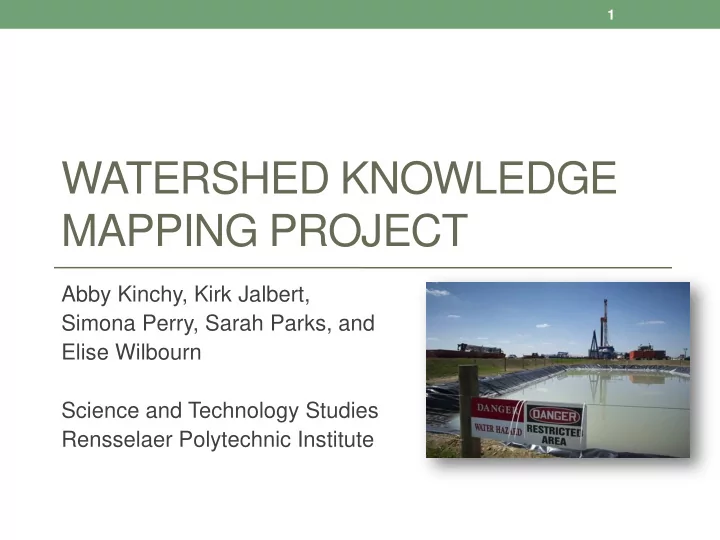
WATERSHED KNOWLEDGE MAPPING PROJECT
Abby Kinchy, Kirk Jalbert, Simona Perry, Sarah Parks, and Elise Wilbourn Science and Technology Studies Rensselaer Polytechnic Institute
1
WATERSHED KNOWLEDGE MAPPING PROJECT Abby Kinchy, Kirk Jalbert, - - PowerPoint PPT Presentation
1 WATERSHED KNOWLEDGE MAPPING PROJECT Abby Kinchy, Kirk Jalbert, Simona Perry, Sarah Parks, and Elise Wilbourn Science and Technology Studies Rensselaer Polytechnic Institute 2 HOW ARE THE EFFECTS OF GAS DRILLING BEING MONITORED?
Abby Kinchy, Kirk Jalbert, Simona Perry, Sarah Parks, and Elise Wilbourn Science and Technology Studies Rensselaer Polytechnic Institute
1
2
watershed impacts of shale gas development in NY and PA.
by governments, researchers, and the public.
the region.
academic, and private (volunteer) research efforts.
Objectives
accessible using:
fracturing
To date, New York has not allowed the use of high-volume hydraulic fracturing.
Both government agencies and non-government
environmental knowledge
9
waste water into soil and streams
forests, new roads
commissions
agencies
districts
authorities
to monitor gas drilling impacts
tributaries not typically monitored
12
known to be involved in watershed protection)
some kind
development or gathering baseline data in anticipation of shale gas development
disturbances, benthic macroinvertebrates
15
Compare the next two maps
16
17
18
Compare the two regions on the next map
19
21
22
23
24
Abby J. Kinchy
Is an assistant professor in the RPI Science and Technology Studies department, and PI for the Watershed Knowledge Mapping Project. She specializes in the study of political controversies surrounding changes in the systems that produce food and
sociology from the University of Wisconsin-Madison.
25
Simona Perry
Is a consultant working to develop dispute mechanisms to address social and environmental conflicts from energy development projects across North America. Simona was also a Mellon Post-Doctoral Scholar at Dickinson College in Carlisle, PA.
Kirk Jalbert
Is a third year doctoral student in the Science and Technology Studies Department at RPI, and research assistant for the Watershed Knowledge Mapping Project. Kirk’s research examines social and political tensions that arise when civil society groups use complex data to support local knowledge about polluting industries.
Sarah Parks
Is the president and founder of Amala Consulting, LLC, a consulting company specializing in geographic information systems (GIS). Sarah is also a PhD graduate from the RPI Ecological Economics Department.
Elise Wilbourn
Is a junior in the RPI Environmental Science program. Elise has assisted the Watershed Knowledge Mapping team throughout the entire data collection and analysis process.
provided by the Directorate for Social, Behavioral & Economic Sciences of the National Science Foundation (Award Number:1126235).
26