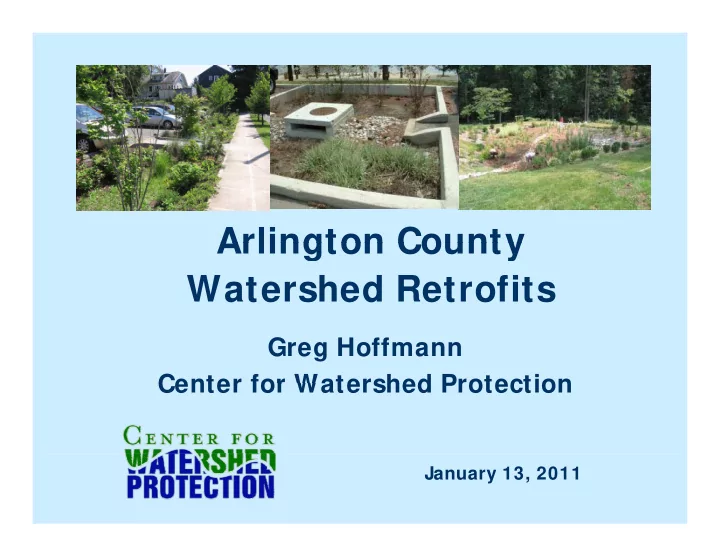
SLIDE 1 Arlington County Arlington County Watershed Retrofits
Greg Hoffmann Center for Watershed Protection Center for Watershed Protection
January 13, 2011
SLIDE 2 About the Center for W t h d P t ti Watershed Protection
- Non-profit 501(c)3 non-advocacy
- Non profit 501(c)3, non advocacy
- rganization
- Work with watershed groups local state
- Work with watershed groups, local, state,
and federal governments P id t l iti d t t t
- Provide tools communities need to protect
and restore streams, lakes, and rivers
www.cwp.org p g
SLIDE 3 Stormwater Retrofits Stormwater Retrofits
- Stormwater retrofits are
- Stormwater retrofits are
just one type of urban watershed restoration practice.
St R i – Stream Repair – Riparian Management – Illicit Discharge Prevention – Watershed Forestry – Pollution Prevention – Municipal Good Housekeeping
www.cwp.org p g
SLIDE 4 Why Retrofit? Why Retrofit?
- Many of our subwatersheds were developed without
Many of our subwatersheds were developed without effective stormwater management practices
- This has caused a number of negative impacts on our
receiving waters
- Stormwater retrofitting can be used to address these
situations and help meet a wide range of situations and help meet a wide range of subwatershed restoration objectives…
SLIDE 5
Solve Chronic Flooding Problem s Fix Past Mistakes & Maintenance Problem s Dem onstration & Education Reduce Pollutants of Concern Education Concern
SLIDE 6
Reduce Storm w ater Runoff Volum es Trap Trash & Floatables Support Stream Restoration Projects Reduce Dow nstream Channel E osion Restoration Projects Channel Erosion
SLIDE 7 Retrofitting is Different Retrofitting is Different
- Retrofitting is different than new stormwater
Retrofitting is different than new stormwater design
– Sleuthing skills to determine what can work at highly constrained sites – Simultaneously envisioning restoration possibilities y g p and anticipating potential problems
- Design, permitting and construction of
stormwater retrofit practices is almost always stormwater retrofit practices is almost always more complex than new stormwater management practices
SLIDE 8 Retrofitting is Challenging
- It can be difficult to find enough retrofit
l ti t t t ti bj ti locations to meet restoration objectives
– Required storage volumes can get prohibitively large particularly when channel protection and large, particularly when channel protection and flood control are restoration objectives – Depending on watershed condition and restoration objectives, many retrofit sites may be needed – The more impervious a watershed becomes – The more impervious a watershed becomes, the more storage is required and the more difficult it becomes to find retrofit sites
SLIDE 9 Our Retrofit Approach Our Retrofit Approach
measurable restoration goals
- Apply to small
- Apply to small
subwatersheds (less than 10 square miles) Utili e apid methods to find
- Utilize rapid methods to find,
design and implement a variety of restoration ti practices
SLIDE 10 Step 1: Retrofit Scoping
– Define a retrofit strategy to meet local restoration objectives
– Review local stormwater management infrastructure and practices – Define restoration objectives – Define preferred retrofit locations and practices
SLIDE 11
Arlington County Retrofit Objectives
Primary Objectives 1. Treat stormwater runoff to eliminate pollutants. p 2. Promote runoff reduction to the extent achievable. 3. Address pollution hotspots where appropriate. Secondary Objectives 4. Alleviate existing drainage problems when feasible. 5 I l t f th ti ll b fi i l t fit 5. Implement safe, aesthetically beneficial retrofits. 6. Provide outdoor learning and outreach opportunities. 7 Create desirable wildlife habitat areas 7. Create desirable wildlife habitat areas. 8. Support existing recreational uses and naturalization efforts.
SLIDE 12
The Big Picture
SLIDE 13
Preferred Retrofit Locations & Practices
Different types of stormwater management practices used in stormwater retrofitting p g
SLIDE 14
Extended Detention, Wet Ponds, and Wetlands
SLIDE 15
SLIDE 16
Bioretention, Filtration, I nfiltration, & Swales
SLIDE 17
SLIDE 18
Other
Cistern Green Roof
SLIDE 19 Arlington County Preferred Retrofit Locations & Practices
SLIDE 20 Arlington County Preferred Retrofit Locations & Practices
SLIDE 21 Arlington County Preferred Retrofit Locations & Practices
SLIDE 22 Arlington County Preferred Retrofit Locations & Practices
SLIDE 23 Arlington County Preferred Retrofit Locations & Practices
- 3. I nstitutional Properties
SLIDE 24 Arlington County Preferred Retrofit Locations & Practices
- 3. I nstitutional Properties
SLIDE 25 Arlington County Preferred Retrofit Locations & Practices
- 4. Large I mpervious Properties
SLIDE 26 Step 2: Desktop Analysis Step 2: Desktop Analysis
– Rapidly search for and identify potential retrofit sites across the subwatershed S ti i th fi ld – Save time in the field
SLIDE 27 Step 3: Retrofit Reconnaissance I nventory (RRI ) Reconnaissance I nventory (RRI )
– Determine feasibility of candidate retrofit locations – Collect information
– Evaluate potential retrofit sites, collect pertinent site information and produce a basic design sketch information, and produce a basic design sketch
SLIDE 28 Step 4: Compile Retrofit I nventory
– Communicate the results of the field assessments. – Provide the information needed to develop an implementation plan implementation plan.
Catalogue the field assessment data – Catalogue the field assessment data. – Rank and prioritize projects. – Develop concept designs for the most highly rated Develop concept designs for the most highly rated projects.
SLIDE 29
Questions? Q
SLIDE 30 Small Group Activity
1.Mark your house on the watershed map. 2 Discuss retrofit process and objectives for 2.Discuss retrofit process and objectives for your watershed. Any questions? Any dditi l bj ti t t? additional objectives to suggest? 3.Discuss possible retrofit locations, p ,
- pportunities, and challenges, and mark
them on map. them on map.
SLIDE 31
Greg Hoffmann gph@cwp.org