Today Morphology of verbs, contd Derivational vs. Inflectional - - PowerPoint PPT Presentation

today
SMART_READER_LITE
LIVE PREVIEW

Today Morphology of verbs, contd Derivational vs. Inflectional - - PowerPoint PPT Presentation

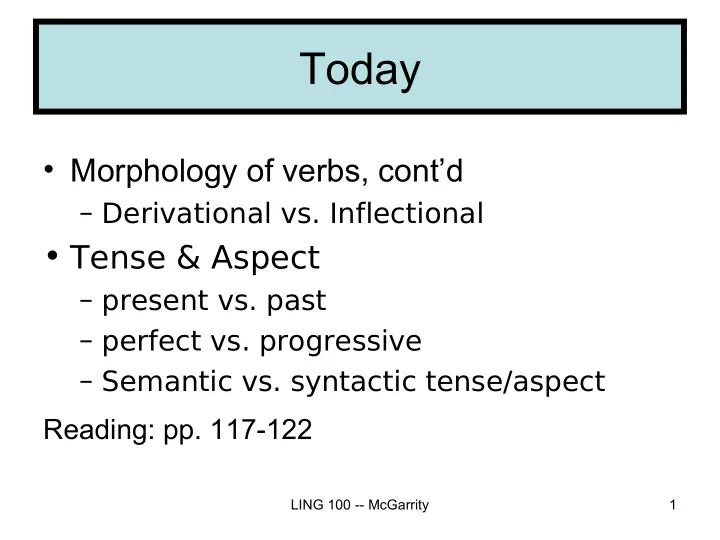
Today Morphology of verbs, contd Derivational vs. Inflectional Tense & Aspect present vs. past perfect vs. progressive Semantic vs. syntactic tense/aspect Reading: pp. 117-122 LING 100 -- McGarrity 1


slide-1
SLIDE 1

LING 100 -- McGarrity 1

Today

  • Morphology of verbs, cont’d

– Derivational vs. Inflectional

  • Tense & Aspect

– present vs. past – perfect vs. progressive – Semantic vs. syntactic tense/aspect Reading: pp. 117-122

slide-2
SLIDE 2

LING 100 -- McGarrity 7

Morphology of Verbs

Inflectional morphology Tense: grammatical expression of time of event relative to time of utterance

Present Past

slide-3
SLIDE 3

LING 100 -- McGarrity 8

Morphology of Verbs

Inflectional morphology Present Tense: event includes/overlaps moment of speech

Josie likes sushi.

NOW Time

slide-4
SLIDE 4

LING 100 -- McGarrity 9

Morphology of Verbs

Inflectional morphology Past Tense: specific event occurs before the moment of speech Amala danced at the wedding.

NOW Time

slide-5
SLIDE 5

10

Morphology of Verbs

Inflectional morphology Past Tense Affixation Internal change Suppletion

V + -ed / -t walk ~ walked deal ~ dealt break ~ broke sink ~ sank steal ~ stole hold ~ held go ~ went am ~ was is ~ were

slide-6
SLIDE 6

LING 100 -- McGarrity 11

Morphology of Verbs

Inflectional morphology Aspect: Information concerning the duration

  • r completion of an event relative to a point
  • f reference

Perfect Aspect Progressive Aspect Present perfect Present progressive Past perfect Past progressive

slide-7
SLIDE 7

LING 100 -- McGarrity 12

Morphology of Verbs

Inflectional morphology Perfect Aspect: Completion relative to some point of reference

Present Perfect: Action that has just been completed at moment of speech

  • Pres. tense Aux has/have + Past participle (-ed/-en/-t)

…has lived… …have fallen… …has slept…

slide-8
SLIDE 8

LING 100 -- McGarrity 13

Morphology of Verbs

Inflectional morphology Perfect Aspect: Completion relative to some point of reference

Present Perfect: Action that has just been completed at moment of speech I hear that Scott has lived in Seattle for 20 years.

NOW

R

slide-9
SLIDE 9

LING 100 -- McGarrity 14

Morphology of Verbs

Inflectional morphology Perfect Aspect: Completion relative to some point of reference

Past Perfect: Action completed relative to past reference Past tense Aux. had + Past participle (-ed/-en/-t) …had lived… …had fallen… …had slept…

slide-10
SLIDE 10

LING 100 -- McGarrity 15

Morphology of Verbs

Inflectional morphology Perfect Aspect: Completion relative to some point of reference

Past Perfect: Action completed relative to past reference

Scott had lived in Seattle for 20 yrs. before he moved to Iowa. NOW

R

slide-11
SLIDE 11

LING 100 -- McGarrity 16

Morphology of Verbs

Inflectional morphology Progressive Aspect: Duration of an action (‘ongoing’) relative to some point of reference

Present Progressive Past Progressive

slide-12
SLIDE 12

LING 100 -- McGarrity 17

Morphology of Verbs

Inflectional morphology Progressive Aspect: Duration of an action (‘ongoing’) relative to some point of reference

Present Progressive: Action is ongoing now

  • Pres. Tense Aux am/is/are + Present participle (-ing)

…am living… …are falling… …is sleeping…

slide-13
SLIDE 13

LING 100 -- McGarrity 18

Morphology of Verbs

Inflectional morphology Progressive Aspect: Duration of an action (‘ongoing’) relative to some point of reference

Present Progressive: Action is ongoing now Sue is writing her dissertation.

NOW

R

slide-14
SLIDE 14

LING 100 -- McGarrity 19

Morphology of Verbs

Inflectional morphology Progressive Aspect: Duration of an action (‘ongoing’) relative to some point of reference

Past Progressive: Action was ongoing in the past (when it was interrupted) Past tense Aux. was/were + Present participle (-ing) …was living… …were falling… …were sleeping…

slide-15
SLIDE 15

LING 100 -- McGarrity 20

Morphology of Verbs

Inflectional morphology Progressive Aspect: Duration of an action (‘ongoing’) relative to some point of reference

Past Progressive: Action was ongoing in the past (when it was interrupted)

Sue was writing her dissertation when she got writer’s block. NOW

R

slide-16
SLIDE 16

Tense and aspect?

S/he is reading a book. S/he was reading a book. S/he has written a book. S/he had written a book.

LING 100 -- McGarrity 21

= Present progressive = Past progressive = Present perfect = Past perfect

slide-17
SLIDE 17

LING 100 -- McGarrity 22

Summary: Verb morphology

  • New verbs can be created with

derivational affixation, compounding, blending, clipping, conversion

  • Inflectional morphology is used to indicate

person, number, tense, aspect

  • Tense indicates time of action, Perfect

Aspect indicates completion of action, and Progressive Aspect indicates duration of action

slide-18
SLIDE 18

LING 100 McGarrity 23

Semantic/Syntactic Tense and Aspect

Tense and Aspect are not always marked morphologically Habitual Aspect Future Tense

slide-19
SLIDE 19

LING 100 McGarrity 24

Semantic/Syntactic Tense and Aspect

Habitual Aspect: An event that recurs or continues indefinitely

I take the bus to work The neighbor’s dog wakes me up Miles eats cereal

  • n Mondays and Fridays.

at 7am every day. each morning for breakfast. Habitual aspect is NOT marked morphologically

  • n the verb, but semantically.
slide-20
SLIDE 20

LING 100 McGarrity 25

Semantic/Syntactic Tense and Aspect

Future Tense Typically marked syntactically, using modals will/shall.

The student attends lecture. (present) The student will/shall attend lecture. (future)

slide-21
SLIDE 21

LING 100 McGarrity 26

Semantic/Syntactic Tense and Aspect

Future Tense REMEMBER: Modals are NOT inflected for person/number, or tense/aspect I / He will attend lecture. The student *wills attend lecture. The student *shalled attend lecture.

slide-22
SLIDE 22

LING 100 McGarrity 27

Semantic/Syntactic Tense and Aspect

Future Tense Can also be marked semantically.

Carmen leaves at 7. She is performing on Broadway next week. Lucy said she was leaving tomorrow.

slide-23
SLIDE 23

LING 100 McGarrity 29

Semantic/Syntactic Tense and Aspect

NOTE: Unlike with auxiliaries, the main verb following a modal is NOT inflected…

The driver has crashed the car.

aux + past participle

The driver is crashing the car.

aux + pres. participle

*The driver might crashed/crashing the car.

… it is a bare infinitive

slide-24
SLIDE 24

LING 100 McGarrity 30

Semantic/Syntactic Tense and Aspect

Infinitives

  • “Non-finite” verbs that lack tense (no past
  • r present)
  • May be ‘bare’ or preceded by to:

She will leave. (= bare infinitive) She wants to leave. (= to-infinitive)

  • Modals cannot be infinitives (*to can, *to

may…)

slide-25
SLIDE 25

Practice: Tense and Aspect

Some squid were taking the bait. The orca will bite the seal. The whale has eaten the krill. A school of fish swam by. The whale will have eaten 3 tons of krill by the end of the day.

LING 100 McGarrity 31

= Past. Prog. = Simple Future = Pres. Perfect = Simple past = Future perfect

slide-26
SLIDE 26

LING 100 McGarrity 32

Summary: Semantic/Syntactic Tense and Aspect

  • Habitual aspect is marked semantically in

Standard English

  • Future tense is typically marked

syntactically (using modals will/shall)

  • Modals do not inflect; they take the

infinitive form of the main verb