Waco Bus Rapid Transit Corridor Engineering and Environmental Review - - PowerPoint PPT Presentation
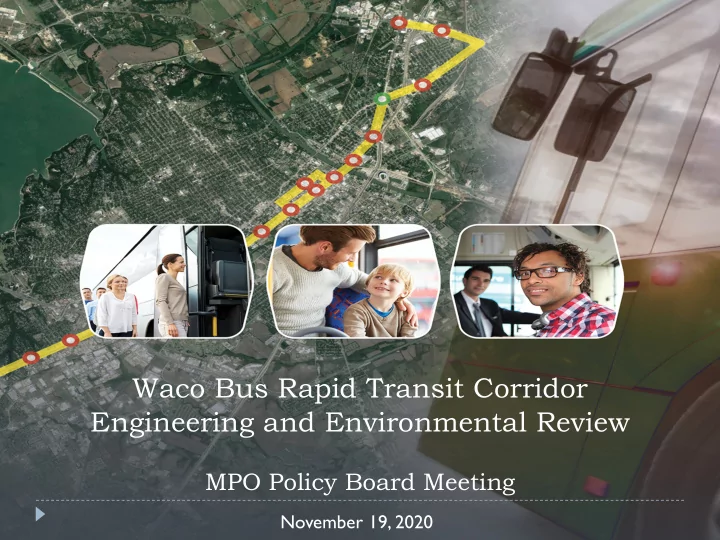
Waco Bus Rapid Transit Corridor Engineering and Environmental Review MPO Policy Board Meeting November 19, 2020 Agenda Project Introduction and Overview Project Team Review Feasibility Study Project Scope and Task Overview/Status
Agenda
Project Introduction and Overview Project Team Review Feasibility Study Project Scope and Task Overview/Status Public Involvement Approach and Schedule Questions
2
Project Introduction & Overview
Waco BRT
Project Route Map
4
Project Team and Project Status
Waco BRT
Key Staff
6
Project Scope (Project Development)
Detailed Route Planning Updating the Feasibility Study Ridership Update Preliminary Design Environmental Review and Clearance Governance and Financial Assessment Stakeholder and Community Outreach
7
Early Project Tasks
Draft Project Workplans Public Involvement Plan (PIP) Review GIS and CAD files Existing Conditions Update Updating Ridership Conduct Agency Coordination Develop Design Criteria (Basis of Design) Public Outreach to Re-Introduce the Project Station and Maintenance Location Siting
8
Project Schedule
9
X – Public Meetings
Project Goals
Project Goals (from Feasibility Study):
Increase the efficiency of WTS operations and decrease
- verall transit travel times
Increase access to employment opportunities and critical
services
Leverage available local, state and federal funding
- pportunities
Other Potential Project Goals
Provide safe and reliable transit service Support and promote economic growth
10
Review of Feasibility Study
Waco BRT
What is BRT?/Why BRT?
Limited stops results in faster operations
Bellmead to Woodway Current system: up to 110 minutes With BRT: 50 to 65 minutes
Significantly greater service frequency
Current system: 1 bus per hour, per route With RTC: 1 bus every 15 minutes (peak service)
Stations are a focus for redevelopment efforts
Transit Oriented Development (TOD) Convenient transfers to other fixed routes or demand response
services
Provides safer and more accessible service options
ADA accessible stations Enhanced bicycle / pedestrian accessibility
12
Review of Feasibility Study
Criteria Alignment 2 - LPA Mobility Impacts Medium 1-way Travel Time
65 min (NB) 50 min (SB)
‘System / RTC’ Ridership (year)
3,990 / 900 (2023) 4,630 / 980 (2040)
Economic Development High Safety High (Conceptual) Cost
$18.3 M – $19.4 M
Community Support Ongoing Overall Rating (Aggregate) High
13
Review of Feasibility Study
14
Preferred Alignment #2
Capital cost: $18.3M to $19.4M Annual operating cost: $3.5M to
$4M
Ridership (System / RTC)* :
3,990 / 900 (year 2023) 4,630 / 980 (year 2040)
2-way operation on Franklin
Better safety, connectivity and service
- perations
More Transit Oriented Development
- pportunities
Increase Hours of Operations
Terminate at 10:00 pm weekdays
Add Sunday service
* - WTS fixed route bus service not optimized for RTC
Project Scope and Task Overview/ Status
Waco BRT
Update Feasibility Study
LPA approved 2018 Purpose and Need Station Areas/ROW Funding Sources/Costs Ensure LPA aligns with
present day conditions
Washington/Franklin DT couplet
conversion
Ridership changes
16
Update Feasibility Study
17
Route Planning
Develop BRT service plan
Travel time Dwell/Boarding Time Service hours Frequency Peak pullout Service days O&M Costs
18
Assessment of existing bus
service within the corridor
Update service to connect
with BRT and optimize the
- verall system
Preliminary Engineering
19
Bus in Motion Passenger Delays Traffic Delays
Preliminary Engineering
20
Bus in Motion Passenger Delays Traffic Delays
Preliminary Engineering
21
BRT Toolbox
Operational Improveme nts
Transit Signal Priority Wider Station Spacing Off-Board Fare Collection and Multi-Door Boarding
Customer Amenities
Enhanced Stations Real-Time Information Multi-Door / Level Boarding Rapid Transit Vehicles / Branding
Preliminary Engineering
Raised Platforms
22
Preliminary Engineering
Raised Platforms costs
Increase Platform Footprint Require Careful Site Design
Raised Platforms benefits
Improve Accessibility Reduce Dwell Time
23
Preliminary Engineering
Station Amenities Affect Cost
Capital Cost Operations & Maintenance
24
Preliminary Engineering
Battery Electric Bus Comfort Station
25
Environmental Review / NEPA
Environmental impacts anticipated to be minimal
Project will be primarily contained within existing ROW and
maintenance facility within existing WTS property
AECOM will complete NEPA documentation for the
project in accordance with 23 CFR Part 771.118 FTA Categorical Exclusions (CE)
FTA Region 6's “D-list CE” is a streamlined NEPA document
consisting of a worksheet with a checklist, brief narrative components and supporting documentation.
26
Environmental Review / NEPA
Environmental Resources to be Reviewed:
27
Land Use/Zoning Wetlands Traffic Water Quality Noise*/Vibration Air Quality Environmental Justice Hazardous Materials Historic/Cultural Resources* Prime/Unique Farmlands Section 4(f) Resources* Safety/Security Biological Resources Construction Impacts Property Acquisition/Relocations* Mitigation Measures *May require specific supporting documentation for the D-list CE
Area of Potential Effects (APE)
28
Governance / Funding
Governance
Peer Review Recommendations specific to Waco Transit
Funding
Financial Analysis
Capital and on-going O&M COVID-19
Paths to funding
Small Starts Buses and Bus Facilities Other
29
Small Start Corridor A substantial investment in a defined corridor Project Features Features that emulate the services provided by rail fixed guideway public transportation systems:
- defined stations
- traffic signal priority for public transportation vehicles
- short headway bidirectional services for a substantial
part of weekdays and weekend days Guideway No requirements regarding dedicated Guideway Capital Cost Less than $300 million CIG Funds Less than $100 million
Bus Projects Eligible for Funding through the Capital Investment Grant (CIG) Program
30
FTA Small Starts Process
31
Projects must receive a Medium rating for both Project Justification and Local Financial Commitment
FTA Small Starts Evaluation
32
Project Milestone Schedule
33
Waco BRT Milestone Schedule Activity Begin End Selection of LPA May 1, 2018 Request for Entry into Project Development May 24, 2019 Pre-award Authority received for Project Development July 29, 2019 LPA in Long Range Transportation Plan January 17, 2020 Preliminary Engineering and NEPA August 3, 2020 February 2021 FTA CIG Evaluation and Rating* August/September 2021 FTA Funding Recommendation February/March 2022 Final Design March 2021 Spring 2022 Construction Grant Agreement Spring 2022 Construction and Vehicle Procurement Spring 2022 Fall 2023 Revenue Service Late 2023
Public Involvement
Waco BRT
Public Involvement Scope
Public Involvement Plan Outreach and Public Involvement Strategies
Traditional Virtual (On-demand and Live)
Key Messages
Education on BRT as a mode choice for the corridor Project development and decision-making process The role of public involvement
Engage Stakeholders from BRT Feasibility Study Coordination with City of Waco, FTA and WTS
35
Public Outreach Schedule
Schedule of outreach efforts parallels with critical project
development milestones
Project Kickoff / Reintroduction (Mid-October) Station Siting / Preliminary Engineering / NEPA Process (Early December) Final Preliminary Engineering / NEPA Documentation of Environmental
Analysis (Mid-February)
36
October Engagement Activities
Purpose
Reintroduce project/recap project history Explain current project approach Preview upcoming input opportunities
Virtual Public Open House
wacoBRT
- penhouse.net
October 20 – November 3 Received 27 public comments 200+ unique site visits
37
December Engagement Activities
Purpose
Review proposed station siting Review preliminary engineering station design Review National Environmental Policy Act requirements for
environmental review
Traditional Engagement Virtual Engagement
38
Waco BRT Project
39