Some considerations for timing photon detection The time resolution - - PowerPoint PPT Presentation

β–Ά
some considerations for timing photon detection
SMART_READER_LITE
LIVE PREVIEW

Some considerations for timing photon detection The time resolution - - PowerPoint PPT Presentation

Some considerations for timing photon detection The time resolution of the drift coordinate: 400 ns (2.5 MS/s) This sets the upper limit on time scale granularity needed for matching the light signal with charge Two aspects for matching timing


slide-1
SLIDE 1

Some considerations for timing photon detection

1

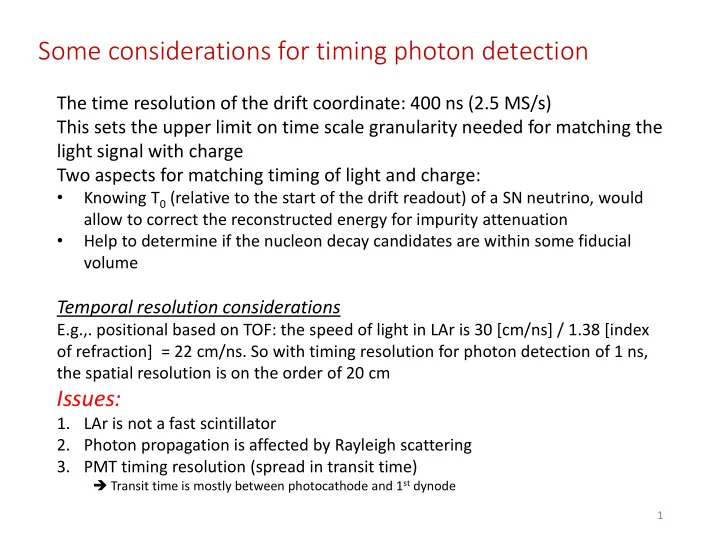
The time resolution of the drift coordinate: 400 ns (2.5 MS/s) This sets the upper limit on time scale granularity needed for matching the light signal with charge Two aspects for matching timing of light and charge:

  • Knowing T0 (relative to the start of the drift readout) of a SN neutrino, would

allow to correct the reconstructed energy for impurity attenuation

  • Help to determine if the nucleon decay candidates are within some fiducial

volume

Temporal resolution considerations

E.g.,. positional based on TOF: the speed of light in LAr is 30 [cm/ns] / 1.38 [index

  • f refraction] = 22 cm/ns. So with timing resolution for photon detection of 1 ns,

the spatial resolution is on the order of 20 cm

Issues:

  • 1. LAr is not a fast scintillator
  • 2. Photon propagation is affected by Rayleigh scattering
  • 3. PMT timing resolution (spread in transit time)

 Transit time is mostly between photocathode and 1st dynode

slide-2
SLIDE 2

Properties of scintillation in LAr

2

Number of the photons (0.5 kV/cm, e- recomb ~ 0.7): ~22 000 𝛿/MeV Maximal number of photons (all e- recombine) : ~51 000 𝛿/MeV Primary scintillation (S1) consists of two components with massively different lifetimes:

  • Fast component: πœπ‘” = 6 ns
  • Slow component: πœπ‘‘ = 1600 ns
  • The fraction of light going into fast / slow contribution depends on

recombination effects, but for mip-like signals fast/slow ~ 30%, Even if all of the light comes from the fast component, trying to get a timing resolution at a level of 1ns for photon arrival times will depend on the number of detectable photons The resolution for TOF with scintillator emission probability π‘“βˆ’π‘’/𝜐 and n arriving photons is: 𝜏 = 𝜐/π‘œ In case of single photon detection timing resolution is given by 𝜐

See e.g., Hitachi et al., Phys. Rev. B27 5279 (1983))

slide-3
SLIDE 3

Rayleigh scattering

3

  • According the latest analyses: πœ‡π‘†π‘‡ ~ 60 cm
  • The scattering is largely isotropic, i.e., photons are as likely to scatter in

any direction

  • For large source-detector distances the photon arrival time is not simply

given by 𝑒/𝑀, but is longer because of non-negligible path variations due to the RS scattering

Source 1m away Source 5m away

Photon arrival time distributions 𝝁𝑺𝑻 = πŸ”πŸ” cm

Calculated PDF Generated

For large distance RS could smear the photon transit time by tens of ns

slide-4
SLIDE 4

Spread in transit time

4

  • The transit time is (surprisingly) long for R5912-mod2 οƒ  68 ns
  • The FWHM is ~3 ns οƒ  Sets a limit on a precision for photon

timing measurements

slide-5
SLIDE 5

Photons per 8” detector

5

No attenuation, no cathode opacity PMT plane is 100 cm below the cathode plane

Simple calculation ~1/D2 Simulation with πœ‡π‘†π‘‡ = 55 cm and 12x12x12 m3 volume

slide-6
SLIDE 6

Photons / m2 in detection plane

6

The number of PE that could be detected can be roughly estimated as π‘‚π‘žπ‘“ β‰ˆ 𝑂𝑒 Γ— 0.0314 Γ— 0.5 Γ— 0.2 Γ— 𝑂𝛿 = 𝑂𝑒 Γ— 3𝑂𝛿/1000

Number of detectors per / m2 x effective det area WLS (1/2 of photons are emitted up) QE Photons / m2

PMT plane is 100 cm is below cathode (at 0)

slide-7
SLIDE 7

Photons / m2 in detection plane

7

SN neutrino spectrum

< 1PE / det / 10 MeV e

  • Large variation in sensitivity to over the

drift volume: O(100) variation

  • Effect of radiological backgrounds? Ar39 is

1Bq/kg οƒ  1400 Bq/m3

Benetti et al., NIM. A574 (2007), 83-88

slide-8
SLIDE 8

Summary

  • For light-charge signal association a timing resolution
  • n light signals should not be greater than 400 ns =

sampling of the charge readout

  • Timing resolution for a detection at a few photon level

is limited by physics of the light production and propagation in LAr and the time response of the PMT

  • For large detector volumes RS would dominate

achievable timing resolution

8