Listening to the Webinar Online: Please make sure your computer - - PDF document

listening to the webinar
SMART_READER_LITE
LIVE PREVIEW

Listening to the Webinar Online: Please make sure your computer - - PDF document

Top Transportation Issues for People with Disabilities and Potential Solutions Celebrating 25 years Americans with Disabilities Act adata.org will begin at 2 pm EST. While you are waiting, take a moment to become a part of the nationwide


slide-1
SLIDE 1

1

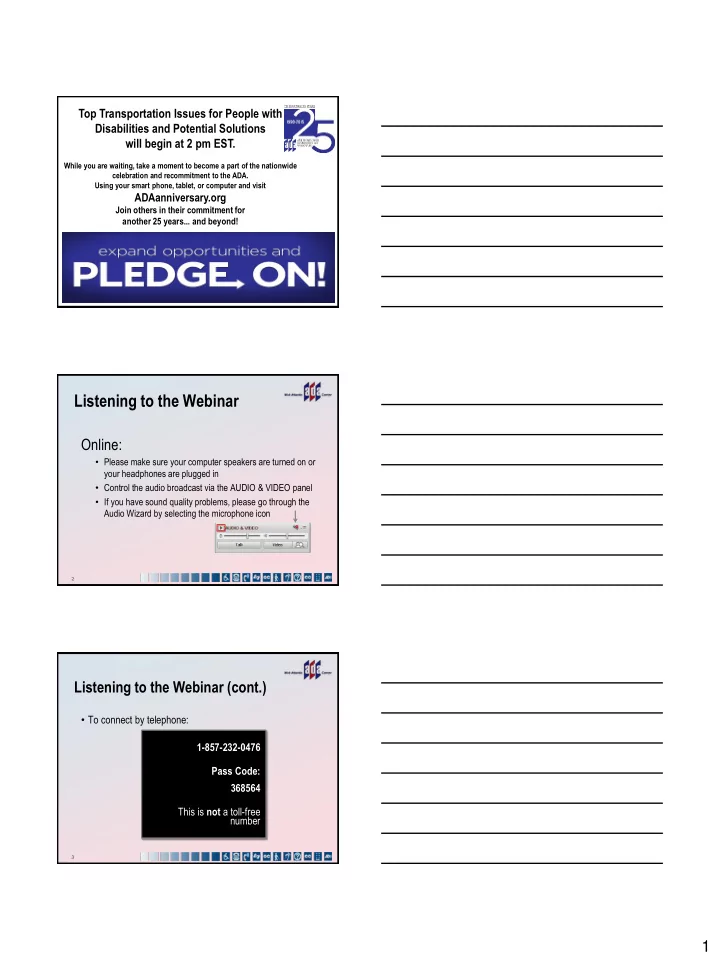
Top Transportation Issues for People with Disabilities and Potential Solutions will begin at 2 pm EST.

While you are waiting, take a moment to become a part of the nationwide celebration and recommitment to the ADA. Using your smart phone, tablet, or computer and visit

ADAanniversary.org

Join others in their commitment for another 25 years... and beyond!

Celebrating 25 years Americans with Disabilities Act adata.org

Expand opportunities and pledge on

Listening to the Webinar

Online:

  • Please make sure your computer speakers are turned on or

your headphones are plugged in

  • Control the audio broadcast via the AUDIO & VIDEO panel
  • If you have sound quality problems, please go through the

Audio Wizard by selecting the microphone icon

arrow points to microphone icon on audio and video panel

2

Listening to the Webinar (cont.)

  • To connect by telephone:

1-857-232-0476 Pass Code: 368564 This is not a toll-free number

3

slide-2
SLIDE 2

2 Captioning Real-time captioning is provided; open the window by selecting the “cc” icon in the Audio & Video panel

  • You can re-size the captioning window, change the font

size, and save the transcript

arrow points to the "cc" icon in the audio and video panel

4

Submitting Questions

  • In the webinar platform:
  • You may type and submit questions in the Chat Area Text Box or

press Control-M and enter text in the Chat Area. You will not be able to see the question after you submit it but it will be viewable by the presenters

  • If you are connected via a mobile device you may submit

questions in the chat area within the App

  • Questions may also be emailed to:

ADAtraining@transcen.org

Participant list

5

Customizing Your View

  • Resize the Whiteboard where the Presentation

slides are shown to make it smaller or larger by choosing from the drop down menu located above and to the left of the whiteboard. The default is “fit page”

Resizing dropdown box

6

slide-3
SLIDE 3

3

Customize Your View continued

  • Resize/Reposition the Chat, Participant

and Audio & Video panels by “detaching” and using your mouse to reposition or “stretch/shrink”. Each panel may be detached using the icon in the upper right corner of each panel

Page icon

7

Technical Assistance If you experience technical difficulties

  • Use the Chat panel to send a message to the Mid-Atlantic ADA

Center

  • E-mail ADAtraining@transcen.org
  • Call 301-217-0124

8

Archive

  • This webinar is being recorded and can be

accessed within a few business days

  • You will receive an email with information on

accessing the archive

9

slide-4
SLIDE 4

4

Certificate of Participation

  • Please consult the reminder email you received about

this session for instructions on obtaining a certificate

  • f participation for this webinar.
  • You will need to listen for the continuing education

code which will be announced at the conclusion of this session.

  • Requests for continuing education credits must be

received by 12:00 PM EDT May 7, 2015

10

Top Transportation Issues for People with Disabilities and Potential Solutions

Donna Smith, Director of Training Kristi McLaughlin, Training and Technical Assistance Specialist II Easter Seals Project Action Consulting

May 6, 2015

ESPA Consulting

  • Training

– Webinars – Online Courses – In-person workshops

  • Technical assistance

– Via phone – 800-659-6428 – Via e-mail – projectaction@easterseals.com

  • Resources – www.projectaction.org

Easter Seals Project Action Consulting web page

12

slide-5
SLIDE 5

5

Learner Objectives

  • Understand the family of transportation services

available in your community

  • Define travel skills needed to travel independently
  • Know rights and responsibilities for using ADA

complementary paratransit service

  • Determine when making a referral to ADA

complementary paratransit is appropriate

13

How do I Find a Ride?

Information Needed to Find a Ride

  • Do you have any specific personal needs for your

trip?

  • Are you traveling with

– Family? – Children? – Personal attendant? – Companion? – Service animal?

  • Are you a person with a disability, or a senior?

15

slide-6
SLIDE 6

6

Information Needed to Find a Ride (cont.)

  • ADA paratransit eligible? A Medicaid recipient? A

veteran?

  • What is the reason for your trip?
  • When do you want to travel (date and time)?
  • Where do you want to travel (actual starting address

and destination address)?

16

Range of Possible Transportation Options

  • Transportation can be viewed as a family of

services: – Options include a range of travel alternatives, services, and modes of travel. – Some options better in urban areas, – Some better in smaller communities and rural areas

17

Range of Possible Transportation Options (cont.)

  • Fixed Route

– Buses that run on a predetermined route on a fixed schedule. – Rail systems such as subway and light rail.

  • ADA complementary paratransit service

– For people who, due to disability, cannot use the fixed route. – Complements or similar to the fixed route in hours

  • f operation and service area.

18

slide-7
SLIDE 7

7

Range of Possible Transportation Options (cont.)

  • Flex Route options

– Operates on a fixed route, with published bus routes, but will deviate from that route a small distance to provide door-to-door service to those that need that additional assistance.

  • Demand Response, Non ADA

– Services for the general population that provides door to door or curb to curb service – Typically called dial-a-ride services

19

Range of Possible Transportation Options (cont.)

  • Medicaid Transportation

– Medicaid eligible for medical trips – Services vary by state

  • Human Service Transportation

– Specialized transportation that meets needs of customers served – Characteristics of the services would likely vary from agency to agency

20

Range of Possible Transportation Options (cont.)

  • Taxis

– Accessible taxis – May provide paratransit trips

  • Shuttle Services

– They usually have either a set departure location

  • r a set destination location

– Employee shuttles

21

slide-8
SLIDE 8

8

Range of Possible Transportation Options (cont.)

  • Volunteer Driver Programs

– Organization provides the vehicle – Volunteers use their own cars

  • Car and van pool programs

– These are forms of ridesharing, usually for commuting to and from jobs and trainings. – For youth or younger adults, you may want to think about using carpooling programs with parents providing rides as well

22

Range of Possible Transportation Options (cont.)

  • Vehicle sharing programs

– Services that provide access to vehicles for certain trips

  • r times – often by the hour without the purchase or

renting of a vehicle. – The organizations renting the car may be a business, a public agency or more of a co-op.

  • Transit Pass/Voucher programs

– Promotes a cost savings and increases rider choice and independence. – Passes/vouchers can be in the form of bus passes or tokens, fare cards, or coupon books

23

Range of Possible Transportation Options (cont.)

  • Travel Training

– Training, most often for public, fixed route services, on using a transit system – Training is often one-to-one training, and tailored to the trainee and often times focuses on the specific routes that the individual wants to learn

  • Trip planning

– Knowing the details of the trip – Having a back-up plan – Having everything needed to make the trip – Having safety/emergency information

24

slide-9
SLIDE 9

9

Thinking Outside the Bus

  • Think “outside the bus” to consider all possible

transportation options

  • Explore all possible transportation options—including

whom to call for information and referral

  • Transportation may be available from different

sources, public and private, groups and individuals

25

211 Service

  • Provides information on transportation, health,

housing, etc.

  • Information may vary depending on what is included

in the system

  • Transportation may be limited to public transit and

large human service or medicaid transportation providers

26

Aging and Disability Resource Centers (ADRC)

  • VA – Easy Access

http://www.easyaccess.virginia.gov/transportation.shtml

  • MD - Maryland Access Point

www.marylandaccesspoint.info

  • DE – Delaware ADRC

www.DelawareADRC.com.PA

  • Pennsylvania Link to ADRC

800-753-8827

  • WV – West Virginia Navigate

www.wvnavigate.org/

27

slide-10
SLIDE 10

10

Eldercare Locator

  • Supported through the National Association for Area

Agencies on Aging

  • Eldercare Locator

– http://www.eldercare.gov/eldercare.net/public/reso urces/topic/Transportation.aspx – 800-677-1116

28

Questions?

2 men on bus, one in wheelchair

29

What are the Skills Needed to Use Public Transportation?

slide-11
SLIDE 11

11

Skills Needed to Ride Fixed-Route

With a reasonable level of effort or risk, can the applicant consistently:

  • Get and Remember Transit System Information
  • Walk/Wheel to and from Transit Stop/Station

– Throughout area – up to ¾ mile – Over various surfaces – Over various terrain – Up/down curbs – Up/down curb-cuts – Cross streets of various widths and with various controls – Find way in familiar and unfamiliar settings

31

Skills Needed to Ride Fixed-Route (cont.)

With a reasonable level of effort or risk, can the applicant consistently:

  • Enter and Exit Transit Stations

– Flights of stairs – Elevators and escalators – Navigating complex stations

  • Wait at a Stop/Station for Transit Vehicle

– With and without benches/shelters

  • Locate and Recognize Bus/Train to Take

– Single route and multiple routes with transfers

32

Skills Needed to Ride Fixed-Route (cont.)

With a reasonable level of effort or risk, can the applicant consistently:

  • Board and Exit Vehicle

– Inaccessible vehicles

  • Accessible vehicles (lift, ramp)
  • Pay Fare
  • Get to Seat/Securement Area
  • Ride in Seated or Standing Position
  • Recognize Destination

33

slide-12
SLIDE 12

12

Skills Needed to Ride Fixed-Route (cont.)

With a reasonable level of effort or risk, can the applicant consistently:

  • Signal for Stop
  • Perform Above Tasks in Various Weather and

Environmental Conditions – Snow, ice, rain, heat, humidity, cold, smog – Bright light, low light, background noise

  • Handle Unexpected Situations
  • Travel Safely in the Community

34

Categories of Skills Needed to Ride Fixed-Route

  • Physical Functional Skills
  • Cognitive Functional Skills
  • Sensory Functional Skills
  • Social Functional Skills

35

Physical Functional Skills

  • Physical functional abilities needed to perform

tasks required to use fixed route transit system. – Walking speed – Endurance – Coordination – Strength – Balance – Gait – Range of Motion – Dexterity

36

slide-13
SLIDE 13

13

Cognitive Functional Skills

  • Cognitive functional abilities needed to perform tasks

required to use fixed route transit system. – Orientation to Person, Place and Time – Judgment and Safety Skills – Problem Solving – Coping Skills – Short and long-term memory – Concentration (Attention to Task) – Ability to Seek and Act on Directions

37

Cognitive Functional Skills (cont.)

  • Cognitive functional abilities needed to perform tasks

required to use fixed route transit system. – Ability to Process Information – Ability to Communicate Needs – Consistency – Behavioral Skills

38

Sensory Functional Skills

  • Sensory functional abilities needed to perform

tasks required to use fixed route transit system. – Orientation to Place – Directional Wayfinding – Ability to Detect Changes on Surfaces – Ability to Detect Environmental Cues (Hearing) – Proficiency in Using Mobility Aids

39

slide-14
SLIDE 14

14

Social Functional Skills

  • People Skills
  • Structure and Space
  • Content of the Transit Environment
  • Expectations
  • Mood (of Transit Professionals)
  • Mood (of other Passengers)
  • Context Cues/Supports

40

RESOURCES

  • Two free discussion forums on travel training

– For students, teachers and parents www.ESPA-NCST.communityzero.com/ATS – Travel training programs of any kind www.ESPA-NCST.communityzero.com/GTTC

41

RESOURCES

  • The Association of Travel Instruction

– www.travelinstruction.org

  • The Consortium for the Educational Advancement of

Travel Instruction – www.ceati-travelinstruction.org

42

slide-15
SLIDE 15

15

Questions?

2 men on bus, one in a wheelchair

43

What are My Rights and Responsibilities Regarding ADA Complementary Paratransit Service?

Tips for Using ADA Complementary Paratransit

  • You may apply for paratransit service

if you are unable to use fixed-route service.

  • Paratransit eligibility is based on:

– Whether you can board, ride or disembark from an accessible vehicle. – Availability of an accessible vehicle on your desired route and/or hour of service. – Existence of a specific impairment, condition or physical barrier that prevents you from getting to

  • r from the bus stop.

45

slide-16
SLIDE 16

16

  • Expect to pay up to double the fixed-route fare for an

ADA complementary trip. Expect to pay premium charges for service offered beyond the transit authority’s ADA obligations.

  • You may negotiate times with the transit provider.

You are not required to schedule a trip more than one hour earlier or later than you would like to travel.

Tips for Using ADA Complementary Paratransit (cont.)

46

  • Personal care attendants ride free of charge on

paratransit.

  • You have the right to file a complaint with the

transportation provider if necessary.

Tips for Using ADA Complementary Paratransit (cont.)

47

Customer Responsibilities

  • If you qualify for ADA complementary paratransit, be

aware that it is a shared-ride service, and you have responsibilities as a passenger.

  • Make sure you understand the pickup window and

vehicle wait time so that you are prepared to board when the vehicle arrives.

48

slide-17
SLIDE 17

17

Customer Responsibilities (cont.)

  • Be prepared for the driver to make stops ahead of
  • yours. You may not be the first one dropped off even

if you were first to be picked up.

  • Prior to making a trip reservation, review the

information needed to book the trip. Be prepared to provide the necessary information when you call.

49

Customer Responsibilities (cont.)

  • Know your provider’s no-show and late-cancellation
  • policies. Cancel reservations as soon as you

determine you don’t need the trip. Be aware that you may be penalized for an excessive number of late cancellations or no-shows.

  • Treat the driver and other passengers with courtesy

and respect.

50

Customer Responsibilities (cont.)

  • If an appeal becomes necessary because of denied

eligibility, be familiar with the appeals process.

51

slide-18
SLIDE 18

18

What is an Appropriate Referral to ADA Complementary Paratransit?

Before Making a Referral

  • Know the facts about ADA Complementary

Paratransit service – What is it and what is it not – Who is eligible – How is functional ability assessed

53

The Purpose of ADA Complementary Paratransit

  • It is intended to be a safety net to provide

transportation to people with disabilities who are unable to use fixed-route transportation

  • It is not a specialized transportation service available

to anyone with a disability

54

slide-19
SLIDE 19

19

Who is Eligible

Three categories of eligibility:

  • Category 1: includes persons with disabilities that

are unable to use accessible fixed route service

  • Category 2: includes persons with disabilities that

have the ability to use the accessible fixed route services, but the service available is not accessible

  • Category 3: includes persons with disabilities that

are unable to travel to or from a station or a bus stop

55

The Eligibility Process May Include

  • A paper application
  • Confirmation of disability by a physician or other

professional

  • Interview – phone or in-person
  • Functional physical assessment
  • Functional cognitive assessment
  • Path of travel assessment

56

Determining Eligibility

  • Basis for eligibility considerations
  • Each transit task and personal ability necessary for

completion of each

  • Exhaustive, complete, under all conditions
  • Physical, cognitive and sensory

– To and from the bus – Waiting for and getting on and off the bus – Riding the bus – Dealing with the unexpected

  • Reflects your community

57

slide-20
SLIDE 20

20

Conditions of Eligibility

  • Basis for eligibility considerations
  • Each transit task and personal ability necessary for

completion of each

  • Exhaustive, complete, under all conditions
  • Physical, cognitive and sensory

– To and from the bus – Waiting for and getting on and off the bus – Riding the bus – Dealing with the unexpected

  • Reflects your community

58

Your Verification as a Professional

  • More than verification of a disability
  • It is your professional opinion that the individual

cannot use fixed-route transportation because of one

  • r more of the conditions listed above

59

Questions?

2 men on bus, 1 in a wheelchair

60

slide-21
SLIDE 21

21

RESOURCES

Check out the FTA web site with information on ADA such as requirements and best practices for vehicle maintenance, stop announcements, eligibility requirements, telephone “hold time” issues, origin to destination policies, on-time performance, and dealing with no-shows. http://www.fta.dot.gov/civilrights/12325.html

61

RESOURCES

Another good FTA resource is “Transit and the ADA – Frequently Asked Questions.” http://www.fta.dot.gov/12325_5110.html

62

RESOURCES

The Disability Rights Education & Defense Fund (DREDF) funded by FTA and the U.S.DOT brought together the requirements of the ADA regulations, FTA determinations, and operational practices that comply with the ADA in their “Topic Guides on ADA Transportation.” http://dredf.org/transportation

63

slide-22
SLIDE 22

22

RESOURCES

Easter Seals Project ACTION website offers information

  • n various topics relating to the ADA and accessible

transportation. http://www.projectaction.org

64

Questions?

2 men on bus, 1 in a wheelchair

65

Thank you!

1425 K Street NW, Suite 200 Washington, DC 20005 (844) 277-3772 www.projectaction.com ESPAConsulting@easterseals.com

slide-23
SLIDE 23

23

Contact Us

  • ADA questions

– ADA National Network

  • 1-800-949-4232 V/TTY
  • www.adata.org
  • Questions about this presentation

– Mid-Atlantic ADA Center

  • 1-800-949-4232 V/TTY (DC, DE, MD, PA, VA, WV)
  • 301-217-0124 local
  • www.adainfo.org

67

Certificates of Participation

  • The continuing education code for this

session:

  • Please consult your webinar reminder e-

mail message for further information on receiving continuing education credits Thank you for joining us!

68