4/28/2014 Welcome! Listening to the Webinar Listening to the - - PowerPoint PPT Presentation

4 28 2014
SMART_READER_LITE
LIVE PREVIEW

4/28/2014 Welcome! Listening to the Webinar Listening to the - - PowerPoint PPT Presentation

4/28/2014 Welcome! Listening to the Webinar Listening to the Webinar (cont.) Online: Accessible Communications for To connect by Please make sure your computer speakers are turned on or 1-443-453-0034 telephone: Deaf and Hard of


slide-1
SLIDE 1

4/28/2014 1

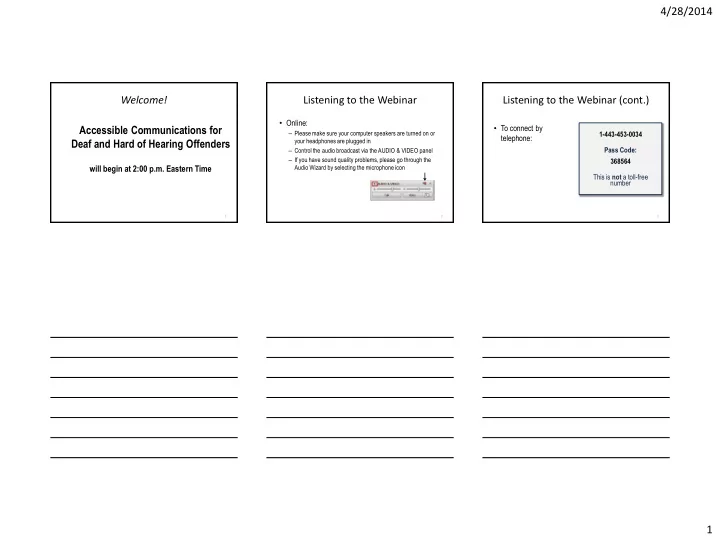
Welcome! Accessible Communications for Deaf and Hard of Hearing Offenders

will begin at 2:00 p.m. Eastern Time

1 2

Listening to the Webinar

  • Online:

– Please make sure your computer speakers are turned on or your headphones are plugged in – Control the audio broadcast via the AUDIO & VIDEO panel – If you have sound quality problems, please go through the Audio Wizard by selecting the microphone icon

arrow points to microphone icon on audio and video panel

3

Listening to the Webinar (cont.)

  • To connect by

telephone:

1-443-453-0034 Pass Code: 368564 This is not a toll-free number

slide-2
SLIDE 2

4/28/2014 2

4

Captioning

  • Real-time captioning is provided; open the window

by selecting the “cc” icon in the Audio & Video panel

– You can re-size the captioning window, change the font size, and save the transcript

arrow points to the "cc" icon in the audio and video panel

5

Submitting Questions

  • In the webinar:

– Double-click on “Mid-Atlantic ADA Center” in the Participant List to open a tab in the Chat panel (keyboard: F-6 and arrow up or down to find Mid-Atlantic ADA Center); type your question in the text box and “enter”

  • Your question will be sent to the presenters;
  • ther participants will not be able to see it
  • E-mail: ADAtraining@transcen.org

Participant list

6

Technical Assistance

  • If you experience technical difficulties

– Use the Chat panel to send a message to the Mid- Atlantic ADA Center – E-mail ADAtraining@transcen.org – Call 301-217-0124

slide-3
SLIDE 3

4/28/2014 3

7

Archive

  • This webinar is being recorded and can be

accessed within a few business days

  • You will receive an email with information on

accessing the archive

Virginia Department of Corrections Webinar Presentation For ADA Compliant Deaf Offender Care

HELPFUL DEFINITIONS

  • “Auxiliary Aids and Services” include, but are

not limited to, “Qualified Interpreters or other effective methods of making aurally delivered materials available to individuals with hearing impairments,” such as hearing aids, computer- aided transcriptions services, assistive listening systems, closed caption decoders, open and close captioning, TDDs, TTYs, videotext displays, written materials, 28 C.F.R. § 35.104, as well as Videophones, access to telephone relay services, and visual alert or alarm systems.

9

slide-4
SLIDE 4

4/28/2014 4

Helpful Definitions continued

  • “Deaf” defines individuals who are unable to

hear well enough to rely on their hearing as a means of processing information and who rely

  • n Auxiliary Aids and Services to Effectively

Communicate

10

Helpful Definitions continued

  • “Direct Threat” means a significant risk to

the health or safety of the Deaf Offender or

  • thers.
  • “Effective Communication” affords Deaf

Offenders opportunities to participate in, and enjoy benefits of services, programs, and activities substantially equal to that enjoyed by a similarly situated Offender who is not Deaf.

11

Helpful Definitions continued

  • “Offsite Medical Care” means medical care

that is provided at a location not owned or

  • perated by the state. “Onsite Medical Care”

means medical care that is provided by the facility, including medical care provided by third parties in facilities owned or operated by the state.

  • “Qualified Interpreter” means a person who

is able to interpret effectively, accurately, and impartially.

12

slide-5
SLIDE 5

4/28/2014 5

Helpful Definitions continued

  • “TTYs” or “TDDs” are devices used to communicate

with persons who are Deaf or Hard of Hearing.

  • “Employees” include all employees, agents, and
  • ther staff whose job responsibilities places them in

regular contact with Deaf Offenders, along with the immediate supervisors of those employees, agents,

  • r other staff.
  • “Videophone” means a telephone with a camera

and screen for visual, real-time communications.

13

GENERAL POLICY OBJECTIVES

  • II. GENERAL POLICIES
  • Non-discrimination Based on Disability

Deaf Offenders in custody of state correctional facilities or under post-release supervision by Community Corrections have full and equal enjoyment of its services, privileges, facilities, advantages, and accommodations as non-Deaf Offenders.

14

GENERAL POLICY OBJECTIVES

continued

ADA Coordinator and Services Designees

– The Department maintains the ADA Coordinator position as required by law. – An Institutional ADA Coordinator on site ensures disability laws are followed and will be in charge of the daily operations, supervision, and disability needs. – All staff, contract employees, and Watch Commanders are trained on the procedures for compliance with the ADA. – Deaf Offenders meet with the Warden or Assistant Warden of Operations at least quarterly to discuss concerns.

15

slide-6
SLIDE 6

4/28/2014 6

INITIAL CLASSIFICATION, ASSESSMENT, AND ASSIGNMENT

Deaf Offender at the Reception and Classification Center have access to Qualified Interpreters.

  • Ensuring Staff Awareness Through Identification Cards

All staff having regular contact with a Deaf Offender are trained on the meaning of the distinct ID cards. Personnel having regular contact with Deaf Offenders are made aware of such a person’s need for Auxiliary Aids and Services. At the entrance to the facility a notice clearly stating that the facility houses Deaf Offenders is posted.

  • Interpretation of Written Materials

At the request of the Deaf Offender, the opportunity to meet with a staff member and a Qualified Interpreter materials is afforded.

  • Creation and Interpretation of Rights Materials

The facility provides every Deaf Offender written materials outlining rights and provides an interpreter for questions. 16

HOUSING

  • General Policy

It is in the best interests of Deaf Offenders to be incarcerated at one facility with the privilege to reside in any housing unit within that facility, and to participate in any programs available to other Offenders if they meet the qualifications. Auxiliary Aids and Services are therefore easily provided in a centralized manner.

  • Schedule of Accommodations

Deaf Offenders are provided with schedules on a designated bulletin board showing when Qualified Interpreters and/or other Auxiliary Aids and Services are available.

17

PROVISION OF AUXILAIRY AIDS AND SERVICES

  • General Policy

In order to ensure equality for Deaf Offenders, appropriate Auxiliary Aids and Services required by the ADA, and the Rehabilitation Act are consistently provided.

18

slide-7
SLIDE 7

4/28/2014 7

Qualified Sign Language Interpreter

  • The state contracts with interpreter service

providers to provide Qualified Interpreters.

  • Situations in which an on-site Qualified Interpreter

is needed include: medical care, dental, vision, audiological, and mental health care; Disciplinary Hearings; and Classification Processes.

  • A Qualified Interpreter is not presumed necessary,

but should be provided for: Education and Other lengthy or other complex communication needs.

19

OTHER MEANS OF COMMUNICATION

  • 1. General policy

Employees communicate with Deaf Offenders for such purposes as they would communicate with the Hearing Individuals.

  • 2. Video Remote Interpreting (VRI)

The institution provides access to and has available, for emergency situations, video remote interpreting which meets industry standards over a high-speed Internet connection.

  • 3. Written Notes

All Employees will receive training with respect to communication difficulties Deaf Offenders

  • experience. The training will include advising the Employees that note writing may be the only

immediate form of communication available to a Deaf Offender at that time.

20

ONSITE & OFFSITE MEDICAL CARE

General Policy

Qualified Interpreters are scheduled for medical appointments.

Informing Appropriate Medical Staff

The employee coordinating Auxiliary Aids will ensure that Medical staff is aware that the Offender is Deaf.

Emergency Events

The institution will provide a Video Remote Qualified Interpreter for use in unscheduled medical

  • emergencies. When remote interpreting services are not available, personnel will coordinate with medical

staff to secure an on-site Qualified Interpreter as soon as possible. Life saving medical care should never be delayed because no interpretation services are available.

Offsite Medical Care

In the case of an emergency, staff will inform an offsite medical provider that a Deaf Offender requiring an Interpreter or other Auxiliary Aid or Service is being transported to the offsite care provider. Staff will notify the offsite medical care provider. Notification will include the estimated time of arrival. 21
slide-8
SLIDE 8

4/28/2014 8

OTHER AUXILIARY AIDS

 The following appropriate Auxiliary Aids and services will be provided:

– Adult Basic Education – Re-entry Programs – Vocational Education Programs – Work Programs – Rehabilitative Programs

 Work Assignments

Opportunities for institutional work assignments are consistent for Deaf and Hearing Offenders. Supervisors retain the discretion to determine if certain work assignments present a Direct Threat of injury to Deaf Offenders and may therefore choose not to employ Deaf Offenders.

 Transfer and Classification Matters

Staff provides a Qualified Interpreter for any Hearings or meetings relating to an Offender’s classification status as such hearings involve the exchange of information between the Deaf Offender and personnel that could affect the Offender’s status. 22

ADDITIONAL COMMUNICATIONS

  • In person or VRI interpreting for any significant

communication between Offenders and staff.

  • A significant communication includes a

communication for which the Offender requests an interpreter, subject to approval by the designated person responsible for coordinating Auxiliary Aids and Services.

23

DISCIPLINARY MATTERS

  • Qualified interpreters for disciplinary process

Disciplinary Proceedings: Deaf Offenders are legally entitled to a Qualified Interpreter in any disciplinary proceedings in which that Deaf Offender is a suspect

  • r charged. A Qualified Interpreter must be available to the Deaf Offender at the

following stages of the above-described disciplinary proceedings:

  • Investigative interviews
  • Servicing of the Disciplinary Report; which involves the exchange of information

between the charged Deaf Offender and Employees;

  • During the Hearing, or a Re-Hearing which involves the exchange of information

between the charged Deaf Offender and personnel. Offender or staff advisors will be provided to Deaf Offenders on the same terms as they are provided to charged Hearing Offenders. A Qualified Interpreter shall be made available to a Deaf Offender for any exchange of information between the Deaf Offender and his advisor.

24

slide-9
SLIDE 9

4/28/2014 9

VISUAL ALERT NOTIFICATIONS

  • General Policy

Deaf Offenders at state correctional facilities should have access to announcements, alerts, or any other auditory information from staff to the general Offender population.

  • Relaying Information

Staff provides visual notification systems that will notify Deaf Offenders of prison wide events and events specific to Deaf Offenders.

  • Visual Alarms and Emergency Evacuation

Deaf Offenders are provided an effective visual notification systems which will advise them of an emergency evacuation or other emergency. In addition, staff notify Deaf Offenders of such events by direct personal contact. 25

TELECOMMUNICATIONS DEVICES

  • General Policy

Deaf Offenders have access to telecommunications as Offenders who are not Deaf.

  • Monitoring Communications

Communications are monitored and recorded as they are with all Offenders.

  • Additional Time for Communications

“Equal access” may necessitate contact that sometimes appears to be greater access than given to Hearing Offenders.

  • Technology For Best Accommodation

Every effort will be made to provide communication technologies at facilities where Deaf Offenders are incarcerated to facilitate communication between Deaf Offenders and people outside of the facility. Deaf Offenders will have a list of communication services available to them upon their arrival at the facility. 26

SPECIFIC DEVICES AVAILABLE

1. TTY (teletypewriter)

At every state correctional facility at which a Deaf Offender is incarcerated, there shall be at least one TTY . Relay Services

  • TTYs are able to contact with available relay services.
  • Deaf Offenders have access to Videophone technology.

Responsibility for Maintaining Equipment and Training Staff

  • The facility will ensure that the technology used for communication is in working
  • rder.
  • Audio-visual media for Offender use open or closed captioning.
  • Televisions Offenders purchase for use will support open or closed captioning.

27

slide-10
SLIDE 10

4/28/2014 10

HAND RESTRAINTS

Off-site Medical Care Operating procedures will implement that Deaf Offenders, whenever possible, be permitted to use their hands for Effective Communication. On-Site Medical Care If a Deaf Offender is permitted to see medical personnel, at a time when for behavioral reasons, his or her hands have been restrained, personnel will consider the needs of the Deaf Offender to use his or her hands for Effective Communication purposes. Personnel will consider the use of alternative restraints. On-site Other Circumstances Deaf Offenders should be restrained with hands in the front so they may be able to communicate.

28

MISCELLANEOUS AUXILIARY DEVICES

  • Purchase of Auxiliary Devices

Where devices such as vibrating clocks and in-line amplifiers are not deemed medically necessary, on a case by case basis, facility administrators may allow a particular Deaf Offender the opportunity to purchase these devices at their own expense.

  • Request in Writing

Deaf Offenders may submit a request in writing to the ADA Coordinator requesting devices not available from the Commissary.

  • Record Keeping

The ADA Coordinator maintains a record of all Deaf Offender’s application for these devices and the outcome of the request.

29

TRAINING

General Policy

  • Training will be incorporated into the

regularly scheduled instruction for new and existing employees with regard to Deaf Offenders.

30

slide-11
SLIDE 11

4/28/2014 11

TRAINING continued

Employee Training will include the following topics:

  • Best practices in communicating with Deaf individuals;
  • Problems encountered by Deaf and late-Deafened individuals;
  • Psychological implications of Deafness and its relationship to

interaction with corrections personnel;

  • The proper use and role of Qualified Interpreters;
  • Directions about using TTYs, TDDs, and other auxiliary

communication devices;

  • Videophones and equipment currently at the facility, which facilitate

communication with Deaf people;

  • Disciplinary matters, described in Section VIII, and grievance

proceedings.

31

GRIEVANCES

The ADA Coordinator will review all grievances submitted by Deaf Offenders, and responses given to Deaf Offenders, whether the grievance is terminated favorably, or unfavorably to the Deaf Offender. ADA Coordinator review under this section is not a part of the Offender Grievance Procedure.

32

CONTACT INFORMATION

INSTITUTIONAL ADA COORDINATOR: BARRY MARANO, ADA COORDINATOR CASE MANAGEMENT COUNSELOR POWHATAN CORRECTIONAL CENTER 3600 WOODS WAY STATE FARM, VIRGINIA 23160 E-MAIL: barry.marano@vadoc.virginia .gov DIRECT AT: 804.372.4956

33

DEPARTMENT CONTACT PERSON: ELISABETH THORNTON, ADA COORDINATOR COMMONWEALTH OF VIRGINIA VIRGINIA DEPARTMENT OF CORRECTIONS 6900 ATMORE DRIVE RICHMOND, VA 23235 E-MAIL: elisabeth.thornton@vadoc.virginia .gov DIRECT AT: 804.887.8085

slide-12
SLIDE 12

4/28/2014 12

Thank You For Your Interest

34

Continuing To Expand Horizons In Modern, Constitutional Care And Humane Treatment