W HAT DOES THIS MEAN FOR FLUOROCHROME PERFORMANCE ? The standard way - - PowerPoint PPT Presentation

w hat does this mean for fluorochrome performance
SMART_READER_LITE
LIVE PREVIEW

W HAT DOES THIS MEAN FOR FLUOROCHROME PERFORMANCE ? The standard way - - PowerPoint PPT Presentation

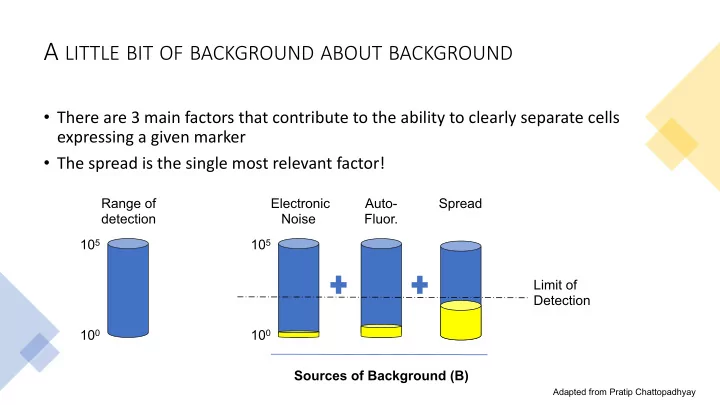
A LITTLE BIT OF BACKGROUND ABOUT BACKGROUND There are 3 main factors that contribute to the ability to clearly separate cells expressing a given marker The spread is the single most relevant factor! Range of Electronic Auto- Spread


slide-1
SLIDE 1

A LITTLE BIT OF BACKGROUND ABOUT BACKGROUND

  • There are 3 main factors that contribute to the ability to clearly separate cells

expressing a given marker

  • The spread is the single most relevant factor!

Electronic Noise Auto- Fluor. Spread Sources of Background (B) Limit of Detection

Adapted from Pratip Chattopadhyay

100 105 Range of detection 100 105

slide-2
SLIDE 2

WHAT DOES THIS MEAN FOR FLUOROCHROME PERFORMANCE?

  • The standard way to describe the performance of a given fluorochrome is to use the

stain index

Single stain only Increased background from spreading = reduced SI

(𝑁𝐺𝐽𝑞𝑝𝑡 − 𝑁𝐺𝐽𝑜𝑓𝑕) 2 𝑦 𝑠𝑇𝐸𝑜𝑓𝑕 SI =

MFIneg MFIneg MFIpos MFIpos rSD rSD SI SI

slide-3
SLIDE 3

HOW TO DETERMINE FLUOROCHROME PERFORMANCE

  • Fluorochrome properties can differ between instruments

ØLaser power, bandpass filters, instrument sensitivity…

  • Optimal method: measure all fluorochromes conjugated to the same antibody and

calculate SI

  • For a rough estimate, use vendor information

From BD Biosciences HVTN Seattle Flow Cytometers PE PE-CF594

slide-4
SLIDE 4

MEASUREMENT ERROR LEADS TO SPREADING

  • The main source of the spreading error is the so-called,

“Poisson Error” that occurs during photo counting in the detector (both PMT and APD)

  • The error is proportional to the square root of the signal

intensity

ØThe stronger/more intense the signal, the greater the error (more photons!)

  • Any error will be propagated throughout mathematical
  • perations

Ngyuen et al., Cytometry Part A 2013

slide-5
SLIDE 5

EXAMPLE: SPREADING IN COMPENSATED DATA

100 104 101 102 103 104

Spillover Fluorescence

100 101 102 103

Primary Fluorescence Uncompensated

10 101 102 103 100 101 102 103

Compensated 700 1100 200 (-200)

Slide provided by M. Roederer, NIH

Measurement error

slide-6
SLIDE 6

INSTRUMENT ALIGNMENT IS CRITICAL

  • The compensation amount

remains the same

  • Improved instrument

alignment means decreased measurement error

  • Spreading decreases and

limit of detection increases Day 1 Day 2

Uncompensated

PE TR-PE

Compensated

Slide provided by S. Perfetto

slide-7
SLIDE 7

COMPENSATION VALUES DO NOT PREDICT THE SPREAD

  • The compensation value does not necessarily reflect the extent of the spreading

error

  • Remember – compensation only subtracts the extra signal

Image courtesy of Florian Mair

slide-8
SLIDE 8

HOW TO CREATE AN SSM IN FLOWJO

  • 1. Gate compensation controls
  • 2. Within the compensation module, there is a button for the SSM in both FlowJo 9.x and FlowJo 10.4

FlowJo 10.4: FlowJo 9.x:

Image courtesy of Florian Mair

slide-9
SLIDE 9

UNDERSTANDING A SPILLOVER/SPREADING MATRIX

B515 B710 G575 G610 G660 G780 R660 R710 R780 U395 U730 V450 V510 V570 V610 V655 V710 V780 B515 0.165 0.0628 0.042 0.0697 0.0436 0.15 0.0537 0.161 0.102 0.0742 0.924 B710 0.385 0.0966 0.067 0.508 1.15 0.324 2.26 0.977 1.54 0.197 0.183 0.166 0.343 1.41 1.38 10.9866 G575 0.291 0.982 1.4 1.08 0.5 0.111 0.244 0.476 0.152 0.191 0.842 0.673 0.273 0.297 0.193 7.705 G610 0.127 2.35 0.46 2.04 1.16 0.28 0.577 0.158 0.139 0.564 0.121 0.556 0.339 0.521 0.344 9.736 G660 0.214 6.68 0.25 0.206 2.09 0.986 1.78 0.529 1.19 0.13 0.108 0.35 1.16 0.456 16.129 G780 0.644 0.313 0.186 0.186 0.29 0.192 0.826 0.0205 5.06E-03 0.192 0.179 1.08 4.11356 R660 0.211 0.903 0.112 0.12 1.75 0.692 2.22 1.15 1.35 0.463 0.451 0.479 9.901 R710 1.09 0.639 0.289 0.877 1.84 1.67 0.882 0.608 0.741 8.636 R780 0.419 0.17 0.121 0.504 1.69 0.728 0.63 0.679 0.332 0.131 0.256 1.42 7.08 U395 0.875 0.463 0.27 0.259 0.479 0.37 0.367 0.28 0.202 0.245 3.81 U730 1.12 0.113 0.493 2.01 1.52 0.468 0.333 0.513 0.0118 0.174 0.321 0.754 7.8308 V450 0.363 0.205 0.141 0.0692 0.953 0.299 0.267 0.113 0.109 0.142 2.6612 V510 0.256 0.412 0.324 0.12 0.194 0.304 0.16 1.23 0.831 1.38 1.45 0.707 0.563 0.669 8.6 V570 0.61 1.1 1.07 0.915 0.582 0.149 0.161 0.46 0.927 0.817 0.253 1.77 0.879 0.827 0.518 11.038 V610 0.257 0.969 0.358 1.23 1.45 0.783 0.345 0.486 0.333 2.19 0.329 0.031 0.369 1.41 1.22 1.18 12.94 V655 0.992 0.573 0.218 0.861 0.457 1.12 1.25 0.797 2.15 0.747 0.503 0.493 0.593 1.77 1.63 14.154 V710 0.648 1.52 0.237 0.385 0.353 0.219 1.87 0.866 0.292 4.71 0.395 0.393 0.313 0.246 3.3 15.747 V780 0.894 0.25 0.839 0.939 0.461 0.386 0.268 0.187 0.207 0.25 4.681 6.772 17.662 3.9744 5.356 9.8527 11.721 4.4512 14.1676 11.228 1.1127 19.776 4.167 3.6242 5.5713 6.45506 6.107 10.144 14.531

Detector

Fluorochrome

Rows with high sums are fluorophores that donate a lot of spillover Columns with high sums are detectors that collect a lot of spillover

slide-10
SLIDE 10

WHAT DO THESE NUMBERS REPRESENT IN REALITY?

G780 R660 R710 R780 U450 U730 U780 0.873 10.3 3.58 1.41 0.287 3.41 2.48

Example of SSM values for U660 (HLA-DR BUV661) for several detectors The larger the value, the more spread

slide-11
SLIDE 11

WHAT DO THESE NUMBERS REPRESENT IN REALITY?

B610 B780 G575 G780 R660 R710 0.668 0.319 0.237 0.0928 0.315 0.179

Example of SSM values for B515 (CD4 Ax488) for several detectors

slide-12
SLIDE 12

IMPLICATIONS OF SPILLOVER/SPREADING ERROR ON RESOLUTION

  • Spreading error is the single most relevant contributor to loss of resolution
  • KEY POINT: spreading error reduces the resolution in the detector that is collecting

the spillover

BUV737 (U740): poor choice for dimly expressed antigens on CD45RA+ cells PE-Cy7 (G780): good choice for dimly expressed antigens on CD45RA+ cells

Dim BUV737 population Dim PE-Cy7 population

Image courtesy of Florian Mair

slide-13
SLIDE 13

IN REVIEW

  • Compensation

Ø What is compensation and why it is necessary Ø Compensation controls Ø Transformation of data to confirm compensation Ø Diagnosis of compensation errors and how to fix them

  • Spillover/Spreading

ØBackground noise and how it impacts resolution ØStain index (fluorchrome performance) and how to calculate it ØMeasurement error (spreading) ØHow to generate and interpret a spillover spreading matrix

  • Panel Design
slide-14
SLIDE 14

PYRAMID OF PANEL DESIGN

Test panel Titrate antibodies Create theoretical panel(s) Assess available fluorophores Draw a gating tree (co-expression) Categorize markers (dim, bright, continuous, etc.) Create an instrument specific SSM Characterize and standardize your instrument

slide-15
SLIDE 15

CYTOMETER STANDARDIZATION AND CHARACTERIZATION

Note – this is for conventional flow cytometers

  • 1. Perform voltage titration on each detector with CD4 stained cells (CD4 is available

in every colour)

  • 2. For each detector, calculate the stain index at each voltage reading and plot SI vs

voltage to obtain a SI curve

  • 3. Choose optimal voltage – minimum voltage where stain index is highest (optimize)

NOTE: Can choose something slightly below optimal voltage to allow for populations that may be brighter than CD4

  • 4. Run QC beads to determine target MFI for each detector (standardize)
  • 5. Run QC beads and adjust voltages before every experiment so that bead MFI

meets target MFI

slide-16
SLIDE 16

CYTOMETER SPECIFIC (REPRESENTATIVE) SSM

  • For each detector…

1. Stain cells with CD4 and acquire samples 2. Create a compensation matrix 3. Create SSM matrix

  • Spillover/Spread matrix is representative (depends on markers in panel) but will

always follow the same pattern IF the cytometer is kept at the same settings