If market is efficient, does this mean expert advice is worthless? - - PDF document

if market is efficient does this mean expert advice is
SMART_READER_LITE
LIVE PREVIEW

If market is efficient, does this mean expert advice is worthless? - - PDF document

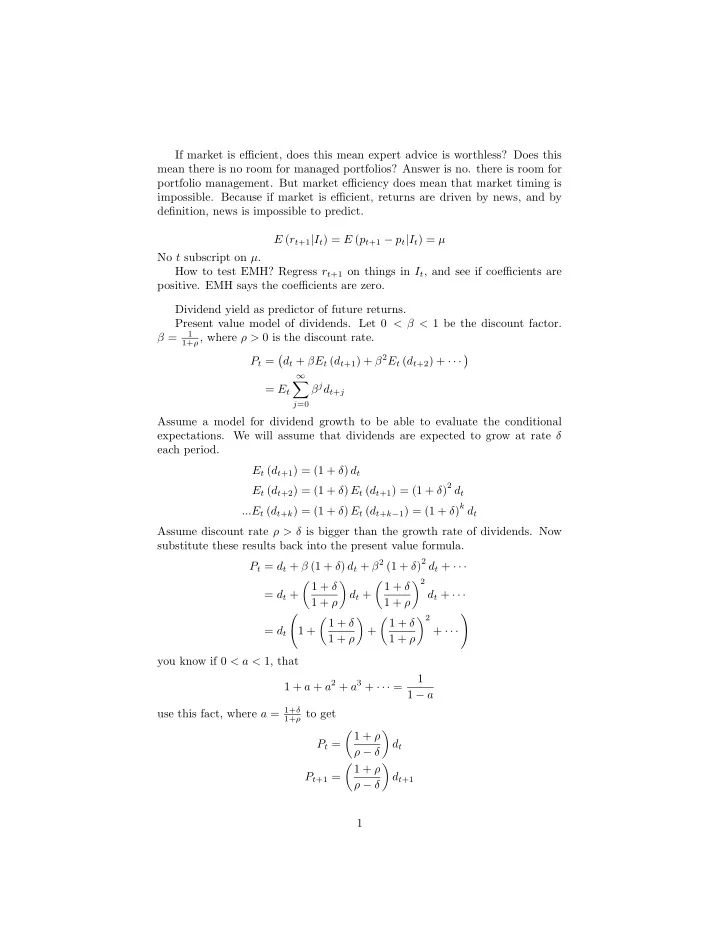
If market is efficient, does this mean expert advice is worthless? Does this mean there is no room for managed portfolios? Answer is no. there is room for portfolio management. But market efficiency does mean that market timing is impossible.


slide-1
SLIDE 1

If market is efficient, does this mean expert advice is worthless? Does this mean there is no room for managed portfolios? Answer is no. there is room for portfolio management. But market efficiency does mean that market timing is

  • impossible. Because if market is efficient, returns are driven by news, and by

definition, news is impossible to predict. E (rt+1|It) = E (pt+1 − pt|It) = µ No t subscript on µ. How to test EMH? Regress rt+1 on things in It, and see if coefficients are

  • positive. EMH says the coefficients are zero.

Dividend yield as predictor of future returns. Present value model of dividends. Let 0 < β < 1 be the discount factor. β =

1 1+ρ, where ρ > 0 is the discount rate.

Pt =

  • dt + βEt (dt+1) + β2Et (dt+2) + · · ·
  • = Et

  • j=0

βjdt+j Assume a model for dividend growth to be able to evaluate the conditional

  • expectations. We will assume that dividends are expected to grow at rate δ

each period. Et (dt+1) = (1 + δ) dt Et (dt+2) = (1 + δ) Et (dt+1) = (1 + δ)2 dt ...Et (dt+k) = (1 + δ) Et (dt+k−1) = (1 + δ)k dt Assume discount rate ρ > δ is bigger than the growth rate of dividends. Now substitute these results back into the present value formula. Pt = dt + β (1 + δ) dt + β2 (1 + δ)2 dt + · · · = dt + 1 + δ 1 + ρ

  • dt +

1 + δ 1 + ρ 2 dt + · · · = dt

  • 1 +

1 + δ 1 + ρ

  • +

1 + δ 1 + ρ 2 + · · ·

  • you know if 0 < a < 1, that

1 + a + a2 + a3 + · · · = 1 1 − a use this fact, where a = 1+δ

1+ρ to get

Pt = 1 + ρ ρ − δ

  • dt

Pt+1 = 1 + ρ ρ − δ

  • dt+1

1

slide-2
SLIDE 2

Take conditional expectations on both sides, Et (Pt+1) = 1 + ρ ρ − δ

  • Et (dt+1) =

1 + ρ ρ − δ

  • (1 + δ) dt

divide both sides by Pt, and we get Et Pt+1 Pt

  • =

1 + ρ ρ − δ

  • (1 + δ) dt

Pt so we can run the regression rt,t+1 = α1 + β1 dt Pt

  • + ǫt+1

and the slope is estimating β1 =

  • 1+ρ

ρ−δ

  • (1 + δ) . Now let’s look at

Pt+2 = 1 + ρ ρ − δ

  • dt+2

Et (Pt+2) = 1 + ρ ρ − δ

  • Et (dt+2) =

1 + ρ ρ − δ

  • (1 + δ)2 dt

Divide both sides by Pt, Et Pt+2 Pt

  • =

1 + ρ ρ − δ

  • (1 + δ)2 dt

Pt so the dividend yield is a predictor of the 2 period return with coeffient

  • 1+ρ

ρ−δ

  • (1 + δ)2 .

We run the regression rt,t+2 = α2 + β2 dt Pt

  • + ǫt+2

and the slope is β2 =

  • 1+ρ

ρ−δ

  • (1 + δ)2 , which is bigger than β1.

The punchline is that today’s dividend yield,

dt Pt should be a predictor of

future returns and that the predicted returns get bigger as the future horizon gets longer. So let’s turn to the data to see how this works. Let rt,t+1 =

  • Pt+1

Pt

  • abstracting from dividends in the returns (i.e., dividends

are imputed into Pt+1). rt,t+2 =

  • Pt+2

Pt

  • =
  • Pt+2

Pt+1 Pt+1 Pt

  • = rt,t+1rt+1,t+2 and so

forth, to rt,t+96 = rt,t+1rt+1,t+2, ..., rt+95,t+96 is the gross 96-month ahead gross return. We will look at regressions such as this, where we use the current dividend yield to forecast future returns, rt,t+k = α + β dt Pt

  • + ǫt+k

2

slide-3
SLIDE 3

slide 8 plots rt,t+12 against dt/Pt. Slide 9 plots rt,t+96 against dt/Pt →correlation is (+). High dt/Pt predicts higher future returns. Reciprocal of dividend yield Pt dt 3