Voice Meaning How were the 1930s and 40s an era of New World - - PowerPoint PPT Presentation

voice meaning
SMART_READER_LITE
LIVE PREVIEW

Voice Meaning How were the 1930s and 40s an era of New World - - PowerPoint PPT Presentation

How do environmental agents Thoreau- and genetics affect Where I health and survival? lived and what I Lived for. Question Wonder Passion Voice Meaning How were the 1930s and 40s an era of New World forced Symphony


slide-1
SLIDE 1

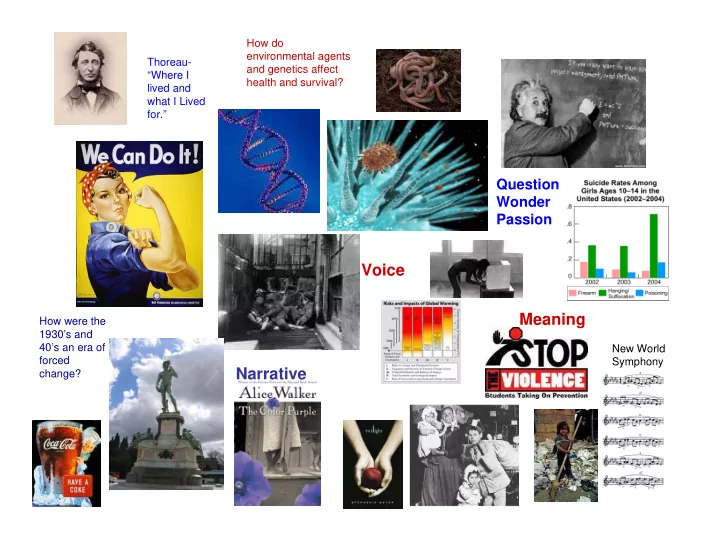
Thoreau- “Where I lived and what I Lived for.” How were the 1930’s and 40’s an era of forced change? How do environmental agents and genetics affect health and survival?

Question Wonder Passion

Meaning

New World Symphony

Narrative Voice

slide-2
SLIDE 2

“DO what works. Do not do what doesn’t work.” Ross Todd, Rutgers University

  • Task driven, teacher directed, static research

leads to low motivation, TRANSFER of facts, sometimes plagiarism, short term factual information without connections, depth, or new understanding.

  • INQUIRY outcomes: meaning, relevance,

engagement, depth, internalization of inquiry process skills, understanding, originality, TRANSFORMATION of text, formative knowledge in the content areas.

slide-3
SLIDE 3

Questions from Allison Zmuda

  • Will students with traditional 20th century

research projects state in their own words what they are finding interesting, what questions they are trying to explore, what connections they are making to draw conclusions?

  • Do they complete forms and record answers as

a bureaucratic exercise uninspired and uncommitted to the struggle to construct knowledge?

  • Does disengagement inhibit true learning?
  • What evidence is present that learning is an

illusion.

slide-4
SLIDE 4

DEFINITION

  • “Inquiry is a way of learning that is driven by

questioning, thoughtful investigating, making sense of information, and developing new

  • understandings. It is cyclical in nature because

the result of inquiry is not simply answers but deep understandings that often lead to new questions and further pursuit of knowledge.” The goal of inquiry is the exploration of significant questions and deep learning in a learner centered climate of critical engagement, social interaction, diverse information resources, and assessment to improve learning. Barbara Stripling

slide-5
SLIDE 5

BIG IDEA Number ONE

  • Engage the learner

Student responsibility Energized, motivated Strategic, apply, connect knowledge Collaborative Challenging Performance based Generative Empathetic

slide-6
SLIDE 6

National School Boards Association

  • 2007 Study
  • 1200 students, parents, teachers
  • Kids go home from school and engage in

meaningful, intelligent, authentic communication and knowledge creation in web environments

  • Kids are highly engaged, creative,

motivated, and connected to meaningful communities via technology after the school day ends

slide-7
SLIDE 7

Think of kids as…

EXPLORERS COGNITIVE APPRENTICES DISCOVERERS INNOVATORS QUESTIONERS PRODUCERS of KNOWLEDGE THINKERS

slide-8
SLIDE 8
slide-9
SLIDE 9
slide-10
SLIDE 10
slide-11
SLIDE 11
slide-12
SLIDE 12
slide-13
SLIDE 13
slide-14
SLIDE 14
slide-15
SLIDE 15
slide-16
SLIDE 16
slide-17
SLIDE 17
slide-18
SLIDE 18
slide-19
SLIDE 19
slide-20
SLIDE 20
slide-21
SLIDE 21
slide-22
SLIDE 22
slide-23
SLIDE 23

BIG Idea Number TWO

America can only assure its economic future by educating children to be creators, innovators, thinkers, collaborators, discoverers.

Thomas Friedman. The World is Flat. Farrar, 2006

,

slide-24
SLIDE 24

“This is a story about the big public conversation the nation is not having about education… w hether an entire generation of kids w ill fail to m ake the grade in the global econom y because they can’t think their w ay through abstract problem s, w ork in team s, distinguish good form ation from bad, or speak a language other than English.” How to Build a Student for the 2 1 st Century, TI ME Decem ber 1 8 , 2 0 0 6

Overview

slide-25
SLIDE 25

Conclusion

“There is remarkable consensus among educators and business and policy leaders on

  • ne key conclusion: we

need to bring what we teach and how we teach into the 21st century.” TIME Magazine, December 18, 2006

slide-26
SLIDE 26
  • INQUIRY embraces an educational

philosophy responding directly to national emphasis on high standards, brain research, 21st Century Skills, and productive pedagogy. Students are involved in a cycle of questioning, investigating, verifying and generating.

Harada and Yoshina

slide-27
SLIDE 27

INQUIRY LEARNING INQUIRY LEARNING

in ACTION is ROUTE 21 HOW? SO WHAT?

slide-28
SLIDE 28
  • Information and communication
  • Thinking and problem solving
  • Interpersonal and self-directional skills
  • Use of digital and technology tools to access,

manage, integrate and evaluate information

  • Construct new knowledge
  • Learn academic content through the real

world

slide-29
SLIDE 29
  • Digital literacy
  • Inventive thinking
  • Effective communication
  • High productivity
slide-30
SLIDE 30

BIG Idea number three

  • Quality of instructional action

has an impact.

Daniel Callison. The Blue Book on Information Age Inquiry, Instruction and Literacy. Libraries Unlimited. 2006

Inquiry is like berrylicious pie. It is full of good things!

slide-31
SLIDE 31

Connections to PRIOR KNOWLEDGE, BACKGROUND KNOWLEDGE, affective area, QUESTIONING, FOCUS, personal meaning and relevance. Collaboration of teacher and school library media specialist, social interaction with teachers and peers, substantive conversation.

slide-32
SLIDE 32

Products that incorporate original

  • riginal

conclusions, conclusions, thinking, transformation of text vs. transfer of text, deep understanding, mastery of content knowledge, reading and writing as tools.

slide-33
SLIDE 33

Ongoing assessment for improvement Ongoing assessment for improvement, reflection, intervention at critical points for target skill development, instruction in information literacy.

slide-34
SLIDE 34

The construction of meaning, synthesis of new understandings, and sharing of products that demonstrate new learning.

slide-35
SLIDE 35

Formational student achievement Formational student achievement embraces knowledge creation, knowledge use, knowledge production, knowledge dissemination, knowledge values, and reading literacy.

slide-36
SLIDE 36

Big Idea number four Big Idea number four

Inquiry dynamics include six steps: Inquiry dynamics include six steps:

  • Connect
  • Focus
  • Investigate
  • Create/Construct
  • Express
  • Reflect
slide-37
SLIDE 37

Paradigm Shift from Problem Solving to INQUIRY

Information problem solving shifts to INQUIRY Information problem solving shifts to INQUIRY Inquiry implies attitude of questioning, reflecting Inquiry implies attitude of questioning, reflecting with cognition with cognition Inquiry means start with a question Inquiry means start with a question Inquiry means open investigation Inquiry means open investigation Inquiry is student centered Inquiry is student centered Goal is new understanding in the student Goal is new understanding in the student Answers involve messy, recursive building of ideas Answers involve messy, recursive building of ideas Open-ended, leads to future questions, experiences Open-ended, leads to future questions, experiences

slide-38
SLIDE 38

INQUIRY PROCESS

  • CONNECT
  • FOCUS
  • INVESTIGATE
  • CREATE/CONSTRUCT
  • EXPRESS
  • REFLECT

Information Fluency Curricula

Capital Region and QUESTAR III BOCES SLS

slide-39
SLIDE 39

Inquiry based learning

“Keep your eye on the ball!”

Information to knowledge journey- Ross Todd

Informational base –

Exchange information, transfer, locate, access, evaluate

Transformational base-

New knowledge, meaning constructed

Formational base-

Knowledge produced, disseminated with critical engagement

slide-40
SLIDE 40

Connect Connect

Prior Knowledge Background knowledge Personal attitude, interest Personal meaning Big Ideas Curiosity

slide-41
SLIDE 41

Focus Focus

Questioning Questioning Engaged learner Engaged learner Student centered/ student Student centered/ student negotiated negotiated Choices Choices

slide-42
SLIDE 42

Investigate Investigate

Access, use, evaluate information Social interaction Construct meaning Active learner

slide-43
SLIDE 43

Draw original conclusions Self-assess Reflect Ongoing assessment to improve performance Validate, analyze

slide-44
SLIDE 44

Create/Construct Create/Construct

Create a KNOWLEDGE product Synthesize Share original conclusions Understanding

slide-45
SLIDE 45

Express Express

Share knowledge product Critical engagement Substantive conversation Authentic process

slide-46
SLIDE 46

Reflect Reflect

Evaluate product and process What worked? What didn’t? What do I know? New questions T t thi ki

slide-47
SLIDE 47

Closure

BIG IDEAS! Select what is meaningful for YOU. Reflect, share. Find common ground. Reaffirm local capacity already established Frame elements of an action plan.

slide-48
SLIDE 48

INQUIRY Based Learning- INQUIRY Based Learning- BIG IDEAS IG IDEAS

“You can’t grow sunflowers in “You can’t grow sunflowers in marigold pots.” marigold pots.” M. Ratzer

  • M. Ratzer - Gardener

ardener

slide-49
SLIDE 49

Promise of INQUIRY

Engage with kids to build deep knowledge deep knowledge, to develop questions develop questions, to communicate communicate and share share new knowledge, to sustain kids sustain kids as thinking, knowledgeable, intelligent people, to apply technology and information skills for deep knowledge and understanding.

Ross Todd- February 2008

slide-50
SLIDE 50

Information Inquiry Curriculum Basics

  • Learner connects to prior

knowledge, questions, constructs meaning from text, evaluates process and products, draws

  • riginal conclusions, synthesizes,

creates, expresses and shares new understanding.

“I care. I count. I can.”