SLIDE 1
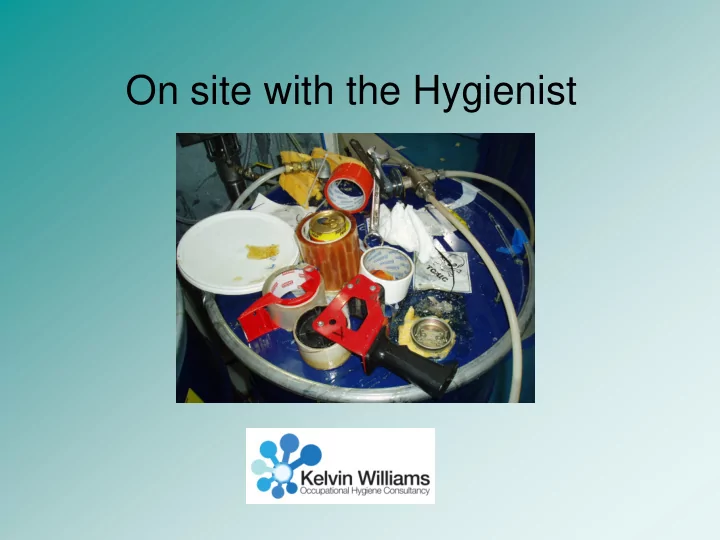
On site with the Hygienist
SLIDE 2 On site for a day
Tall Order! Given –
may represent about 0.03% of operational time
– “you should be here when…”
SLIDE 3
SLIDE 4 On site for a day
with a clipboard
– Excess caution on the day (usual) – Excess recklessness
conscious worker!) – Effect on results?
SLIDE 5 On site for a day
Pitfalls
- Poor research / planning / strategy
- Failure to identify hazards / issues (poor dialogue with
client)
- Over reliance on measurement results
- Poor observation skills
– No “bedside manner” – Laziness / lack of thoroughness / not inquisitive
- Poor interpretation of data
- Unhelpful report – client doesn’t know what to do
SLIDE 6 Consequences of poor survey
Context: Soldering
dissatisfied with previous survey
– No mention of technique or job monitored – “Hygienist” spent day in local café – Results – all well below WEL – therefore all OK
SLIDE 7 Consequences of poor survey
Re-survey: one day results
was 1.5x WEL
WEL
SLIDE 8 Do these measurements matter?
Analyte Airborne concentration (mg.m-3)* P G D B P P cis-1, 2 Dichloroethene
Chloroform 0.02
1,1,1-Trichloroethane 0.04
Carbon tetrachloride
1,2-Dichloroethane 0.006
Trichloroethene 0.007
Toluene 0.017 0.021 1.17 Ethylbenzene
m&p-Xylene 0.024
Isopentane 0.008 0.005 0.66 Pentane 0.015 0.005 1.67 2-Methyl propanal **
Acetone 0.015
Ethyl acetate
Allyl ether
1.49 3-Carene
SLIDE 9 On site for a day
Reliance on Air Monitoring Results CLIENT – WASTE CONSOLIDATION – “just wanted numbers”
No local exhaust ventilation No health surveillance No adequate training No monitoring records (apart from 1 x A4 sheet similar to soldering case study) Inappropriate personal protective equipment (eg domestic Marigold kitchen gloves) Inadequate COSHH assessments
“Ah yes! – but the results show we’re OK!”
SLIDE 10 Client dialogue
- What is the problem?
- Where is the problem?
- What do you do?
- What are the hazardous agents involved? (if known – get
MSDS or similar) Thoroughly research the above
- What is the history / who is concerned?
- How many staff do you have? How many are affected?
Note: the above two questions are crucial for discerning psycho-social issues / possible industrial relations issues
- What is the working pattern? (Busy days / quiet days / worst
case days)
SLIDE 11 On site for a day
Making it count
- Planning / Identifying hazards and issues
- If possible visit site
- Walk through the process (include maintenance)
- Identify exposed groups
- Collect data (including shift times / production
schedules / worst case etc)
Ask: What can I do that is going to be helpful?
SLIDE 12
Making measurements that matter
SLIDE 13
Making measurements that matter
SLIDE 14
It could be obvious
SLIDE 15
It could be obvious
SLIDE 16
SLIDE 17 Nocebo and Psychosocial factors
- Prevalent in office environments (in my
experience)
- Often vague / non-descript symptoms
- Explore history and extent of problem carefully –
step back and take broad view
- Is there a stress issue?
- Lack of job satisfaction?
Good literature on the subject
SLIDE 18 On site for a day
DETAILED OBSERVATIONS ARE VITAL!!
- Gather as much information as possible –
THROUGHOUT THE DAY!!
- Take notes, photos, video – make diagrams etc
continually! Be curious – don’t be afraid to be a pain.
– Working sequence / how does it all work / be alert and questioning / poke around / rummage through the cupboards – Air movement – PPE – Training
- Bedside Manner – charm the details out of staff (what
happens when you’re not there)
- Good questions – draw out staff
SLIDE 19 On site for a day
Be prepared to be thorough
- Equipment - smoke tubes, dust lamp (torch), Drager kit
(or similar), camera / video, thermometer etc.
- Contingency equipment - be prepared to make additional
measurements as unforeseen circumstances arise,
- Don’t be afraid to be a nuisance, pursue the information
you need,
- Be inquisitive, get the “whole story”.
- Use checklists
- Consider and investigate feasibility of control measures
while on site
SLIDE 20
On site for a day
TIP WRITE THE REPORT WHILE YOU’RE ON SITE (afarp!) Think!! - could you defend your ideas? If not, what do you need to do, right here and right now, to get the information necessary to qualify your ideas?
SLIDE 21
Demonstrate problems
SLIDE 22
Demonstrate Problems
SLIDE 23
Demonstrate problems
SLIDE 24
Demonstrate Solutions
SLIDE 25 Data Interpretation (EN689)
- We are normally dealing with an
inadequate sample size
- Context of survey is a crucial report item
eg;
– Normal working – Worst case scenario – Quiet day
SLIDE 26 Statistics - RCS survey
Three results Compliant or not?
0.04 mg.m-3 0.03 mg.m-3 0.02 mg.m-3 WEL 0.1 mg.m-3
SLIDE 27 Report Writing
- Give clear helpful advice
– You’re being paid to be helpful – Client needs to know what to do
- Reflect in-depth research
- Provide reasonable caveats
- Beware personal bias
– Let data / evidence speak – Imagine being in front of a barrister (actually, you might be!)
SLIDE 28 On site for a day
SUMMARY
- One day surveys are rarely straightforward and
need very careful planning to be of any use
- The results of measurements made during one
day surveys need careful interpretation in light of a wide range of factors
- Measurements that matter are
– those that address the real issues (properly researched) – those that are qualified by detailed supporting information and observations
- Report must be helpful, with properly supported
and clearly listed action points and graphics