Virtual Reality and Augmented Reality in Medical Education Douglas - - PowerPoint PPT Presentation

virtual reality and augmented reality in medical education
SMART_READER_LITE
LIVE PREVIEW

Virtual Reality and Augmented Reality in Medical Education Douglas - - PowerPoint PPT Presentation

Virtual Reality and Augmented Reality in Medical Education Douglas Danforth, Ph.D. Associate Professor of Obstetrics and Gynecology Academic Program Director LeadServeInspire VR/AR in Medical Education - Objectives Review the emerging


slide-1
SLIDE 1

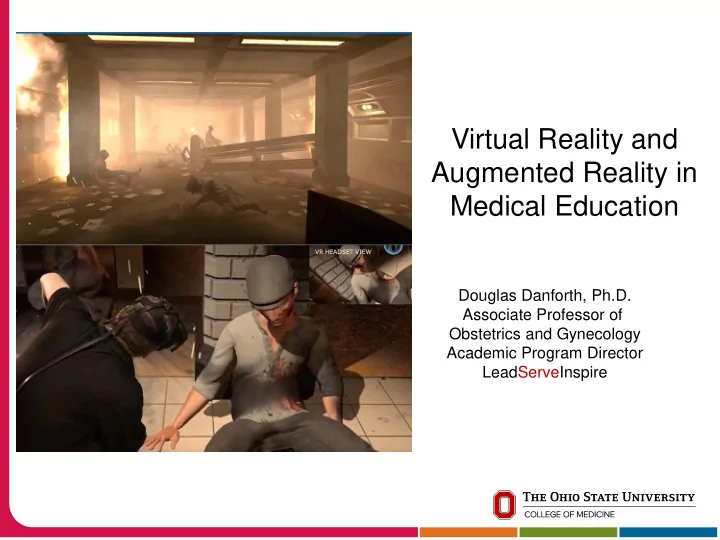
Virtual Reality and Augmented Reality in Medical Education

Douglas Danforth, Ph.D. Associate Professor of Obstetrics and Gynecology Academic Program Director LeadServeInspire
slide-2
SLIDE 2
  • Review the emerging field of Virtual Reality and

Augmented Reality in Medical Education

  • Discuss the opportunities and challenges involved in

realizing the potential of these technologies.

VR/AR in Medical Education

  • Objectives
  • Define/Describe Virtual Reality, Augmented Reality, Mixed Reality
  • History of VR/AR/MR in Medical Education
  • Current Technologies
  • Opportunities/Examples
  • Challenges
  • Future Directions
slide-3
SLIDE 3

Virtual Reality (VR)

  • Definition:
  • the computer-generated simulation of a three-dimensional image or

environment that can be interacted with in a seemingly real or physical way by a person using special electronic equipment, such as a helmet with a screen inside or gloves fitted with sensors.

  • Description:
  • “Completely” immersive
  • Isolated from physical world
  • Can create experiences not possible

in physical world

  • Created vs 360 video

Define/Describe Virtual Reality, Augmented Reality, Mixed Reality

slide-4
SLIDE 4

Augmented Reality (AR)

  • Definition:
  • a technology that superimposes a computer-generated image on a

user's view of the real world, thus providing a composite view.

  • Description:
  • Not completely immersive
  • Interact with physical world
  • Can augment experiences possible

in physical world

Define/Describe Virtual Reality, Augmented Reality, Mixed Reality

slide-5
SLIDE 5

Mixed Reality (MR)

  • Definition:
  • sometimes referred to as hybrid reality, is the merging of real and

virtual worlds to produce new environments and visualizations where physical and digital objects co-exist and interact in real time.

  • Description:
  • Useful for displaying Reality

and Virtual Reality simultaneously

Define/Describe Virtual Reality, Augmented Reality, Mixed Reality

slide-6
SLIDE 6

History of VR/AR

Sensorama 1950s ViewMaster 1939 ????

slide-7
SLIDE 7

Cave Automatic Virtual Environment CAVE

History of VR/AR in Medical Education

slide-8
SLIDE 8

Second Life

History of VR/AR in Medical Education

slide-9
SLIDE 9

Current Technologies - VR

Google Cardboard

Advantages

  • Inexpensive - $5.00 - $15.00
  • Uses display of your smartphone
  • Entry level device

Disadvantages

  • Low resolution
  • Stationary VR
  • Limited interaction
slide-10
SLIDE 10

Current Technologies – VR

YouTube Virtual Reality

360 Camera

slide-11
SLIDE 11

Samsung Gear VR

Advantages

  • Relatively Inexpensive - $50 - $100
  • Uses display of your smartphone
  • Mid level device
  • Allows some interaction

Disadvantages

  • Low resolution
  • Stationary VR

Google Daydream

Current Technologies - VR

slide-12
SLIDE 12

Advantages

  • Relatively Inexpensive - $200
  • Built in display
  • Built in sound
  • Allows interaction via controller

Disadvantages

  • Somewhat low resolution
  • Stationary VR

Current Technologies - VR

Oculus Go

slide-13
SLIDE 13

Advantages

  • High resolution
  • Smooth Video
  • Allows interaction
  • Mobile VR

Disadvantages

  • Expensive - $400 - $800
  • Requires powerful computer
  • Can be challenging to set up

PlayStation VR

Current Technologies - VR

Samsung Odyssey Oculus Rift HTC Vive

slide-14
SLIDE 14

Advantages

  • Not isolated from surroundings
  • Good for training not requiring

immersion

  • Access to real time

schematics/information Disadvantages

  • Can be expensive - $3,000
  • Requires powerful computer
  • Challenging to set up
  • Limited content

Current Technologies - AR

Google Glass Microsoft HoloLens Pokemon Go

slide-15
SLIDE 15

Opportunities/Examples VR Anatomy Education

slide-16
SLIDE 16

Opportunities/Examples VR Anatomy Education

slide-17
SLIDE 17

Opportunities/Examples AR Anatomy Education - HoloAnatomy

https://www.youtube.com/embed/SKpKlh1-en0

slide-18
SLIDE 18

Opportunities/Examples Voxel Bay – Nationwide Children’s Hospital

https://www.youtube.com/embed/uVRilk_6UWI

slide-19
SLIDE 19

Opportunities/Examples Mass Casualty Training

https://www.youtube.com/embed/JNdKo1uSRto

slide-20
SLIDE 20

Opportunities/Examples Mass Casualty Training

https://www.youtube.com/embed/wGLg1XiWgo0

slide-21
SLIDE 21

Opportunities/Examples Mixed Reality Video Example

https://www.youtube.com/embed/QqugCQzWOYA

slide-22
SLIDE 22

Virtual Patient

Opportunities/Examples Virtual Standardized Patients

slide-23
SLIDE 23

Virtual Patient

Opportunities/Examples Virtual Standardized Patients

https://www.youtube.com/embed/mvXIruMt9Ek

slide-24
SLIDE 24

Virtual Patient

Opportunities/Examples

Use VR to create illusion of loss of balance Heather E. Stokes, Jessica D. Thompson, Jason R. Franz. The Neuromuscular Origins of Kinematic Variability during Perturbed Walking. Scientific Reports, 2017; 7 (1) DOI: 10.1038/s41598-017-00942-x Virtual Reality Exposure Therapy for Combat-Related PTSD Judith Cukor, Maryrose Gerardi, Stephanie Alley, Christopher Reist, Michael Roy, Barbara O. Rothbaum, JoAnn Difede, Albert Rizzo, In: Posttraumatic Stress Disorder and Related Diseases in Combat Veterans, Springer International Publishing, 2016. The feasibility and acceptability of virtual environments in the treatment of childhood social anxiety disorder. Sarver, N., Beidel, D., & Spitalnick, J. (2014). Journal of Clinical Child & Adolescent Psychology,43 (1), 63-73.

slide-25
SLIDE 25

VR/AR - Challenges

slide-26
SLIDE 26

VR/AR - Challenges

  • Emerging technology
  • Fatigue, disorientation and vertigo
  • Difficult to scale
  • Movement in virtual space
  • Lack of haptic tools
  • Limited interoperability
  • Limited evidence of efficacy
slide-27
SLIDE 27

VR/AR – Future Directions

Technology

  • Portability
  • Untethered systems
  • Smaller more comfortable headsets
  • Fidelity
  • Higher resolution displays/increased

framerates

  • Haptic feedback
  • Multiplayer
  • Team based simulations
  • Interoperability
  • Build once – deploy everywhere
slide-28
SLIDE 28

VR/AR – Future Directions

Content/Applications

  • Surgical simulation
  • Patient specific simulations
  • Remote surgery
  • Virtual Patients
  • Practice history taking, physical exam skills,

differential diagnoses

  • Automated assessment
  • Team training
  • Emergency medicine, surgical siumulation
slide-29
SLIDE 29

Questions?