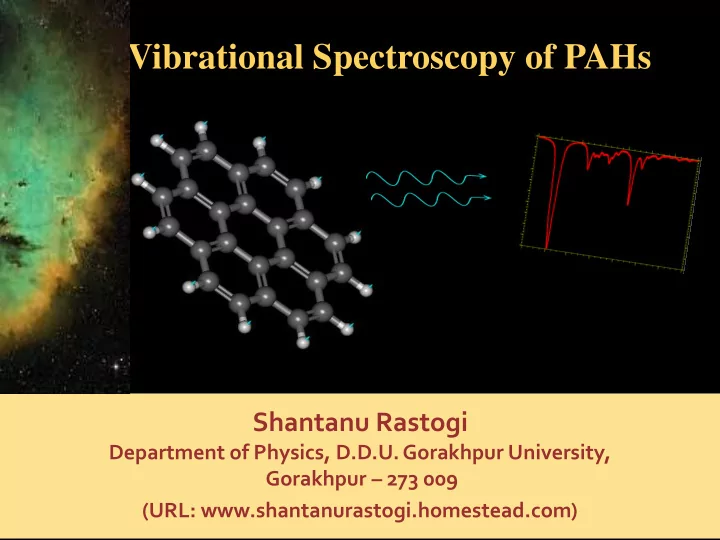
Vibrational Spectroscopy of PAHs Shantanu Rastogi Department of - - PowerPoint PPT Presentation
Vibrational Spectroscopy of PAHs Shantanu Rastogi Department of Physics, D.D.U. Gorakhpur University, Gorakhpur 273 009 (URL: www.shantanurastogi.homestead.com) Polycyclic Aromatic Hydrocarbons (PAHs) Ubiquitous in Space Detected
Emphysema is a lung disease; caused by exposure to toxic chemicals and tobacco smoke.
Polycyclic Aromatic Hydrocarbons (PAHs)
‘Ubiquitous’ in Space Detected via IR emission features at 3.3, 6.2, 7.7, 8.6, 11.2 & 12.7 mm
ISO-SWS spectra,
(First ISO results, 1996, A&A, 315)
- The features observed in a variety of
sources: planetary nebulae, reflection
nebulae, transition objects, novae, the galactic disk, and even external galaxies.
- The bands: typical vibrational transitions in
Aromatic moieties, indicating widespread
presence of PAHs in the ISM.
Infrared emission features –
3030, 1613, 1299, 1163, 893 & 787 cm-1 (3.3, 6.2, 7.7, 8.6, 11.2 & 12.7 mm).
- 3030 cm-1 – CH stretching vibration
- 1600 cm-1 – CC stretching vibration
- 1300 – 1100 cm-1
– CC stretch + CH bend vibration
- 3030 cm-1 – CH stretching vibration
- 1600 cm-1 – CC stretching vibration
- 1300 – 1100 cm-1
– CC stretch + CH bend vibration
- ~900 cm-1 – CH out of plane vibration
- 3030 cm-1 – CH stretching vibration
- 1600 cm-1 – CC stretching vibration
- 1300 – 1100 cm-1
– CC stretch + CH bend vibration
- ~900 cm-1 – CH out of plane vibration
- All vibrations are typical aromatic characteristics
- No specific molecule identification possible
a) Emission from IRAS 22272+5435 (a proto PNe) b) Absorption from PAH mixture (60% neutral + 40% ionized) c) Orion nebula emission spectra d) Absorption from a mixture of ionized PAHs only.
In a population of emitters, each
unique signature blends into a composite spectrum representative of the whole family.
More ionized species in star
forming regions and hydrogenated species in dense molecular clouds or outflows of AGB stars.
The emission features vary from source to source
Matrix Isolation Spectroscopy (MIS)
IR /
Laboratory Study of PAH vibrations – Infrared spectroscopy
Collision-free low temperature environment of ISM are reproduced in supersonic gas expansions.
empty cavity sample
Cavity Ring Down Spectroscopy (CRDS)
I(t) = I1 exp(-tt)
t = L/cT (Ring Down time)
ts = L/c(T+aS) a = [1/ts – 1/t]*L/Sc
Gas phase direct absorption
spectra.
Low sample concentration –> less
absorption per pass –> accurate measurement of ring-down time.
High reflectivity cavity mirrors lead to
long path lengths (~ 10 Km) and high resolution.
PAHs injected into the cavity need to be
ionized through a discharge.
- Difficul
cult to obtain ex exper eriment imental al spec ectra tra in I ISM condition
- ns
- PAHs
s possi ssibl ble e in the e ISM difficul cult to syn ynthes esize ize
Quan antu tum m Chemi mical cal cal alcula lati tion
- ns
s provi vide de th the mi miss ssin ing g li link nk.
- Visua
ualize ze a p a possi sible ble PAH. H.
- Optimize ge
geometry try – obt btai ain n normal al vibr brat ations. ions. Density ty Fun unctional ional Theory ry (DFT) ) ap applied for IR ab absor
- rpti
ption
- n
dat atabase abase.
Cataconde condensed nsed PAHs
38 to 96
- 96 C
atom
- m PAHs
The Sample database – Plain PAHs DFT - B3LYP/4-31G
- Absorption of UV ‘hn’ photon excites the PAH to a peak temperature ~ 1000 K,
depending on size and absorption cross section.
- Intersystem crossing / Internal conversion to very high vibrational levels;
- Emission from v v-1 levels in a cascade.
PAH Emission Mechanism
neutral cation
Meaningful comparison with observations require emission spectra
Th The T Ther ermal E al Emis issio ion Mod Model
- The thermal approximation for cascade emission model is considered
as average energy of individual modes is small compared to the total energy U(T) of the excited PAH.
- ‘i’ is vibrational mode within individual PAH having frequency i in cm-1
and m is total number of normal modes (3N – 6; N being the number
- f atoms). Emission photon flux for the ith mode is i.
- For a fall in internal energy by U, the fractional energy emitted in
the ith mode is given as:
- Fractional energy Ei is integrated over the cooling range from Tp to a
temperature of 50 K below which the energy emitted is negligible.
Composite emission spectra neutrals cations
Model Ι – small PAHs; less than 30 carbon atoms Model ІІ – medium sized PAHs; 30-50 carbon atoms. Model ІІІ – large PAHs; up to ~100 carbon atoms.
Enlarged Enlarged
7.7 7.7 µm ba m band nd
- The 7.7 µm Aromatic IR Band has components at 7.6 and 7.8 µm.
- 7.6 µm dominates in UV rich environments with processed PAHs.
- 7 .8 µm feature dominates in cooler regions having newly formed PAHs.
Peeters et al., A&A 390, 1089, 2002
Class A' Class B'
Strong UV sources
Observational classifications
- The 7.6 mm feature dominant in UV rich regions matches the
model spectra of medium sized PAH cations (a).
- The 7.8 mm component, observed in benign regions, correlates
with the model spectra of large PAH cations (b). Large PAHs form in out flows of post-AGB stars that transform to medium sized ones in strong UV sources.
Modeling observations - The “7.7” mm complex
Emission from cations for the three models in the 1450 to 1650 cm-¹ region
- The models do not satisfactorily match
the 6.2 μm feature.
- Most spectra fall short by 30 - 40 cm-1
from this 1610 cm-1 AIB.
- Study of a wider variety of PAHs
needed to explain all bands simultaneously.
Problems…
- The most favorable pathway is
condensation acetylene (C2H2).
- Intermediate
products like acetylene, vinyl-radicals, poly-acetylene indicate the possibility of PAHs with side groups. Growth of PAHs in the ISM
PAH with vinyl side groups
The presence of C=C bond in the vinyl side group on PAHs may increase the frequency of vibration of the C – C stretch mode.
2-vinyl-anthracene; 1625 cm-1 mainly vinyl C=C stretch
PAH with vinyl side groups
The presence of C=C bond in the vinyl side group on PAHs may increase the frequency of vibration of the C – C stretch mode.
2-vinyl-anthracene; 1615 cm-1 mainly ring C – C stretch
The database –
vinyl-PAHs DFT - B3LYP/4-31G Poster P-7
PAH vibrational signatures in the Far-infrared
- beyond 20 mm (500 cm-1)
C96 Jumping jack, 570 cm-1 (17.5 mm)
PAH vibrational signatures in the Far-infrared
- beyond 20 mm (500 cm-1)
Coronene Drum head, 118 cm-1 (84 mm) C96 Drum head 300 cm-1 (33 mm)
PAH vibrational signatures in the Far-infrared
- beyond 20 mm (500 cm-1)
Drum heads – edge not fixed
C90 Swimming – breast stroke 130 cm-1 (77 micron) C96 Swimming – breast stroke 195 cm-1 (51 micron)
PAH vibrational signatures in the Far-infrared
- beyond 20 mm (500 cm-1)