Infrared spectroscopy depends upon a change in the vibrational state - - PowerPoint PPT Presentation

infrared spectroscopy depends upon a change in the
SMART_READER_LITE
LIVE PREVIEW

Infrared spectroscopy depends upon a change in the vibrational state - - PowerPoint PPT Presentation

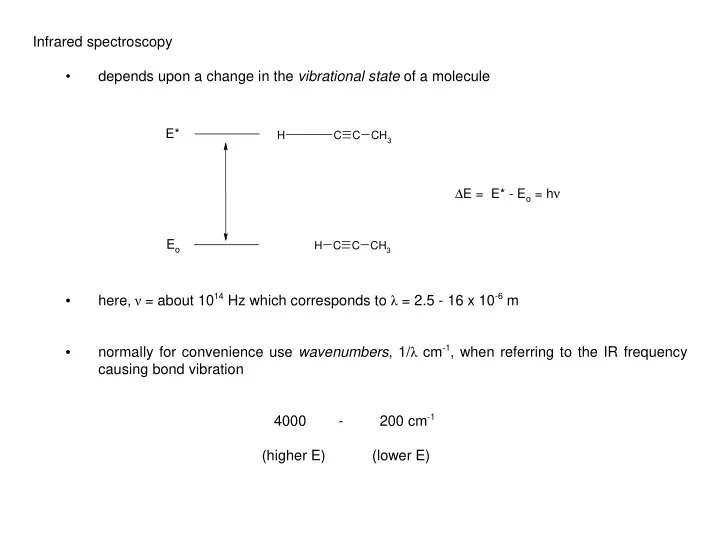
Infrared spectroscopy depends upon a change in the vibrational state of a molecule E* H C C CH 3 E = E* - E o = h E o H C C CH 3 here, = about 10 14 Hz which corresponds to = 2.5 - 16 x 10 -6 m normally for convenience


slide-1
SLIDE 1

Infrared spectroscopy

  • depends upon a change in the vibrational state of a molecule
  • here, ν = about 1014 Hz which corresponds to λ = 2.5 - 16 x 10-6 m
  • normally for convenience use wavenumbers, 1/λ cm-1, when referring to the IR frequency

causing bond vibration 4000 - 200 cm-1 (higher E) (lower E)

C C CH3 H C C CH3 H

Eo E* ∆E = E* - Eo = hν

slide-2
SLIDE 2

The vibrational behavior of the chemical bonds in molecules is well-described by Hooke’s Law

ν π µ

= ( /

) / 1 2 c k

so the frequency of the vibration depends upon

  • the masses of the bonded atoms: the greater the difference, the lower the frequency
  • the strength of the bond: the weaker the bond, the lower the frequency
  • a change in the dipole moment of the bond as it vibrates
slide-3
SLIDE 3

How an IR spectrometer works detector source sample (a heater) (film sandwiched (thermometer) between salt plates)

  • as the wavelength of radiation is varied, is the detector hot or not?
slide-4
SLIDE 4

absorbance 100 = cold 0 = hot ν X X X X X X