Union Pacific's Next Generation Track Technologies Dwight Clark - - PowerPoint PPT Presentation

union pacific s next generation track technologies
SMART_READER_LITE
LIVE PREVIEW

Union Pacific's Next Generation Track Technologies Dwight Clark - - PowerPoint PPT Presentation

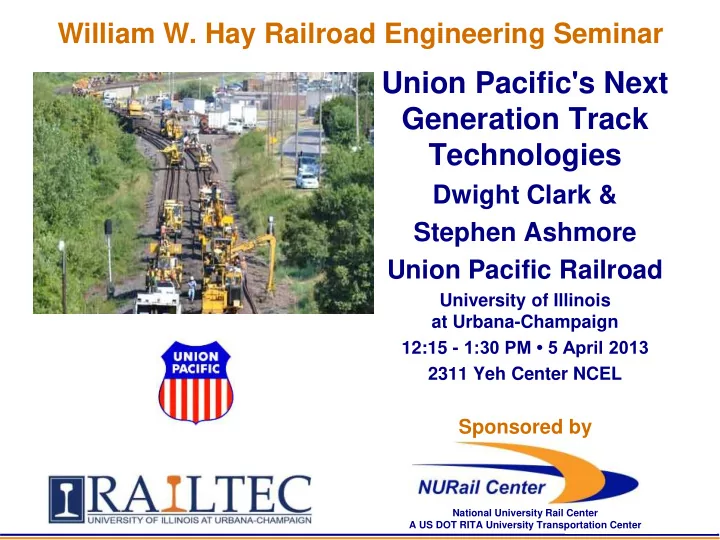
William W. Hay Railroad Engineering Seminar Union Pacific's Next Generation Track Technologies Dwight Clark & Stephen Ashmore Union Pacific Railroad University of Illinois at Urbana-Champaign 12:15 - 1:30 PM 5 April 2013 2311 Yeh


slide-1
SLIDE 1

William W. Hay Railroad Engineering Seminar

Union Pacific's Next Generation Track Technologies

Dwight Clark & Stephen Ashmore Union Pacific Railroad

University of Illinois at Urbana-Champaign 12:15 - 1:30 PM • 5 April 2013 2311 Yeh Center NCEL

Sponsored by

National University Rail Center A US DOT RITA University Transportation Center

slide-2
SLIDE 2

2 2

  • U. P. Next Generation Track Technologies

The William W. Hay Railroad Engineering Seminar Series

April 5, 2013

Dwight Clark, Asst. Chief Engineer – Engineering Technology & Strategy Steve Ashmore, Director Standards & Technology

slide-3
SLIDE 3

3 3

Talking Points

  • Rail industry health
  • U. P. profile & infrastructure
  • Remote track assessment systems
  • Vision-based evaluation systems
  • Next generation rail steels
  • High speed passenger turnouts
  • Concrete & advanced fastening

systems

slide-4
SLIDE 4

4 4

Freight Rail Industry Vibrant and Growing

  • 1916 – 254,521 route miles
  • 1940 vs. 2011 - 93% < miles
  • 1940 vs. 2011 - 460% > ton miles
  • 1944 vs. 2011 – 230% > aver. tons/car
  • 2011 – 138,623 route miles

Big freight trains shot

200 400 600 800 1,000 1,200 1,400 1,600 1,800 2,000 50,000 100,000 150,000 200,000 250,000 300,000 1940 1950 1960 1970 1980 1990 2000 2011 Ton Miles of Freight (billions) Miles of Track Miles of Track Ton-Miles of Frieght

slide-5
SLIDE 5

5 5

Background on Union Pacific Railroad

  • Largest railroad in North America.
  • Operates western 2/3rd of U. S.
  • 150 year old company.

– Founded in 1862.

  • Fortune 143 company with

revenues of $19.5 billion.

  • Primary role is freight with

increasing passenger participation

  • 45,000 Employees
slide-6
SLIDE 6

6 6

Operating Infrastructure

  • 32,006 mi route
  • 112 Million ties
  • 12,245 mi of yards, sidings, & industry

leads

  • 31,434 Turnouts
  • 18,031 Bridges (417 mi)
  • 296 Tunnels (62.2 mi)
  • 26,441 Active public crossings
  • 6,793 Buildings
  • 62 Auto or intermodal ramps
  • 62 Car and loco shops
  • 45 Major switching yards
  • 12,500 Signal facilities
slide-7
SLIDE 7

7 7

  • U. P. Commodities Carloads

Intermodal 3.6 million Energy 2.0 million Chemicals .9 million Industrial .9 million Agricultural .8 million Automotive .4 million

slide-8
SLIDE 8

8 8

  • U. P. Engineering Department
  • Designing, constructing and

maintaining track, bridges, structures and signals

  • Engineering Sub-departments

– Design – Track Renewal – Construction – Track Maintenance – Bridges – Signal

  • Resources

– 12,500 employees – 5,719 Vehicles – 4,463 Pieces of Equipment

slide-9
SLIDE 9

9 9

Remote Track Assessment (VTI)

  • Vehicle Track Interaction (VTI)

– System measure wheel/axle impacts (force) and car body acceleration (G’s) to identify possible track defects from the rail car’s perspective. – Installed on 52 locomotives & 2 cars

  • Provide notification of critical locations.

– High Priority exceptions inspected winin 24 hours. – Mediums inspected within 7 days. days.

  • Measures : CB Vertical & Lateral, Truck

Lateral, Axle Vertical, CBR.

  • Newest measurements: Mid Chord Offset

& Combo Cluster VTI System

slide-10
SLIDE 10

10 10

Mid Chord Offset (10’) Exception

  • 10’ Mid Chord Offset (MCO)

– Axle accelerations are effective for detecting wheel impacts. – Axle Accelerations can be used to derive space curves and calculate MCO. – 10’ chord recommended and detection added to VTI’s. – MCO initially developed to find the short profile exceptions in concrete tie track 5 ft 5 ft +MCO Y+5 Y=0 y-5 Rail Surface

slide-11
SLIDE 11

11 11

Mid Chord Offset (10’) Exception

.

slide-12
SLIDE 12

12 12

Combo Cluster Exception

  • Combines urgent, near urgent and priority

MCO’s, CBV’s, CBL’s, CBR’s and Axle VTI exceptions.

  • Provide the ability to determine and manage

potential high risk derailments locations.

  • Cluster exceptions are identified as repeat

VTI exceptions occurring at the same location, typically containing two or more different types of VTI exceptions.

  • Ranks based on average track speed, type
  • f exception, quantity of exceptions and

relative age.

  • Types of exceptions found from inspection:

non-supported joints, striped insulated joints, broken concrete ties, transitions from wood to concrete (turnouts, bridges, crossings etc.), crushed heads and rail conditions with signs of pumping.

Carbody Exception Axle Exception MCO Exception Example “Combo Cluster”
slide-13
SLIDE 13

13 13

Remote Track Assessment (ATGMS)

  • Autonomous Track Geometry Measuring

Systems (ATGMS)

  • ATGMS systems can be mounted on

locomotives or rail cars and operated without an operator.

  • FRA is operating an ATGM system and

technology is still be tested.

  • U. P. does not have a system mounted on a

locomotive or car. – Have similar system mounted on truck.

  • Provides a tool for monitoring the health of

the railroad. ATGMS

slide-14
SLIDE 14

14 14

Remote Track Assessment (MRail)

  • MRail Track Deflection Msmt. System

– Sensor system consists of a digital vision system and two line lasers. – Lasers projected onto the rail surface four feet in front of a loaded wheel . – Changing vertical support generate a variation in track deflection. – Large deflection have found bad welds, joint conditions, broken or missing ties. – Produces exceptions that correlate with 10-ft MCO and 10-ft ECO values generated from space curve data collected with the EC-5 vehicle. – Currently running a monthly test on South Morrill Subdivision to study degradation.

slide-15
SLIDE 15

15 15

Machine Vision Technology

  • Purpose:

– Develop and implement “vision” based systems for conducting asset inspections, inventory verifications and overall condition assessments.

  • Potential Opportunities:

– Concrete tie evaluation – Wood tie evaluation – Rail surface conditions – Joint bar Inspections – Rail brand recognition – Fastening recognition and evaluation – Rail seat abrasion on concrete ties

  • Benefits

– Reduce demand for visual inspections – Improve track availability and reliability – Asset inventory

slide-16
SLIDE 16

16 16

Improvements in Rail

  • U. P. is installing rail that is 100% head

hardened. – 72% premium head hardened (400+ brinell) rail – 28% intermediate head hardened (360 – 370 brinell)

  • 480’ Long rail
  • 2 welds per 1440 ft string vs 17.
  • Future rail will increased hardness at

¾” depth.

  • Improved plant welds
slide-17
SLIDE 17

17 17

Plant Weld Improvement

  • Some plant welds fatiguing on heavy

tonnage rail

  • Induction coils will be used to perform

post weld heat treating of plant welds.

  • Objective is to reduce residual stress and

the width of the heat affected zone,

slide-18
SLIDE 18

18 18

Results Western Mega Sites Premium Rails

  • Rolling contact fatigue (RCF)
  • ccurrence can be significant, if not

controlled.

  • Significant benefits from preventive

grinding or top of rail friction control to control RCF and reduce wear.

  • Premium rails continue to show

excellent wear performance, without internal defects identified

slide-19
SLIDE 19

19 19

0.0 0.2 0.4 0.6 0.8 1.0 200 400 600 800 1000 1200 1400 1600 1800 Rail Wear - in2

MGT

2 Degree, Low Rail, Preventive Grinding 0.0 0.2 0.4 0.6 0.8 1.0 200 400 600 800 1000 1200 1400 1600 1800 Rail Wear - in2 2 Degree, Low Rail, Friction Control

Results Western Mega Sites Premium Rails

  • Friction control is effective in

controlling RCF and reducing natural wear – 960 MGT without recurring RCF

  • Preventive grinding is effective, but

leads to more rail section area loss

  • Rail wear on 2-degree test curve at

1,660 MGT tonnage – 17% of railhead cross section on the curve with grinding – 12% of railhead on the test curve with friction control

slide-20
SLIDE 20

20 20

Premium Rail in Revenue Service

  • Premium test rails in the 1-degree curve were replaced in Feb. 2013 for sporadic

severe RCF spots. – No RCF maintenance strategies implemented for the 1-degree test curve, similar to those implemented for the two 2-degree curves

  • Summary of past test results:

– For the 1-degree test curve, moderate but isolated RCF spots were

  • bserved only after 960 MGT since the rail installation

– For the 2-degree test curves, however, severe RCF occurred at 300-350 MGT after the rail installation

  • Future testing at the mega-site will:

– Monitor performance of next generation premium rails compared to previous generation premium rails

  • RCF, wear, internal flaws

– Develop and demonstrate “optimized” strategies to prevent RCF and reduce rail wear

slide-21
SLIDE 21

21 21

Track Assessment Group

Ties/Turnouts Rail Surface/Ballast Other Trk Comp Trk Assessment EC Cars Gauge Trucks GRMS Field Survey Other Testing Tie/TO R&D Tie/TO Stnds Tie/TO Prd Dev Tie/TO Qlty

  • Maint. Stnds

Field Support Curve Assessment Rail/Diamond R&D Rail/Diamond Stnds Rail Prd Dev Rail/Diamond Qlty Field Support Ballast Stnds Ballast Qlty Ballast R&D Surface Strategy

  • Maint. Stnds

Assessment Tech Field Support Othr Trk Prod Dev Othr Trk QC Other Trk Stnds Other Trk R&D Trk Assess Support Field Support Dir Standards/Technology Accountabilities

Organize around specific asset classes to build expertise, improve product development/R&D, improve field assessment/support, improve product quality and decrease product development/implementation cycles.

Stephen Ashmore

Steve Ashmore (Vacant) Sam Atkinson Caleb Douglas Chris Rewczuk Chuck Richardson

Tie Assessment

Doug Mitchell

Tie Assessment

slide-22
SLIDE 22

22 22

Mixed Use Passenger/Freight Turnout Design

University of Illinois – 4/5/2013 Stephen Ashmore, Union Pacific Railroad

slide-23
SLIDE 23

23 23

Union Pacific Turnout Facts

  • The UPRR system has over 13,000 mainline

turnouts. – In addition to this there are thousands of yard and industry turnouts.

  • Turnouts are a hodge-podge of different sizes,

layouts and configurations.

  • UPRR utilizes concrete turnout primarily where

concrete tie mainline track is located.

slide-24
SLIDE 24

24 24

Passenger Service on Union Pacific

Weekly Riders Weekly Trains On-Time %

UP Commuter

(incl Capitol Corridor)

647,000 1,450 94% Amtrak on UP 89,000 328 85% Total UP 736,000 1,778 92% LA El Paso Seattle Twin Cities

Duluth

  • Ft. Worth

Denver Portland Bay Area San Antonio Salt Lake City KC Austin New Orleans

Amtrak on UP Commuter Services

North Platte Memphis

  • St. Louis

547,000

Weekly Riders

47,000

Weekly Riders

53,000

Weekly Riders

Chicago Houston

slide-25
SLIDE 25

25 25

SPCSL Line – St. Louis to Chicago

  • Route is a critical freight corridor for UPRR.
  • Route will provide a major AMTRAK connection

between St. Louis and Chicago.

  • Trains will be able to operate at 110 MPH (Class 6)
  • ver major sections of the route.
  • Major sections of the track will be upgraded to

concrete ties and 141 lb. rail.

  • Currently single mainline that will be gradually

upgraded to double mainline.

Woodland Jct.

Chicago

  • St. Louis

Springfield Ridgely

Bloomington

Findlay Jct.

  • E. St. Louis

De Soto

Salem

  • Mt. Vernon

Benton Jct. Gorham/Chap Chester

Springfield Sub

Joliet Sub

BNSF Galesburg Nelson

Peoria

Rochelle

slide-26
SLIDE 26

26 26

Illinois HSR – Chicago to St. Louis

Before & After TRT – Tangent Track MP 194.00

slide-27
SLIDE 27

27 27

SPCSL Route Challenges - Turnouts

  • Class 6 (110 MPH) is a different operating environment for UPRR, who traditionally
  • perates in Classes 1 through 5.
  • The 110 MPH speeds require efficient interchange points (or crossovers) that allow

trains to move seamlessly between the two mainlines. This will help the network remain fluid and minimize impacts of maintenance interventions, weather etc.

  • With the 110 MPH speed a high speed turnout move helps keep traffic moving, a speed
  • f greater than 50 MPH is desired.
  • Time reduction is the key…….must be competitive with alternatives.
  • Traditional AREA turnouts are designed to maximize space, longer turnouts increase

cost and maintenance.

slide-28
SLIDE 28

28 28

Lateral Forces in Turnouts

  • UPRR has done a tremendous amount of strain gauging to understand turnout

loading conditions.

  • Reduced lateral forces provide higher passenger comfort when transitioning from
  • ne track to the other. Reduced forces also allow for faster speeds.
  • Reduced lateral forces decrease wear on components.
slide-29
SLIDE 29

29 29

Lateral Forces in #20 Turnouts

  • There is a high peak load about 6 ft. behind the point of switch
  • Figure below provides the average (for five trains) maximum lateral force exerted
  • n the track structure. Highest lateral forces recorded ahead of and behind switch

points with a gradual reduction thereafter until a slight peak at the frog (MPF).

0 ft. (ahead of points) 6 ft. (behind points) 34 ft. 54 ft. 94 ft. 134 ft. (toe

  • f frog)

176 ft. (heel of frog) 194 ft. Max Lateral Force 9283 17475 13471 9767 6203 8735 4596 4933 4000 8000 12000 16000 20000 Lateral Force

  • Ft. Back From Point of Switch
slide-30
SLIDE 30

30 30

Desired Load Profile

  • Goal is a much more consistent and spread out loading throughout the entire turnout.
  • Elimination of high peaks reduces wear on turnout structure.
slide-31
SLIDE 31

31 31

#24 Laguna Nigel, CA - MetroLink

  • UPRR approached voestalpine

Nortrak Inc. to determine current switch designs that could reduce lateral loading.

  • “Semi” tangential switches,

currently installed on MetroLink in CA were identified as targets.

  • Tangential means the entry angle

is as close to zero as possible.

  • Goal is to very slowly move

loading on to the point.

slide-32
SLIDE 32

32 32

Comparison Standard #24 vs. Semi Tan #24

UP EXISTING #24 SEMI-TANGENTIAL #24

Vmax 61mph 60mph Entry jerk : based on Wheel base (the distance between the center of the two wheel sets) L=20m 0.1g/s 0.07g/s

If we use ACELA coach car L =13.589m, keeping entry jerk =0.1g/s

Vmax=50mph Vmax=60mph

3” UNBALANCED SUPERELEVATION

slide-33
SLIDE 33

33 33

Comparison #24 Semi-Tan vs. Standard #24

  • Total Turnout Length:

– Standard: 267’ – Semi-Tan: 296’

  • Total Switch Point Length:

– Standard: 39’ 0” – Semi-Tan: 61’ 6”

slide-34
SLIDE 34

34 34

Standard #24 AREA #24 Semi-Tangential

slide-35
SLIDE 35

35 35

#24 Semi – Tangential: Athol, IL

slide-36
SLIDE 36

36 36

Moving Forward

  • Union Pacific has had a tremendous amount of success with the semi-tangential

turnouts.

  • We are currently working to implement revised geometry turnouts in other applications.
  • Currently testing similar turnouts on our heavy coal routes.

– Using revised geometry in addition to other key features to strengthen the turnout. – Goal is to reduce peak loads and reduce number of maintenance interventions.

  • We will continue to monitor the performance of these turnouts and do additional strain

gauge work to monitor loading.

  • Of course we will also be actively engaging in the “spilled coffee test” going forward…..
slide-37
SLIDE 37

37 37

Concrete Tie and Fastening System Research

University of Illinois – 4/5/2013 Stephen Ashmore, Union Pacific Railroad

slide-38
SLIDE 38

38 38

Union Pacific Concrete Tie Facts

  • Union Pacific began utilizing concrete ties in spot applications in the 1980’s
  • Today over 3,000 route miles are concrete, utilized in three primary applications:
  • High degree of curvature territories such as mountain ranges
  • High tonnage areas such as the Nebraska/Kansas coal routes
  • Locations where operating conditions dictate higher track strength
  • UPRR has utilized 9 different fastening systems in various quantities.
slide-39
SLIDE 39

39 39

Economic Competitors to Concrete Ties

Wood Composite Steel

slide-40
SLIDE 40

40 40

What Drives UPRR Concrete Tie Research?

  • 1. Highest maintenance intervention areas

1. Curves 2. Turnouts – Tremendous amount of work done last 3 years

  • 2. Increased fastening system component life cycles

1. Fastening system degradation, particularly in curves drives cost

  • 3. Increased long term durability
  • 4. Ability to handle long term increased axle loadings

1. Long term desire to increase from 286K 2. Better ability to handle high wheel impact loads

  • 5. Decreased surfacing interventions and failure replacements
slide-41
SLIDE 41

41 41

Advantages of Concrete Ties in Curves

  • Increased lateral stability. Concrete ties can have much higher lateral restraint than

alternatives.

  • Increased gage restraint. Concrete is a much more solid system than alternatives for

maintaining tie dimensions and eliminating degradation.

slide-42
SLIDE 42

42 42

slide-43
SLIDE 43

43 43

Impact of Forces on Fastening System

  • Currently UPRR finds the biggest issues with concrete ties in curvature 3 degrees and
  • greater. Curvature changes the loading conditions heavily and results in excess:

– Insulator wear – Pad wear

  • Insulator and pad wear drives the other critical issues in curvature.

– Rail seat deterioration – Shoulder wear or lag screw wear – Wide gage – Excess cant

slide-44
SLIDE 44

44 44

slide-45
SLIDE 45

45 45

How Does UPRR Look for these Conditions?

  • UPRR inspects and maintains aggressively to

the UPRR and FRA requirements.

  • Boots on the ground human inspections.
  • Measurements are taken in multiple ways to

determine performance. – By hand by M&R Staff. – By Geometry measurement tools such as EC-5.

  • Gage restraint measurement systems.
  • Physical tie rating teams.
slide-46
SLIDE 46

46 46

Sample EC Car Strip Chart

slide-47
SLIDE 47

47 47

Concrete Tie Research

  • Curve failures are really driving our research…..we are focusing on the highest most

costly failure area.

  • Looking for ways to reduce fastening system failures and extend the life to match the

life of the rail or the life of the surrounding tangents.

  • Developing systems that work with production equipment and are easily maintainable.
  • Developing systems that can be produced on large scale.
  • Developing systems that can be inspected visually.
slide-48
SLIDE 48

48 48

2013 Tie and Fastening System Research

  • In 2013 UPRR is going to begin a massive test of different types of tie systems in high

curvature.

  • Over 6,000 Ties of 8 different designs will be produced by multiple U.S. vendors.
  • Goal will be to determine which fastening system and tie type performs the best in
  • curvature. Curves will be 3 to 12 degrees.
  • Ties will be evaluated in every aspect from fastening system degradation to rail seat

abrasion and center binding condition.

  • Ties will also be cycle tested using the MTS.
slide-49
SLIDE 49

49 49

Key Concepts Being Tested – Combating Issues

  • Use of stirrups to provide internal end containment.

– Testing multiple different designs to try and increase tie strength and reduce crack propagation.

  • Full face insulators and wear surfaces.

– Goal is to use the entire width of the tie for bearing instead of just a small shoulder area.

  • Larger tie sections and different reinforcing patterns to increase center negative

strength.

  • Different pad and rail seat epoxy types that prevent rail seat abrasion.
slide-50
SLIDE 50

50 50

Hydraulic Actuator Hydraulic Actuators Cyclic Load Test Steel Frame

MTS Testing Machine

  • UPRR recently began utilizing and MTS hydraulic cycle testing apparatus capable of

mimicking track loading conditions in a lab environment.

  • The machine is capable of performing multiple different tests at loads up to 50,000 lbs.

at a rate of up to 5 Hz.

  • For example 3 million cycles (roughly a year in high usage track) can be completed in

about 2 weeks.

slide-51
SLIDE 51

51 51

Epoxy Coating

  • All new ties have rail seats that are epoxy coated prior to installation.
  • Epoxy is either a two part air activated or a single part UV activated.
  • Epoxy is meant to displace water and provide a better seal against sand and dust.
  • Research has shown that epoxy can cut RSA by as much as 200%.
  • Epoxy coating is used during field replacement operations during mid-life cycle events.
  • Hardness is between 80 – 95 Durometer Shore D.
slide-52
SLIDE 52

52 52

SSL – Half Frame “Sleepers”

– Currently in test on the UPRR and at TTCI – South Morrill Subdivision (UPRR/TTCI Mega-Site)

  • Three test Locations

– Bridge Approaches » Installed 15 SSL ties on east and west approach » Installed April 2011 – Bridge Approach » Installed 15 SSL ties on west approach » Standard ties on east approach » Installed April 2011 – Insulated Joint Location » Installed 30 SSL ties underneath insulated joints » Installed August 2011

– La Grande Subdivision (Curve Test)

  • 7 Degree 14 Minute 37 Second RH Curve

– Installed June 2012 – 253 SSL ties installed out of face

slide-53
SLIDE 53

53 53

Key Features of the Half Frame Tie

  • Larger bearing area, results in reduced ballast pressures
  • Larger friction surface against horizontal movement. Prevents curves from moving in

and out during temperature swings.

  • Utilizes the Vossloh fastening system that provides over 7 ½” of wear surface per tie.
  • Produced using a single tie carousel system, very tight Quality Assurance and Control

checks.

  • Utilizes an under tie pad produced by Getzner. Tie pad helps to provide a more

consistent ballast loading condition.

slide-54
SLIDE 54

54 54

slide-55
SLIDE 55

55 55

slide-56
SLIDE 56

56 56

slide-57
SLIDE 57

57 57

Half Frame Ties – Going Forward

  • UPRR continues to monitor the test locations.

– Surface condition – Rail condition – Ballast condition – Top of rail elevations – Curve movement

  • Going forward the Half Frame ties potential lies in its ability to provide relief in high

maintenance areas.

slide-58
SLIDE 58

58 58

Special Thanks

  • Chris Rewczuk, UPRR
  • John Jerome, UPRR
  • Eric Gehringer, UPRR
  • Antonio Buelna, UPRR
  • Gary Click, voestalpine Nortrak Inc.
  • Gord Weatherly, voestalpine Nortrak Inc.
slide-59
SLIDE 59

59 59

Take A Ways

  • Rail industry is healthy and growing.
  • Increased understanding of U. P. and

it’s infrastructure.

  • Excellent advances in the industry

with new technology.

  • U. P. is trying to capitalize on latest

technology.

  • Still opportunity to find solutions to

the challenges that face railroads.

  • Looking for practical cost effective

solutions.

  • Research is driven by demand.
slide-60
SLIDE 60

60 60

Rail Related Engineering Degrees

  • The railroad industry offers graduate

engineers a very rewarding environment to work.

  • Excellent opportunities for new graduate

engineers in the present and coming years.

  • Engineering degrees favored for the U. P.

Engineering Associates in the Operating Management Training program: – Civil – Construction Management – Electrical – Electronic – Industrial – Structural – Mechanical

slide-61
SLIDE 61

61 61

To Apply and Find Additional Information

  • Visit www.up.jobs

61

slide-62
SLIDE 62

62 62

Union Pacific would like to thank the University of Illinois Urbana-Champaign for their hospitality.

slide-63
SLIDE 63

63 63

Questions?