
SLIDE 1
Beaver Creek Hydrology, LLC.
Beaver Creek Hydrology, LLC. Project Partners: Vulcan Materials: - - PowerPoint PPT Presentation
Beaver Creek Hydrology, LLC. Project Partners: Vulcan Materials: boulders and gravel National Recognition On the 2012 TEN WATERS TO WATCH list by National Fish Habitat Partnership Americas Great Outdoors Rivers Initiative: Harpeth
Beaver Creek Hydrology, LLC.
Vulcan Materials: boulders and gravel
Identifies projects that are models to conserve key rivers, expand outdoor opportunities, and support jobs. Announced May 21, 2012. One per state and D.C.
River segment is on 303(d) list:
impaired by Siltation and Habitat Alteration and low dissolved oxygen (2 TMDLs)
There are other approaches for
withdrawing water that will not affect river dynamics, water quality and aquatic life
Required as part of upgrade of
water intake in city of Franklin’s water withdrawal permit
Primary In-Stream Impact:
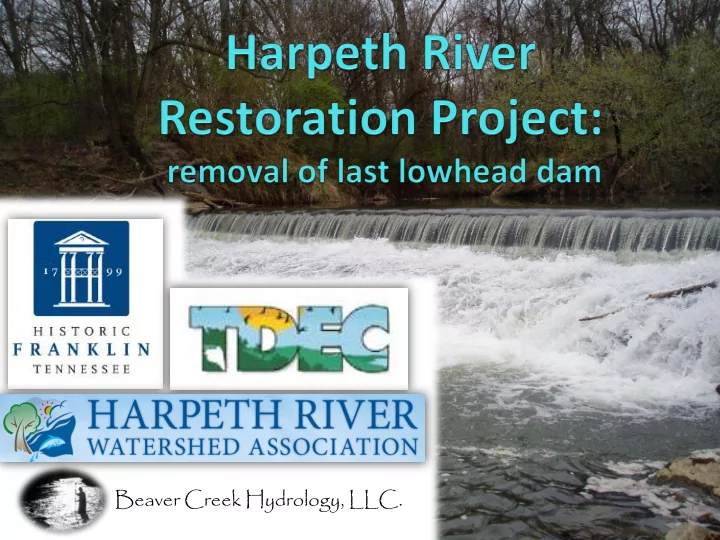
Low Head Dam
6.2 feet high, 66 feet across Creates aquatic habitat loss Creates downstream bank instability Creates upstream sedimentation
issues
Fish passage barrier Very low dissolved oxygen in pool
below structure violates water quality standards
Summer 2007 before state water withdrawal permit was set for city
Winter high flow season
FUNDED BY: SARP – NFHAP – USFWS Aquatic Habitat Restoration Program - Total Award $350,000 Primary Goals
Increase Fish Habitats and Remove Fish Passage Barriers Improve Channel Stability Improve Recreational Activities- Harpeth River BLUEWAY
Primary Objectives
Remove Low Head Dam ($200,000 for Fish Passage)
Reconnect 36 miles upstream (meet southeast aquatic habitat plan)– Harpeth will
be one of few completely unobstructed, free-flowing rivers in TN
Restore freshwater passage and habitats (physical) Increase dissolved oxygen level (chemical) (help meet Franklin’s stormwater permit
requirements)
Install “Natural” In-Stream Habitats ($150,000 for Habitat Restoration)
Natural channel design methodology stabilize vertical stream banks and prevent erosion create riffle/run/pool/glide habitats for native species meet southeast aquatic habitat plan Address impairments listed by State Improve this TWRA winter trout stocking site
Dam Removal - By TDEC No Blasting Involved Double-invert boulder cross vane Bankfull benching Toe wood structure Boulder clusters Log cross vanes Log and boulder step-pools Native vegetation
run pool glide Bankfull bench Bankfull bench Flow
structures, Wildland Hydrology.)
riffle riffle
A Winter Trout Stocking Reach in Clear Creek, Golden, Colorado (after
Restoration of Murfrees Fork of the West Harpeth River, Williamson County, TN (during construction) Endangered Crawfish Habitats in Restoration of Mill Creek, Nolensville, Tennessee (after one growing season) Upstream Pool Control, Mill Creek, Nolensville, Tennessee (after one growing season)
Engineering Analysis
City water withdrawal
The bankfull benches allow
easy access trails and points along water’s edge for recreation during low flows.
The project reach is entrenched. Entrenchment occurs when
bank heights exceed the normal high water (bankfull) heights
The bankfull benches
additionally increase flood capacity
Bankfull bench reduces stresses
erosion
Construction Total $ 578,720 Admin/Design/Management $ 229,400 Monitoring/Maintenance for 5-years $ 57,206 Estimated Total Project Cost $ 865,326
Compare to M&E intake upgrade and modified dam replacement (Alt. 2)
$ 1,160,000 USFW Grant Funds $ 350,000 Total in-kind needed $ 515,326 TDEC in-kind $ 189,000 Possible Further in-kind $ 33,860 City of Franklin cost $ 292,466
Compare to M&E cost to just remove lowhead dam (Alt. 5) $ 280,000
City of Franklin- project at 1/3 cost TDEC- the regulating entity actually conducting part of the project, big
benefit to the city who has a permit specifically the lowhead dam removal.
Project is a POSITIVE image enhancer to TDEC and Franklin. Also
viewed as Voluntary versus Required.
Project shows state, federal, local governments and private sector with
conservation organization working together. This helps balance image that these entities are usually only at odds with each other.
USFWS and TWRA– federal and state wildlife agencies and
partnerships are getting project that is high profile and helps implement wildlife recovery plans
USFWS- might get a ESA candidate species agreement from Franklin Without collaboration, project would likely not have the restoration
improvements, would have been done under regulatory pressure, would have cost the city full price. AND would very likely not have used innovative Natural Channel Design so there would still have been a structure in the river blocking fish passage.
Complex efforts like watershed plan implementation will not happen
entirely without partnerships that include trusted entities by the public
Partnerships that include governments, NGOs, academia, private
entities can really leverage each others strengths– reduce costs, make projects happen with less contention, bring more private landowners and public support into the efforts
TRUST among leadership in partners is ESSENTIAL– need key
people in partnership who already know each other. Can help build trust among other partners- ie permittee and agency
Partnerships enable entities to take on roles on behalf of all. Ie- NGO
might be better to facilitate discussions among regulated and regulator to keep things informal or in be the applicant for certain funds on behalf of partnership.
Promote INNOVATION which then can become more
Overcome inertia and/or outright hostility toward new
TRAINING on the innovation is important. Help demonstrate complete costs and benefits–