
SLIDE 1
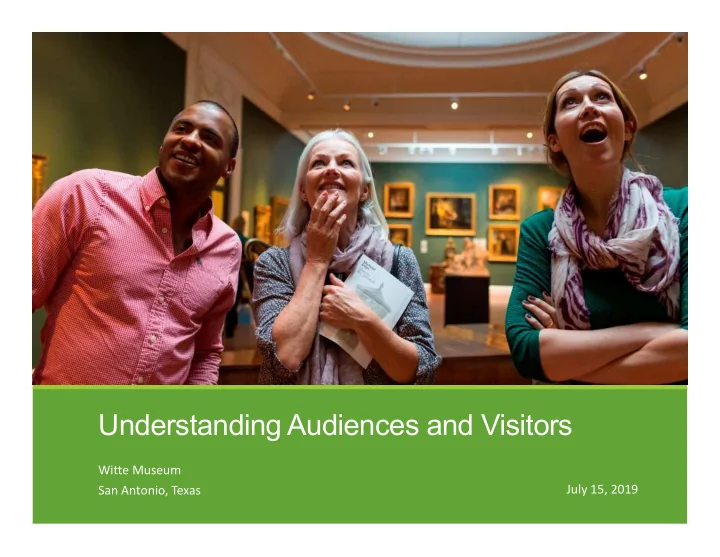
Understanding Audiences and Visitors
Witte Museum San Antonio, Texas July 15, 2019
Understanding Audiences and Visitors Witte Museum July 15, 2019 - - PowerPoint PPT Presentation
Understanding Audiences and Visitors Witte Museum July 15, 2019 San Antonio, Texas Welcome Introductions A few words from our hosts Why We Are Here What is an audience? Who are visitors? Who comes to your institution? Who
Witte Museum San Antonio, Texas July 15, 2019
For the purpose of this workshop, we’ll use these two definitions –
what do/did I do?
sites?
museums/historic sites?
museums/historic sites do I visit?
museums/historic sites?
have?
Visitors, unlike audiences, can be measured through their attendance
Important to be accurate in counting your visitors
back up your numbers
Guest books
them
party
Estimating
then let’s just multiply the number of days we are open by 20.”
that tour... or were there 10? Maybe 6 this afternoon?”
Automatic Door Counters
mop or broom . . . . or your resident ghost!)
Ticket Sales
Counting everybody who comes in
public, funders, and others)
You can count everyone if . . .
mission-related activities
Some institutions count everyone, even the UPS guy. Is that fair? Other institutions count only visitors who come for mission-based
Where do you draw the line?
Most accurate way to take attendance is every day, with a daily log Formalize it as part of daily operations
so does not tell you much about how many people are visiting
Equals 1 unique visitor
Decide what you want to measure:
your website
Date Regular Adult Visitor Regular Child Visitor School Programs Outreach Programs Website Visitors Notes Saturday, April 5
7 3
Wednesday, April 9
2 90
Saturday, April 12
8 4
Friday, April 18
50
Saturday, April 19
10 3
Saturday, April 26
1 Poured all day
April Totals
8 10 90 50 1753
Different ways of segmenting (and different ways of looking at the data)
White 89% Hispanic or Latino 5% Black or African American 3% Asian 6% American Indian 2% Mixed Race 4%
Adds up to more than 100% as some individuals identify as more than one race or ethnicity
Note: as you develop your database of visitor data, you will be able to better segment your visitors . . . and see how it changes over time.
What visitors are most valuable to you? Why? Possible reasons include:
Does Your Institution Serve Your Entire Community? You now basically know who is coming to your institution. But who isn’t? Use US Census data to learn more about your community, compare it who does come, and then learn who doesn’t.
Go to https://www.census.gov/quickfacts/fact /table/US/PST045218
Enter your city (or county, if your city/town population is less than 5,000) Results will appear
While you may not know your visitors’ educational attainment
tend to have significantly higher educational attainment, and incomes, than the general public.
Click the magnifying glass icon next to the city name to bring up links to more detailed datasets on the American Communities Survey.
The Social Characteristics Fact Sheet provides greater detail on household composition, school enrollment, languages spoken, etc.
The Economic Characteristics Fact Sheet provides greater detail on incomes, employment rates, etc.
The Housing Characteristics Fact Sheet provides greater detail on housing occupancy, etc.
The Demographic Estimates is the jackpot page. It tells you:
The Demographic Estimates is the jackpot page. It tells you:
With the US Census data (demographic estimates page) and your attendance data, you can:
Visitors Local Population White 89% 71% Hispanic or Latino 5% 3% Black or African American 3% 4% Asian 6% 21% American Indian 2% <1% Mixed Race 4% 2%
Adds up to more than 100% as some individuals identify as more than one race or ethnicity
For those potential audience segments that you are falling short on reaching:
It is up to you, and your organization, to determine if you want to try to reach those under-served potential audiences . . . and how
Sources: Reach Advisors database of 70,000+ museum-going households, US Census Bureau, Federal Reserve Board, Centers for Disease Control
up 70%
Generally happy audience Most likely to be a member
Significantly better educated, more affluent 50% more likely to have advanced degrees than young moms Visit with:
Generally do not visit with minor children/grandchildren History buffs
High levels of curiosity
Seeking experiences that are:
Love to go behind the scenes Have very specific interests
Women over age 60 Visit museums they support less often but . . . Visit wide variety of museums, but especially art and history Heavy museum goers Why?
Social outing with friends
Generally happy audience More likely to be a member
Omnivorous Cultural Consumers
And largely have time to cultivate these interests
visit zoos, aquariums, children’s museums, science centers than history museums, historic sites
guided tours, but costumed interpretation very popular.
learn more about your visitors, your audiences, and their needs
changes
. . . . and parents 10 years from now will be different yet again
patterns as seniors today
community
“Teens like to be unique and to get to do things no one else can do, so we decided to create a program where the kids spend multiple nights at the zoo. No other audience gets to do this. We also wanted to give the teens a chance to discover the “real” experience of working at a zoo. We ended up with a 3 day, 2 night hands on program [adapted from a much larger zoo] where up to 9 teens work alongside all of the keeper
department, education, and the commissary (animal kitchen). We have offered the camp for 3 summers now. It has filled, the kiddos have been great, and we have had campers who have returned each year.” Jennifer Chapman, Chapman Zoo, Tyler, Texas
In 2001, Hillwood formed an advisory committee comprised of leaders from Washington's GLBT community including the Mayor's Office on GLBT Affairs to create and maintain a welcoming environment for members of this community. During these eight years, Hillwood has strived to serve the full diversity of the gay, lesbian, bisexual and transgender community and can proudly say that today it offers family and youth programming, Gay Day, outdoor film classics, and concerts. As always, the estate continues to be a venue for social discussion for local GLBT organizations.
“We have had a huge success with our Toddler Time program at the New Children's Museum. We initiated this program as a
following consistent requests from visitors for age- specific programming, especially for the toddler set. We now host a monthly finger painting session just for toddlers, as well as a new monthly toddler-only activity. “ Lauren Popp, Associate Curator
visit as often, learn more about your community
their motivations
audience segments
This workshop is a program of the Texas Association of Museums (www.texasmuseums.org) and the Museums Services Program of the Texas Historical Commission (www.thc.texas.gov/preserve/projects-and- programs/museum-services). The curriculum was adapted and presented by Erin McClelland of Erin McClelland Museum Services (www.erinmcclelland.net). This workshop is adapted from materials provided by the American Association for State and Local History (AASLH) and its StEPs program. You can learn more about the StEPs Program at www.aaslh.org/steps These workshop materials are made available by AASLH under a Creative Commons Attribution-NonCommercial-ShareAlike 4.0 International (CC BY-NC-SA 4.0) license.
Images courtesy of: