UNC-CH Comp/Phys/APSc 715 Custom Applications for nanoScale Science - - PDF document

unc ch comp phys apsc 715
SMART_READER_LITE
LIVE PREVIEW

UNC-CH Comp/Phys/APSc 715 Custom Applications for nanoScale Science - - PDF document

4/14/2014 UNC-CH Comp/Phys/APSc 715 Custom Applications for nanoScale Science Medicine High-Energy Physics 4/15/2014 nanoScience Applications Comp/Phys/APSc 715 Taylor 1 Administrative Presentations next week Brief data and goal


slide-1
SLIDE 1

4/14/2014 1

Custom Applications for nanoScale Science Medicine High-Energy Physics

UNC-CH Comp/Phys/APSc 715

4/15/2014 nanoScience Applications 1 Comp/Phys/APSc 715 Taylor 4/15/2014 nanoScience Applications Comp/Phys/APSc 715 Taylor

Administrative

  • Presentations next week

– Brief data and goal intro – Describe ideal design

  • What perceptual characteristics help user do task?
  • Why parameters chosen (color map, viewpoint)?
  • Consider second-best approach

– Describe implementation if any (and demo) – Evaluation plan or report

Overview

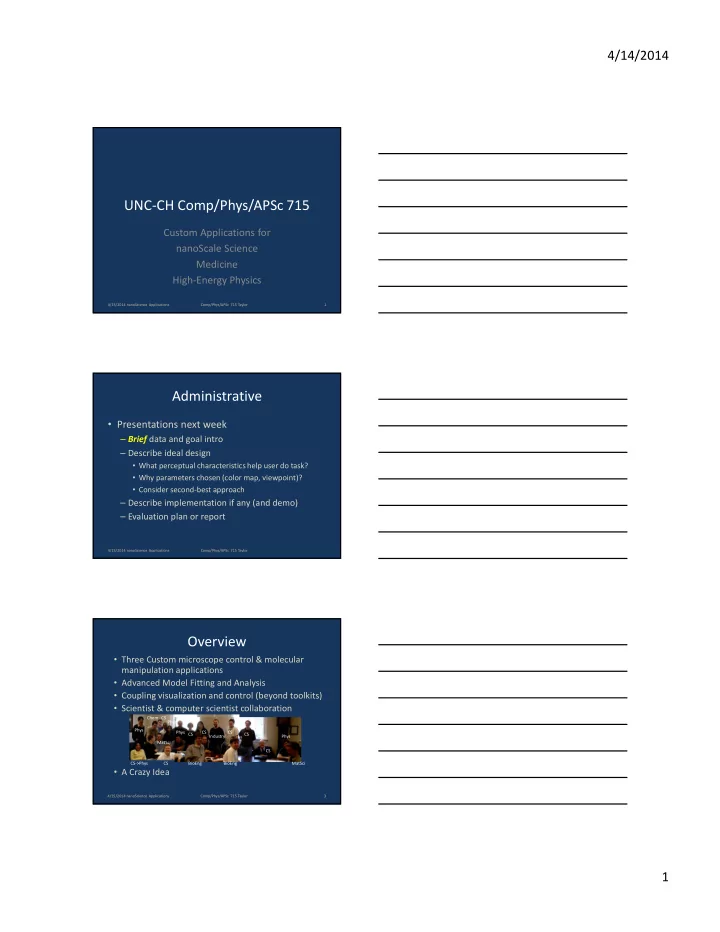
  • Three Custom microscope control & molecular

manipulation applications

  • Advanced Model Fitting and Analysis
  • Coupling visualization and control (beyond toolkits)
  • Scientist & computer scientist collaboration
  • A Crazy Idea

CS CS CS CS Phys Phys CS->Phys MatSci BioEng BioEng Chem Phys Industry MatSci CS CS Phys CS

4/15/2014 nanoScience Applications 3 Comp/Phys/APSc 715 Taylor

slide-2
SLIDE 2

4/14/2014 2

Docker

  • Ming Ouh-Young’s dissertation project

– Showed NTE factor-of-2 speedup with haptics – 6-DOF positioning task – “Lock and Key” problem – Hard surface + electrostatic

4/15/2014 nanoScience Applications 4 Comp/Phys/APSc 715 Taylor

Rendering SPM Data has always been a problem

4/15/2014 nanoScience Applications Comp/Phys/APSc 715 Taylor

What this rendering seems like to me

4/15/2014 nanoScience Applications 6 Comp/Phys/APSc 715 Taylor

slide-3
SLIDE 3

4/14/2014 3

What they’ve done with it

  • Simply Incredible!
  • Imagine what they could do with ink!

4/15/2014 nanoScience Applications 7 Comp/Phys/APSc 715 Taylor

A virtual environment interface to SPM

The Goal:

  • Remove boundaries

between user and sample

  • Can we make experiments
  • n the molecular scale as

easy as rolling a pencil or pushing a golf ball?

nanoManipulator

4/15/2014 nanoScience Applications 8 Comp/Phys/APSc 715 Taylor

Conception

  • R. Stanley Williams

– Then professor of Chemistry at UCLA – Now head of nanocomputing research at HP

  • Warren Robinett

– Then director of HMD research at UNC – Later doing nanocomputing research at HP

  • My dissertation topic in Computer Science

– Under direction of Frederick P. Brooks, Jr.

4/15/2014 nanoScience Applications 9 Comp/Phys/APSc 715 Taylor

slide-4
SLIDE 4

4/14/2014 4

Interoperability

Commercial interface 3D graphics GUI Analysis PC Optical microscope Test & measurement Force

4/15/2014 nanoScience Applications 10 Comp/Phys/APSc 715 Taylor

nanoManipulator Collaborators

Belgium Toronto ASU WPAFB NIST Information & Library Science Education CS Dist. Sys. Gene Therapy Physics CS Graphics CS Image Biology Chemistry NIEHS RTP Psychology 3rdTech

4/15/2014 nanoScience Applications 11 Comp/Phys/APSc 715 Taylor

Now a Commercial System!

  • nanoManipulator DP-100
  • 2001 R&D 100 Award Winner
  • www.nanomanipulator.com

4/15/2014 nanoScience Applications 12 Comp/Phys/APSc 715 Taylor

slide-5
SLIDE 5

4/14/2014 5

Adenovirus 85 nm Icosahedral AFM Images virus ps sphere TEM Color by slope: Flat=dark Steep=bright Specular highlights through Directional illumination

Adenovirus: Imaging icosahedral shape with advanced rendering

4/15/2014 nanoScience Applications Comp/Phys/APSc 715 Taylor 4/15/2014 nanoScience Applications

800 nm

Measurements on Individual Fibers

Tip hits fiber Partial surface Detachment Rupture Tip fiber

Ft Fs Fr Lateral force Tip position

B

Translocation Deformation 0.5 1 1.5 2 2.5 3 1000 2000 3000 4000 5000 6000 1000 2000 3000 4000 5000 6000 s(nm)

Lateral force (nN) Comp/Phys/APSc 715 Taylor

a b

A B C D

a b

1 2 3 1 2 3 3 3 1 2 1 2

Stacking Carbon Nanotubes

4/15/2014 nanoScience Applications Comp/Phys/APSc 715 Taylor

slide-6
SLIDE 6

4/14/2014 6

Bending and Buckling

4/15/2014 nanoScience Applications Comp/Phys/APSc 715 Taylor

Question: Which Interface is Best?

3 5 4 2 1

4/15/2014 nanoScience Applications 17 Comp/Phys/APSc 715 Taylor 4/15/2014 nanoScience Applications 18 Comp/Phys/APSc 715 Taylor

slide-7
SLIDE 7

4/14/2014 7

NIMS: SEM + AFM

SEM:

  • Imaging
  • elemental analysis
  • ebeam lithography

AFM:

  • topography
  • local (mech., elect,..) properties
  • manipulation

nM:

  • Manipulation (XYZ control)
  • Multiple Data Set Rendering
  • Registration

Hitachi S4700 Topometrix Observer Combine the best of:

4/15/2014 nanoScience Applications Comp/Phys/APSc 715 Taylor

SEM/AFM in action

  • Hand-controlled AFM
  • Zooms in on nanotube
  • “Twangs” nanotube
  • Play movie

4/15/2014 nanoScience Applications Comp/Phys/APSc 715 Taylor 4/15/2014 nanoScience Applications Comp/Phys/APSc 715 Taylor

SEM/AFM in action

21

slide-8
SLIDE 8

4/14/2014 8

4/15/2014 nanoScience Applications Comp/Phys/APSc 715 Taylor

SEM/AFM in action

  • Two paddles

– Suspended on tube

  • Tip comes down
  • Paddle sticks
  • Tries to pry off
  • Game over

22

Force curves all at single point (+/-50nm)on single paddle Force gets 20x larger after repeats!

Measuring Torsion

4/15/2014 nanoScience Applications Comp/Phys/APSc 715 Taylor

Challenges:

  • Real-Time overlay/registration
  • E Beam Lith Integration
  • Optimized Integration of Data Sets
  • 3D manipulation-where is the tip?

SEM/AFM

4/15/2014 nanoScience Applications Comp/Phys/APSc 715 Taylor

slide-9
SLIDE 9

4/14/2014 9

4/15/2014 nanoScience Applications 25 Comp/Phys/APSc 715 Taylor

3DFM: The Next Step in Biological Force Microscopy

* Puncture the cell membrane to image inside the cell?

  • How to do force microscopy inside a cell?

4/15/2014 nanoScience Applications Comp/Phys/APSc 715 Taylor

One Solution: Put the Probe Inside the Cell

  • Problems:

– How to measure the probe’s position? – How to apply forces?

4/15/2014 nanoScience Applications 27 Comp/Phys/APSc 715 Taylor

slide-10
SLIDE 10

4/14/2014 10

Our Solution

3-D Force Microscope

  • Magnetic fields apply forces to magnetic particle
  • Particle position is monitored using optical tracking

1. Very specific forces 2. Little localized optical heating 3. Relatively high forces

Magnetic Particle

Cell

Solenoid pole tips

  • ptical

tracking substrate 4/15/2014 nanoScience Applications Comp/Phys/APSc 715 Taylor

3DFM: Concept Video

  • Link to video

4/15/2014 nanoScience Applications 29 Comp/Phys/APSc 715 Taylor

VTK UI Prototype

2D Video More controls Slivered surf Wireframe bead

4/15/2014 nanoScience Applications 30 Comp/Phys/APSc 715 Taylor

slide-11
SLIDE 11

4/14/2014 11

Lower 100x

  • bjective lens

Upper 100x

  • bjective lens

CCD camera Diode Laser

  • ptical

fiber Pigtail fiber connector Collimating Lens BFP Imaging lens, f=50mm sample chamber polarizing beam splitter cube quadrant photo diode fiber light mirror tube lens, f=100mm filter 50/50 beam splitter q1 q4 q2 q3

Optical Layout: Laser tracking

4/15/2014 nanoScience Applications Comp/Phys/APSc 715 Taylor

Optical Tracking

  • Incident beam (maximum

in center)

  • Bead Scattering
  • Resulting pattern

(maximum in center)

  • Terrible Visualization

– Rainbow scale – No shading on surfaces – Down/blue is more

4/15/2014 nanoScience Applications 32 Comp/Phys/APSc 715 Taylor

Z Tracking, QPD Image

Theoretical Image Measured Image

4/15/2014 nanoScience Applications 33 Comp/Phys/APSc 715 Taylor

slide-12
SLIDE 12

4/14/2014 12

3D Tracking: Bead Capture

  • Bead 2.8 microns in diameter attached to cilium

– Two beats uncaptured – Several captured – Note background (XY) – Note focus (Z) – Video link

4/15/2014 nanoScience Applications 34 Comp/Phys/APSc 715 Taylor

3dFM: Magnetic Drive

4/15/2014 nanoScience Applications 35 Comp/Phys/APSc 715 Taylor

3DFM: From CS Point of View

RTS1 RTS2

RTS3

4/15/2014 nanoScience Applications 36 Comp/Phys/APSc 715 Taylor

slide-13
SLIDE 13

4/14/2014 13

Initial Experiment Target: CF

  • CF gene controls Cl- and Na+ transport

through cells

  • Affects airway secretions (mucin)
  • Mucociliary clearance is the first line of

defense against inhaled particulates, aerosols, etc.

  • Particulate-laden mucus transported by

cilia

– beating in a mucus-free periciliary liquid (PCL) – to the glottis where it is expelled and swallowed

4/15/2014 nanoScience Applications 37 Comp/Phys/APSc 715 Taylor

Tracked cilium beating at 15 Hz

4/15/2014 nanoScience Applications 38 Comp/Phys/APSc 715 Taylor 4/15/2014 nanoScience Applications 39 Comp/Phys/APSc 715 Taylor

slide-14
SLIDE 14

4/14/2014 14 Tools to help Scientists Build Better Models

Real Structure, Macromolecule

  • r Cell

Model Macromolecule

Optical AFM 3DFM Simulator Sensors and Actuators Visualize Transform Combine

Natural Control And Manipulation

System Under Study Merged Idea of system Under study

  • Extract Model
  • Display Model

with Experiment

  • Simulate scan of

model with microscope

  • Enable direct

visual comparisons

4/15/2014 nanoScience Applications 40 Comp/Phys/APSc 715 Taylor Comp/Phys/APSc 715 Taylor

Rapid Microscope Simulation

“What Should I See?” Dilation and Erosion using Arbitrary Tip

?

Erie

4/15/2014 nanoScience Applications

Location of Mitotic Spindle: Cory Quammen

Real image Simulated

Problem: What is the geometry of the mitotic spindle? Investigator: Kerry Bloom, Biology Optimization of a Structural Model “Model-based deconvolution”

4/15/2014 nanoScience Applications Comp/Phys/APSc 715 Taylor

slide-15
SLIDE 15

4/14/2014 15 Putting it Together: Fibrin (Conceptual)

  • Extract

– Fibrin model from optical (Tube Tracer) – Estimate fluorophore locations (FSM-like)

  • Track

– Motion of fluorophores (FSM-like)

  • Optimize

– Find expected motion (Lin NSF grant) – Find expected image (Fluoro-sim) – Adjust model parameters for best fit (MIBO)

  • Compare

– Actual and simulated images (nM, ScalarStack) – Quantitative: Simulated and measured displacements

4/15/2014 nanoScience Applications 43 Comp/Phys/APSc 715 Taylor

Comparing Two Surfaces: Chris Weigle

  • Model vs. AFM Scan
  • Manual vs. Automatic:
  • Tumor vs. Isodose

Boucher, Davis Bullitt

4/15/2014 nanoScience Applications 44 Comp/Phys/APSc 715 Taylor

Viz: Multivariate 3D Display David Feng

  • Virtual Cell

– Loew – P41 Collab

4/15/2014 nanoScience Applications Comp/Phys/APSc 715 Taylor

slide-16
SLIDE 16

4/14/2014 16

AFM + Simulate BSE from SEM: Adam Seeger

4/15/2014 nanoScience Applications 46 Comp/Phys/APSc 715 Taylor

GPU-Accelerated TEM Simulation: David Borland

Multislice Kinematic (20 minutes) (Let’s see…)

4/15/2014 nanoScience Applications 47 Comp/Phys/APSc 715 Taylor

AMF&A: Summary

  • Scientist or image analysis estimates model
  • f object(s) scanned by a microscope
  • Computer produces detailed result of

applying a specified transfer function (model of instrument behavior) to this model to produce “what should I see in the image if my model is correct?”

  • Scientist or image analysis compares the

detailed simulation with experiment image, “”does my model predict this?”

  • Scientist or optimization code adjusts

model trying to make simulated image better fit experiment image, “is this better?”

Insight into Instrument Behavior Insight into Model Correctness

4/15/2014 nanoScience Applications 48 Comp/Phys/APSc 715 Taylor

slide-17
SLIDE 17

4/14/2014 17

4/15/2014 nanoScience Applications 49 Comp/Phys/APSc 715 Taylor

Virtual Pediatric Airways Workbench

  • Virtual Bronchoscopy + Flow

– Stereo 3D graphics display – Automatic front-surface removal – Add flow-simulation data

  • Virtual Surgery

– Force-feedback pen can edit geometry

  • Workflow Integration System
  • Inter-Technique Comparison Tool

– Geometry vs. geometry – Flow vs. flow

4/15/2014 nanoScience Applications Comp/Phys/APSc 715 Taylor 50

Improved 3D interaction

4/15/2014 nanoScience Applications Comp/Phys/APSc 715 Taylor

slide-18
SLIDE 18

4/14/2014 18 Surface textures for improved shape perception

4/15/2014 nanoScience Applications Comp/Phys/APSc 715 Taylor

Vector comparison glyph technique

4/15/2014 nanoScience Applications Comp/Phys/APSc 715 Taylor

Modeling and Data Analysis Initiative

4/15/2014 nanoScience Applications Comp/Phys/APSc 715 Taylor

  • NSF-sponsored project
  • Statistics + Visualization
  • Scientific domains

– Particle collisions – Weather – Galaxy Formation, Universe formation – Supernovae

slide-19
SLIDE 19

4/14/2014 19

MADAI Workbench: ParaView++

4/15/2014 nanoScience Applications Comp/Phys/APSc 715 Taylor

Radius = sqrt(mass); color is time since creation (brightest = newest)

MADAI Workbench: ParaView++

4/15/2014 nanoScience Applications Comp/Phys/APSc 715 Taylor

Radius = sqrt(mass); color is rapidity (signed speed in X)

4/15/2014 nanoScience Applications Comp/Phys/APSc 715 Taylor 57

slide-20
SLIDE 20

4/14/2014 20

The Right Tool for the Job…

  • All-in-one, not optimal for any

– Sears ShopSmith – Computer (WIMP) interface

  • Finely-tuned for the task

– Specific power tools: table saw, lathe, router – Automobile, airplane cockpit – Bill Buxton: Bow for violin – What computers should be

4/15/2014 nanoScience Applications 58 Comp/Phys/APSc 715 Taylor

CS Through the Science Lens

  • Changing relationships between scientists and computers

–Taking numbers to computer priesthood –Entering numbers on office computer –Connecting data collection computer to instrument –The computer interface is the instrument interface

  • Bad news: The knobs and poking around and tools each

designed for their function are replaced by keyboard and mouse

  • Good news: Enables arbitrary mappings (in particular, we

are looking for the natural and effective ones) and new knobs, poking, tools

–Requires careful crafting in Visualization and UI design

4/15/2014 nanoScience Applications 59 Comp/Phys/APSc 715 Taylor

Science seen through CS Lens

  • Scientists are a source of many problems

– Some are solvable with pedestrian CS (Undergraduate use as learning tool, visualization course may do) – Some are stretches or require new application (Visualization Case Study, Masters Thesis) – Some are really hard (CS dissertations, whole new project directions)

  • Our main goal is cool new research, in CS and PS

4/15/2014 nanoScience Applications 60 Comp/Phys/APSc 715 Taylor

slide-21
SLIDE 21

4/14/2014 21

How does it go?

  • Team Building

– Goodwill forms as each feels heard, and valued – Trust and increased engagement comes as results arrive

  • Arms Race

– Scientists ask for capabilities “yesterday” – CS looking for features for “3 months from now” – With the AIMS system, CS is ahead! – Need to start the software at least as soon as HW

  • Iterative design: Having a new tool for a task changes

the task

4/15/2014 nanoScience Applications 61 Comp/Phys/APSc 715 Taylor 4/15/2014 nanoScience Applications 62 Comp/Phys/APSc 715 Taylor

Crazy Idea: DNA + Nanotube Comp 1 Bit Full Adder: Chris Dwyer

4/15/2014 nanoScience Applications 63 Comp/Phys/APSc 715 Taylor

slide-22
SLIDE 22

4/14/2014 22 Crazy Idea: DNA + Nanotube Comp: Assembly of NAND gate

  • Link to movie

4/15/2014 nanoScience Applications 64 Comp/Phys/APSc 715 Taylor 4/15/2014 nanoScience Applications Comp/Phys/APSc 715 Taylor 65

Credits

  • UNC-CH nanoScale Science Research Group

– www.cismm.org

  • Modeling & Data Analysis Initiative

– madai.us

4/15/2014 nanoScience Applications 66 Comp/Phys/APSc 715 Taylor

slide-23
SLIDE 23

4/14/2014 23

Extra slides

4/15/2014 nanoScience Applications 67 Comp/Phys/APSc 715 Taylor 4/15/2014 nanoScience Applications Comp/Phys/APSc 715 Taylor

Education Overview

68 4/15/2014 nanoScience Applications Comp/Phys/APSc 715 Taylor

Ed: Simulator

69

slide-24
SLIDE 24

4/14/2014 24

4/15/2014 nanoScience Applications Comp/Phys/APSc 715 Taylor

Ed: Interview

70 4/15/2014 nanoScience Applications Comp/Phys/APSc 715 Taylor

Ed: nanoManipulator

71 4/15/2014 nanoScience Applications Comp/Phys/APSc 715 Taylor

Advanced Model Fitting: Microscope Simulation

  • Simulated AFM scanner

– Scanned surface vs. model surface – “What should I be seeing?” – Ongoing collaboration with chemist Dorothy Erie to produce a model of what happens when proteins/DNA are scanned with an AFM

72

slide-25
SLIDE 25

4/14/2014 25

4/15/2014 nanoScience Applications Comp/Phys/APSc 715 Taylor

AFM Simulator Version Two

73 4/15/2014 nanoScience Applications Comp/Phys/APSc 715 Taylor

Beyond the Toolkits

  • Why/When?

–Extreme performance –Tightly-coupled systems

  • How?

–Extend the toolkits! (when you can) –Any way you can (when you must) –“A tale of two Systems…” Vis

74 4/15/2014 nanoScience Applications Comp/Phys/APSc 715 Taylor

“A Tale of 2+ Systems…”

nM v1: nM v3: 3DFM v1:

Sun 4 Host computer for Pxpl5 graphics engine and coordinator for the system Renderer Renderer 19 ... 36 ... 128x128 processors each Left eye Right eye Head-Mounted display Frame Buffer Frame Buffer Stereo Projection screen 160 MHz Ring Network I-860 Graphics Processor I-860 Graphics Processor I-860 Graphics Processor Host Interface HP4195A Test Input Signal Generation Reference Input Crystal Tunnel junction Preamp 1X probe PA88 10X probe The rest of the feedback circuit

75

slide-26
SLIDE 26

4/14/2014 26

4/15/2014 nanoScience Applications Comp/Phys/APSc 715 Taylor

Face-to-face:

  • social interactions is natural
  • cooperative physical activities

are natural

  • teams share a single user

scientific instrument.

Distributed:

  • social interaction is mediated by

technology

  • shared physical activities are difficult
  • the instrument must support access

by multiple users over the network.

Internet 2

Tele-nM for Collaboration

Bead Pulled in Circle

  • Link to movie

4/15/2014 nanoScience Applications 77 Comp/Phys/APSc 715 Taylor

VTK UI Prototype

  • Parameter menus
  • Bead Histogram
  • Yellow trace
  • Green estimate
  • Translucent volume

swept by bead

  • Complicated path

from Brownian motion simulator

4/15/2014 nanoScience Applications 78 Comp/Phys/APSc 715 Taylor

slide-27
SLIDE 27

4/14/2014 27

3DFM: CS Challenges

  • Data Visualization

– Overlaying volume, surface, line-trace data: both visually and haptically – Displaying surfaces with uncertain borders

  • Computation and Rendering

– Real-time volume convolution and display (COSM) – Incremental updates of a subset of the volume

  • Measurement and Control Theory

– Tracking the bead, estimation of forces, viscosity and other system state parameters

4/15/2014 nanoScience Applications 79 Comp/Phys/APSc 715 Taylor

What does it take?

  • Sustained hard work across disciplines

– CS: Russ Taylor, Mary Whitton, Leandra Vicci, Gary Bishop, Greg Welch, Steve Pizer, Prasun Dewan, Paul Morris, David Marshburn, Kurtis Keller, Aron Helser, Tom Hudson, Adam Seeger, David Borland, Yoni Fridman, Alexandra Bokinsky, Alvin Richardson, Chris Dwyer, Chris Weigle, Haris Fretzagias, Jonathan Robbins, Jameson Miller, Tatsuhiro Segi, Ben Wilde, Rajeev Dassani – P&A/MS: Rich Superfine, Sean Washburn, Mike Falvo, Lu-Chang Qin, Stefan Seelecke, Stergios Papadakis, Garrett Matthews, Kalpit Desai, Jay Fisher, Jeremy Cribb, Sreeja Panmanabhan, Andrea Hilchey, Lloyd Carol, Michael Stadermann, Adam Hall, Aarish Patel, Rohit Prakash, Debbie Sill – SILS/EDU: Diane Sonnenwald, Gail Jones, Dennis Kubasko, Michele Kloda, Tom Trettor, Atsuko Negishi, Kelly Maglaughlin

  • Sustained funding

– $1M+: NIH/NCRR (12+ yr), NSF/HPCC (5+ yr), NSF/ROLE (3 yr), ONR/MURI (5 yr), ARO/DURIP (2 yr), Keck Foundation (1 time)

4/15/2014 nanoScience Applications 80 Comp/Phys/APSc 715 Taylor