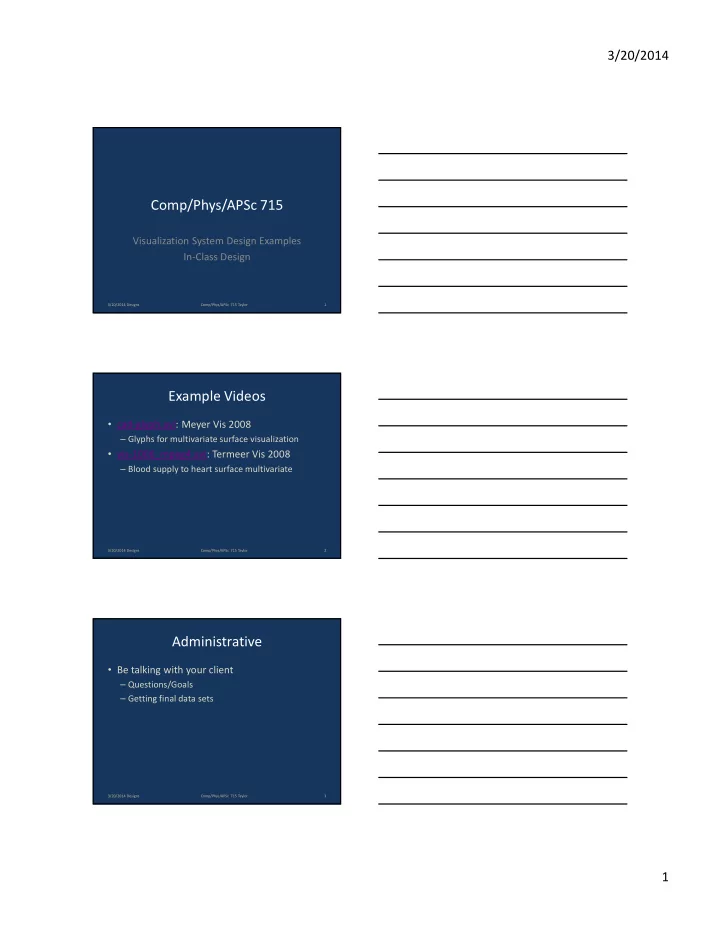
Comp/Phys/APSc 715 Visualization System Design Examples In-Class - - PDF document

comp phys apsc 715
SMART_READER_LITE
LIVE PREVIEW

Comp/Phys/APSc 715 Visualization System Design Examples In-Class - - PDF document

3/20/2014 Comp/Phys/APSc 715 Visualization System Design Examples In-Class Design 3/20/2014 Designs Comp/Phys/APSc 715 Taylor 1 Example Videos cad-glyph.avi: Meyer Vis 2008 Glyphs for multivariate surface visualization


slide-1
SLIDE 1

3/20/2014 1

Comp/Phys/APSc 715

Visualization System Design Examples In-Class Design

1 3/20/2014 Designs Comp/Phys/APSc 715 Taylor

Example Videos

  • cad-glyph.avi: Meyer Vis 2008

– Glyphs for multivariate surface visualization

  • vis-1006_mpeg4.avi: Termeer Vis 2008

– Blood supply to heart surface multivariate

2 3/20/2014 Designs Comp/Phys/APSc 715 Taylor

Administrative

  • Be talking with your client

– Questions/Goals – Getting final data sets

3/20/2014 Designs 3 Comp/Phys/APSc 715 Taylor

slide-2
SLIDE 2

3/20/2014 2

Example Final Projects++

  • GyVe - supercluster of galaxies
  • ImageSurfer - confocal microscopy data
  • InnerSpace - virtual arthroscopy
  • Ensemble vector field display

3/20/2014 Designs 4 Comp/Phys/APSc 715 Taylor

Galaxy Viewer (2005)

  • Clients

– Matthew Fleenor, Astronomy graduate student – James Rose, Astronomer

  • Team

– Jameson Miller, CS student – Cory Quammen, CS student

  • Problem:

– Seeing structure in Horologium Reticulum data

3/20/2014 Designs 5 Comp/Phys/APSc 715 Taylor

Gyve Advertisement

Link

3/20/2014 Designs 6 Comp/Phys/APSc 715 Taylor

slide-3
SLIDE 3

3/20/2014 3

Gyve Display

3/20/2014 Designs 7 Comp/Phys/APSc 715 Taylor

Gyve Results

  • Revealed Spherical Voids

3/20/2014 Designs Comp/Phys/APSc 715 Taylor 3/20/2014 Designs Comp/Phys/APSc 715 Taylor

Gyve Results

  • Disproved incorrect filament structures

9

slide-4
SLIDE 4

3/20/2014 4

Gyve: What Helped?

  • Stereo
  • Torsional Rocking
  • Curved drop shadows

– Tied to previous technique’s views – Showed appropriate space warping

3/20/2014 Designs 10 Comp/Phys/APSc 715 Taylor

Measures of Success

  • Scientists trooped over to CS repeatedly to use the stereo

display!

  • Linux version to run on scientists’ computers
  • http://sourceforge.net/projects/gyve
  • Jameson Miller, Cory W. Quammen, and Matthew C. Fleenor,

Interactive Visualization of Intercluster Galaxy Structures in the Horologium-Reticulum Supercluster, IEEE Transactions on Visualization and Computer Graphics (Proceedings Visualization / Information Visualization 2006), vol. 12, no. 5,

  • pp. 1149–1155, Sept.–Oct. 2006.

3/20/2014 Designs 11 Comp/Phys/APSc 715 Taylor 3/20/2014 Designs 12 Comp/Phys/APSc 715 Taylor

slide-5
SLIDE 5

3/20/2014 5

ImageSurfer (2002)

  • Clients:

– Alain Burette, Cell Bio Postdoc – Richard Weinberg, Cell and Developmental Bio

  • Team:

– Dennis Jen, CS student – Peter Parente, CS student

  • Problem:

– How to correlate membrane and calcium?

3/20/2014 Designs 13 Comp/Phys/APSc 715 Taylor

How is the concentration of PMCA distributed along a dendrite?

DiO PMCA

3/20/2014 Designs 14 Comp/Phys/APSc 715 Taylor

Looking through the stacks…

3/20/2014 Designs 15 Comp/Phys/APSc 715 Taylor

slide-6
SLIDE 6

3/20/2014 6

End of Course

  • Two views, 3D volume and 2D slice

3/20/2014 Designs 16 Comp/Phys/APSc 715 Taylor

Going Beyond the Course

3/20/2014 Designs 17 Comp/Phys/APSc 715 Taylor

Failed Attempts

3/20/2014 Designs 18 Comp/Phys/APSc 715 Taylor

slide-7
SLIDE 7

3/20/2014 7 CISMM-sponsored additions

3/20/2014 Designs 19 Comp/Phys/APSc 715 Taylor

… easing the pain

3/20/2014 Designs 20 Comp/Phys/APSc 715 Taylor

… adding analysis

3/20/2014 Designs 21 Comp/Phys/APSc 715 Taylor

slide-8
SLIDE 8

3/20/2014 8

Measures of Success

  • http://www.imagesurfer.org

– Maintained by scientist collaborators! – ~3 downloads per day

  • Dennis Jen, Peter Parente, Jonathan Robbins, Christopher

Weigle, Alain Burette, Richard Weinberg, and Russell M. Taylor II, “ImageSurfer: A Tool for Visualizing Correlations between Two Volume Scalar Fields,” IEEE Visualization 2004 Proceedings, October 10-15, Austin Texas, pp. 529-536.

  • David Feng, David Marshburn, Dennis Jen, Richard Weinberg,

Russell M. Taylor II, Alain Burette, “ToolBox: Stepping into the third dimension,” Journal of Neuroscience, 27(47), Nov. 21, 2007, pp. 12757-12760.

3/20/2014 Designs 22 Comp/Phys/APSc 715 Taylor 3/20/2014 Designs 23 Comp/Phys/APSc 715 Taylor

Innerspace

  • David Borland’s dissertation work

3/20/2014 Designs 24 Comp/Phys/APSc 715 Taylor

slide-9
SLIDE 9

3/20/2014 9

Arthroscopy

  • Use fiber-optic camera and

surgical tools to investigate joint for pathology

  • Problems

– Invasive – Costs time and money – Very cramped area to maneuver in

3/20/2014 Designs 25 Comp/Phys/APSc 715 Taylor

MRI Slice Viewing

  • Current standard for

joint pathology diagnosis

  • Features

– Less invasive – Contrast agent routinely injected to aid imaging

  • Problems

– Requires tedious selection of slices – Requires non-intuitive mental reconstruction

  • f 3D features

Shoulder MRI

Contrast agent in the joint-space

Humeral Head Socket Humeral Head Humeral Head Socket

3/20/2014 Designs 26 Comp/Phys/APSc 715 Taylor

Virtual Arthroscopy

  • Work by John Clarke from

UNC Radiology

  • Features

– Also less invasive – More intuitive visualization

  • Problems

– Viewpoints limited to the joint-space – Must maneuver the virtual camera across the entire joint surface for evaluation – “Like looking at the palm of your hand with it touching your nose.”

Humeral Head

3/20/2014 Designs 27 Comp/Phys/APSc 715 Taylor

slide-10
SLIDE 10

3/20/2014 10

Visualization Course Project

  • Sean Hanlon,

Karl Strohmaier, Kelly Van Busum

  • DVR for context
  • Extracted

isosurface for detail

– Slow…

  • Adjustable

clipping planes

– Problem…

3/20/2014 Designs 28 Comp/Phys/APSc 715 Taylor

If at first you don’t succeed…

  • Volume Rendering?

–Still have occlusion problem

  • Transparency?

–Confusion

3/20/2014 Designs 29 Comp/Phys/APSc 715 Taylor

Volumetric Depth Peeling (VDP)

  • Extension to standard ray-casting Volume Rendering algorithm
  • Enables anatomical views not possible with standard clinical techniques
  • Works with complicated structures for which no clipping plane will

suffice

  • Requires no pre-segmentation
  • Works for self-occlusion and tube-like structures
  • Takes advantage of routine contrast enhancement

Presented at Visualizaton and Data Analysis 2006

3/20/2014 Designs 30 Comp/Phys/APSc 715 Taylor

slide-11
SLIDE 11

3/20/2014 11 Standard Volume Rendering vs. VDP

Constrained to Joint-Space VDP Ligament and Labrum (Ring of Cartilage) Tear Humeral Head

3/20/2014 Designs 31 Comp/Phys/APSc 715 Taylor

Movie 1

3/20/2014 Designs 32 Comp/Phys/APSc 715 Taylor

Movie 2

3/20/2014 Designs 33 Comp/Phys/APSc 715 Taylor

slide-12
SLIDE 12

3/20/2014 12

Movie 3

3/20/2014 Designs 34 Comp/Phys/APSc 715 Taylor

Movie 4

3/20/2014 Designs 35 Comp/Phys/APSc 715 Taylor

1973_repeat.mpg from F:\taylorr\Supervision\Borland

Innerspace

  • Built with VTK, wxWidgets, and gdcm
  • Loads DICOM format
  • Visualization features

– 3 slice views – 3D render view – Axes – Camera widget in slice views updated with 3D motion – Slices updated with 3D motion – 3D view updated with camera widget motion – Simple sliders and full transfer function control – View threshold value in slice views

3/20/2014 Designs 36 Comp/Phys/APSc 715 Taylor

slide-13
SLIDE 13

3/20/2014 13

Additional Work: Glove Phantom Study

Shell Stone Stone Fatty Tissue Fatty Tissue

Exterior Interior

  • Proof of

concept for VDP

  • f urinary

system

  • Performed on 3

contrast-filled rubber gloves with various

  • bjects placed

inside

3/20/2014 Designs 37 Comp/Phys/APSc 715 Taylor

Measures of Success

  • Collaborator found funding to support student
  • Two domain-science publications
  • UNC Ph.D. dissertation
  • Patent issued
  • Summer internship for student at Siemens
  • Patent licensed to Siemens and put into Syngo software

3/20/2014 Designs 38 Comp/Phys/APSc 715 Taylor 3/20/2014 Designs Comp/Phys/APSc 715 Taylor 39

slide-14
SLIDE 14

3/20/2014 14

Ensemble Vector Display (2011)

  • Clients

– IEEE Visualization Design Contest – Centrifugal pumps

  • Team

– Alexis Yee Lyn Chan – Joohwi Lee

  • Problem:

– Where do the simulations differ? Where vortices?

3/20/2014 Designs 40 Comp/Phys/APSc 715 Taylor

Goal 1: Contextual Flow

  • What is the flow structure surrounding the turbine

blades? Does high flow separation from the blades coincide with the development of “vortices”?

  • LIC background
  • Sparse Streamlines

– Seeded in vortices

  • Geometry prop

3/20/2014 Designs 41 Comp/Phys/APSc 715 Taylor

Goal 1: Contextual Flow

3/20/2014 Designs 42 Comp/Phys/APSc 715 Taylor

slide-15
SLIDE 15

3/20/2014 15

Goal 2: Vortex Visualization

  • Identify regions of the dataset that contain swirling

flow that is not laminar (i.e. parallel to the circular boundary of the turbine geometry or the boundary

  • f the blades).

– Solved for vortex location – Streamtubes near there

  • R/Y/G Winding angle

– Streamlines for context

3/20/2014 Designs 43 Comp/Phys/APSc 715 Taylor

Goal 2: Vortex Visualization

3/20/2014 Designs 44 Comp/Phys/APSc 715 Taylor

Goal 3: Unsteady vortex tracking

  • Identify “vortices” that drift over time (i.e. the ones

that are not stationary). Do the “vortices” move between turbine blades? Do the axis of rotation of these “vortices” change over time?

– Designed – Not implemented

3/20/2014 Designs 45 Comp/Phys/APSc 715 Taylor

slide-16
SLIDE 16

3/20/2014 16

Immersive System

3/20/2014 Designs Comp/Phys/APSc 715 Taylor 46

Computational Support

  • Learned a lot about vortex identification

– Wikipedia, reading domain papers – Winding angles

  • Implemented vortex detection to seed vis.

3/20/2014 Designs Comp/Phys/APSc 715 Taylor 47

Beyond the Course

3/20/2014 Designs Comp/Phys/APSc 715 Taylor 48

slide-17
SLIDE 17

3/20/2014 17

Beyond the course

  • Vortex Core timeline

3/20/2014 Designs Comp/Phys/APSc 715 Taylor 49

Beyond the course

  • Ribbon summary

3/20/2014 Designs Comp/Phys/APSc 715 Taylor 50

Measures of Success

  • Scientist reviewers saw useful things.
  • 2nd place in Visualization Design Contest
  • Presented technique at the conference
  • SPIE publication the following year: Alexis Yee Lyn Chan,

Joohwi Lee, Russell M. Taylor II, “Vortex Core Timelines and Ribbon Summarizations: Flow Summarization over Time and Simulation Ensembles,” Proceedings of SPIE Visualization and Data Analysis 2013. Proceedings of the SPIE, Volume 8654.

  • pp. V1-V8. 2013.

3/20/2014 Designs 51 Comp/Phys/APSc 715 Taylor

slide-18
SLIDE 18

3/20/2014 18

3/20/2014 Designs Comp/Phys/APSc 715 Taylor 52

Example Visualization Design Example AVS Implementation

  • The Research Questions

– Which directions can four magnetic poles located at the corners of a tetrahedron pull a magnetic bead that is centered between them? – How uniform is the pull in each direction?

3/20/2014 Designs 53 Comp/Phys/APSc 715 Taylor

The Raw Data

  • Magnetic field simulation for four poles

– 10,000 sets of random currents on each pole – Computes direction of force (Phi, Theta) – Computes force magnitude for each

  • Data Type

– 2D Ratio Scalar Field (mag) – Unstructured (scatter phi/theta)

Density Plot: |B|, >4.071e- 3.701e-001 : 4.071e- 3.331e-001 : 3.701e- 2.961e-001 : 3.331e- 2.591e-001 : 2.961e- 2.221e-001 : 2.591e- 1.851e-001 : 2.221e- 1.481e-001 : 1.851e- 1.111e-001 : 1.481e- 7.412e-002 : 1.111e- 3.712e-002 : 7.412e- <3.712e-

Increasing Field Density 3/20/2014 Designs 54 Comp/Phys/APSc 715 Taylor

slide-19
SLIDE 19

3/20/2014 19 Discussion: How Best to Visualize?

  • No fair helping if you peeked at today’s notes
  • r have seen this before

– Unless you have a better idea for how to do it!

3/20/2014 Designs 55 Comp/Phys/APSc 715 Taylor

Cooking the Data

  • Convert from unstructured set of points

– Place points into regular set of bins in phi, theta – Average all points falling within each bin – Produces regular grid with missing values – Expect high-frequency changes across the grid

  • Put back into natural space for the problem

– Convert (phi, theta, magnitude) to (x,y,z)

  • Spherical coordinates to Cartesian coordinates

– 2D surface embedded in 3-space

3/20/2014 Designs 56 Comp/Phys/APSc 715 Taylor

Visualization Design

  • Height field encodes force magnitude for primary goal
  • f estimating coverage of directions
  • Color redundantly encodes magnitude to show

uniformity of force (banded, isoluminant would have been better than the one I found in AVS Express)

  • Missing values leave holes in the displayed surface
  • Iso-height sphere model added to improve

understanding of fraction of sphere covered

  • Enable user to rotate view to explore region shape

3/20/2014 Designs 57 Comp/Phys/APSc 715 Taylor

slide-20
SLIDE 20

3/20/2014 20

Six Poles? Eight Poles?

  • Really want max in each bin, not average?

3/20/2014 Designs 58 Comp/Phys/APSc 715 Taylor

What the real data looks like

3/20/2014 Designs 59 Comp/Phys/APSc 715 Taylor

Real vs. Simulated

  • Real is all data, simulated is averaged in

direction

Note the outlying white sphere

3/20/2014 Designs 60 Comp/Phys/APSc 715 Taylor