6/15/2009 2 Projects Projects MIRALab research on medical - - PDF document

6 15 2009
SMART_READER_LITE
LIVE PREVIEW

6/15/2009 2 Projects Projects MIRALab research on medical - - PDF document

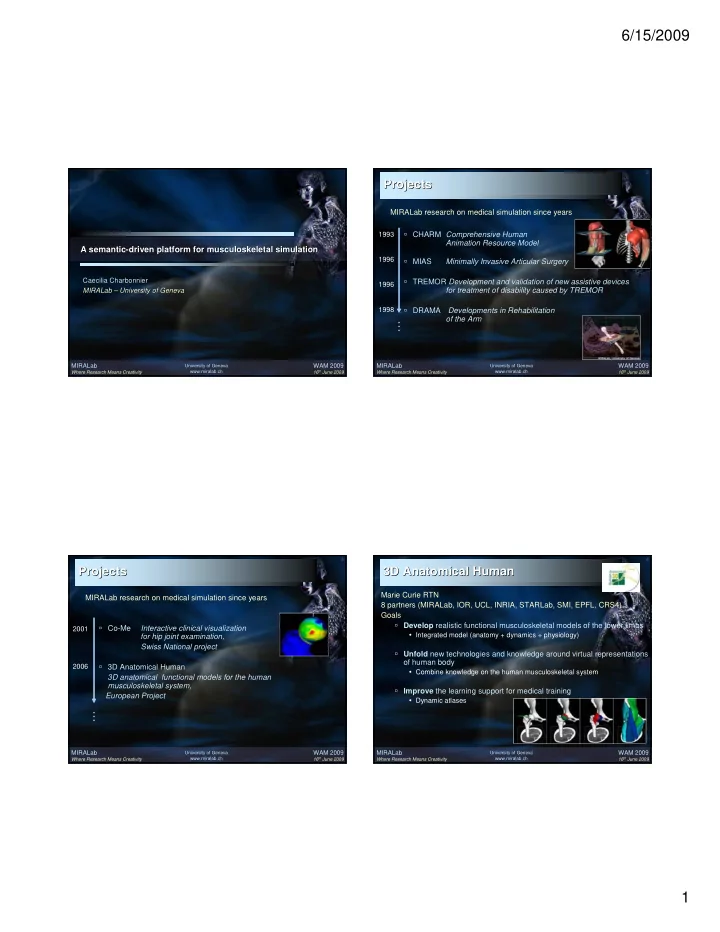
6/15/2009 2 Projects Projects MIRALab research on medical simulation since years CHARM Comprehensive Human 1993 Animation Resource Model A semantic- -driven platform for musculoskeletal simulation driven platform for musculoskeletal


slide-1
SLIDE 1

6/15/2009 1

University of Geneva www.miralab.ch

MIRALab

Where Research Means Creativity

WAM 2009

16th June 2009

A semantic A semantic-

  • driven platform for musculoskeletal simulation

driven platform for musculoskeletal simulation

Caecilia Charbonnier Caecilia Charbonnier MIRALab MIRALab – – University of Geneva University of Geneva

University of Geneva www.miralab.ch

MIRALab

Where Research Means Creativity 2

WAM 2009

16th June 2009

Projects Projects

MIRALab research on medical simulation since years CHARM Comprehensive Human Animation Resource Model MIAS Minimally Invasive Articular Surgery TREMOR Development and validation of new assistive devices for treatment of disability caused by TREMOR DRAMA Developments in Rehabilitation

  • f the Arm

1993 1996 1996 1998

University of Geneva www.miralab.ch

MIRALab

Where Research Means Creativity 3

WAM 2009

16th June 2009

Projects Projects

MIRALab research on medical simulation since years Co-Me Interactive clinical visualization for hip joint examination, Swiss National project 3D Anatomical Human 3D anatomical functional models for the human musculoskeletal system, European Project

2001 2006

University of Geneva www.miralab.ch

MIRALab

Where Research Means Creativity 4

WAM 2009

16th June 2009

3D Anatomical Human 3D Anatomical Human

Marie Curie RTN 8 partners (MIRALab, IOR, UCL, INRIA, STARLab, SMI, EPFL, CRS4) Goals Develop realistic functional musculoskeletal models of the lower limbs

Integrated model (anatomy + dynamics + physiology)

Unfold new technologies and knowledge around virtual representations

  • f human body

Combine knowledge on the human musculoskeletal system

Improve the learning support for medical training

Dynamic atlases

slide-2
SLIDE 2

6/15/2009 2

University of Geneva www.miralab.ch

MIRALab

Where Research Means Creativity 5

WAM 2009

16th June 2009

CO CO-

  • ME

ME

Subproject of the Swiss NCCR 5 partners (MIRALab, EPFL, MEM Center, HUG, INSELSPITAL Bern) Goal: early detection of hip osteoarthritis (hip joint degeneration)

Improve understanding:

Cause: repetitive femoro-acetabular impingement (FAI) ?

  • > This hypothesis need to be demonstrated through clinical studies

Improve detection:

Support early diagnosis More automatic and objective assessment

Improve treatment (minimally invasive surgery):

Support corrective surgery planning: bone and labrum resection Support arthroscopy

University of Geneva www.miralab.ch

MIRALab

Where Research Means Creativity 6

WAM 2009

16th June 2009

Outline Outline Introduction Current medical ontology development A semantic-driven platform

The Ontology For Anatomical Simulation (OFAS) model System overview

Scenarios

University of Geneva www.miralab.ch

MIRALab

Where Research Means Creativity 7

WAM 2009

16th June 2009

Generic model reconstruction Patient model reconstruction

Static MRI (Generic) Anatomical Models (Generic) Interactive segmentation Static MRI (Patient) Anatomical Models (Patient)

Registration

Modeling of the musculoskeletal system from MRI Modeling of the musculoskeletal system from MRI

University of Geneva www.miralab.ch

MIRALab

Where Research Means Creativity 8

WAM 2009

16th June 2009

Modeling of the musculoskeletal system from MRI Modeling of the musculoskeletal system from MRI

4 Bones 3 Cartilages, 3 Ligaments 21 Muscles

slide-3
SLIDE 3

6/15/2009 3

University of Geneva www.miralab.ch

MIRALab

Where Research Means Creativity 9

WAM 2009

16th June 2009

Motion modeling Motion modeling

University of Geneva www.miralab.ch

MIRALab

Where Research Means Creativity 10

WAM 2009

16th June 2009

Body scanning Body scanning

Determination of the bone segments in the marker cluster technical frame:

3D body scanning Skin and markers registration

University of Geneva www.miralab.ch

MIRALab

Where Research Means Creativity 11

WAM 2009

16th June 2009

Physical Physical-

  • based simulation

based simulation

Simulator:

Based on particles system implementation of FE Optimizes for large deformations Accurate and fast

Biomechanical modeling:

Hip + femur bones (rigid) Labrum cartilage (deformable)

Young’s modulus: 20 MPa Poisson’s ratio: 0.4

University of Geneva www.miralab.ch

MIRALab

Where Research Means Creativity 12

WAM 2009

16th June 2009

The complete pipeline The complete pipeline

slide-4
SLIDE 4

6/15/2009 4

University of Geneva www.miralab.ch

MIRALab

Where Research Means Creativity 13

WAM 2009

16th June 2009

Medical data Medical data

Medical Data

Medical images Motion capture EMG Kinematical & morphological parameters 3D models 3D body scanning Material properties

University of Geneva www.miralab.ch

MIRALab

Where Research Means Creativity 14

WAM 2009

16th June 2009

Needs Needs More user-centric systems “intelligent” assistants, centralize the data, interact naturally with human users and with the information environment.

that act as able to and to

University of Geneva www.miralab.ch

MIRALab

Where Research Means Creativity 15

WAM 2009

16th June 2009

What knowledge? What knowledge? The terminologies commonly used by clinicians

Anatomy Physiology Pathology, etc.

Available from:

Medical atlases Medical literature Medical discourse, etc.

University of Geneva www.miralab.ch

MIRALab

Where Research Means Creativity 16

WAM 2009

16th June 2009

Why do we need ontology? Why do we need ontology? For information management To share common understanding of the structure of information among people or software agents To enable reuse of domain knowledge To analyze domain knowledge

slide-5
SLIDE 5

6/15/2009 5

University of Geneva www.miralab.ch

MIRALab

Where Research Means Creativity 17

WAM 2009

16th June 2009

Outline Outline Introduction Current medical ontology development A semantic-driven platform

The Ontology For Anatomical Simulation (OFAS) model System overview

Scenarios

University of Geneva www.miralab.ch

MIRALab

Where Research Means Creativity 18

WAM 2009

16th June 2009

The world of medical ontologies The world of medical ontologies

ICD OPCS MeSH SNOMED CPT UMLS GALEN FMA NCI LOINC MedDRA ICPC

308’000 concepts, 924’000 relations 52’000 entities 120’000 concepts, 2.1 million relations 36’000 concepts

University of Geneva www.miralab.ch

MIRALab

Where Research Means Creativity 19

WAM 2009

16th June 2009

Medical Knowledge ONTOLOGY Medical Data

Current medical ontology development Current medical ontology development Aims:

Biological databases, medical record, health insurance, clinical billing, indexing, …

What next?

Develop end user applications Build the links with the medical data and the 3D content

Medical Knowledge ONTOLOGY

University of Geneva www.miralab.ch

MIRALab

Where Research Means Creativity 20

WAM 2009

16th June 2009

Outline Outline Introduction Current medical ontology development A semantic-driven platform

The Ontology For Anatomical Simulation (OFAS) model System overview

Scenarios

slide-6
SLIDE 6

6/15/2009 6

University of Geneva www.miralab.ch

MIRALab

Where Research Means Creativity 21

WAM 2009

16th June 2009

The clinical platform The clinical platform

DATA

Clinical platform

user input

  • utput

ONTOLOGY

University of Geneva www.miralab.ch

MIRALab

Where Research Means Creativity 22

WAM 2009

16th June 2009

The OFAS model The OFAS model

Classification of anatomical musculoskeletal concepts

825 classes, 1244 instances

Contains parameters for the functional anatomy simulation (kinematics, mechanics) All concepts are linked to a 3D model Limited to the musculoskeletal system of the lower limb

University of Geneva www.miralab.ch

MIRALab

Where Research Means Creativity 23

WAM 2009

16th June 2009

The OFAS model The OFAS model

Class hierarchy Instances Attributes and values

Structure (in Protégé):

University of Geneva www.miralab.ch

MIRALab

Where Research Means Creativity 24

WAM 2009

16th June 2009

The OFAS model The OFAS model Relations between classes

Classes Relations

Example: A muscle has a tendon which is attached to a bone (skeletal component).

slide-7
SLIDE 7

6/15/2009 7

University of Geneva www.miralab.ch

MIRALab

Where Research Means Creativity 25

WAM 2009

16th June 2009

System overview System overview

Protégé XML file Clinical platform DB XML

export

University of Geneva www.miralab.ch

MIRALab

Where Research Means Creativity 26

WAM 2009

16th June 2009

System overview System overview

Ontology browser

University of Geneva www.miralab.ch

MIRALab

Where Research Means Creativity 27

WAM 2009

16th June 2009

Outline Outline Introduction Current medical ontology development A semantic-driven platform

The Ontology For Anatomical Simulation (OFAS) model System overview

Scenarios

University of Geneva www.miralab.ch

MIRALab

Where Research Means Creativity 28

WAM 2009

16th June 2009

Scenario 1: visualization Scenario 1: visualization

The system queries the ontology

slide-8
SLIDE 8

6/15/2009 8

University of Geneva www.miralab.ch

MIRALab

Where Research Means Creativity 29

WAM 2009

16th June 2009

Scenario 2: simulation Scenario 2: simulation

The system queries the ontology The system queries the ontology

University of Geneva www.miralab.ch

MIRALab

Where Research Means Creativity 30

WAM 2009

16th June 2009

Scenario 3: medical training Scenario 3: medical training

The system queries the ontology The system queries the ontology

University of Geneva www.miralab.ch

MIRALab

Where Research Means Creativity 31

WAM 2009

16th June 2009

Acknowledgments Acknowledgments

Computer Aided and Image Computer Aided and Image Guided Medical Interventions), Guided Medical Interventions), Swiss national project Swiss national project www.co www.co-

  • me.ch

me.ch FO FOster ster the the C Comprehension

  • mprehension

and and US USe e of Knowledge

  • f Knowledge

intensive technologies for intensive technologies for coding and sharing coding and sharing 3D 3D media media content, EU project (FP7) content, EU project (FP7) www.focusk3d.eu www.focusk3d.eu

University of Geneva www.miralab.ch

MIRALab

Where Research Means Creativity

WAM 2009

16th June 2009

Thank you! Thank you!

Questions? Questions?