Unalakleet Valley Electric Cooperative (UVEC) Wind-Diesel System - - PowerPoint PPT Presentation

unalakleet valley electric cooperative uvec wind diesel
SMART_READER_LITE
LIVE PREVIEW

Unalakleet Valley Electric Cooperative (UVEC) Wind-Diesel System - - PowerPoint PPT Presentation

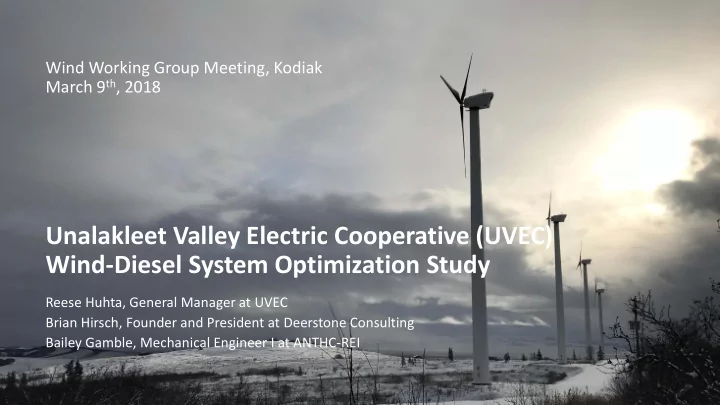
Wind Working Group Meeting, Kodiak March 9 th , 2018 Unalakleet Valley Electric Cooperative (UVEC) Wind-Diesel System Optimization Study Reese Huhta, General Manager at UVEC Brian Hirsch, Founder and President at Deerstone Consulting Bailey


slide-1
SLIDE 1

Unalakleet Valley Electric Cooperative (UVEC) Wind-Diesel System Optimization Study

Reese Huhta, General Manager at UVEC Brian Hirsch, Founder and President at Deerstone Consulting Bailey Gamble, Mechanical Engineer I at ANTHC-REI

Wind Working Group Meeting, Kodiak March 9th, 2018

slide-2
SLIDE 2

UVEC’s System

  • Electric loads: 400 – 1000 kW
  • Four Cat 3456 475 kW gensets.
  • Six 100 kW Northern Power

Systems wind turbines.

  • Recovered heat system.
  • 300 kW Electric boiler –

secondary load.

slide-3
SLIDE 3

Objective

Optimize integration and performance of existing equipment in order to achieve single genset operation and pave the way for the incorporation of additional renewables and energy storage.

Known Barriers and Concerns

  • Electric boiler
  • Wind curtailment
  • Reactive power
  • Data collection/access
slide-4
SLIDE 4
slide-5
SLIDE 5

Assessment Focus Areas

  • Power Line

Capacity

  • Capacitor Bank
  • Secondary Load

Controller/Electric Boiler

  • SCADA – Data

Collection and Analysis

slide-6
SLIDE 6

Power Line Capacity

Transmission line capacity constraints have led to a demand for reactive power at the wind farm. Higher turbine production often requires a second genset come online.

Findings

At a typical level of wind production (300 kW),

  • Paladin analysis indicates transmission line

loss > 12%.

  • Voltage drop at plant > 10%.
  • Power loss over time = annual power
  • utput of an entire 100 kW turbine.
slide-7
SLIDE 7

A 300 kVAr power factor correction cabinet in the power plant has been out of

  • peration for years.

Findings

  • 9 out of 10 capacitors have failed.
  • Per manufacturer:
  • Likely incurred thermal damage.
  • Recommend fitting with filters

(inductors) when used with diesel gensets.

Capacitor Bank

slide-8
SLIDE 8

An electric boiler (secondary load) is plumbed into the hottest section of the secondary (district) heating loop.

Findings

  • SLC elements tested and found to

be in working order.

  • Boiler elements have the capacity

to provide sufficient frequency regulation.

  • Blown fused discovered and

replaced.

Secondary Load Controller

slide-9
SLIDE 9

SCADA

SCADA equipment has aged and the link between the operator workstation and the plant data server has failed.

Findings

  • Need to re-establish data

collection and visualization.

  • Need for clear sequence of how

to extract data.

slide-10
SLIDE 10

Prioritized Recommendations

Recognizing interrelatedness of issues, based upon least cost and highest immediate impact:

  • 1. Re-plumb the electric boiler,

moving it from the hot side of the secondary heating loop to the cold side to increase frequency regulation capacity and reduce wind production curtailment. Estimates Cost: $8,500

  • 2. Improve SCADA and related data

management systems.

  • New data server, extended

memory.

  • Re-establish data collection and

visualization.

  • Update control and SCADA

schematics.

  • Collect data, use to conduct root

cause analysis of outages. Estimate Cost: Additional info needed.

slide-11
SLIDE 11

Prioritized Recommendations

Recognizing interrelatedness of issues, based upon least cost and highest immediate impact:

  • 3. Pending additional data

collection to confirm harmonics and power quality issues, install a new filtered capacitor bank, to meet current reactive power needs. Estimates Cost: $20,000 - $50,000

  • 4. Pending full engineering study,

upgrade power line, starting with transformer replacement, then conductor and structural improvements as long term solution to mitigate reactive power issues. Estimate Cost: $350,000-$400,000

slide-12
SLIDE 12

Future Upgrades

Once priorities 1-4 plus reprogramming for improved diesel dispatch and energy efficiency are in place:

  • Smaller sized and/or variable speed diesel generator to take advantage of times when

this could supply whole village load.

  • Incorporation of additional wind, solar and/or other renewables.
  • Additional electric boilers and/or electric thermal storage to meet other heat loads.
  • Incorporation of energy storage.
  • Adoption of advancing technology such as electric vehicles and electric heat pumps
slide-13
SLIDE 13

Bailey Gamble Mechanical Engineer I, ANTHC bbgamble@anthc.org (907) 729-4501 Brian Hirsch President, Deerstone Consulting bhrischak@gmail.com (907) 299-0268 Reese Huhta General Manager, UVEC uvec@gci.net (907) 624-3474