
SLIDE 1
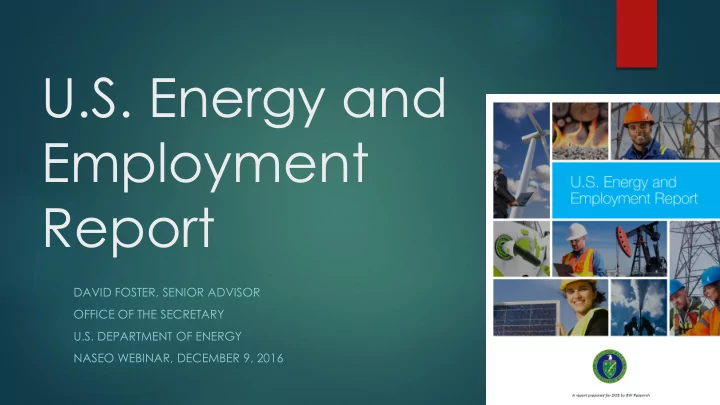
U.S. Energy and Employment Report
DAVID FOSTER, SENIOR ADVISOR OFFICE OF THE SECRETARY U.S. DEPARTMENT OF ENERGY NASEO WEBINAR, DECEMBER 9, 2016
U.S. Energy and Employment Report DAVID FOSTER, SENIOR ADVISOR - - PowerPoint PPT Presentation
U.S. Energy and Employment Report DAVID FOSTER, SENIOR ADVISOR OFFICE OF THE SECRETARY U.S. DEPARTMENT OF ENERGY NASEO WEBINAR, DECEMBER 9, 2016 U.S. Energy and Employment Report Four major gaps exist in current Bureau of Labor Statistics
DAVID FOSTER, SENIOR ADVISOR OFFICE OF THE SECRETARY U.S. DEPARTMENT OF ENERGY NASEO WEBINAR, DECEMBER 9, 2016
Four major gaps exist in current Bureau of Labor Statistics (BLS) energy employment data.
1.
Business activities essential to the operation of traditional energy companies, but classified by the North American Industry Classification System (NAICS) within the business activities of other sectors,
2.
Jobs associated with the production of renewable energy such as wind, solar, geothermal, etc.,
3.
Jobs associated with energy efficiency, and
4.
Jobs associated with energy efficiency in manufacturing processes.
Examples:
1.
Full-time contractor maintenance workers at nuclear plants classified as construction workers
2.
Residential PV installers, classified as construction electricians or roofers.
3.
No differentiation between employees producing or installing high efficiency, Energy Star and non-Energy Star products.
4.
No measurement of jobs improving energy efficiency in industrial processes.
20,000 business surveys administered
Margin of Error for incidence is+- 0.85% 95% confidence interval
Subsector codes matched with business indices
382,500 businesses identified Representative sample selected
Based on QCEW Jobs Data for Surveyed Sectors
Identified Subsectors with targeted employment Agriculture and Forestry, Mining and Extraction, Utilities, Construction, Manufacturing, Wholesale Trade, and Business and Professional Services
All fuel production, including coal mining, oil and gas extraction and processing, nuclear fuels, solar, wind, hydro, biofuels, and utility and non- utility production of electricity, etc. All electrical and gas transmission systems, wholesale and retail distribution systems, including gas stations, and all forms of energy storage. Jobs associated with the manufacture of energy efficiency products certified by the Environmental Protection Agency’s Energy Star program
capture jobs associated with energy efficient manufacturing processes.) Jobs classified by the Quarterly Census of Employment and Wages (QCEW) as the Motor Vehicles industry including, assembly, parts production, repair and maintenance. (Does not include auto dealerships—approximately 1 million jobs.) Electrical Power Generation and Fuels = Transmission, Distribution, and Storage = Energy Efficiency = Motor Vehicles =
Sector Definitions
1,605,065 2,035,438 1,880,149 2,421,591
GENERATION AND FUELS TRANSMISSION, DISTRIBUTION AND STORAGE ENERGY EFFICIENCY MOTOR VEHICLES
ANALYZED SECTORS
In total, 3.64 million Americans work in traditional energy industries, defined as the jobs “necessary for the production, transmission, distribution, or storage of the energy that fuels economic and social activities.”
1.15 million additional jobs were identified through the Energy Employment Index survey. These jobs include jobs such as business services employment supporting the utility industry, maintenance construction in nuclear plants, and roof top PV solar jobs, otherwise classified as construction electricians.
Electric Power Generation and Fuel technologies directly employ 1.6 million workers, almost double the 935,000 covered in the BLS direct industry classifications.
968,000 work with fossil generation and fuels.
600,000 people work in low-carbon generation and fuels, defined as nuclear, renewables (including hydro), biomass, and high efficiency natural gas.
Transmission, Wholesale Trade and Distribution, and Storage technologies employ more than one million Americans, 280,000 more than previously known.
When retail sales and distribution in this sector—primarily gasoline stations—are included, an additional 990,000 individuals work in this sector, for a total of 2.04 million Americans.
1.9 million people work, in whole or part, with Energy Efficiency
technologies
1.2 million of these jobs are in construction. 35,000 Americans manufacture Energy Star products. 482,000 Americans are employed in Energy Efficiency business and
professional services.
This number does not include jobs in retail trade, such as hardware
stores, big box appliance stores, etc.
Motor vehicles are included in this report primarily due to their intensive use of energy and contribution to carbon emissions.
28% of domestic energy is used for transportation, and
More than half of the oil consumed in the U.S. on a daily basis.
The Motor Vehicles industry employs 2.4 million Americans in vehicle assembly, parts manufacturing, automotive repair and maintenance, as well as vehicle, parts, and supplies wholesalers, including air, rail, water, and truck transportation
Of these, 921,000 work in manufacturing. (Note this does not include the indirect manufacturing jobs in motor vehicles, such as steel, aluminum, glass, etc.)
Over 190,000 employees work with alternative fuels vehicles, including natural gas, hybrids, plug-in hybrids, all electric, fuel cell and hydrogen vehicles.
Hybrids, plug-in hybrids, and all electric vehicles make up over half of this number, supporting 108,000 employees.
Of the 6.8 million construction jobs in the U.S., about 30% are directly
supported by traditional energy or energy efficiency firms.
1.23 million jobs are in Energy Efficiency. 353,000 jobs are in Transmission, Wholesale Distribution, and Storage 225,000 jobs are in Electric Power Generation and Fuels
600,000 Americans are employed in low carbon emissions generation and fuels.
In generation, these include:
Solar--300,000 with 200,000 spending a majority of their time
Wind—77,000
Nuclear—43,000
Biomass and other generation—39,000
Geothermal--7700
Hydro—35,000
Low emissions natural gas—36,000
In fuels, these include:
Corn Ethanol—49,000
Woody Biomass—20,000
Other Ethanol and Non-woody Biomass—23,000
72% of all surveyed employers reported difficulty hiring qualified workers over the last 12 months; 26% noted it was very difficult
Electric Power Generation—71%
Fuels—68%
Transmission, Wholesale Distribution and Storage—68%
Energy Efficiency—76%
Motor Vehicles—78%
Employer projected hiring rates for 2016:
Energy Efficiency—14% growth or 260,000 jobs
Transmission, Wholesale Distribution and Storage—5% growth or 50,000 jobs
Solar—15% growth or 30,ooo full-time jobs
Oil and gas extraction—shrank by 8% in 2015 to 185,000 remaining jobs.
Motor Vehicles—1% growth or 24,000 jobs.
Ethnic and racial minorities constitute 23-26% of workers in Electric
Power Generation; Fuels; Transmission, Wholesale Distribution and Storage, and Motor Vehicles compared to the national average of 34 percent.
Women make up about 18-25% of these sectors compared to 47%
Veterans comprise about 10% of employees, compared to 7%
nationally.
By Daniel Moore / Pittsburgh Post-Gazette For every 10 Americans working to create and distribute energy in 2015, there were roughly seven others working to limit its consumption. The surprising prevalence of jobs related to energy efficiency — in which 1.9 million people were employed last year and another 257,000 are expected in 2016 — is just one of the highlights from a trailblazing report released on Thursday by the U.S. Department of Energy. The first annual “United States Energy and Employment Report” aimed to define a work that has become increasingly spread among industries. “We’re undergoing an energy revolution in the country, shifting the way we extract fuels, create energy, distribute it and consume it,” said David Foster, the agency’s senior adviser on Energy and Industrial Policy. “The transformation of our energy system and the growth of energy efficiency technologies is creating opportunities for thousands of new jobs.”
Energy Efficiency
Rapid job growth, 2016—14%, 260,000 new jobs
Employer hiring difficulty at 76%
Need concentrated effort to define in-demand job skills
Energy Infrastructure
50,000 new jobs in Transmission, Distribution, and Storage
Energy security, resilience, and efficiency are a key opportunity.
Solar
30,000 new jobs in 2016
Rapid growth justifies exploring new solar apprenticeships.
Hiring difficulty across all surveyed sectors
Underscores the importance of a new Energy and Advanced Manufacturing Workforce Initiative, coordinating the resources of DOL, NSF, Commerce, Education, and Defense
Size and complexity of energy systems is disguised by new business models and technology shifts
USEER identified 1.15 million additional jobs that are essential to our traditional energy production, transmission, distribution and storage systems.
Construction industry skills and training systems, including union apprenticeship programs, are key to our energy security and resilience.
Diversity—less diversity than workforce as a whole, warrants a sustained initiative to remove barriers to entry.
To be released in December, 2016. New features:
Combined Heat and Power Automotive Parts Industry by Fuel Type and Fuel Efficiency State Energy and Jobs Profiles
Objective: Accelerating the growth of and access to jobs in the U.S. energy and
advanced manufacturing sectors while developing and maintaining a skilled domestic energy and advanced manufacturing workforce
Participating Agencies: Energy, Labor, Education, Commerce, Defense, National
Science Foundation
Key Activities:
Coordinated by DOE with program offices and labs Quarterly meetings Focused primarily on the community college system Identification of opportunities for collaboration on technology and curricula development Coordinate other priorities on apprenticeship, career pathways, and place-based initiatives
in energy and manufacturing.
DOE Education NSF Defense Commerce Labor
Jobs Strategy Council, DOE Program Offices, NLDC Workforce Committee
Job Driven Training Initiative; Skills Working Gr0up; QER Workforce Policies
Contacts Matt Garcia: Matt.Garcia@ee.doe.gov Chris Nichols: Christina.Nichols@ee.doe.gov