Employment Land Employment (ELE) Intensification Study 575 Hood - - PowerPoint PPT Presentation

employment land employment ele intensification study
SMART_READER_LITE
LIVE PREVIEW

Employment Land Employment (ELE) Intensification Study 575 Hood - - PowerPoint PPT Presentation

Employment Land Employment (ELE) Intensification Study 575 Hood Road 575 Hood Road Pre-Expansion Post-Expansion Final Report Presentation June 13, 2011 Study Intent Employment Land Employment (ELE) includes manufacturing,

slide-1
SLIDE 1

Final Report Presentation June 13, 2011

Employment Land Employment (ELE) Intensification Study

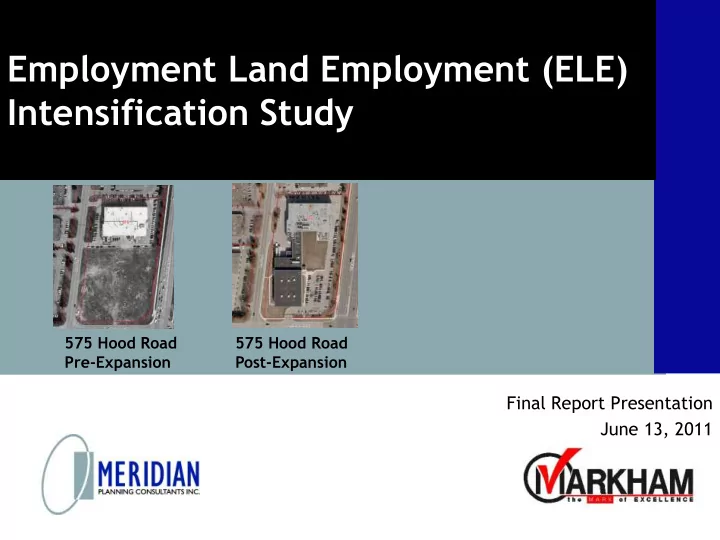
575 Hood Road 575 Hood Road Pre-Expansion Post-Expansion

slide-2
SLIDE 2

Study Intent

  • Employment

Land Employment (ELE) includes manufacturing, processing, warehousing and distribution related uses

  • 2009 ELS indicated that there was some

potential for additional employment through intensification on ELE properties – however, the amount was not determined

  • The intent of this study is to determine

what that potential may be

  • The study also recommends what actions

the Town could take to encourage intensification

2

slide-3
SLIDE 3

Factors Considered

1. Physical capacity of existing lots to support additional floor space on the ground floor 2. Potential for the vertical expansion of existing buildings (adding additional floors) 3. Potential of existing developed lots to be severed to create new development opportunities 4. Economic viability of intensifying existing buildings either vertically or horizontally NOTE: Increases in floor space do not automatically translate into an increase in the number of employees

3

slide-4
SLIDE 4

Stakeholder Comments

  • Three

sessions held with real estate professionals, business

  • perators and developers
  • Most participants believed that the potential for additional ELE

intensification was limited

  • Many indicated that most properties are already developed to their

maximum potential

  • Others indicated that additional jobs could be created if more

retail was permitted in employment areas

  • Some indicated that permitting residential development in some

key areas along corridors would stimulate additional development

  • Lastly, some business owners indicated that introducing ‘sensitive’

land uses (such as day cares, places of worship, private schools,

  • ffices that are not associated with manufacturing or warehousing

uses, restaurants, banks and medical clinics) into employment areas has the potential to significantly impact their businesses

4

slide-5
SLIDE 5

Defining the Study Area

  • Municipal Property Assessment Corporation data reviewed
  • Air-photo interpretation and site visits also carried out
  • Local knowledge considered
  • Result was the identification of 593 industrial/warehouse ELE

properties

  • An additional 75 office properties also identified
  • Buildings that were the site of primarily retail uses were not

included in study area

  • Buildings that were subdivided into condominium units were

also not included

5

slide-6
SLIDE 6

Location of ELE Properties in Study Area

6

slide-7
SLIDE 7

Study Findings

  • Majority of industrial and warehouse ELE properties located

within the interior of industrial areas

  • Over 50% of industrial and warehouse buildings are multiple

unit buildings

  • There is about 2,600,000 square metres of floor space in

existing industrial and warehouse buildings

  • This amount of floor space is located on 6,500,000 square

metres of land

  • About 38% of the available land on these parcels is occupied by

buildings

  • About 55% of the properties have lot coverages between 35%

and 45%

  • Vast majority of industrial/warehouse properties are the site
  • f one storey buildings

7

slide-8
SLIDE 8

History of ELE Building Expansion

  • 23 buildings were expanded by 46,930 square metres in last 10

years - average lot coverage went from 30.7% to 41.9%

  • This amount of new floor space represents about 1.8% of the

industrial/warehouse ELE floor space in the study area

  • Very limited amount of office building expansion

8

Pre-Expansion – 14th Avenue Post-Expansion – 14th Avenue

slide-9
SLIDE 9

Physical Capacity Analysis

  • The intent is to determine what physical capacity constraints

exist

  • The expansion of Industrial warehouse ELE businesses occurs in
  • ne of two ways.

1. The expansion of a single use building on the same property 2. Expanding within a multiple unit building

  • Factors considered are related to business operations, including

economic viability, purpose of additional space, timing of need for additional space and the amount

  • f additional space required.

9

slide-10
SLIDE 10

Limiting Factors

  • Limiting factors are not mathematically based
  • Instead, they are based on a combination of factors that are

derived from operational site requirements and site design considerations

  • These factors include the need for parking areas, loading

areas, landscaping, driveways and areas for truck movements, drainage areas, setbacks and fire access routes

  • Permitting ‘sensitive’ land uses in an employment area may

also limit expansions on nearby properties

10

slide-11
SLIDE 11

Office Properties

  • There is a clear relationship between lot coverage and FSI

based on number of storeys

  • The greater the number of floors – the lower the amount of

lot coverage because of the need to provide for parking

11

Number of Storeys Lot Coverage FSI 1 28% 39% 2 21% 43% 3 21% 63% 4 16% 64% 5 12% 58% 6 10% 62%

slide-12
SLIDE 12

Vertical Expansion

  • Mechanical

and electrical systems in shed buildings are commonly left exposed

  • Shed buildings have offices in front and are set back from the

street to provide for parking in the front

  • Most shed buildings do not have windows other than for the
  • ffice component
  • The most significant factor having an impact on additional

storeys is the nature of the structural framing systems

  • Major structural upgrades would be required – very capital

intensive

  • Potential for mezzanine construction is more likely

12

slide-13
SLIDE 13

Economic Factors

  • The economic viability of expanding is very much based on the

viability of the company

  • Generally, the owner’s first choice will be to expand in place

rather than to move

  • The

use

  • f

the additional floor space is also a factor (manufacturing versus storage)

  • For office buildings, expansion will generally only occur if

structured parking is introduced

  • Multi-use buildings are generally more adaptable for internal

expansion purposes since the internal organization of these buildings can be modified as required (no additional gfa)

13

slide-14
SLIDE 14

Study Conclusions

Based on our review, we have determined that:

  • Very few additions to ELE buildings have occurred in the last

ten years;

  • The potential for expanding existing industrial/warehouse

buildings through ground floor additions is very limited as a result of site constraints;

  • Adding

additional floors to existing industrial/warehouse buildings is very unlikely as a result of structural limitations (with mezzanines being more likely);

  • Adding additional floor space beside or on top of office

buildings is also very unlikely because most if not all office buildings are purpose built for the size they are at the time of construction; and,

  • Some potential does exist for new lot creation on a limited

number of ELE properties.

14

slide-15
SLIDE 15

What does this mean?

1

Purely speculative to predict how much ELE job growth is possible through intensification

2

ELE Job growth occurring through intensification would be very limited in comparison to what is anticipated to 2031

3

Relying upon any ELE intensification number to make decisions may have an impact on Markham’s ability to implement the ELE allocation

4

Findings are consistent with the Employment Lands Strategy (Phase 1) recommendations regarding land budget and intensification

15

slide-16
SLIDE 16

Some considerations….

Two matters the Town could consider to support ELE development as we move forward…

  • 1. Zoning by-law standards
  • 2. Sensitive land uses

16