Employment matters too much to leave to markets alone The role of - - PowerPoint PPT Presentation

employment matters too much to leave to markets alone
SMART_READER_LITE
LIVE PREVIEW

Employment matters too much to leave to markets alone The role of - - PowerPoint PPT Presentation

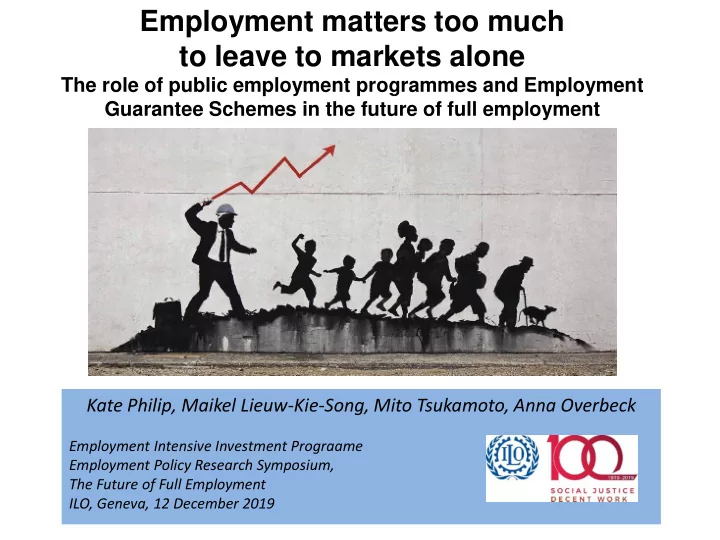
Employment matters too much to leave to markets alone The role of public employment programmes and Employment Guarantee Schemes in the future of full employment Kate Philip, Maikel Lieuw-Kie-Song, Mito Tsukamoto, Anna Overbeck Employment


slide-1
SLIDE 1

Employment matters too much to leave to markets alone

The role of public employment programmes and Employment Guarantee Schemes in the future of full employment Kate Philip, Maikel Lieuw-Kie-Song, Mito Tsukamoto, Anna Overbeck

Employment Intensive Investment Prograame Employment Policy Research Symposium, The Future of Full Employment ILO, Geneva, 12 December 2019

slide-2
SLIDE 2

What are they?

  • Public Employment Programme: a range of

interventions, publically financed which share the primary objective of creating ‘state-sponsored employment for working age poor who are unable to support themselves due to the inadequacy of market- based employment opportunities. PEPs usually produce assets or services that create public value and contribute to the public good, but is outside the normal public service.

  • Employment Guarantee Schemes (EGS) – programmes

which guarantee state sponsored employment to all those seeking it. (PEP that offer a guarantee. Right to work)

slide-3
SLIDE 3

Plan A

Macro policy Industrial policy Development finance Public investment Labour market policy ALMPs, incentives And more

All of the above enable and/or shape market-based employment outcomes

What is their role? Plan B

For when the market response still falls short in delivering full employment:

Deliver on Social Contract through orms

  • f direct employment

(PEPS) / employment guarantees / the state as employer of last resort

slide-4
SLIDE 4

Are they affordable? MGNREGA in India:

Full Employment Guarantee

  • Under the Mahatma Gandhi National Rural Employment Guarantee Act, the

state guarantees every rural household up to 100 days of work per annum, as needed.

  • It’s a right. Over 60 million people participate annually.
slide-5
SLIDE 5

Guarantee only in Rural Areas

Are they affordable? MGNREGA in India:

slide-6
SLIDE 6

Guarantee in rural areas but to households instead of individuals

Are they affordable? MGNREGA in India:

slide-7
SLIDE 7

Cost of a 100 days per year guarantee for households in rural areas

  • Costs are manageable- by design- EGS far from a blank check! (But

any of these parameters can be relaxed if you want a fuller guarantee)

  • Realities of implementation: actual taken up-50 million
  • Result: actual cost: around 0.5% of GDP

Are they affordable? MGNREGA in India:

slide-8
SLIDE 8

Income security matters. Whether through UBI or

  • ther social protection

measures.

Why not Universal Income instead of Full Employment?

8

But few people want to rely on minimum incomes all their working life.

UBI/Jobs Guarantee: Not a binary choice: Scope for synergies and complementarities

slide-9
SLIDE 9

Full Employment…because:

Social value of work Work is not just a means for distributing purchasing power. It is also among the most important sources of identity and purpose in individual’s lives. If the role of work in society is to shrink, other sources of purpose and identity will need to grow. (Avent, 2016)

slide-10
SLIDE 10
  • Set a labour standards floor

(India)

  • Provide pathways out of

informality (South Africa)

  • Contribute to paid work in the

care economy (South Africa, Egypt)

  • Respond to migration and

displacement (Jordan)

  • Provide activation and

transitionas an ALMP (Greece, South Korea)

  • Reach higher skilled workers, not

just the unskilled/ poorest (Greece, South Korea)

What is our recent experiences?

While versatile and common: Experience on some issues limited, unintended consequences to be managed and evidence sometimes still thin- much more to learn

slide-11
SLIDE 11

But what will people do?

There’s work to be done to (re) build the commons: Experiment with new forms of work AND reassess how we place a value on work

slide-12
SLIDE 12

Employment matters too much to leave to markets alone

What we need now is experimentation and innovation in the strengthened use of this EGS/PEPs as a policy instrument:

– To end involuntary unemployment and underemployment– not as a crisis response but as an institutionalised, counter-cyclical part of the labour market – To use PEPs to set a labour standards floor – giving people alternatives. – To design integrated approaches that synergise with minimum incomes and other social protection polices – To identify new forms of public value creation – through new forms of work – To use for PEPs to strengthen the commons and create new forms of social engagement in strengthening communities.