U N I V O E T R O S Y I T K Y Kyoto Univ. 28 - - PowerPoint PPT Presentation

u n i v o e t r o s y i t k y kyoto univ 28 2011 1 24
SMART_READER_LITE
LIVE PREVIEW

U N I V O E T R O S Y I T K Y Kyoto Univ. 28 - - PowerPoint PPT Presentation

U N I V O E T R O S Y I T K Y Kyoto Univ. 28 , 2011. 1. 24, F KYOTO JAPAN 7 O 9 U 8 1 N D E D Progress


slide-1
SLIDE 1 K Y O T O U N I V E R S I T Y F O U N D E D 1 8 9 7 KYOTO JAPAN

Kyoto Univ. 第28回無機材料に関する最近の研究成果発表会, 2011. 1. 24, 東海大学校友会館
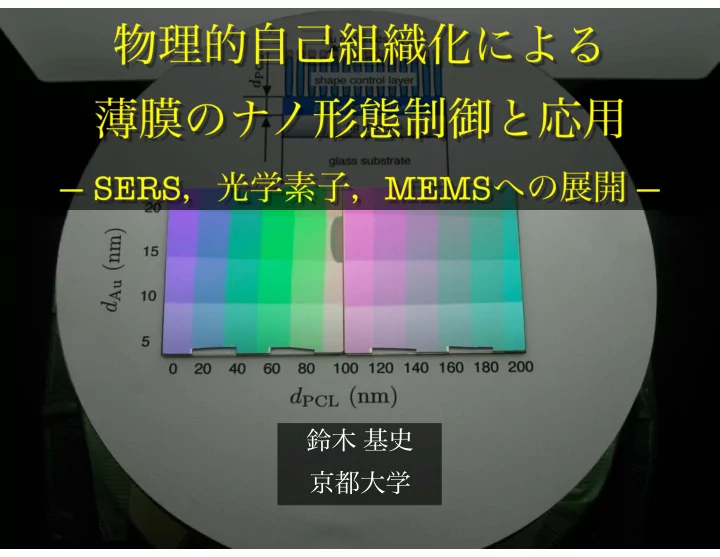
鈴木 基史 京都大学

slide-2
SLIDE 2 K Y O T O U N I V E R S I T Y F O U N D E D 1 8 9 7 KYOTO JAPAN

Kyoto Univ. 第28回無機材料に関する最近の研究成果発表会, 2011. 1. 24, 東海大学校友会館

Progress of our research on nanoparticles

Au SiO2 SiO2

Au, Ag nanorod arrays LR-WG polarizers

SERS & PC-SERS

  • M. Suzuki et al., "Direct formation of arrays of

prolate Ag nanoparticles by dynamic oblique deposition," Jpn. J. Appl. Phys. Part 2 44 (1-7), L193-L195 (2005).

  • M. Suzuki et al., "In-line aligned and bottom-up Ag

nanorods for surface-enhanced Raman spectroscopy," Appl. Phys. Lett. 88 (20), 203121 (2006).

  • M. Suzuki et al., "Low-reflective wire-grid polarizers with

absorptive interference overlayers," Nanotechnology 21 (17), 175604 (2010).

Local plasmon resonator for SERS

  • M. Suzuki et al., "Tailoring coupling of light to local

plasmons by using Ag nanorods/structured dielectric/mirror sandwiches," Journal of Nanophotonics 3 (1), 031502 (2009).

  • Photothermal devices

for micro-fluid?

  • Polarized &

Wavelength selective IR emitters?

Polarizer

Spatiotemporal nanoheaters

  • Nanoparticle absorber
  • Enhanced properties
  • New functions

http://www.nidek.co.jp/

slide-3
SLIDE 3 K Y O T O U N I V E R S I T Y F O U N D E D 1 8 9 7 KYOTO JAPAN

Kyoto Univ. 第28回無機材料に関する最近の研究成果発表会, 2011. 1. 24, 東海大学校友会館

Au nanorod arrays for SERS

In-line aligned Au nanorods prepared by dynamic oblique deposition (DOD)

slide-4
SLIDE 4 K Y O T O U N I V E R S I T Y F O U N D E D 1 8 9 7 KYOTO JAPAN

Kyoto Univ. 第28回無機材料に関する最近の研究成果発表会, 2011. 1. 24, 東海大学校友会館

Near-IR Surface Enhanced Raman Scattering (SERS)

  • SERS: Direct and sensitive method to

identify molecules

  • Drastic enhancement of the local field

due to plasma resonance in metal nanoparticles

  • Why NIR?
  • Compatible with a biological tissues’

transparency window →little damage to tissues

In order to develop the NIR SERS substrates, control of size, shape and arrangement of nanoparticles are important!

[1]

  • B. Chance, "Near-Infrared Images Using

Continuous, Phase-Modulated, and Pulsed Light with Quantitation of Blood and Blood Oxygenation," Annals of the New York Academy of Sciences 838, 29-45 (1998).

slide-5
SLIDE 5 K Y O T O U N I V E R S I T Y F O U N D E D 1 8 9 7 KYOTO JAPAN

Kyoto Univ. 第28回無機材料に関する最近の研究成果発表会, 2011. 1. 24, 東海大学校友会館

Various ‘ ’ for NIR SERS substrates

top down bottom up random

  • rdered

Orendorff et al., Anal. Chem. 77, (2005) 3261.

Random aggregates of nanorods

Liao et al., Chem. Phys. Lett. 82 (1981) 355.

Evaporated on lithographic template.

Martínes et al., Phys. Rev. B 35 (1987) 9481.

Obliquely deposited columns.

  • G. Laurent et al., Phys. Rev. B 71 (2005) 045430.

EB lithographic arrays.

side by side

Local field can be significantly enhanced at the end of nanorod. Further enhancement is expected for in-line alignment. Low cost Expensive

  • M. Suzuki et al., Jpn. J. Appl. Phys., 44, L193-L195 (2005).
  • We have succeeded in aligning the

nanorods end-to-end.

  • Physical self-assemble technique:

Dynamic oblique deposition.

slide-6
SLIDE 6 K Y O T O U N I V E R S I T Y F O U N D E D 1 8 9 7 KYOTO JAPAN

Kyoto Univ. 第28回無機材料に関する最近の研究成果発表会, 2011. 1. 24, 東海大学校友会館

slide-7
SLIDE 7 K Y O T O U N I V E R S I T Y F O U N D E D 1 8 9 7 KYOTO JAPAN

Kyoto Univ. 第28回無機材料に関する最近の研究成果発表会, 2011. 1. 24, 東海大学校友会館

Growth mechanism of oblique columnar structure

Nucleation Self-shadowing Columnar growth

  • The physical origins of the columnar structure in obliquely

deposited thin films are the self-shadowing effects and the limited mobility of the deposited atoms.

  • When the vapor flux is obliquely incident, atoms in the growing

films shadow unoccupied sites from the direct sticking of incident atoms.

  • Owing to limited mobility, the unoccupied sites are not filled
  • later. → Large islands grow selectively.
  • Oblique columns grow in the direction of the incident vapor

beam.

slide-8
SLIDE 8 K Y O T O U N I V E R S I T Y F O U N D E D 1 8 9 7 KYOTO JAPAN

Kyoto Univ. 第28回無機材料に関する最近の研究成果発表会, 2011. 1. 24, 東海大学校友会館

Preparation of shape control layer

deposition angle;

αSiO2

substrate

SiO2

① Preparation of SiO2 template

αSiO2 → 79˚ dSiO2 → 0 — 500 nm

Substrate is set at oblique angle and rotated by 180˚ with each deposition of 10 nm thick.

(Serial bideposition[SBD])

Substrate: Ordinary flat glass

  • Columnar morphology characteristic to serial

bideposition is physically self-assembled.

slide-9
SLIDE 9 K Y O T O U N I V E R S I T Y F O U N D E D 1 8 9 7 KYOTO JAPAN

Kyoto Univ. 第28回無機材料に関する最近の研究成果発表会, 2011. 1. 24, 東海大学校友会館

αAg Ag

deposition angle: αAg

A g , A u

② Oblique deposition of Ag (or Au)

thickness of Au, Ag; dAu, Ag

αAu, Ag → 73˚ dAu, Ag→ 125 nm

Preparation of nanorod arrays by DOD

  • Au, Ag sticks only to the top of columns due to the self-

shadowing and forms elongated nanoparticles so-called nanorods.

Au, Ag

slide-10
SLIDE 10 K Y O T O U N I V E R S I T Y F O U N D E D 1 8 9 7 KYOTO JAPAN

Kyoto Univ. 第28回無機材料に関する最近の研究成果発表会, 2011. 1. 24, 東海大学校友会館

Properties of Au nanorod arrays (tAu = 10 nm, αAu = 73◦)

SEM of Au nanorods. Absorbance spectra. SERS spectra of 4,4’-bpy solutions measured on Au

  • NRA. (λ=785 nm)
  • In-line aligned nanorods
  • Polarization dependent absorption

due to local plasma resonance.

  • Strong SERS. ∼107 times

enhancement

Ag nanordos

hν h(ν − ν′)

4,4’-bipyridine 1 mM solution

[1]

  • M. Suzuki, K. Nakajima, K. Kimura, T. Fukuoka, and Y. Mori, "Au Nanorod Arrays Tailored for

Surface-Enhanced Raman Spectroscopy," Analytical Sciences 23 (7), 829-833 (2007).

slide-11
SLIDE 11 K Y O T O U N I V E R S I T Y F O U N D E D 1 8 9 7 KYOTO JAPAN

Kyoto Univ. 第28回無機材料に関する最近の研究成果発表会, 2011. 1. 24, 東海大学校友会館

SERS強度の濃度依存

  • 1 μmol/lまでは比較的容易に4,4’-bpyを検出できる.
  • レーザのスポットサイズ~1 μm2,

ナノロッドの厚さ~10 nm

  • 1 μm2 × 10 nmの体積に存在する分子数

→1 μmol/lでは10個以下(6個). 単純計算では1分子計測に近い高感度.

  • SERSスペクトルの変化 (~15 mW)

1014 cm-1近傍のピーク強度の 濃度依存

slide-12
SLIDE 12 K Y O T O U N I V E R S I T Y F O U N D E D 1 8 9 7 KYOTO JAPAN

Kyoto Univ. 第28回無機材料に関する最近の研究成果発表会, 2011. 1. 24, 東海大学校友会館

ページ 1/2 https://www.nidek.co.jp/products/coating_others/sers.html

slide-13
SLIDE 13 K Y O T O U N I V E R S I T Y F O U N D E D 1 8 9 7 KYOTO JAPAN

Kyoto Univ. 第28回無機材料に関する最近の研究成果発表会, 2011. 1. 24, 東海大学校友会館

Au nanorods

  • SERS in the water solution is

rather stable and reproducible.

  • Unidentified peaks appear when

SERS is measured without analyte.

  • Spectra are spatially &

temporary unstable.

SERS spectra on Au nanorod arrays

hν h(ν − ν)

SERS spectra of air Unidentified peaks are due to the contaminations on the surface of Au

  • nanorods. Contaminations may cause

serious problems for the highly sensitive Au nanorod arrays.

slide-14
SLIDE 14 K Y O T O U N I V E R S I T Y F O U N D E D 1 8 9 7 KYOTO JAPAN

Kyoto Univ. 第28回無機材料に関する最近の研究成果発表会, 2011. 1. 24, 東海大学校友会館

Self-cleaning SERS Sensors

(日本板硝子材料工学助成会 助成研究)

slide-15
SLIDE 15 K Y O T O U N I V E R S I T Y F O U N D E D 1 8 9 7 KYOTO JAPAN

Kyoto Univ. 第28回無機材料に関する最近の研究成果発表会, 2011. 1. 24, 東海大学校友会館

  • Feasibility study of self-cleaning SERS

sensors; Au/TiO2

Cleaning contaminations

plasma treatment [1]

Vacuum equipment is required beside Raman Microscope

UV-O3 treatment Less effective (preliminary experiment) self-cleaning by PC

?

  • No expensive equipment
  • Quick in situ cleaning
  • Additional effects

[1] R. J. Walsh and G. Chumanov, "Silver Coated Porous Alumina as a New Substrate for Surface-Enhanced Raman Scattering," App. Spectroscopy 55 (12), 1695-1700 (2001).

slide-16
SLIDE 16 K Y O T O U N I V E R S I T Y F O U N D E D 1 8 9 7 KYOTO JAPAN

Kyoto Univ. 第28回無機材料に関する最近の研究成果発表会, 2011. 1. 24, 東海大学校友会館

Morphology

  • Anisotropic columnar TiO2

template was successfully grown.

  • Elongated Au nanoparticles

were grown on the template.

  • Average length: 93 nm
  • Average width: 43 nm
  • Average aspect ratio: 2.1

TiO2, Au TiO2 cross section surface TiO2, Au TiO2

slide-17
SLIDE 17 K Y O T O U N I V E R S I T Y F O U N D E D 1 8 9 7 KYOTO JAPAN

Kyoto Univ. 第28回無機材料に関する最近の研究成果発表会, 2011. 1. 24, 東海大学校友会館

Au nanorods TiO2 template

Photocatalysis of Au/TiO2 nanorod arrays

  • TiO2 template works as

a photocatalyst even for the sample with Au nanorods.

Au/TiO2 dAu=5 nm, αAu=83°

TiO2 glass

UV LED MB solution

slide-18
SLIDE 18 K Y O T O U N I V E R S I T Y F O U N D E D 1 8 9 7 KYOTO JAPAN

Kyoto Univ. 第28回無機材料に関する最近の研究成果発表会, 2011. 1. 24, 東海大学校友会館

SERS of 4,4’-bipyridine solution

dAu=5 nm, αAu=83° dAu=10 nm, αAu=73°

100 200 300 400 500 600 700 800 500 1000 1500 2000 intensity (a.u.) Raman shift (cm-1) 200 400 600 800 1000 1200 500 1000 1500 2000 intensity (a.u.) Raman shift (cm-1)

Au nanorods TiO2 template

4,4’-bipyridine solution

hν h(ν − ν)

TiO2 TiO2 4,4’-BiPy 4,4’-BiPy

[1] P. J. Huang, H. Chang, C. T. Yeh, and C. W. Tsai, "Phase transformation of TiO2 monitored by Thermo-Raman spectroscopy with TGA/DTA," Thermochimica Acta 297 (1-2), 85-92 (1997).

515 640 515 640

  • Well enhanced Raman spectra of 4,4’-bipyridine are
  • btained.
  • Peaks at 515 cm-1 & 640 cm-1 are identified as TiO2
  • anatase. [1]
  • TiO2 is in contact with Au nanorods.

The surface of the Au nanorods is expected to be

cleaned by the chemically active species generated at the photocatalytic TiO2 surface.

slide-19
SLIDE 19 K Y O T O U N I V E R S I T Y F O U N D E D 1 8 9 7 KYOTO JAPAN

Kyoto Univ. 第28回無機材料に関する最近の研究成果発表会, 2011. 1. 24, 東海大学校友会館 100 200 300 400 500 600 700 800 500 1000 1500 2000 intensity (a.u.) Raman shift (cm-1) 0 min 5 min 10 min 15 min

SERS of air with UV irradiation

hν h(ν − ν)

Au nanorods TiO2 template

UV LED

  • No significant unidentified peak is observed.
  • SERS spectra are stable spatially & temporally.
  • Such stability has never been achieved for NRA on SiO2.
  • Self-cleaning effect of template stabilizes the SERS properties
  • f Au nanorod arrays.

TiO2 SiO2

slide-20
SLIDE 20 K Y O T O U N I V E R S I T Y F O U N D E D 1 8 9 7 KYOTO JAPAN

Kyoto Univ. 第28回無機材料に関する最近の研究成果発表会, 2011. 1. 24, 東海大学校友会館

Further enhancement of SERS by Local Plasmon Resonator

  • ∼50% of incident light is reflected or transmitted to far field.

Further enhancement of SERS is expected by improvement of coupling of local plasmon with photon.

100 300 300 300 500 73 73 73 85 73

tAu = 10 nm

slide-21
SLIDE 21 K Y O T O U N I V E R S I T Y F O U N D E D 1 8 9 7 KYOTO JAPAN

Kyoto Univ. 第28回無機材料に関する最近の研究成果発表会, 2011. 1. 24, 東海大学校友会館

Progress of our research on nanoparticles

Au SiO2 SiO2

Au, Ag nanorod arrays LR-WG polarizers

SERS & PC-SERS

  • M. Suzuki et al., "Direct formation of arrays of

prolate Ag nanoparticles by dynamic oblique deposition," Jpn. J. Appl. Phys. Part 2 44 (1-7), L193-L195 (2005).

  • M. Suzuki et al., "In-line aligned and bottom-up Ag

nanorods for surface-enhanced Raman spectroscopy," Appl. Phys. Lett. 88 (20), 203121 (2006).

  • M. Suzuki et al., "Low-reflective wire-grid polarizers with

absorptive interference overlayers," Nanotechnology 21 (17), 175604 (2010).

Local plasmon resonator for SERS

  • M. Suzuki et al., "Tailoring coupling of light to local

plasmons by using Ag nanorods/structured dielectric/mirror sandwiches," Journal of Nanophotonics 3 (1), 031502 (2009).

  • Photothermal devices

for micro-fluid?

  • Polarized &

Wavelength selective IR emitters?

Polarizer

Spatiotemporal nanoheaters

  • Nanoparticle absorber
  • Enhanced properties
  • New functions

http://www.nidek.co.jp/

slide-22
SLIDE 22 K Y O T O U N I V E R S I T Y F O U N D E D 1 8 9 7 KYOTO JAPAN

Kyoto Univ. 第28回無機材料に関する最近の研究成果発表会, 2011. 1. 24, 東海大学校友会館

Ag mirror (200 nm) glass substrate stepped phase control layer Au nanorods shape control layer (500 nm)

Flat Ag film deposited at α=0˚ SiO2 film deposited at α=0˚: flat but stepped by moving a shutter. 0 − 200 nm. SiO2 film serial-bideposited at α=79˚. Au deposited at α=73˚, average thickness=10 nm.

Preparation of local plasmon resonator (Au NRA/SCL/PCL/Ag mirror)

  • By recycling the light scattered by nanorods, we tried to

enhance the coupling of light to the local plasmon. ≈ To minimize reflectance of Au NRA/SCL/PCL/Ag mirror.

  • Mirror: reflecting the light transmitted through the nanorods.
  • Phase control layer: tuning the optical path length.
  • To find the optimum structures quickly, a series of different SiO2

thicknesses were realized.

slide-23
SLIDE 23 K Y O T O U N I V E R S I T Y F O U N D E D 1 8 9 7 KYOTO JAPAN

Kyoto Univ. 第28回無機材料に関する最近の研究成果発表会, 2011. 1. 24, 東海大学校友会館

Ag mirror (200 nm) glass substrate stepped phase control layer Au nanorods shape control layer (500 nm)

Preparation of stepped phase control layer

  • A series of different thicknesses were realized on a

single substrate by moving a shutter incrementally across the sample during deposition.

shutter substrate vapor

slide-24
SLIDE 24 K Y O T O U N I V E R S I T Y F O U N D E D 1 8 9 7 KYOTO JAPAN

Kyoto Univ. 第28回無機材料に関する最近の研究成果発表会, 2011. 1. 24, 東海大学校友会館

Morphology & spectra of local plasmon resonators

(a) (b) glass subst. Ag mirror PCL (SiO2) SCL (SiO2) A u N R A

SiO2 SiO2 Au

SiO2 SiO2 Au s'-polarized p'-polarized

  • The designed multilayered structures are successfully realized.
  • The reflectance changes periodically as a function of the photon energy.
  • Dark lines: Narrow band perfect reflector
  • Yellow & Red parts: Narrow band perfect absorber
  • Perfect reflector/absorber conditions are tuned precisely by changing

thickness of the phase control layer.

500 nm

phase control layer Ag mirror (200 nm) Au nanorods shape control layer

dP

glass substrate

  • polarized

abscissa: photon energy

  • rdinate: thickness of PCL

dAu = 10 nm

Colors: − log10 R yellow→small R & large absorption purple →large R & small absorption

slide-25
SLIDE 25 K Y O T O U N I V E R S I T Y F O U N D E D 1 8 9 7 KYOTO JAPAN

Kyoto Univ. 第28回無機材料に関する最近の研究成果発表会, 2011. 1. 24, 東海大学校友会館

(b)

1 2 500 1000 1500 intensity (a.u.) Raman shift (cm-1) dP=75 nm dP=150 nm

  • n glass

(a)

SERS on Au-NRA/SCL/PCL/Ag mirror

Selected SERS spectra and the SERS spectra as a function of dP.

  • SERS is enhanced significantly near

AR condition.

  • about 50 times larger than Au

NRA without mirror.

  • > 108 times enhancement is

expected.

phase control layer Ag mirror (200 nm) Au nanorods shape control layer

dP

glass substrate

λ=785 nm

Ag nanordos

hν h(ν − ν′)

4,4’-bipyridine (model analyte) 1 mM solution Au NRA

slide-26
SLIDE 26 K Y O T O U N I V E R S I T Y F O U N D E D 1 8 9 7 KYOTO JAPAN

Kyoto Univ. 第28回無機材料に関する最近の研究成果発表会, 2011. 1. 24, 東海大学校友会館

Novel application of local plasmon resonator to plasmonic nanoheaters

slide-27
SLIDE 27 K Y O T O U N I V E R S I T Y F O U N D E D 1 8 9 7 KYOTO JAPAN

Kyoto Univ. 第28回無機材料に関する最近の研究成果発表会, 2011. 1. 24, 東海大学校友会館

Progress of our research on nanoparticles

Au SiO2 SiO2

Au, Ag nanorod arrays LR-WG polarizers

SERS & PC-SERS

  • M. Suzuki et al., "Direct formation of arrays of

prolate Ag nanoparticles by dynamic oblique deposition," Jpn. J. Appl. Phys. Part 2 44 (1-7), L193-L195 (2005).

  • M. Suzuki et al., "In-line aligned and bottom-up Ag

nanorods for surface-enhanced Raman spectroscopy," Appl. Phys. Lett. 88 (20), 203121 (2006).

  • M. Suzuki et al., "Low-reflective wire-grid polarizers with

absorptive interference overlayers," Nanotechnology 21 (17), 175604 (2010).

Local plasmon resonator for SERS

  • M. Suzuki et al., "Tailoring coupling of light to local

plasmons by using Ag nanorods/structured dielectric/mirror sandwiches," Journal of Nanophotonics 3 (1), 031502 (2009).

  • Photothermal devices

for micro-fluid?

  • Polarized &

Wavelength selective IR emitters?

Polarizer

  • Nanoparticle absorber
  • Enhanced properties
  • New functions

http://www.nidek.co.jp/

Spatiotemporal nanoheaters

slide-28
SLIDE 28 K Y O T O U N I V E R S I T Y F O U N D E D 1 8 9 7 KYOTO JAPAN

Kyoto Univ. 第28回無機材料に関する最近の研究成果発表会, 2011. 1. 24, 東海大学校友会館

Appearance & morphology of local plasmon resonator chips

20 40 60 80 100 12.6 9.1 10.3 11.5

50mm

  • Multilayered thin films with various

combinations of the layer thicknesses have been successfully prepared.

  • The absorption was measured on

each chip.

  • The temperature of H2O in a

silicone cell was measured by thermal viewer.

dP

phase control layer (SiO2) Ag mirror

shape control layer (SiO2)

substrate Au nanorods

slide-29
SLIDE 29 K Y O T O U N I V E R S I T Y F O U N D E D 1 8 9 7 KYOTO JAPAN

Kyoto Univ. 第28回無機材料に関する最近の研究成果発表会, 2011. 1. 24, 東海大学校友会館

Spatially selective absorption

phase control layer Ag mirror (200 nm) Au nanorods

shape control layer (400 nm)

dP

glass substrate

  • The optical absorption can be controlled between 0∼97%

by changing dP.

  • When dP = 80 nm,

A ≥ 95% @ 1.6 eV and A ∼ 0% @ 2.1 eV. When dP = 220 nm, A ∼ 0% @ 1.6 eV and A ≥ 95% @ 2.1 eV.

The high-absorption area can be switched spatially by

changing the wavelength of the incident light.

slide-30
SLIDE 30 K Y O T O U N I V E R S I T Y F O U N D E D 1 8 9 7 KYOTO JAPAN

Kyoto Univ. 第28回無機材料に関する最近の研究成果発表会, 2011. 1. 24, 東海大学校友会館

Spatially selective heating

  • Temperature variation can be

fit with only one parameter of Q.

  • ΔT∞ ∝ A

phase control layer Ag mirror (200 nm) Au nanorods

shape control layer (400 nm)

dP

glass substrate

(λ=785 nm)

T0 Q(T-T0)

  • Photon → Plasmon → Water

heating

  • The photothermal conversion

efficiency is controlled by thickness of PCL. absorber reflector

slide-31
SLIDE 31 K Y O T O U N I V E R S I T Y F O U N D E D 1 8 9 7 KYOTO JAPAN

Kyoto Univ. 第28回無機材料に関する最近の研究成果発表会, 2011. 1. 24, 東海大学校友会館

Proposal: Spatiotemporally controllable nanoheaters

0.5 μm∼100 mm Low thermal conductance

High thermal conductance

dP

phase control layer (SiO2) Ag mirror

shape control layer (SiO2)

substrate Au nanorods

  • High photothermal conversion efficiency
  • Perfect absorber/reflector
  • High speed
  • Heat is well localized in very small volume
  • Multifunction
  • Switching hot area by wavelength/polarization
  • Applications
  • Control of micro- and nano-fluid
  • Manipulation of molecules
slide-32
SLIDE 32 K Y O T O U N I V E R S I T Y F O U N D E D 1 8 9 7 KYOTO JAPAN

Kyoto Univ. 第28回無機材料に関する最近の研究成果発表会, 2011. 1. 24, 東海大学校友会館

Low-reflectivity wire-grid polarizers with nanoparticle resonator

slide-33
SLIDE 33 K Y O T O U N I V E R S I T Y F O U N D E D 1 8 9 7 KYOTO JAPAN

Kyoto Univ. 第28回無機材料に関する最近の研究成果発表会, 2011. 1. 24, 東海大学校友会館

Polarizers in LC-projectors

  • Al WG-polarizers

→High durability; →High R;

Recycling light Stray light

  • Polymer polarizers

→Absorptive, low R; →Poor durability

[1]

  • M. Pate, J. Meyer, J. Shiefman, and D. Hansen, "Wire-grid

polarizers in modern LCOS light-engine configurations," Journal

  • f the Society for Information Display 14 (3), 275-283 (2006).

polymer polarizer WG polarizers Recycling light

  • Development of low-reflectivity (LR) WG polarizers
  • To improve brightness & durability of projectors

by replacing polymer polarizers with LR-WG polarizers → AR coatings for metal substrate are required.

slide-34
SLIDE 34 K Y O T O U N I V E R S I T Y F O U N D E D 1 8 9 7 KYOTO JAPAN

Kyoto Univ. 第28回無機材料に関する最近の研究成果発表会, 2011. 1. 24, 東海大学校友会館

Fabrication of LR-WG polarizers

  • Fabrication of Al WG polarizers by interference lithography

& dry etching. → Normal deposition of gap layer (SiO2).

  • GLAD of absorptive layer(FeSi2) at α=87°

Elongated FeSi2 nanoparticles are arrayed on the Al WG

covered with the gap layer of SiO2.

Al FeSi2 SiO2

(a) (b) (c)

FeSi

2

  • 3. GLAD of FeSi2
  • 2. Deposition of SiO2
  • 1. Preparation of Al WG

Al WG: width; 60 nm, height; 190 nm, pitch; 150 nm dSiO = 24 nm dF eSi = 10 nm dabs ∼ 30 nm dgap ∼ 24 nm

slide-35
SLIDE 35 K Y O T O U N I V E R S I T Y F O U N D E D 1 8 9 7 KYOTO JAPAN

Kyoto Univ. 第28回無機材料に関する最近の研究成果発表会, 2011. 1. 24, 東海大学校友会館

(a) (b)

Reflection & transmission spectra of LR-WG polarizers

  • Spectra
  • The reflectance of LR-WG is very much smaller than that of conventional one,
  • No significant degradation of the transmission properties is recognized
  • Visual appearence
  • TM: Both polarizers appear almost completely transparent.
  • TE: LR-WG appears much darker than the conventional WG polarizer.

conventional WG LR-WG

dF eSi = 10 nm, dSiO = 30 nm

TE TM

TE

WG LR-WG

TM

slide-36
SLIDE 36 K Y O T O U N I V E R S I T Y F O U N D E D 1 8 9 7 KYOTO JAPAN

Kyoto Univ. 第28回無機材料に関する最近の研究成果発表会, 2011. 1. 24, 東海大学校友会館

Summary

Au SiO2 SiO2

Au, Ag nanorod arrays LR-WG polarizers

SERS & PC-SERS

  • M. Suzuki et al., "Direct formation of arrays of

prolate Ag nanoparticles by dynamic oblique deposition," Jpn. J. Appl. Phys. Part 2 44 (1-7), L193-L195 (2005).

  • M. Suzuki et al., "In-line aligned and bottom-up Ag

nanorods for surface-enhanced Raman spectroscopy," Appl. Phys. Lett. 88 (20), 203121 (2006).

  • M. Suzuki et al., "Low-reflective wire-grid polarizers with

absorptive interference overlayers," Nanotechnology 21 (17), 175604 (2010).

Local plasmon resonator for SERS

  • M. Suzuki et al., "Tailoring coupling of light to local

plasmons by using Ag nanorods/structured dielectric/mirror sandwiches," Journal of Nanophotonics 3 (1), 031502 (2009).

  • Photothermal devices

for micro-fluid?

  • Polarized &

Wavelength selective IR emitters?

Polarizer

Spatiotemporal nanoheaters

  • Nanoparticle absorber
  • Enhanced properties
  • New functions

http://www.nidek.co.jp/

slide-37
SLIDE 37 K Y O T O U N I V E R S I T Y F O U N D E D 1 8 9 7 KYOTO JAPAN

Kyoto Univ. 第28回無機材料に関する最近の研究成果発表会, 2011. 1. 24, 東海大学校友会館

ACKNOWLEDGMENTS

  • Students
  • K. Namura, Y. Imai, R. Tabuchi, H. Tokunaga, S. Li,
  • Y. Wada, W. Maekita
  • Coworkers;
  • K. Kimura, K. Nakajima, S. Kinoshita (Kyoto Univ.),
  • Collaborators;
  • T. Fukuoka (Univ. Hyogo), Y. Mori (Doshisha Univ.)
  • A. Takada et al. (SONY Info. & Chem. Devices)
  • H. Nakanishi, T. Kawai, S. Oka (NIDEK Corporation)